
Climate challenges and the physics of winter threats to entrance groups
The climatic conditions of the winter period create an extremely aggressive and extreme environment for the operation of any outdoor metal structures, especially moving ones. The constant temperature fluctuations around the zero mark, characteristic of modern winters, lead to continuous cyclic freezing and thawing of moisture that settles on metal surfaces. This thermodynamic process is the main enemy of metal gates, wickets, their locking systems, and high-precision automatic drives. Moisture, getting into the microscopic crevices of the mechanisms, inevitably expands during crystallization and transition to a solid state. This expansion creates colossal internal pressure on fragile parts, which most often leads to jamming, deformation, or complete destruction of the key nodes of the entrance group.
In addition to the physical expansion of ice, the winter season is always accompanied by increased air humidity, the aggressive influence of road chemical reagents, technical salt, and abrasive sand, as well as significant wind and snow loads. To ensure durability, preserve aesthetic appeal, and guarantee the uninterrupted operation of entrance groups, a deep, systematic approach to maintenance is required. Such an approach should be based on an understanding of the design features of modern fences, the properties of metal at low temperatures, and the chemical characteristics of protective and lubricating materials. This analytical report provides comprehensive information on preventive protection, proper selection of materials, and emergency maintenance of metal gates and wickets in winter, focusing on advanced solutions and designs.
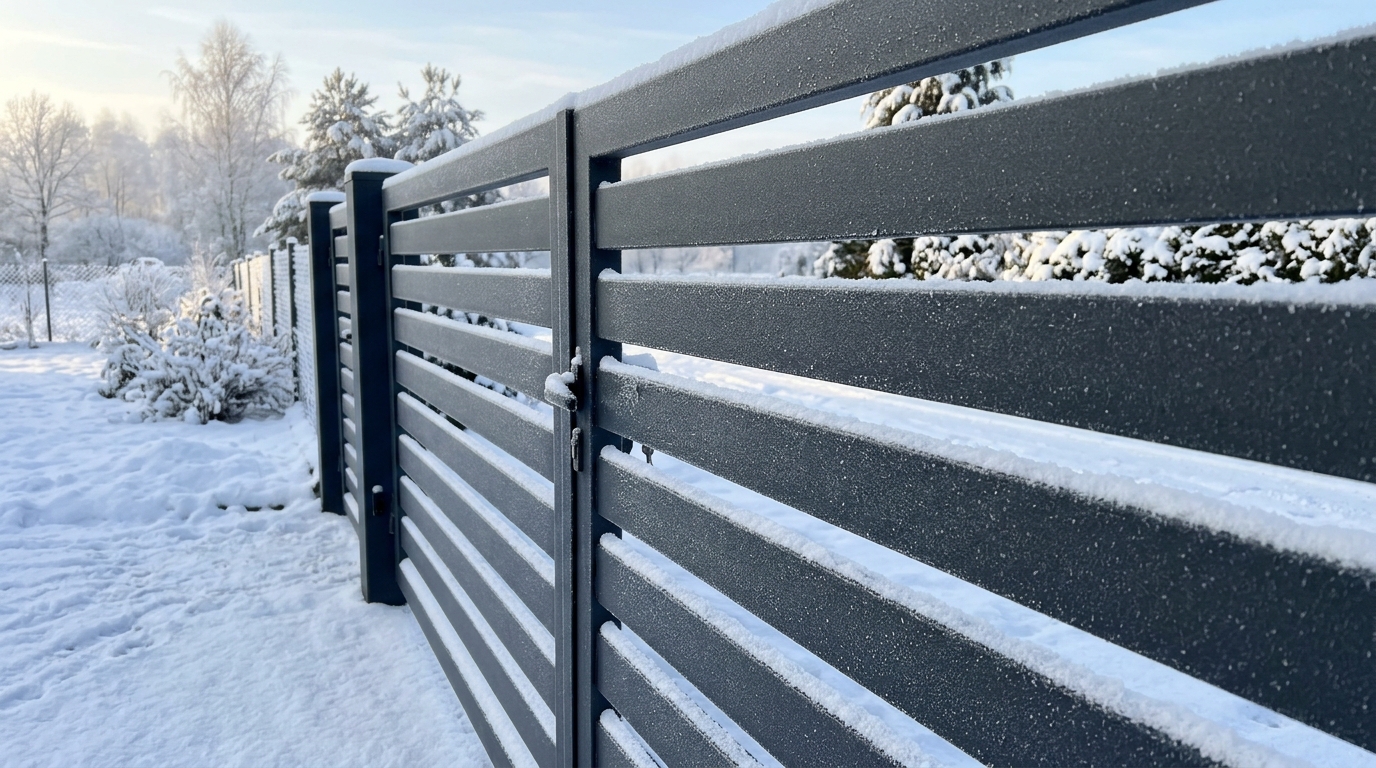
The architecture of modern metal fences: The impact of design on snow load and icing
Modern entrance groups and fences manufactured by advanced specialized enterprises (for example, the Mehbud plant) are designed with deep consideration for minimizing the impact of an aggressive external environment. The design of the gates, the angle of inclination of the elements, and the distance between them directly affect how snow accumulates on them, where ice forms, and how natural ventilation occurs. All metal fences can be classified into several large groups: ventilated, solid, and innovative structures such as blinds. Understanding these differences is key to proper winter maintenance.
Ventilated structures and blinds fences
Structures of the blinds type, represented by various lines (such as “Premium”, “Exclusive”, “Classic”, “Exclusive Lego”, “Standard”), are designed in such a way that their metal profiled slats are located at a clearly calculated angle. This creates a unique aerodynamic effect. On the one hand, the wind freely passes through the sections, which significantly reduces the wind load on the support pillars, hinges, and automation even during winter storms. On the other hand, from the point of view of winter operation, the sloping shape of the slats ensures ideal natural drainage of meltwater during a thaw.
Profiles with thoughtful geometry deserve special attention. For example, “Alpha” shape slats have a pronounced drip overhang that effectively drains moisture away from the main plane of the fence. “Sigma” models are equipped with longitudinal grooves, which not only imitate the texture of a board but also serve as additional channels for water drainage. Thanks to such solutions, wet snow practically does not linger on the surfaces, which critically minimizes the weight of the ice shell on the gate leaves.
The material for manufacturing such slats is high-quality galvanized steel up to one millimeter thick or aluminum, which provides extremely high rigidity with a relatively low weight of the structure. Ventilated fences of the “Rancho” line (single-sided, double-sided, or wide) use a tubular slat design. This allows them to be made very long without the risk of sagging under the weight of adhering snow. The presence of gaps between the slats effectively prevents the formation of a solid snow wall, which guarantees the preservation of the ideal geometry of the gates even after the most intense snowfalls.
Solid fences and their thermophysical features
Unlike ventilated solutions, solid metal gates and fences of the “Brus” and “Horizont” lines create an absolutely blank, wind- and sight-impenetrable plane. The joints of the massive slats in such structures not only form an ideal appearance but also act as powerful additional stiffening ribs. This allows the gate leaves to withstand the colossal frontal pressure of snowdrifts without any deformations.
However, a blank design has its specific challenges in winter. Due to the temperature difference between the street and the courtyard (especially if the territory is densely planted with trees or has a different microclimate), condensation forms much more intensively on the inside of solid metal gates. Moisture settling on a large area of metal is not blown away by the wind, as in the case of blinds, but slowly flows down. That is why the protection of locking zones, bottom seals, and hinges in solid gates requires maximum attention, since condensed water can get directly into the vulnerable mechanisms of mortise locks or freeze on the threshold, blocking the movement of the leaf.

The anatomy of locking system freezing: From causes to consequences
The lock on a wicket or swing gate is, without exaggeration, the most vulnerable element of the entire protective structure. Operating experience shows that the vast majority of problems with access to the territory in the winter period do not arise due to mechanical breakdown of the device itself, but solely due to the crystallization of water inside its secret mechanism. Locks freeze much faster and more often than massive hinges or support rollers because the narrow keyhole acts as an ideal trap for liquid.
Ways moisture enters the mechanism
The process of moisture accumulation in the lock is gradual and often imperceptible to the owner. Water penetrates inside in several main ways:
- Direct atmospheric exposure: During a blizzard, driving rain, or wet snow, precipitation gets directly into the keyhole. Even the smallest drop is enough to block the movement of miniature parts.
- Temperature condensation: This is the most insidious factor. With a sharp drop in ambient air temperature (for example, in the evening after a sunny day), moisture contained in the air in the form of steam instantly condenses on the cold metal mass of the lock. Even in the complete absence of snow or rain, natural moisture from fog or damp air is enough to reliably block the lock cylinder at zero temperature.
- Capillary effect of metal: Small crevices between moving parts of the lock, and gaps between the body and the gate leaf have the ability to draw in water in microdrops due to surface tension forces.
- Transfer on keys: Often users themselves bring moisture into the mechanism by inserting a key that got snow on it while outside, or a key covered in condensation after being taken from a warm room into the frost.
Impact on different types of locks
If the inner part of the lock has not been previously treated with a special water-repellent compound, the formed ice dead-locks the moving parts.
In cylinder locks, ice blocks the spring-loaded pins. They lose the ability to move up and down, causing the key either to not insert fully or to be unable to align the pins into the correct combination to turn the rotor. In lever tumbler locks (which are often used outdoors due to their reliability), ice glues the metal plates (levers) together. Although such locks have a wider keyhole and are less afraid of dust, water accumulates in them in larger volumes. Mechanical combination locks deserve a separate mention. They are extremely vulnerable because they have a large number of external buttons. Wet snow gets into the gaps around the keys, and after freezing, it becomes physically impossible to press the correct combination without prior defrosting. Electromechanical locks combine both mechanical deadbolts and electrical coils. The freezing of moisture in them not only blocks the mechanics but also creates a risk of a short circuit or burnout of the solenoid when trying to apply voltage to a deadbolt blocked by ice.
Attempting to turn a key in a frozen lock using excessive physical force or additional levers is a guaranteed way to break the key in half directly in the keyhole or fatally deform the lock’s internal secrets, which will lead to the need for complete and expensive dismantling.
The tribology of winter care: The science of proper lubrication
Tribology is a branch of physics that studies the processes of friction, wear, and lubrication of interacting surfaces. For outdoor mechanisms, choosing the right lubricant is the most important stage of preparation for winter. Using the wrong product or ignoring the manufacturer’s instructions will not only fail to solve the freezing problem but will significantly worsen it, turning the lubricant into an extremely thick, unyielding mass or an aggressive abrasive paste that will quickly destroy the mechanism.
Detailed analysis and classification of lubricants
The table below provides a detailed comparative analysis of the most common products for treating locks, hinges, moving rollers, and guides.
| Lubricant class and type | Behavior at low temperatures | Advantages and efficiency in winter | Main disadvantages and risks |
| Silicone lubricant (spray or liquid) | Maintains viscosity in severe frosts | The optimal basic choice. Creates a durable water-repellent polymer film. Does not thicken, reliably protects against corrosion. Ideal for lock cylinders, rubber leaf seals, and door hinges. | Requires periodic renewal (once every few months) or after intensive prolonged precipitation, as it washes off over time. |
| Graphite lubricant (dry dust) | Absolutely independent of temperature | The best solution for lock secrets. Dry friction of graphite particles prevents jamming, ensures ideal sliding of pins. Dry graphite does not attract or retain moisture and dust at all. | Extremely difficult to apply evenly inside a closed mechanism without a special dispenser with a fine tip. |
| Synthetic machine oil | Up to moderate frosts | Accessible, has good penetrating ability. Suitable for emergency lubrication of massive hinges or external joints. | Washes out quickly with water. Outdoors, it mixes with sand and dust, forming persistent and sticky dirt that wears out parts. |
| Plastic greases (Solidol, Litol-24) | Solidol thickens at minus 20°C, Litol works longer | Has excellent adhesion to metal, stays on large open mechanisms and rolling bearings (inside carriages) for a very long time. | Absolutely forbidden for locks. In the frost, it turns into a dense mass, completely blocking the movement of small lock parts. |
| Gun (neutral) oil | Practically does not freeze | Extremely high penetrating ability. Designed for harsh conditions. A reliable barrier against metal abrasion and micro-corrosion. | High cost compared to household analogs. Requires careful application. |
The chemical reality of penetrating moisture-displacing aerosols
Universal penetrating aerosols based on white spirit, mineral oils, and volatile hydrocarbons (well-known American and European preparations in blue cans belong to this category) are extremely popular among homeowners. It is very important to deeply understand the chemical nature and true purpose of such agents in order not to harm the system.
These liquids are created primarily for rapid moisture displacement, dissolving light rust, and unlocking seized threaded connections. However, they are not full-fledged lubricants for long-term operation under conditions of constant friction. Using such an aerosol (preferably through a thin capillary nozzle) will indeed quickly defrost the lock and wash all ice water out of it, which is an excellent solution in an emergency.
However, after the rapid evaporation of volatile solvents, the internal mechanism of the lock will remain practically dry, degreased, and completely defenseless against the external environment. If the lock is left in this state, the next portion of condensation will instantly freeze it again, and pure metal without a protective oil film will quickly begin to rust under the influence of oxygen. Therefore, the golden rule of winter care is as follows: after using a penetrating aerosol for defrosting, it is mandatory to inject a specialized silicone or dry graphite lubricant inside the lock for long-term and reliable protection. Only such two-stage treatment guarantees uninterrupted operation.
Emergency unlocking protocols: How to safely defrost the system
If prevention was not carried out properly, or weather conditions turned out to be anomalous (for example, freezing rain that abruptly turned into severe frost), and the lock, wicket, or hinges have already completely frozen, it is necessary to act very carefully. The main rule of defrosting is to strictly avoid brute physical force, impact, and extreme, shocking temperature changes. When a person tries to pull a frozen leaf open with all their might, they risk bending the metal elements of the frame, breaking the lock deadbolts, or damaging the expensive roller carriages of sliding gates.
Scientifically based and safe defrosting methods
- Thermal transfer (Heating the key): This is the most accessible, classic method for mechanical locks. It is necessary to slightly heat the metal working part of the key with a lighter (while strictly avoiding heating the plastic handle of the key so it does not melt) and insert it into the lock. The heated metal will slowly and safely transfer heat to the internal pins and melt the ice around them. The procedure should be repeated several times, carefully trying to turn the mechanism left and right without any sharp jerks.
- Chemical melting (Alcohol-containing liquids): This method is based on the laws of physical chemistry, according to which alcohol has an extremely low freezing point (below minus one hundred degrees). Injecting medical alcohol, a special automotive lock de-icer, or, in extreme cases, an ordinary alcohol hand sanitizer directly into the keyhole causes a rapid ice dissolution reaction with the formation of a liquid solution that does not freeze. This method is absolutely safe for metal and polymer coatings and quickly yields results in moderate frosts.
- Mild dry heat: An excellent method for deep heating not only the lock but also large frozen hinges. Use a regular rubber medical hot water bottle with very hot water, applied tightly to the metal leaf in the freezing zone. Metal has high thermal conductivity, so the heat will quickly reach the mechanism. Also, a very effective traditional method is to use a thick cotton sock or bag filled with salt, rice, or sand heated in a pan. This provides a prolonged, slow warm-up of the entire node without the risk of new water leaking inside.
- Directed flow of warm air: A cordless construction heat gun (set to a moderate temperature) or an ordinary powerful household hair dryer are ideal tools. Warm air can gradually, evenly, and safely melt monolithic ice in any areas: in the lock, on hinges, rollers, and even on the bottom seal frozen to the ground.
- Using car exhaust: In extreme conditions (for example, at a summer house or remote site), if a car and a long rubber hose of appropriate diameter are available, you can put the hose on the exhaust pipe and direct the stream of warm gas directly at the frozen gate node. The gases will quickly warm up the metal.
Fatal errors: What strictly must not be done
The worst and most destructive thing an owner can do with frozen metal gates is to generously pour boiling water from a kettle over them. At first glance, this method gives an instant unlocking effect, but it has catastrophic delayed consequences. Hot water in severe frost partially evaporates quickly, creating thick steam, and partially (and this is the worst) flows under pressure into the deepest micro-crevices of the locking mechanism, hinges, and rollers. Due to the sharp, extreme temperature drop, precision metal can deform, rubber seals can instantly crack, and the water, which will cool very quickly inside the mechanism, will turn into a new, much thicker layer of monolithic ice that will physically tear the mechanism from the inside.
Experts also strictly forbid trying to warm the lock by breathing into it. Warm air from the lungs contains a huge amount of water vapor. This vapor will instantly settle on the icy metal of the internal secrets in a new layer of frost, only worsening the situation. Using a strong solution of table salt to pour on the frozen parts of the gates is also absolutely unacceptable. Salt does melt ice quickly, but it leaves behind an extremely aggressive electrolytic environment, which in a matter of weeks will cause deep, devastating corrosion of the metal leaf, destruction of the paint, and crumbling of the thin internal springs of the lock.
Physical barrier protection: Visors and insulation methods
Regardless of the quality of chemical lubricants, the most effective protection is to prevent moisture from getting on sensitive elements. For mechanical, combination, and electromechanical locks, experts strongly recommend installing protective visors or canopies. As already noted, combination locks are especially vulnerable because moisture freely penetrates and freezes under their numerous buttons, making it impossible to enter the correct password and blocking the return spring.
Modern protective visors are made of various materials: sheet metal (painted in the color of the gate), strong transparent polycarbonate, or printed on 3D printers using UV-resistant PLA plastic. The depth of such a canopy over the lock is usually from four to five centimeters, which, according to the laws of geometry, is quite enough to cut off vertical and oblique precipitation, reliably protecting the keyboard, fingerprint scanner, or the core of a classic lock from wet snow and rain.
In the event of an emergency storm warning, the approach of an abnormal freezing rain, or a sharp frost after a prolonged thaw, an extremely effective and very cheap temporary solution is to tightly wrap the lock zone with ordinary food-grade aluminum foil or carefully fix a polyethylene film with strong adhesive tape. Foil is an excellent insulator and a physical barrier that is guaranteed not to allow liquid moisture to penetrate the crevices, keeping the mechanism absolutely dry until the owners arrive.
Gate automation in winter: Specifics of drive maintenance
Automatic sliding and swing gates require a separate, much more thorough winter maintenance algorithm. Modern automation is an extremely complex set of electromechanical devices, optical sensors, limit switches, and powerful gearboxes. All these elements are extremely sensitive to changes in the physical properties of the external environment, in particular to an increase in friction resistance and ice formation.
Sliding systems: Gear rack and roller carriages
The main and unbreakable rule for the smooth operation of sliding gates is maintaining the absolute cleanliness of the rollback zone (the space where the leaf retracts) and the guide beam with the gear rack. Snow and dense ice accumulating on the rack create excessive resistance for the electric motor, unforeseen by engineers. The gear rack must be regularly and thoroughly cleaned of snow and dirt with a stiff nylon brush.
It is strictly forbidden to generously lubricate the outer steel or polymer gear rack with thick greases (such as solidol, litol, or thick machine oil). In winter, such grease inevitably hardens, and worst of all — it acts as a magnet, collecting abrasive sand, salt mixtures, and dirt from the street. This mixture quickly turns into a harsh emery paste that can completely wear away the teeth of the electric drive gear or damage the rack itself in one season. If lubricating the rack surface is truly necessary to reduce noise, experts recommend using exclusively dry polytetrafluoroethylene (Teflon) sprays. They evaporate quickly, leaving a slippery invisible film that has no sticky layer and does not attract abrasives.
Internal drive mechanisms, limit switches, and electronics
The gearbox of any automation contains factory grease. In cheap drive models, this grease is often hygroscopic (that is, it has the ability to absorb moisture over time). In severe frost, such water-logged grease turns into a viscous, stone-like mass. The motor simply lacks the starting power to turn such a blocked mechanism. The only correct and long-term solution is the routine complete replacement of the grease in the gearbox with a high-quality, severe-frost-resistant lithium base before the start of each winter season. This will ensure an easy motor start even at minus thirty degrees.
Another non-obvious, but very common winter problem is the loss of capacity of starting capacitors during prolonged exposure to low temperatures. If, when you press the remote, the motor only hums quietly but does not start, or starts but stops from the slightest resistance of snow, the problem most likely lies in the degradation of the capacitor. This is a consumable item that should be checked or replaced once every few years.
It is extremely important to pay attention to limit switches. If they are mechanical (with a spring), they can be blocked by ice. Magnetic limit switches are more reliable, but if the gear rack is covered with a thick layer of snow, the leaf may physically stop before the magnet reaches the reed switch. It is also critically important to regularly wipe the photocells (infrared safety sensors located along the edges of the opening) with a soft dry cloth. Adhering snow or dirt blocks the infrared beam, and the electronic control board will assume that a car or person is in the opening, tightly blocking the movement of the leaf for safety.
If you see that the automatic gates have visually frozen to the ground or guides, never attempt to open them using the remote control. The strong effort of the ice-blocked motor will inevitably lead to burning out the motor’s electrical winding, tearing the traction, or destroying the fragile gearbox gears. In such cases, always use the special emergency release key (which comes with the drive) to physically disconnect the motor and switch the gates to manual mode. Carefully knock the ice off around the rollers with a rubber mallet (strictly avoiding metal crowbars or hammers, which will deform the guide and destroy the polymer coating). And only after you are convinced that the gates have absolutely free manual movement across the entire width of the opening, can you lock the gearbox back and return the automatic control mode.
Thermal expansion of metal and care for rubber seals
Winter is a time not only of stable colds but also of sharp temperature fluctuations. Any metal has the physical property of shrinking in frost and expanding when heated. Even in winter, dark metal gates can heat up significantly under the direct rays of the bright winter sun, and sharply cool down at night. This cyclic thermal expansion and contraction can cause micro-skewing of the massive swing gate leaves. To correctly compensate for powerful wind loads and constant temperature fluctuations, during the professional installation of high-quality metal structures, calculated technological gaps (usually from fifteen to twenty-five millimeters) must be left between the leaves themselves and the supporting pillars. If the installers neglected this rule and made the gaps too small, in winter the massive gates can simply jam in the frame, deforming the hinges.
The bottom and side rubber seals, which are mounted to ensure silent closing, shock absorption, and isolation of the courtyard from dust and drafts, experience enormous stress in winter. At sub-zero temperatures, ordinary rubber rapidly loses its elasticity, becomes stiff, brittle, and very often sticks firmly to the metal threshold, concrete, or frame due to the freezing of condensation on its surface. If you try to quickly open such gates or a wicket, the frozen seal will simply tear off or tear to pieces.
To avoid this expensive damage, before the onset of frosts and periodically throughout the winter, all rubber along the contour must be generously treated with silicone spray or a special silicone lubricant stick. Liquid silicone penetrates deep into the pores of the rubber, restores and preserves its initial flexibility, and most importantly — creates a reliable hydrophobic film that breaks the water barrier, making the physical freezing of rubber to metal or ice simply impossible.
Protection of the polymer coating from harsh chemical threats
In addition to purely mechanical damage by sharp ice or shovels during cleaning, gates in winter are subjected to an extremely harsh, continuous chemical attack. Road technical salt and special reagents that municipal services use to combat ice (often in proportions of over a hundred kilograms of salt per one ton of sand mixture) are spread by car wheels in the form of fine dirty dust and splashes. This highly corrosive cocktail settles in a thick layer on the bottom of swing and sliding gates, as well as on wickets facing directly onto the roadway of the street.
Modern high-quality metal products (such as the products of the Mehbud plant) are reliably protected at the production stage using the powder coating method. This complex high-tech process creates an extremely dense, uniform polymer coating that is baked in infrared chambers at high temperatures and flawlessly isolates the steel from moisture and destructive oxygen. Such a baked coating has extremely high resistance to ultraviolet radiation, road salt, and moderate mechanical impacts.
However, if deep micro-scratches or chips have formed on the metal during operation (most often this happens from careless attempts to knock off frozen ice with a sharp metal shovel, crowbar, or scraper), the concentrated salt solution will instantly penetrate through the damaged layer directly to the unprotected steel. From this moment, a rapid and irreversible process of sub-film corrosion will begin — rust will spread under the paint, blistering it in large chunks.
To maintain the integrity of the paintwork, it is necessary to regularly clean the bottom of the gates from salt deposits. However, washing gates in winter must be done extremely delicately and carefully. Using stiff brushes or abrasive sponges on an icy or sand-covered surface will inevitably leave a deep web of scratches that will ruin the appearance of the matte or glossy finish. For washing, use only large soft car sponges, plenty of warm water, or contactless washing systems under moderate pressure. After wet cleaning, be sure to wipe dry all flat surfaces, slat joints, and grooves so that residual water does not freeze in micro-crevices and tear the connections apart.
It should also be remembered that under no circumstances should you attempt to perform local repairs or seam sealing with polymer glue-sealants (for example, popular MS polymers) directly at sub-zero temperatures outside, since such chemical materials require at least ten degrees of heat to trigger the correct adhesion and polymerization reaction.
Detailed algorithm for regular seasonal maintenance
For modern metal gates, wickets, their complex locking systems, and expensive automation to function smoothly throughout the long and changeable winter, the owner must adhere to a clear and systematic maintenance schedule divided into logical stages.
Autumn preventive stage (carried out in dry weather before the first frosts):
- General cleaning: Thorough washing of all metal surfaces, guides, joints, and rollers from summer dust, dried dirt, cobwebs, and fallen leaves, which often accumulate in the guide beam.
- Lock maintenance: Blowing out keyholes of micro-debris using a can of compressed air. Generous treatment of all internal mechanisms, deadbolts, and cylinders with dry graphite or penetrating silicone lubricant. Installation of protective plastic or metal visors over vulnerable locks.
- Seal protection: Careful checking of integrity and generous treatment of absolutely all rubber seals around the perimeter of the leaves with high-quality silicone spray to preserve their maximum elasticity in frost.
- Automation revision: Checking the condition and, if necessary (according to regulations), completely replacing the grease in the automatic drive gearbox with a frost-resistant lithium base. Cleaning and lubricating the gear rack with dry Teflon (if necessary).
- Mechanical check: Monitoring the tightness of the leaves, checking roller wear, assessing the free manual travel of the gates without the drive connected. In case of jamming or skewing — immediate adjustment of the geometry or hinge eccentrics.
Winter daily operational stage:
- Timely clearing: Constant, after every snowfall, clearing of the area in front of swing gates and the entire rollback zone for sliding gates. To do this, use exclusively plastic shovels with a rubber edge or stiff brooms, strictly avoiding blows with metal instruments on the gate leaf or automation.
- Cleaning key nodes: Regular, careful sweeping of the metal gear rack, safety photocell lenses, and signal lamp with a small soft-bristled brush.
- Freeing from ice: Careful removal of snow caps from canopies and protective visors over locks. In case of slight icing of guides or bottom seal — light tapping with a rubber mallet to relieve ice tension before the first opening.
Spring rehabilitation stage:
- Washing off salt: Thorough, repeated washing with warm water and car shampoo of the bottom part of the gate leaf, pillars, and guides to completely remove the remnants of aggressive road salt and chemical reagents accumulated over the winter, which will prevent the development of corrosion.
- Coating audit: Detailed visual diagnostics of the entire polymer paintwork for micro-scratches, paint chips, and the first signs of surface rust. If detected — immediate local stripping with fine abrasive, degreasing, and treatment with high-quality anti-corrosion primer followed by touch-up painting.
- Updating lubricants: Complete cleaning of hinges, support roller carriages, and top supporting guides from winter dirt and applying a fresh layer of the appropriate seasonal lubricant to ensure smooth running throughout the summer period.
Caring for modern metal gates, wickets, and their complex access systems in winter is not an overly complicated procedure, however, this process absolutely does not tolerate negligence, ignoring the laws of physics, or the use of brute force. A detailed analysis shows that the primary cause of the absolute majority of winter breakdowns — from trivially jammed mortise locks to completely burned-out motors of expensive automation or deformed hinges — is ordinary water, which freely penetrated vulnerable nodes and, having transitioned into a solid state, destroyed them from the inside.
Successful, safe, and long-term operation of entrance groups is based on three unshakable pillars. First, this is thoughtful physical prevention of moisture ingress, which is implemented through the installation of protective visors over mechanisms and the choice of the correct ventilated gate design (for example, the blinds shape), which naturally repels snow and water. Second, this is reliable chemical isolation and tribological protection, requiring the use of modern hydrophobic silicone and dry graphite lubricants instead of outdated thick oils or aggressive solvents. And thirdly, this is a delicate, scientifically based solution to already arisen crisis situations, involving the use of medical alcohol, dry heat, or directed warm air instead of destructive boiling water, salt, and hammer blows. Strict and systematic adherence to these professional rules guarantees not only flawless mechanical reliability but also the preservation of the premium aesthetic appeal of metal entrance groups for many decades of continuous operation.
Related articles
Profiled sheet: types, coatings, and choosing for a fence
How to choose a profiled sheet for a fence, roofing, or cladding: what to check in the marking, base thickness, and coating, how to account for…
Arrangement of surface drainage systems along metal fences and paths
Surface drainage for walkways and fences: protect paving and pavers from settling and water damage. Expert guide on effective channel selection.
Fence Installation on Challenging Soils: Foundation Mistakes and Solutions
Installing fences on difficult soils: foundation mistakes, frost heave, pile selection, and drainage. Expert tips for a durable enclosure.