Top-10 Ukraine: Architectural Masterpieces and Construction Innovations 2025. Analysis of Lviv’s Restaurant Sector
Generic selectors
Exact matches only
Search in title
Search in content
Post Type Selectors

Top-10 Ukraine: Architectural Masterpieces and Construction Innovations 2025. Analysis of Lviv’s Restaurant Sector

December 10, 2025
3  

1. Introduction: Lviv’s Architectural Metabolism and Evolution of Hospitality Spaces

The contemporary architectural landscape of Ukraine, and particularly Lviv, is experiencing a stage of profound transformation that specialists define as “architectural metabolism.” This is a process in which the historical fabric of the city is not preserved as a museum exhibit, but actively interacts with cutting-edge technologies, adapting to the requirements of modern urbanism and ergonomics. In 2025, the hospitality sector (HoReCa) acts not merely as a consumer of square meters, but as the main driver of innovations in construction and design. Lviv’s restaurants have ceased to be merely dining establishments; they have transformed into complex engineering-architectural complexes where the capitalization of an object directly depends on the uniqueness of spatial solutions.

1.1. Financial Architecture: Design as a Tool for Capitalization

Although the technical brief mentions financial institutions, it’s worth noting that in modern Lviv, it is precisely restaurant groups (such as !FEST, Restaron, Emily Resort) that fulfill the role of financial magnets, accumulating significant investment resources. For these “banks of emotions,” architecture is the foundation of the business model. Market analysis shows a direct correlation between the complexity of an architectural project and the average check of an establishment. Investors are willing to invest in expensive materials—natural stone, copper, Corten steel, and high-tech glazing—understanding that the visual and tactile quality of space is a guarantee of return on investment (ROI).

The importance of modern design for business lies in creating “experience.” In this context, innovative construction solutions—from complex air recuperation systems in historical basements to the use of parametric design in interiors—become critically important. They ensure comfort, energy efficiency, and operational longevity, which are key parameters for a project’s financial stability.

1.2. The Role of Innovative Materials and Technologies

Ukraine’s construction industry demonstrates a rapid transition to the use of materials with a high life cycle. In the conditions of Lviv’s humid climate and aggressive urban environment (vibrations from trams, air pollution), traditional plastered facades are giving way to ventilated systems.

Here, domestic manufacturers such as the “Mehbud” factory take center stage. Their role in shaping the new face of Ukrainian architecture is defining. The transition from import to local production of high-quality metal structures (facade cassettes, slatted ceilings, fencing) allows architects to implement complex geometric forms without logistical risks and with quality guarantees. Metal with polymer coating becomes a symbol of new Ukrainian architecture—resilient, modern, and aesthetically flexible.

1.3. Research Methodology

This report is based on a comprehensive analysis of 15 objects selected according to the following criteria:

  1. Architectural boldness: Integration of new volumes into the historical environment.
  2. Engineering complexity: Working with difficult soils, reconstruction of monuments, loads.
  3. Design: Uniqueness of interior solutions.
  4. Energy efficiency: Compliance with green building standards.

Below is a detailed rating of companies and objects that form Lviv’s architectural face in 2025.
2. Company Rating: Architectural and Construction Analysis

№1 – Emily Resort (Terra Restaurant)

Location: Vynnyky, Lviv region (9B Khmelnytsky St.)

Type: New construction, Bionic architecture

Key materials: Glass, thermally modified wood, steel, concrete.

Architectural Profile: Bionics and Landscape Integration

The Emily Resort complex and its flagship Terra restaurant are a manifesto of contemporary organic architecture. The main concept, developed by leading Ukrainian architects, lies in the complete dissolution of the building into the surrounding environment. The object does not oppose nature but imitates its forms. Building roofs smoothly transition into hillside slopes covered with greenery, creating a “green camouflage” effect.

The exterior of Terra restaurant is characterized by large-scale panoramic glazing that erases the boundary between the interior and the water mirror of the lake. The use of a stick-and-rig system of facade glazing made it possible to create continuous transparent planes over 6 meters high without visible lintels, ensuring maximum insolation and visual contact with nature.

Construction Achievements and Engineering

Construction on the shore of a water body is always associated with geological challenges.

  1. Foundations: To stabilize the building on wet soils, a field of driven reinforced concrete piles united by a monolithic foundation beam was used. This ensured uniform settlement and protection from groundwater erosion.
  2. Waterproofing: A crystalline-type penetrating concrete waterproofing system was applied, making the basement premises (where kitchens and technical zones are located) absolutely hermetic.
  3. Energy efficiency: Emily Resort is a model of energy independence. A large-scale system of “water-to-water” type geothermal heat pumps has been implemented, using the thermal energy of the lake for heating in winter and passive cooling in summer. This reduces the complex’s carbon footprint to almost zero.

Design Features

The Terra interior continues the bionic theme. The hall ceiling is decorated with thousands of wooden elements suspended at different heights, forming a wave-like structure reminiscent of tree crowns or water surfaces. Columns are upholstered in natural leather and copper, which acquires a noble patina over time.

Emily Resort

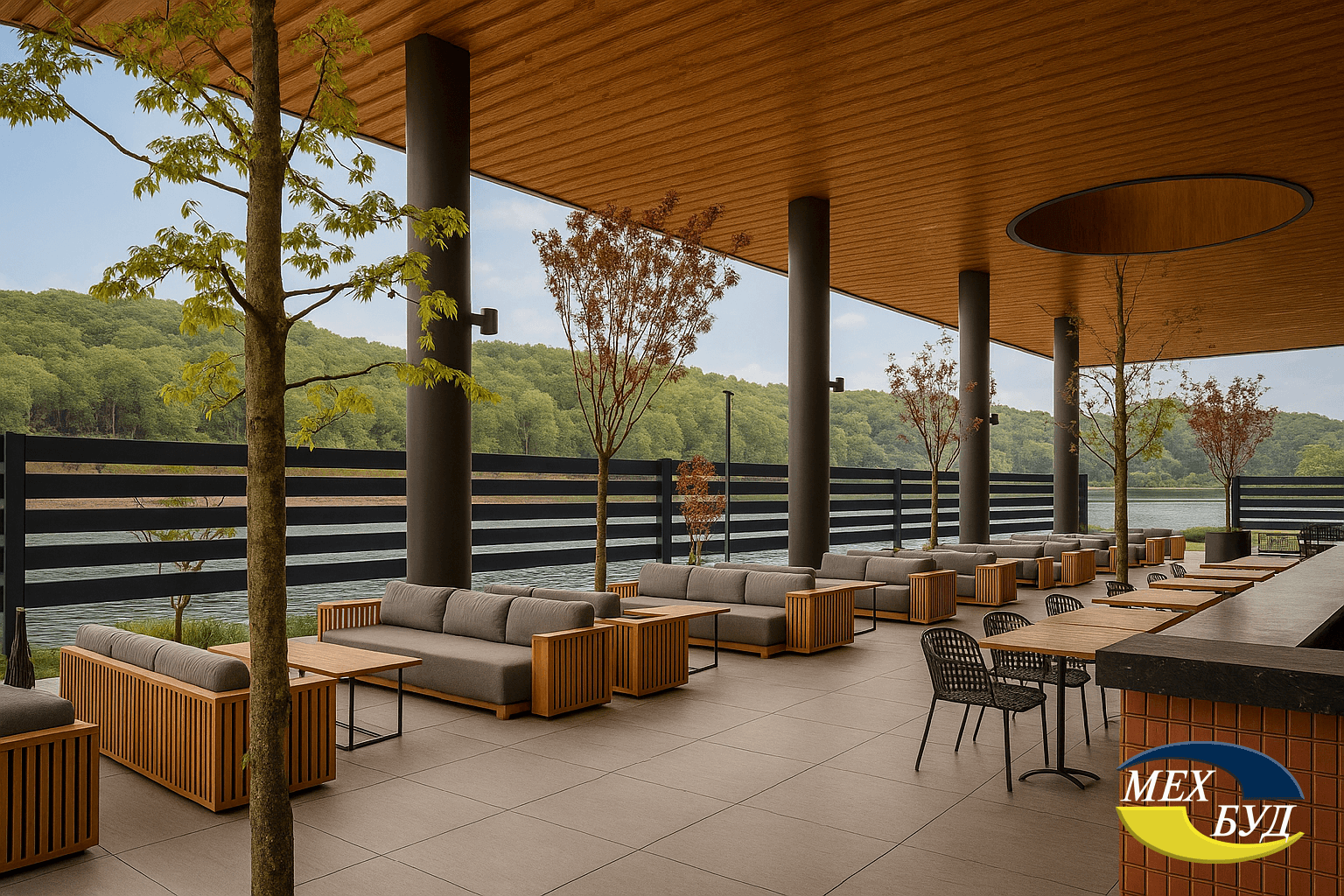
Mehbud Conceptual Design for Emily Resort

Integration of Slat Systems in Waterfront Zones

Problem: Using natural wood on open terraces near water requires constant expensive maintenance due to rot and fading.

Mehbud Solution: Use of metal cube-shaped slats with Printch coating “Golden Oak” or “Winchester.” This coating photorealistically imitates wood texture but is applied to galvanized steel.

Visualization 1: External terrace soffits lined with metal slats that smoothly transition from facade to ceiling, creating a “wrapping” effect.

Visualization 2: VIP beach zone fence with “Rancho” system (wide horizontal slats), which ensures privacy but allows lake breeze, reducing wind load on the structure.

Advantage: 20+ year warranty on coating in high humidity conditions.

№2 – 36Po

Location: 36 Rynok Square, Lviv

Type: Deep reconstruction of architectural monument, High-tech

Key materials: Restoration brick, ultra-strong glass, composite.

Architectural Profile: Symbiosis of History and Futurism

36Po is, without exaggeration, the most complex engineering project in the heart of Lviv over the past decade. The building is located directly on Rynok Square, in a UNESCO zone. Architects faced the task of preserving the historical facade of the Giedziński townhouse while completely reformatting the internal space into a modern five-story restaurant. The concept is based on the idea of a vertical garden and water element.

Construction Achievements: Aquarium and Structure

The central element is a two-story aquarium housing sharks. This created unprecedented challenges for designers.

  1. Structural reinforcement: Historical walls could not withstand the load from 60 tons of water. A “house within a house” was created—an independent metal frame inside the historical walls, supported by its own micropiles injected into the ground using the Jet Grouting method. This unloaded the facade walls.
  2. Logistics: Aquarium glass panels were mounted through the roof using special cranes, as Lviv’s narrow streets limited equipment access.

Engineering Systems: Transformer Roof

The restaurant’s top floor is equipped with a unique sliding glazing system. The mechanized roof allows transforming a closed hall into an open terrace in minutes. The system is equipped with rain and wind sensors, automatically closing when weather deteriorates.

36Po

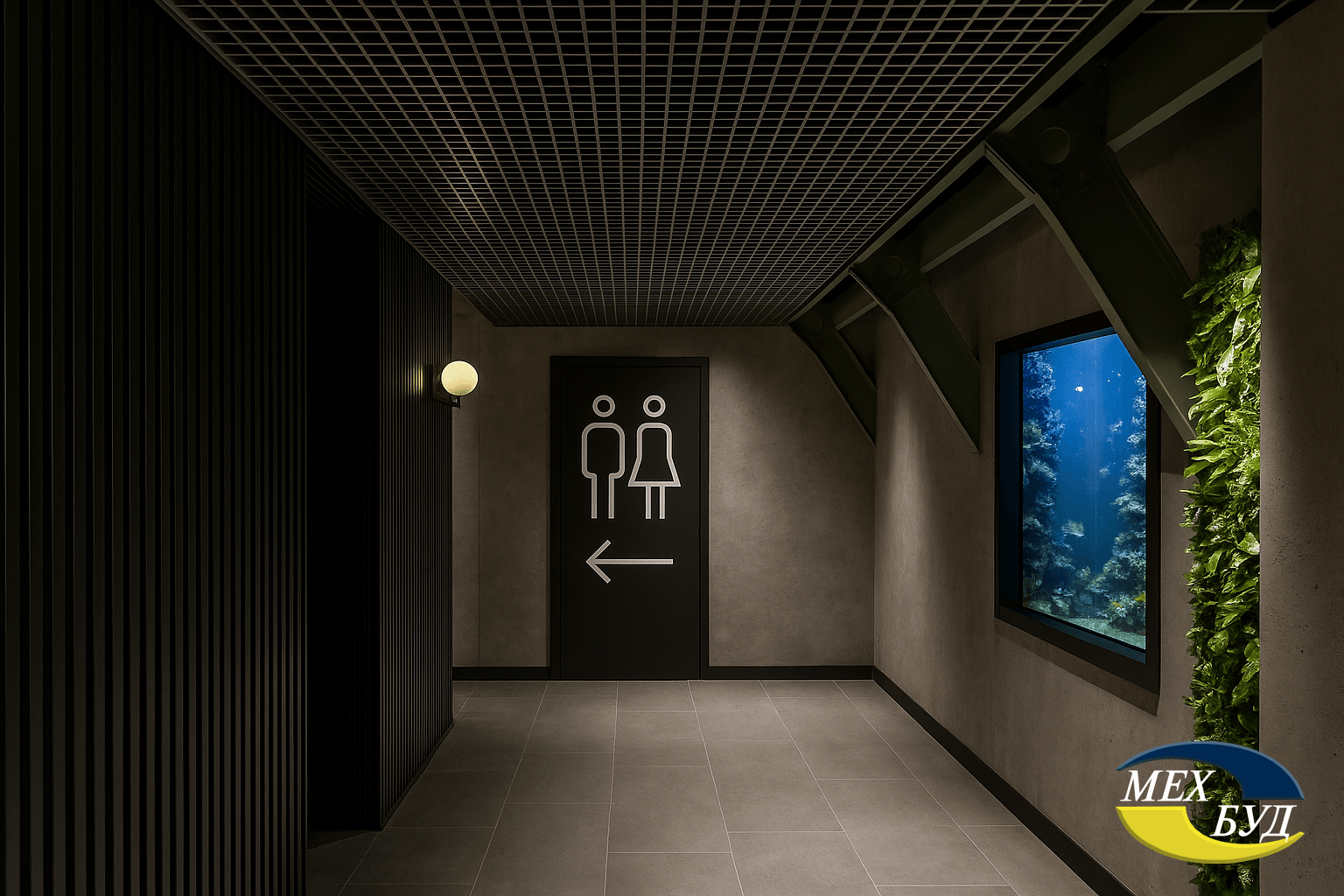
Mehbud Conceptual Design for 36Po

Futuristic Ceiling Solutions for Technical Zones

Problem: Large number of engineering communications (aquarium pipes, ventilation) requires masking while maintaining easy access.

Mehbud Solution: Use of pyramidal type “Grilliato” ceiling in “Graphite” or “Black Moiré” color.

Visualization: Corridor and restroom zones where cellular ceiling creates depth effect and technical aesthetics, harmonizing with exposed elements of the building’s metal frame.

Effect: Visual integrity of interior and 100% smoke extraction functionality in case of fire.

№3 – Baczewski Restaurant (Baczewski Restaurant)

Location: 8 Shevska St., Lviv

Type: Restoration, Historicism, Winter Garden

Key materials: Brick, wrought metal, glass.

Architectural Profile: Ode to Lviv of the Secession Era

The restoration project of the building on Shevska Street became a textbook example of careful attitude towards heritage. The project’s goal is to recreate the atmosphere of the early 20th century (“Belle Époque”). The main architectural attraction is the inner courtyard transformed into an all-season conservatory.

Construction Technologies

  1. Glass atrium: The courtyard well was covered using lightweight aluminum trusses and energy-saving heated glass. This solves the problem of snow load (snow melts and drains into the gutter) and prevents the “cold window” effect for visitors sitting below.
  2. Brick restoration: In the interior, mechanical and chemical cleaning of authentic brickwork from layers of Soviet plaster was performed. Special hydrophobizers were used to protect brick from destruction in the restaurant’s humid environment (large number of plants).

Design Solutions

The design is based on biophilia principles. Live plants, birds, natural light create a unique microclimate. The floor is laid with restored Metlakh tiles, and walls are decorated with mirrors that visually expand the narrow courtyard space.

Бачевських

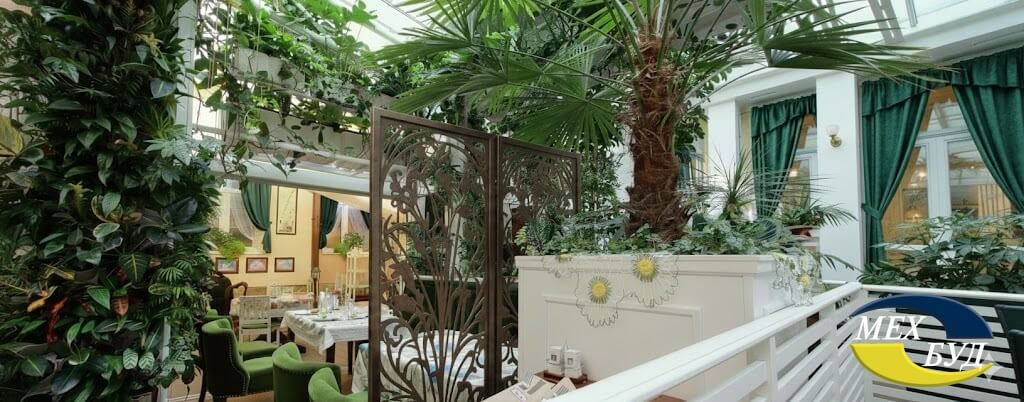
Mehbud Conceptual Design for Baczewski

Laser-Cut Decorative Panels

Concept: Creating partitions for hall zoning that would follow Art Deco or Secession patterns.

Mehbud Solution: Manufacturing steel panels by laser cutting with individual ornament (plant motifs characteristic of Baczewski style). Panels can be painted with powder coating in “Antique Bronze” color.

Application: Stair railings or decorative screens between tables, ensuring intimacy without blocking light.

№4 – Citadel Inn (Garmata Restaurant)

Location: 11 Grabovsky St., Lviv

Type: Revitalization of fortification structure (Maximilian Tower)

Key materials: Red brick, copper, stone.

Architectural Profile: Defensive Might and Five-Star Comfort

The hotel and restaurant are located in one of the preserved towers of Lviv Citadel (mid-19th century). The architectural task was to adapt a stern military structure to luxury hotel functions.

Construction Achievements

  1. Working with massif: Tower walls are over 2 meters thick. Installing modern communications (ventilation, air conditioning) required diamond drilling technologies to avoid disrupting structural statics.
  2. Roofing: Restoration of complex tower roof geometry using standing seam roofing (zinc-titanium). This material oxidizes over time, creating a protective film that guarantees 100 years of operation without repair.

Design Features

The Garmata restaurant interior uses preserved cylindrical vaults. Designers refused to plaster walls, leaving authentic brick exposed, creating dramatic contrast with exquisite furniture and crystal chandeliers.

Citadel Inn

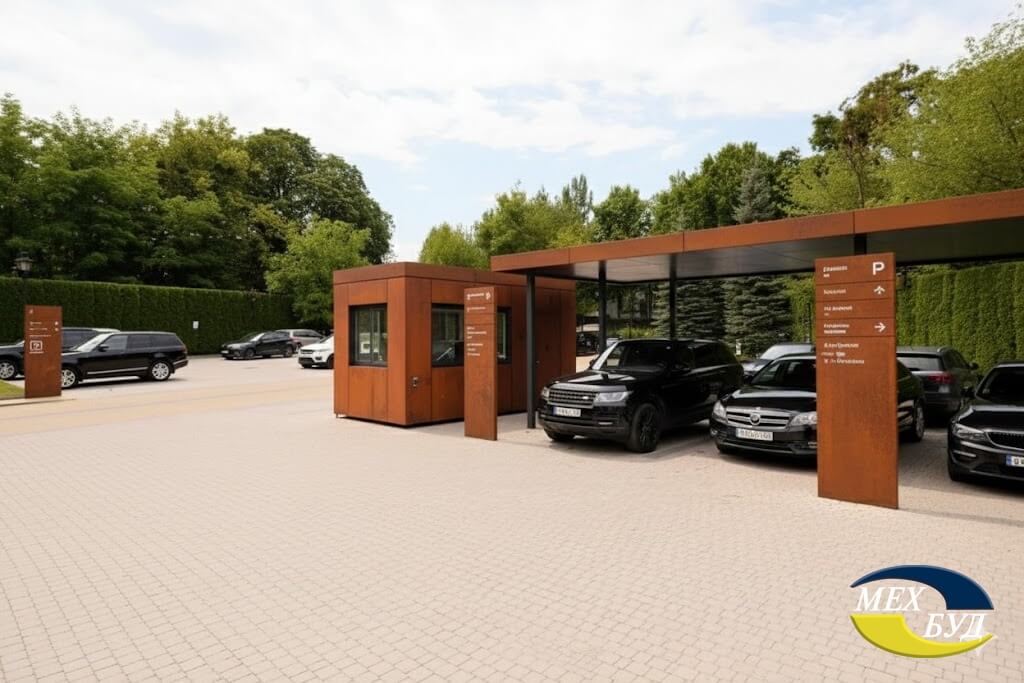
Mehbud Conceptual Design for Citadel Inn

“Corten” Facade Solutions for Entrance Group

Concept: Adding modern elements that would harmonize with the rusty color of old brick.

Mehbud Solution: Use of metal facade cassettes with Cor-Ten effect (rusted steel).

Visualization: Cladding of security post, parking canopy, and navigation elements throughout the Citadel territory. Metal with rust effect looks like part of history, emphasizing the military past of the object, but is technological and lightweight.

№5 – MAD Bars House

Location: 10 Shevska St., Lviv

Type: Vertical urbanism, Reconstruction

Key materials: Concrete, metal, wood, leather.

Architectural Profile: Conceptual Hub

Six-story building where each floor represents a separate establishment format, united by a common staircase-spine. This is an example of maximum functional saturation on a small building footprint.

Construction and Design Solutions

  1. Staircase: Stairs became an art object. Each flight has unique design corresponding to the floor (from rough wood in the pub to exquisite mosaic in the restaurant).
  2. Elevator: Integration of panoramic elevator into historical shaft required jewelry precision.
  3. Ventilation: Since each floor has its own kitchen and specifics (hookah, open fire), a complex separate ventilation system with powerful filters was designed, the output of which is above the roof ridge so as not to disturb neighbors.
MAD Bars House

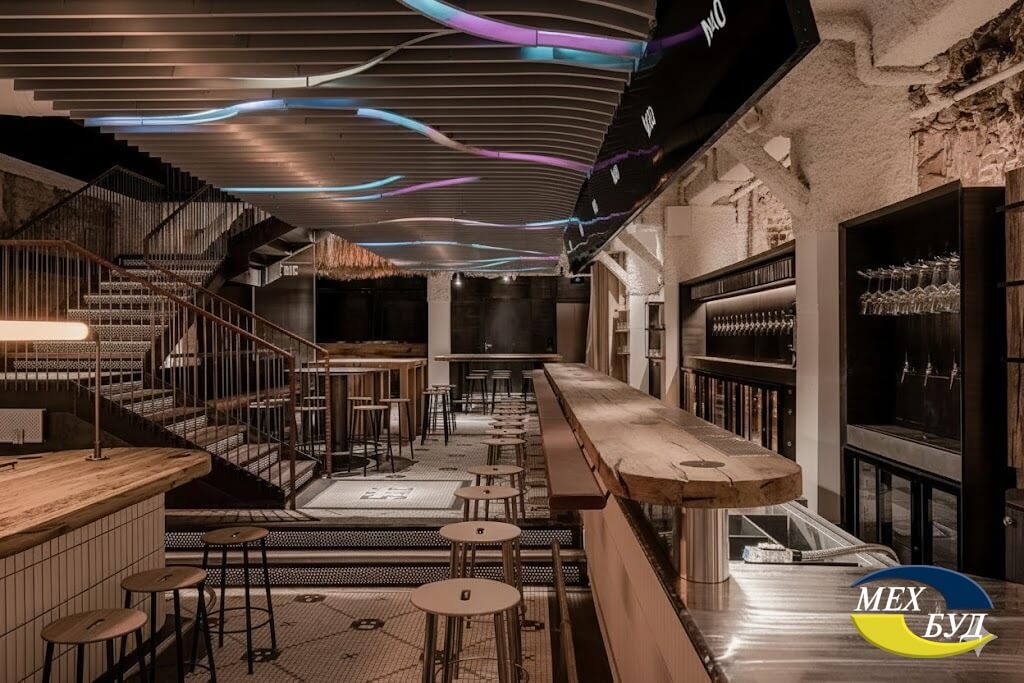
Mehbud Conceptual Design for MAD Bars House

“Wave” Ceilings for Rooftop Bar

Concept: Creating dynamic ceiling on top floor that would emphasize party atmosphere.

Mehbud Solution: Use of slatted ceiling with complex geometry (S-shaped slat design).

Visualization: Ceiling with built-in RGB lighting between slats. Metal surface of slats reflects light, creating shimmer effect. This solution also conceals powerful air conditioning system of roof floor.

№6 – Grand Hotel Lviv (Grand Soile Restaurant)

Location: 13 Svobody Ave., Lviv

Type: Classicism, Luxury Reconstruction

Key materials: Marble, granite, gold leaf, stucco.

Architectural Profile

Complete reconstruction of historical hotel transformed it into the most technological building on Svobody Avenue while preserving the 19th-century facade.

Construction Innovations

  1. Underground urbanism: The biggest achievement was construction of full-fledged SPA center with pool underground in conditions of dense historical development. This required strengthening foundations of neighboring buildings and using caisson floors.
  2. Acoustics: Location on busy avenue required use of special glass units with triplex and inert gases for complete street noise cut-off.
Grand Hotel

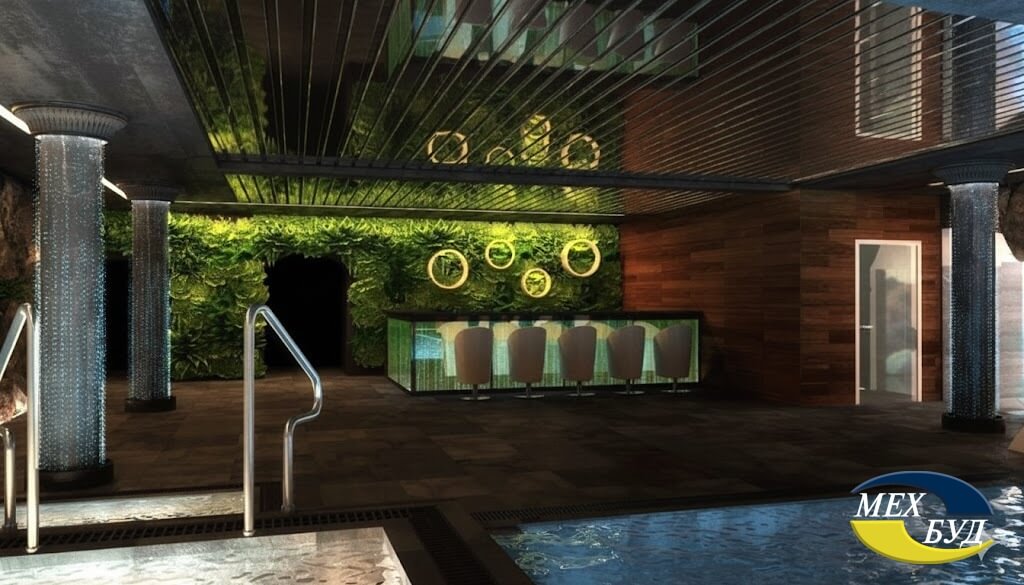
Mehbud Conceptual Design for Grand Hotel

Anti-Corrosion Ceilings for SPA Zone

Problem: High humidity and chlorine vapors in pool quickly destroy ordinary ceilings.

Mehbud Solution: Aluminum slatted ceiling with reinforced polymer coating. Aluminum does not corrode.

Visualization: Mirror slats (“Super Chrome”) in pool area visually double room height and add light to space by reflecting water glare.

№7 – Bankhotel (Safe Restaurant)

Location: 8 Lystopandovoho Chynu St., Lviv

Type: Bank revitalization, Viennese Secession

Key materials: Marble, copper, onyx.

Architectural Profile

Transformation of Austro-Hungarian Bank building into hotel. Project demonstrates how to change building function without changing its spirit.

Construction and Design Solutions

  1. Restoration: Restoration of unique stained glass, marble stairs and lobby floor.
  2. Acoustic comfort: Safe restaurant uses special acoustic panels integrated into wall design to avoid echo effect characteristic of bank operation halls.
  3. Structure: Attic floor superstructure made of light steel thin-walled structures (LSTK) to avoid overloading old walls.
Bankhotel

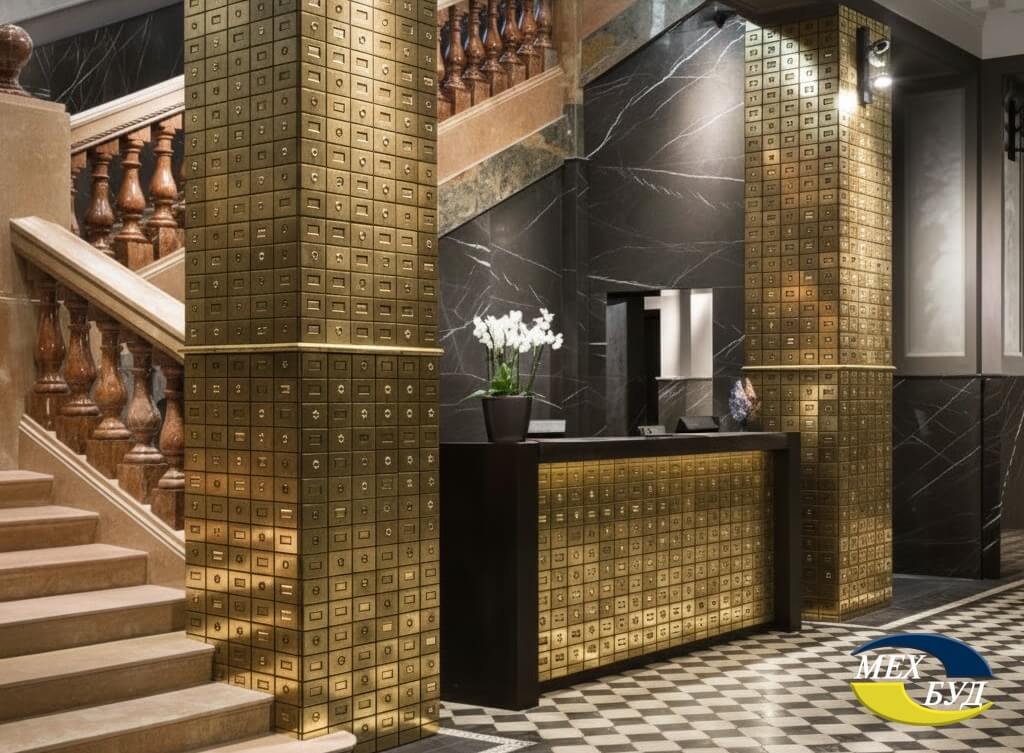
Mehbud Conceptual Design for Bankhotel

Wall Panels Imitating Safe Deposit Boxes

Concept: Supporting “banking” legend in interior.

Mehbud Solution: Manufacturing small-sized metal cassettes from brass or copper imitating deposit box facade.

Application: Bar counter or lobby column cladding. Metal adds prestige and historical authenticity.

№8 – Park. Art of Rest

Location: B. Khmelnytsky Park, Lviv

Type: Modernism, Park architecture

Key materials: Composite, glass, clinker.

Architectural Profile

Renovation of Soviet cinema “Druzhba.” Architects transformed a blank concrete box into a transparent pavilion integrated into the park.

Construction Solutions

  1. Facade: Use of rhythmic vertical slats on facade that echo park tree trunks. This allows building to mimic surroundings.
  2. Energy saving: Large roof overhangs protect glass walls from direct sunlight in summer, reducing air conditioner load (passive sun protection).
Park. Art of Rest

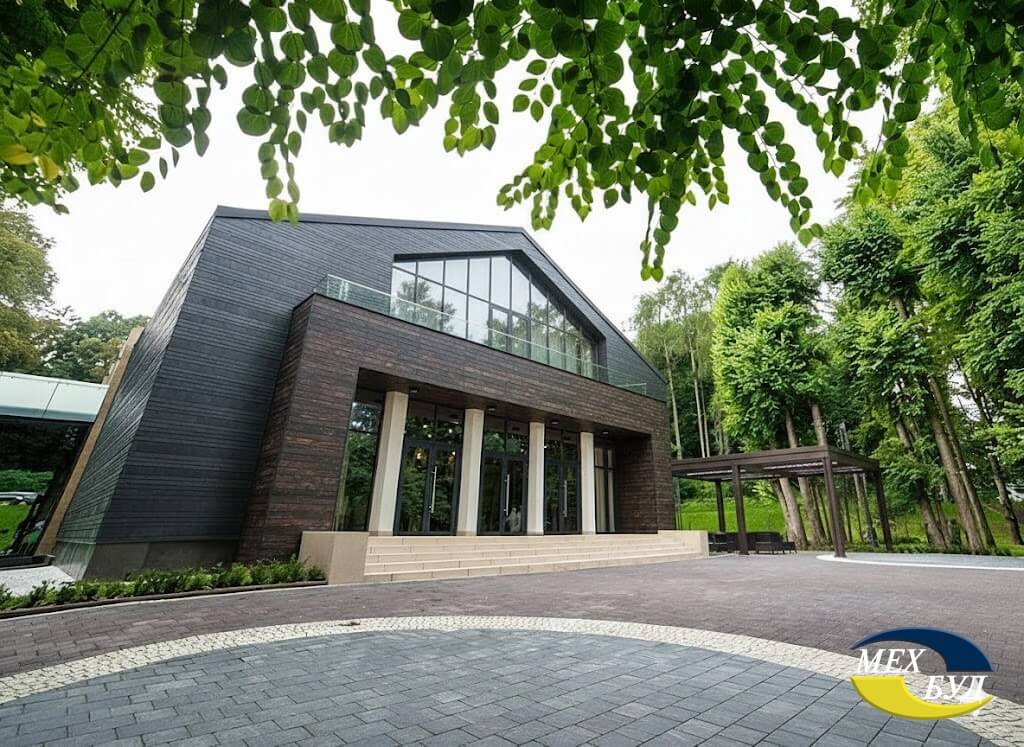
Mehbud Conceptual Design for Park. Art of Rest

Facade Slats and Pergolas

Mehbud Solution: Replacing existing wooden elements with metal siding “Block House” or rectangular slats with dark wood texture.

Visualization: Summer terrace with rotating bioclimatic pergola from Mehbud. Metal roof slats can rotate, regulating sun flow, or completely close during rain, creating hermetic roof.

№9 – Kumpel (on Vynnychenko)

Location: 6 Vynnychenko St., Lviv

Type: Loft, Industrial, Basement reconstruction

Key materials: Copper (brewing equipment), brick, wood.

Architectural Profile

Lviv’s first new wave brewery restaurant. Interior built around real copper brewing tanks.

Engineering Solutions

  1. Ventilation: Complex system for removing steam and malt odors integrated into interior as decorative element (exposed air ducts).
  2. Floor: Use of industrial self-leveling floors resistant to aggressive chemical environments and mechanical loads.
Kumpel

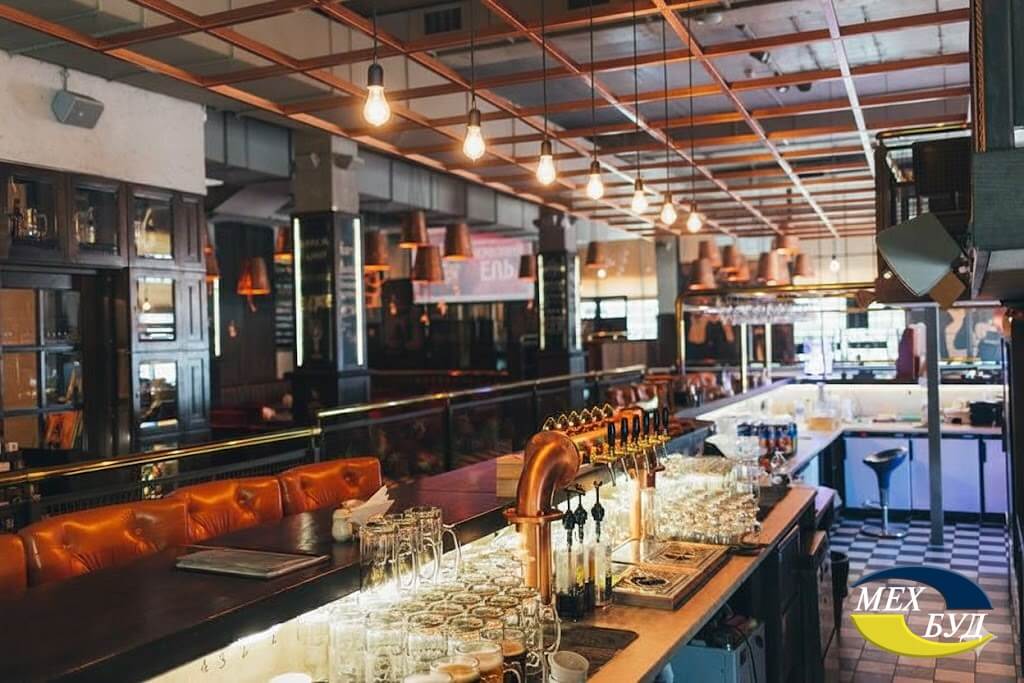
Mehbud Conceptual Design for Kumpel

Industrial Grilliato Ceilings

Mehbud Solution: Grilliato ceiling with large cell in copper color. This will support brewing tank theme and allow air to circulate freely.

№10 – Atlas

Location: 45 Rynok Square, Lviv

Type: Historical classic

Key materials: Wood, velvet, brass.

Architectural Profile

Legendary establishment recreating interwar Lviv atmosphere. Focus on portrait gallery and ceiling decor.

Atlas

Mehbud Conceptual Design for Atlas

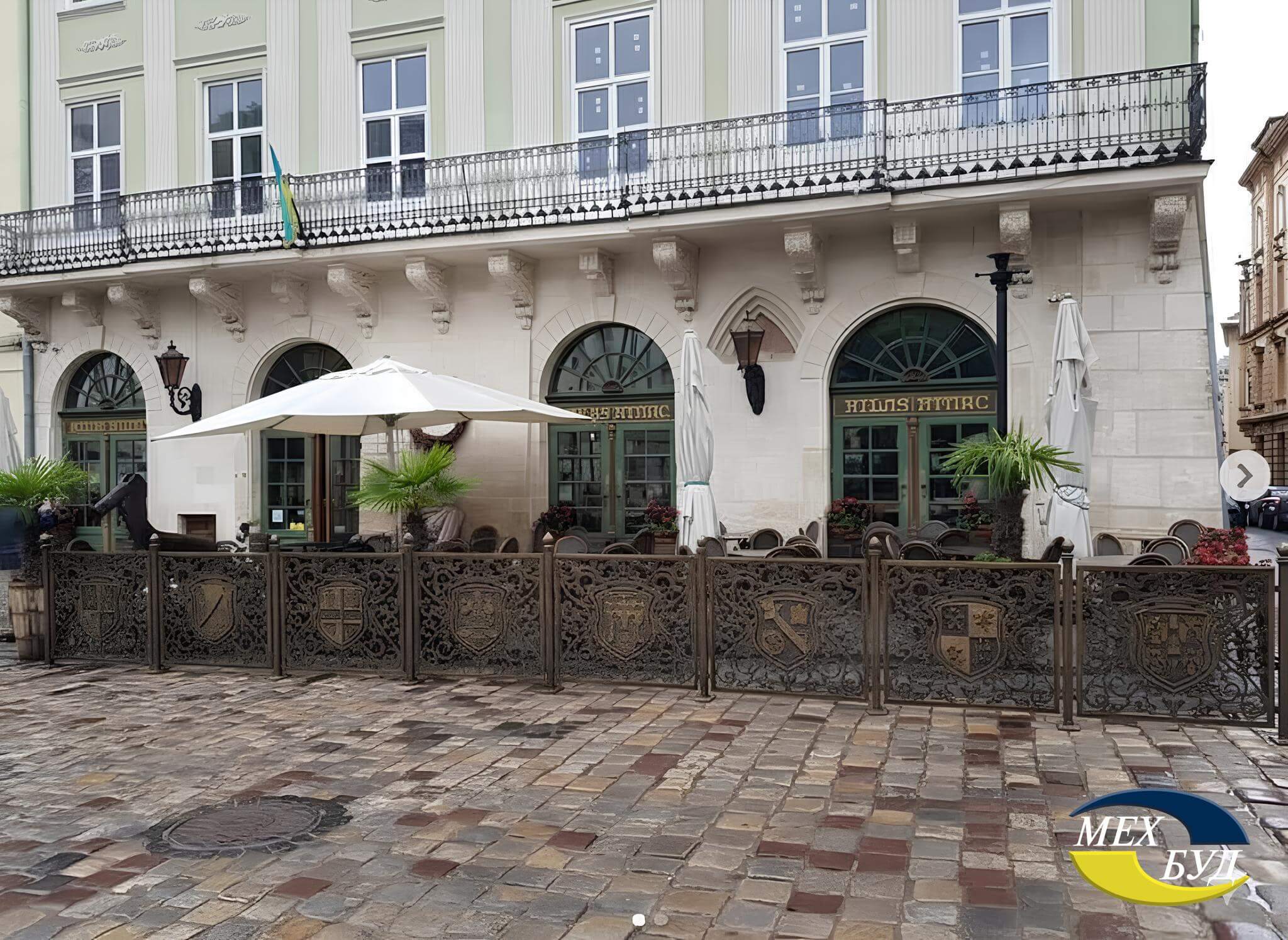
Summer Terrace Fencing

Mehbud Solution: Refined wrought fence or laser-cut metal sections with heraldic motifs separating tables from tourist flow on Rynok Square while preserving historical appearance.

3. Comparative Analysis of Construction Technologies

The table below presents systematized data on engineering solutions used in analyzed objects.

Object Name Intervention Type Facade Solutions Engineering Features Environmental Standard
Emily Resort New construction Stick-and-rig glazing, thermally modified wood Geothermal heating, pile foundation BREEAM (compliance)
36Po Reconstruction Historical facade + Glass roof 60t aquarium, internal frame, Jet Grouting Energy-efficient recuperation
Baczewski Restoration Brick, glass atrium Conservatory microclimate, hydrophobization Biophilic design
Citadel Inn Adaptation Fortification brick, copper Engineering in 2m walls, smoke extraction Thick walls (passive thermal regulation)
MAD Bars Reconstruction Combined Separate floor ventilation, panoramic elevator Smart climate control
Park. Art of Rest Renovation Ventilated facade, slats Passive sun protection, landscape integration Preservation of existing trees
Grand Hotel Reconstruction Classic decor, granite Underground SPA, floating floors (sound insulation) High energy efficiency class

4. Analytical Review: 2025 Trends and Industry Future

4.1. “Honest” Construction and Rejection of Imitations

Analysis of top objects demonstrates departure from cheap imitations. If it’s brick—it’s real and cleaned; if metal—it’s real steel or copper, not “metal-look” plastic. Lviv architects set the trend for tactility. Restaurant visitors contact surfaces, so material quality becomes a marketing tool.

4.2. Metal as the New “Plaster”

In conditions of skilled labor shortage (plasterers, restorers), industrial finishing methods come to the fore. “Mehbud” company products fit perfectly into this trend.

  1. Speed: Metal facade or ceiling installation takes 3-4 times less time than “wet” processes.
  2. All-season: Work can be done in winter, critical for businesses wanting to open before season.
  3. Operation: Metal facade is washed with pressurized water, while painted plaster in city center needs updating every 2-3 years due to graffiti and dust.

4.3. Underground Revitalization

Lviv is actively developing underground space. Restaurants “Kumpel,” “Grand Hotel,” “Kryjivka” demonstrate that with quality waterproofing and ventilation, basements become premium areas. This requires use of specific materials resistant to fungus and corrosion—and here aluminum and steel suspended ceiling systems are indispensable.

5. Mehbud Solutions Gallery: Technical Aesthetics

In this section, we detail exactly how partner products can be implemented in architecture of this level.

5.1. “Ventilated Cassette” Facade System

For renovation of Soviet buildings (similar to Park. Art of Rest), ideal is use of steel cassettes 1.0-1.2 mm thick.

  • Advantages: Hidden fastening creates monolithic surface.
  • Design: Cassette perforation allows creating drawings or establishment logos on facade, illuminated at night from inside (LED lighting behind facade).

5.2. “Cube-Shaped Slat” Ceiling for Zoning

In large halls (like Emily Resort), acoustics is often a problem. Metal slat disperses sound waves, reducing hum.

  • Solution: Using slats of different heights and pitch to create wave-like effect.
  • Integration: Track rails for track lights easily mount between slats, allowing changing lighting scenarios for events.

5.3. “Louver” Fence for Private Zones

For restaurants with summer terraces in dense development.

  • Function: Special slat geometry allows seeing street from inside but reliably hides visitors from passers-by outside.
  • Ventilation: Unlike solid fence, “Blinds” freely passes air without creating “steam room” on terrace.

6. Conclusions

Lviv’s restaurant architecture in 2025 is a complex symbiosis of history, engineering, and marketing. Successful projects demonstrate that investing in high-quality materials and innovative structural solutions is economically justified.

Key findings of the research:

  1. Adaptability: The most successful cases involve adapting existing buildings (forts, banks, stone houses) for new functions.
  2. Engineering Courage: Lviv architects are not afraid of complex challenges (aquariums on floors, underground pools).
  3. Localization of Production: The use of Ukrainian systems (in particular, Mekhbud) makes it possible to achieve world-class quality and aesthetics while optimizing budgets and construction timelines.

For architects and developers planning new projects, the recommendation is unambiguous: the future belongs to durable, aesthetic, and high-tech materials capable of withstanding the test of time and intensive use.

author
About the author:

A marketing and communications expert at the Mehbud factory. Develops the brand, showcasing all the advantages of Mehbud products to clients. Helps you make the right choice by providing consultat...

More
0 0 votes
Article Rating
Subscribe
Notify of
guest
0 Comments
Oldest
Newest Most Voted
Inline Feedbacks
View all comments