Modern modular towns in Ukraine have become a strategic solution to overcome the crisis housing deficit. The innovative architecture of temporary housing guarantees exceptional construction speed and maximum energy efficiency. This report provides a deep analysis of engineering materials, production logistics, and a compiled list of the TOP-10 verified companies. This information will help you choose a reliable partner, as professional modular construction in Ukraine offers solutions for both private living and large-scale social investments.
Modular Towns Ukraine: TOP-10 Housing Manufacturers

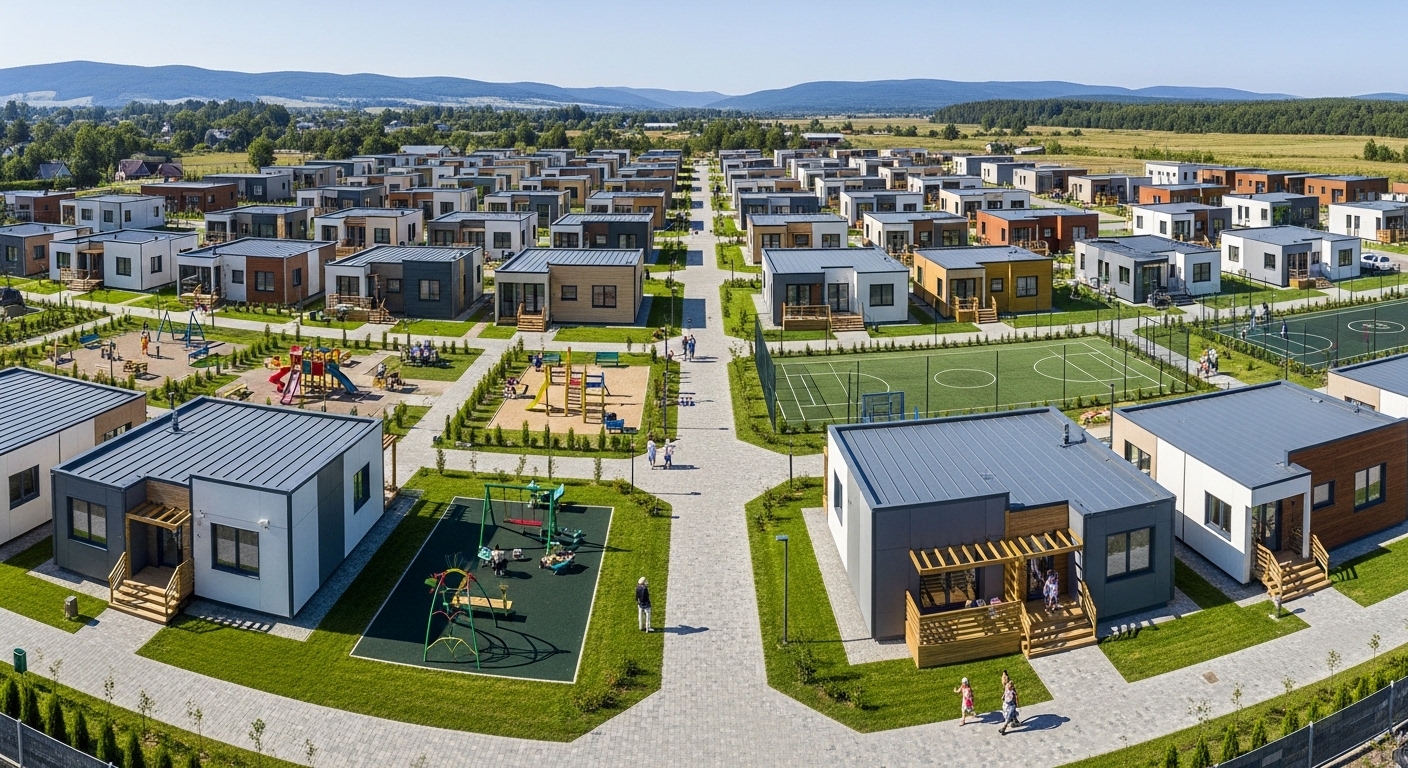
Global Macroeconomic Context and the Evolution of Temporary Housing Architecture
The global construction technology market is undergoing a profound structural transformation. Traditional capital construction methods are gradually giving way to innovative approaches, among which modular architecture dominates. According to recent analytical data, the global volume of the modular construction market has reached an all-time high, crossing the mark of $104.64 billion USD in 2024. Leading experts in urbanism and spatial planning view this trending technology as the most effective global tool for overcoming the affordable housing crisis. For Ukraine, which has suffered unprecedented infrastructural destruction and massive internal population displacement, modular construction has evolved from a niche architectural concept into a foundational element of the national recovery strategy.
In the initial stages of the crisis, the concept of temporary housing architecture in Ukraine was purely emergency-driven. The first attempts to provide a roof over the heads of internally displaced persons (IDPs) were based on adapting existing resources. A prime example is the initiative by “Ukrzaliznytsia”, which in June 2022 deployed a temporary settlement in the city of Irpin, retrofitting railway cars for people who had lost their homes to artillery and missile strikes. However, considering Ukraine’s climatic conditions and the need for long-term comfort, engineering approaches quickly adapted. By August 2022, a fully functional modular town was assembled on the territory of the “Dubky” sanatorium in Irpin. This facility demonstrated a new level of spatial organization: four autonomous sections, each containing 22 living rooms, were complemented by integrated dining rooms, sanitary facilities, and children’s sports areas, providing comfortable accommodation for 352 people.
Subsequent stages in the development of temporary housing architecture were characterized by improved material quality and the involvement of international donors. In the cities that suffered the most during the attempted advance on Kyiv (Borodianka, Bucha, Hostomel, Makariv), a massive deployment of eco-friendly modular settlements began. In Bucha, the city council initiated the creation of new generation eco-friendly housing, where the cost of one high-tech house was approximately 10,000 euros. The project planned the installation of 150 such units, attracting both private and institutional investors. This marked a transitional phase from the “temporary shelter” paradigm to the concept of “fully-fledged ecological housing”.
Today, modular towns in Ukraine are transforming into comprehensive socio-economic ecosystems. The most representative in this context is the pilot project in the Myronivka community in the Kyiv region. According to official data, the region has taken in over 233,000 internally displaced persons from the Donetsk, Zaporizhzhia, Kharkiv, and other regions. To address their integration, the Ministry of Communities and Territories Development of Ukraine, the Kyiv Regional Military Administration, local authorities, and charitable foundations (including the “MHP – Gromadi” Foundation) initiated the construction of a town with 200 modular units. The uniqueness of this project lies in the implementation of the “70/30” settlement model: 70% of the housing stock is allocated to the economically active population on the condition of their parallel employment in cooperation with local employers, while 30% is allocated for socially vulnerable categories. Such a symbiosis of architecture and economics confirms that modern modular towns for displaced persons are not just a forced refuge for a few months, but a strategic foundation for demographic stabilization and the revival of the economic potential of communities.

Engineering and Physical Analysis: Materials and Thermal Dynamics
The fundamental difference between modular construction and traditional “wet” construction (brick, aerated concrete, monolithic concrete) lies in the use of multi-layered structures, where each engineering layer performs a strictly defined function: load-bearing, thermal insulation, vapor barrier, or protective. An analysis of the materials used by leading Ukrainian manufacturers demonstrates an uncompromising approach to ensuring energy efficiency.
Load-Bearing Structures and Frame Systems
The foundation of any modular home is its frame, which must withstand static and dynamic loads, especially during the transportation of the finished module from the factory to the land plot.
- Wooden Frame: Premium segment companies, such as Qhome, Unitbud, and Norvil, use exclusively dry, calibrated, kiln-dried timber. The process of drying wood in controlled factory conditions to optimal humidity guarantees that the material will not shrink, deform, or crack during the building’s operation. For maximum durability and fire safety, the timber is treated with specialized impregnants (e.g., Drevofix AntiFire Impregnat), which create a reliable barrier against fire, insect pests, fungi, and mold. The lower part of the frame is often additionally reinforced with steel mesh and moisture-resistant OSB boards to protect against ground moisture and rodents.
- Metal Frame and LGSF: For commercial projects, multi-story modular dormitories, and infrastructure facilities, companies (e.g., Modulex, Trident Modular Housing) use steel frames or light gauge steel framing (LGSF) technology. These materials provide the highest level of fire resistance and seismic reliability, enabling the creation of large-scale structures with free internal layouts.
Insulation Systems and the “Thermos” Effect
Given the harsh winters and hot summers in Ukraine, the thermophysical properties of wall enclosing structures are a critical parameter.
- Mineral (Basalt) Wool: This is the most popular insulation among the eco-friendly lines of modular homes. Basalt wool is characterized by high density, absolute non-combustibility, hypoallergenic properties, and excellent sound insulation. For instance, the base configurations of Nano Hous and Unitbud homes use insulation ranging from 150 mm thick in the walls to 200-250 mm in the roof and floor. Norvil also adheres to this standard (15 cm in walls, 20 cm in ceilings). Thanks to this thickness, combined with super-diffusion wind and vapor barrier membranes, complete hermetic sealing of the module is achieved. The house begins to operate on the “thermos” principle: the internal space heats up instantly from the heating system and releases heat to the outside extremely slowly, allowing owners to minimize electricity costs.
- Sandwich Panels and Polymer Insulators: Ready-made structural insulated panels (SIPs) or classic sandwich panels are widely used for the rapid construction of industrial buildings, trade pavilions, and modular towns for IDPs. The Lviv-based enterprise LLC “Modul” specializes in manufacturing sandwich panels with polyurethane foam (PIR/PUR) and expanded polystyrene fillings. PIR material has one of the lowest thermal conductivity coefficients among all known building materials, allowing it to meet regulatory energy efficiency standards with a significantly thinner wall compared to mineral wool.
Exterior Finishing and Glazing
Modern temporary and permanent housing architecture rejects aesthetic compromises. Facades are finished with click-fold roofing, profiled metal, false timber (e.g., “Smereka” wood imitation), composite aluminum panels, or HPL panels. To minimize heat loss through translucent structures, all responsible manufacturers install double- or triple-chamber energy-saving glass units filled with inert gas (argon or krypton), using multi-contour profiles (5 or 6 chambers).
| Technological Element | Traditional Construction (Brick) | Modular Construction (Wood/LGSF Frame) |
| Thermal Insulation Material | Polystyrene foam, mineral wool (external insulation 100 mm) | Basalt wool, PIR/PUR panels (integrated into the frame 150-250 mm) |
| Impact of Moisture During Build | High (mortars, concrete, precipitation) | Absent (100% factory assembly in a dry workshop) |
| Sound Insulation Performance | High | High (due to multi-layering and acoustic wool) |
| Service Life | 100+ years | 50 – 70 years (depends on wood treatment) |
| Eco-friendliness & Recycling | Low (construction waste) | High (possibility of relocation and reuse) |

Logistics and the Revolution in Construction Speed
The parameter by which temporary housing architecture unequivocally beats traditional methods is the speed of construction. According to statistics from Qhome, waiting 2-3 years for the construction of one’s own home is an “unacceptable luxury” for modern people. Reducing the project implementation time by 5-7 times is achieved through the engineering decomposition of the construction process into parallel streams.
In classic construction, all stages are rigidly linear: you cannot build walls until the foundation cures; you cannot install wiring until the shell is built; you cannot do fine interior finishing until the floor screed releases its moisture. Modular construction breaks this paradigm.
The process begins with project development and layout approval. After this, work starts simultaneously at two locations: at the client’s site and at the manufacturer’s factory. Because modular structures are exceptionally light, they do not require the installation of an expensive and time-consuming monolithic strip foundation. The most effective engineering solution has been the use of galvanized ground screws or screw piles. This technology allows for the installation of a reliable foundation on any terrain (slopes, forests, sand) in just 1 day, without disturbing the natural landscape or requiring heavy excavator equipment.
While the foundation is being mounted, the complete manufacturing of the house takes place in the dry and thermally insulated workshops of the factory. The Technical Control Department monitors every stage of assembly using high-precision equipment, ensuring perfect corner geometry and tight joints. Modules are equipped with all internal engineering networks: water supply pipes (Wavin, Valrom) are laid, electrical automation is installed, underfloor heating is mounted, laminate flooring is laid, hidden doors are hung, and even stretch ceilings are fitted. The level of factory readiness reaches 80-100%.
Certain manufacturers demonstrate impressive production capacities. For instance, Qhome can produce up to 3,000 m² of living space per month , while the BudMall Center cluster produces around 2,000 m² per month. After the workshop operations are complete, the finished large-scale blocks are loaded onto specialized trailers and transported to the site. The final stage — the installation and joining of the modules — takes place without dirt, dust, or construction debris, and takes anywhere from a few hours to a week. Trident Modular Housing, for example, claims it can mount a house onto a prepared foundation in just one daylight period. As a result, the total timeline from signing the contract to handing over the keys to the owner is: 2-6 weeks (Unitbud) , about 60 working days (Nano Hous) , or 2-3 months (Norvil).

Market Analytics and UBA.TOP 2025 Evaluation Methodology
To identify the best modular towns in Ukraine and the most reliable manufacturers, we rely on comprehensive data, specifically the independent analytical ranking by the Ukrainian Business Award (UBA.TOP) for 2025, created in partnership with Serpstat and Clarity Project. Inclusion in this ranking requires companies to pass a strict multi-factor audit, serving as public confirmation of their professional reliability.
The independent ranking methodology is based on the following critical indicators:
- Engineering Activity and Standard Solutions: The company’s ability to offer a wide line of projects is evaluated. For example, Modulex has developed 38 unique solutions, BudMall — 27, and Sipbud — 24. Trident Modular Housing leads in the number of ready-made standard formats (14 solutions), which optimizes the selection process for the end consumer.
- Diversity of Building Types: Leading players do not limit themselves to private cottages. BudMall and Sipbud each implement 8 different architectural types of buildings, including social housing, hotel complexes, glampings, and commercial pavilions.
- Market Longevity and Reputation: In the construction industry, a company’s age directly correlates with the reliability of its warranty obligations. The oldest players are Modulex (19 years), Moduldim (18 years), and BudMall (17 years). However, even relatively young companies, such as Unitbud (2 years), can demonstrate explosive growth through the aggressive implementation of innovations.
- Digital Presence and Reviews: The most crucial modern criterion. Unitbud leads with a phenomenal figure — 30,429 unique website visits per month. Companies were evaluated on the quality of their social media presence and reputation management on Google Reviews. BudMall, Trident, Sipbud, and Unitbud received the maximum scores in this metric, demonstrating deep interaction with their audience.
TOP-10 Modular Towns of Ukraine: Overview of Manufacturers
Based on the defined criteria of quality, construction speed, client reviews, and digital reputation, a list of the best operators in the modular construction market has been formed.
1. Modulex
Main services and specialization: Large-scale construction of modular towns for IDPs, administrative buildings, dormitories, medical outpatient clinics, and mobile offices based on a reliable metal frame.
Key advantages and unique value: 19 years of market experience and absolute leadership (1st place) in the independent UBA 2025 ranking. They have developed 38 adaptive engineering solutions that allow for extremely fast area expansion by attaching new insulated blocks made of sandwich panels.
Contact Information: Phone: +38 (050) 000-00-00. Website: modulex.ua.
Why you should apply: The best choice for the B2B sector and municipal authorities. The company guarantees an unprecedented speed of deploying large infrastructure, which is critically important for creating comprehensive modular towns.

2. Sipbud (СІПбуд)
Main services and specialization: Design and production of energy-efficient modular and capital housing using modern Structural Insulated Panel (SIP) technology.
Key advantages and unique value: An honorable 2nd place in the UBA 2025 ranking. The use of SIP panels provides buildings with monolithic strength and the highest level of thermal insulation. The company implements 24 thoroughly detailed projects across 8 different types of facilities.
Contact Information: Phone: +38 (067) 919-42-83. Website: sipbud.com.ua.
Why you should apply: Deep expertise (over 6 years) and consistently high scores on Google Reviews confirm the flawless quality of their projects and client communication. The ideal option for those who value maximum savings on heating.
3. Unitbud
Main services and specialization: Full-cycle production of premium energy-efficient modular homes ranging from 27 to 140 m², as well as turnkey modular saunas.
Key advantages and unique value: 100% workshop production guarantees perfect precision. Basalt wool insulation, 3 configurations to choose from (“Base”, “Comfort”, “Premium”). Construction timeframe — a record 2-6 weeks.
Contact Information: Phone: +38 (067) 106 75 06 (Zhytomyr). Website: unitbud.com. Social networks: Facebook, Instagram, YouTube.
Why you should apply: 3rd place in UBA 2025 and the highest web traffic on the market (over 30,000 visits/month) are testaments to immense trust. Transparent pricing without hidden fees, a housing lifespan of 50-70 years, and real positive video reviews from owners.
4. Trident Modular Housing
Main services and specialization: Premium customized construction using LGSF (Light Gauge Steel Framing) and SIP technologies: residences, houseboats, glampings, and B2B modules.
Key advantages and unique value: Implemented the international ISO 9001 quality management standard and the RAMS reliability system. Maximum readiness concept: the module is assembled at the factory and installed on the client’s site in just 1 day.
Contact Information: Phone: +38 (073) 503 57 57 (Kyiv, Lviv). Website: tridentmodular.com.ua. Active on Instagram, Facebook, YouTube.
Why you should apply: Winner of the “Choice of the Year UBA 2025” nomination. The company rejects trivial solutions, providing exceptional architectural aesthetics, making their objects a reliable and highly profitable asset for investors.
5. BudMall Center
Main services and specialization: The largest Ukrainian cluster of manufacturers of ready-made “turnkey” ecological housing. They specialize in social housing (IDPs), private cottages, and large-scale recreation bases.
Key advantages and unique value: The widest network of open-air exhibition grounds in Ukraine (Kyiv, Ternopil, Lviv). Production capacities allow for the release of 2,000 m² per month, ensuring the construction of a custom house from 30 days.
Contact Information: Phone: +38 (066) 077 77 21. Website: budmall.center. Video blog on YouTube, Instagram, Facebook.
Why you should apply: 14 years of experience, 8 international awards, and profound social responsibility. A high level of service, transparent customer reviews in video blogs, and the ability to implement the most complex commercial projects.
6. Qhome
Main services and specialization: Production of premium modular homes for year-round living based on a durable frame made of dry, calibrated timber.
Key advantages and unique value: Colossal production capacity (3,000 m² per month). Foundation construction (ground screws) takes 1 day. Thanks to the QLife scalability concept, houses can be disassembled, relocated, or expanded with new modules in the future.
Contact Information: Website: qhome.ua. Actively engage with the community via Instagram, Facebook.
Why you should apply: Exclusive focus on energy efficiency — the houses work like a “thermos.” Fixed pricing, zero construction debris on the plot, and a predictable delivery date of less than 2 months guarantee the client’s peace of mind.
7. Norvil
Main services and specialization: Manufacturing of mass-produced models (including Barn House) and custom projects with the delivery of finished modules across Ukraine and to the European Union.
Key advantages and unique value: Maximum mineral wool insulation (walls — 15 cm, roof/floor — 20 cm) and the use of triple-glazed windows. Presence of two robust branches in Vasylkiv (Kyiv region) and Zhovkva (Lviv region).
Contact Information: Phones: +38 095 228 52 55; +38 050 505 21 35. Website: norvil.com.ua. TikTok, Instagram, YouTube.
Why you should apply: Clients get absolute step-by-step control over production and a transparent payment schedule. Homes are delivered with fully wired electrical and plumbing systems, allowing for an instant move-in within 2-3 months.
8. Nano Hous (Nanohousbud)
Main services and specialization: Affordable modular construction of comfortable ecological houses for permanent living (from compact 36 m² to spacious 96 m²).
Key advantages and unique value: A strictly fixed production cycle of 60 working days. Even the base “Standard” configuration includes energy-saving windows, an electric boiler, radiators, ventilation with recuperators, and quality interior finishing.
Contact Information: Phone: +38 (093) 114 24 12. Website: nanohousbud.com.
Why you should apply: The best ratio of affordable price (starting at 25,000 UAH per m²) to premium inclusions on the Ukrainian market. The company offers advantageous “turnkey” setups with options to install a fireplace and underfloor heating systems.
9. LLC “Modul” (Lviv)
Main services and specialization: Comprehensive design, material production, and rapid installation of modular buildings, industrial facilities, and shopping complexes in Western Ukraine.
Key advantages and unique value: Ownership of proprietary production facilities for manufacturing innovative sandwich panels (PIR/PUR fillings, mineral wool) and Termo Fiberglass plates. This eliminates logistical delays and significantly accelerates on-site installation.
Contact Information: Phone: +380 (67) 908 88 44. Address: Lviv, 30 V. Vynnychenka St. Website: modul-lviv.com.ua.
Why you should apply: Direct cooperation with the manufacturer of enclosing structures guarantees clients favorable prices without middleman markups, high building thermal insulation, and the guaranteed operational reliability of the materials.
10. Nordi House
Main services and specialization: Construction of unique, deeply customized modular homes and infrastructure elements (canopies) tailored to the individual requirements of the customer.
Key advantages and unique value: Physical presence in major regions (exhibition showrooms operate in Kyiv, Lviv, Dnipro, and Vinnytsia). A team of experts provides premium after-sales service and support.
Contact Information: Phone: +38 (097) 634 28 75. Address: Kyiv, Khotiv village, 11 Dolynna St. Website: nordihouse.com.ua. Active on Instagram, Facebook, TikTok.
Why you should apply: The company’s reliability is backed by years of partnership with large corporations (Socar, Roshen, KFC). They offer a personalized approach and openness to dialogue at every stage of creating your future home.
Configurations, Layouts, and Pricing Models: How Price is Formed
When evaluating temporary housing architecture and private modular objects, it’s essential to understand the pricing structure. As of spring 2025, the base cost of a move-in-ready modular home measuring 27 m² (with a bathroom and kitchen area) is approximately $24,000, while a premium 45 m² barnhouse costs about $40,000. The price is always fixed in the contract, which is a massive advantage over the unpredictable estimates of capital construction.
Market offerings are usually segmented into several tiers of configuration, allowing budgets to be optimized:
- Base Configuration (Base / Standard): Includes an assembled frame, full exterior finishing (false timber, click-fold), insulation (roof, walls, floor), and the installation of energy-efficient windows and entrance doors. Interior walls are clad with OSB plates or rough drywall. All utilities are routed to connection points. For instance, Nano Hous includes recuperators and an electric boiler right out of the box in the standard setup.
- Optimal / Comfort Configuration (Comfort): The most popular choice. The house is completely ready for living: features fine interior finishing (laminate, tiles, stretch ceilings, interior doors), installed lighting fixtures, switches, a boiler, underfloor heating, and a ventilation system.
- Premium Configuration (Premium / Optimum): Intended for the most demanding clients. Uses premium materials: flush-mounted doors, reinforced glass units with double lamination, expensive drywall systems with paint, installed wood-burning fireplaces, designer kitchen furniture, and built-in premium European brand plumbing.
The architectural palette of models is striking in its versatility. Leading manufacturers offer dozens of ready-made solutions: from 27 m² micro-homes to full-fledged two-story family residences covering 140 m². The catalogs of Trident Modular Housing feature the iconic “A-frame”, two-story chalets, functional estates covering 164 m² with a garage, as well as Riva houseboats and Match Point sports hubs. Nano Hous executes the popular “Mono Barn” (58 m²) and “Svitlo House” (89 m²) models. This diversity proves that modular construction has long moved past standardized containers and evolved into a true art of creating individual spaces.

Commercial Investments: B2B Sector and Glamping
Beyond solving social and private housing needs, modular construction in Ukraine opens up colossal prospects for B2B investments. Protracted capital construction of commercial properties freezes an investor’s capital for years, whereas modular technology allows profit generation to begin in just a few months.
Companies offer specialized solutions to expand hotel businesses. For instance, creating a tourist town or glamping site in the Carpathians using manufacturers (like BudMall Center) takes no more than 3 months from concept to the first guests. Trident Modular developed a special line of B2B objects, among which is “Match Point” (a commercial module for sports hubs or showrooms) and “Riva” — a houseboat, perfect for establishing a highly profitable over-water rental business. Thanks to the use of wear-resistant materials (fiber cement, HPL panels), such commercial modules do not require regular, expensive facade maintenance, preserving their premium aesthetics for decades. In the event of a change in business strategy or the expiration of a land lease, a modular office, cafe, or hotel room can be quickly deinstalled and transported to a new location while preserving 100% of its functionality — an unprecedented advantage unavailable in classical brick architecture.
Ecological Imperative and the Future of the Industry
Today, temporary housing architecture is inextricably linked with sustainability standards. The construction industry is traditionally considered one of the largest generators of waste and carbon emissions. Shifting 90% of building operations to enclosed factory workshops radically alters this paradigm. Precise computer calculation of materials (for example, the cutting of sandwich panels or OSB boards) minimizes construction debris. Timber scraps can be used to heat the workshops or be recycled, creating a virtually waste-free cycle.
At the operational level, thanks to recuperative ventilation systems and total sealing (achieving “passive house” standards), modular towns consume significantly less energy for heating and cooling, which greatly reduces the settlement’s carbon footprint. Furthermore, the possibility of utilizing renewable energy sources (integrating solar panels into the roof, as provided for in specific Trident Modular projects) transforms these homes into energy-independent autonomous hubs.
Looking ahead over the coming years, given the need for Ukraine’s reconstruction, we will witness further evolution of modular towns. The Myronivka community model (combining housing and workplaces) will become the matrix for developing de-occupied territories. Public-private partnerships in this area will deepen, and Ukrainian manufacturers will continue expanding into European markets, exporting not only finished structures but also a unique expertise in crisis urban management.

The market architecture for temporary housing and modern modular towns in Ukraine prove their undeniable efficiency, harmoniously blending incredible construction speeds, premium material quality, and technological innovation. By choosing a reliable, licensed manufacturer from our ranking, you are investing in durability, energy independence, and everyday comfort. Do not delay — request professional consultations from industry leaders today to realize your ideal home or profitable business project quickly and completely risk-free!
Subscribe
Login
0 Comments
Oldest