Enhancing Architectural Precision: Predictive Kinematics in CNC Press Brakes
Generic selectors
Exact matches only
Search in title
Search in content
Post Type Selectors

Enhancing Architectural Precision: Predictive Kinematics in CNC Press Brakes

March 24, 2026
3  

The exterior envelope and interior structural accents of a building are its defining characteristics, tasked with combining aesthetic grandeur with uncompromising environmental defense. Historically, constructing these elements relied heavily on standard, mass-produced materials that offered limited design flexibility. However, the trajectory of contemporary architecture, driven by the dual engines of aesthetic modernism and rigorous performance standards, has precipitated a fundamental material and philosophical shift. The modern architectural lexicon demands parametric designs, geometric 3D surfaces, and flawless weather-resistant transitions, rendering traditional, rigid cladding methods obsolete.

Fulfilling the promise of a perfect architectural envelope requires absolute dimensional perfection, which cannot be achieved on the job site alone. Achieving the flawless tolerances required for modern ventilated facades, intricate suspended metal ceilings, and robust fencing systems is impossible without advanced manufacturing technologies. The integration of predictive kinematics in CNC press brakes has revolutionized sheet metal processing, turning raw aluminum and galvanized steel into precision-engineered architectural components. This report provides an exhaustive analysis of architectural metal systems, examining the advanced manufacturing technologies that make them possible, their underlying metallurgy, installation methodologies, lifecycle economics, and their vital role in fire safety and sustainable building practices.

The Paradigm Shift in Architectural Metalwork: From Standard Cladding to Parametric Envelopes

The traditional construction workflow for building exteriors often relied on standard panels that were cut and manipulated on-site, a process prone to human error and high material waste. Modern commercial, institutional, and high-end residential architecture increasingly rejects these generic approaches in favor of minimalist, highly engineered details. This transition represents a shift toward “precision assembly,” where facades, fences, and ceilings are manufactured to exact specifications off-site.

The adoption of Building Information Modeling (BIM) has fundamentally altered the risk profile of metal installation. By integrating 3D coordination, projects can experience a reduction in on-site errors by approximately 40%. This is crucial because when an architect specifies a complex geometric facade or a perfectly aligned louvered fence, there is zero margin for error. The rigidity of steel and the precise finishing requirements of architectural metals mean that these materials cannot be easily modified in the field without significant financial penalty and a compromise to structural integrity.

To achieve the precise angles and perfectly straight linear profiles required for these integrated systems, manufacturers rely heavily on advanced robotics. The production of these flawless metal profiles requires an intricate synergy between metallurgical science and algorithmic machine control.

1 Predictive Kinematics

Predictive Kinematics in CNC Press Brakes

The fabrication of architectural metalwork, particularly long continuous runs of facade cladding or complex structural hat channels, requires advanced sheet metal forming. The primary technological catalyst driving this manufacturing revolution is predictive kinematics in CNC press brakes.

The Physics of Metal Bending and the Challenge of Springback

When bending a three-meter length of galvanized steel or aluminum to form a custom architectural louver, the material naturally resists permanent deformation. Sheet metal possesses inherent elasticity; when the punch of a press brake forces the metal into the V-die, the inner radius of the bend is subjected to compression, while the outer radius experiences tension. Upon the release of the bending force, the material attempts to return to its original flat state, a phenomenon universally known in metallurgy as “springback.”

Furthermore, the immense pressure applied to the center of the press brake causes the machine bed and the ram to deflect slightly under the load. In older environments, overcoming springback and machine deflection required operators to perform multiple test bends, a process resulting in high scrap rates and inconsistent angular tolerances along the length of the metal panel.

For large facade panels or fencing slats, the physical weight of oversized sheets introduces another complication: gravity. When bending large, heavy, or exceptionally thin plates (such as 20-gauge steel), the overhang generates torque that can cause the sheet to bend around the die edge under its own weight, creating a “counterbend”. To mitigate this, advanced press brakes utilize sheet followers (sheet support systems) that actively support the metal throughout the bending cycle, preventing deformation and ensuring precision.

Algorithmic Modeling and Inverse Kinematics

Predictive kinematics entirely eliminates guesswork by introducing advanced computational modeling to the fabrication floor. In the context of metal forming, predictive kinematics refers to the algorithmic forecasting of the machine’s movement and the physical behavior of the specific material being manipulated before the physical action ever occurs.

Modern CNC controllers utilize sophisticated software to calculate the exact required trajectory of the ram. These models analyze variables simultaneously: alloy type, material thickness, ultimate tensile strength, grain direction, and tool geometry. By computing the inverse kinematics, the machine can predict the exact degree of springback.

Armed with this predictive data, the CNC controller automatically programs the press brake to “over-bend” the metal by the exact fraction of a degree necessary. Simultaneously, the system activates dynamic crowning mechanisms which flex the machine bed upward to perfectly counteract the predicted deflection of the ram, ensuring uniform pressure distribution across the entire length of the architectural profile.

Closed-Loop Laser Angle Measurement and Sensor Fusion

Actual sheet metal can exhibit microscopic inconsistencies in thickness or hardness from batch to batch. To ensure mathematical models align with physical reality, state-of-the-art CNC press brakes pair predictive kinematics with active optical feedback systems, specifically laser angle measurement.

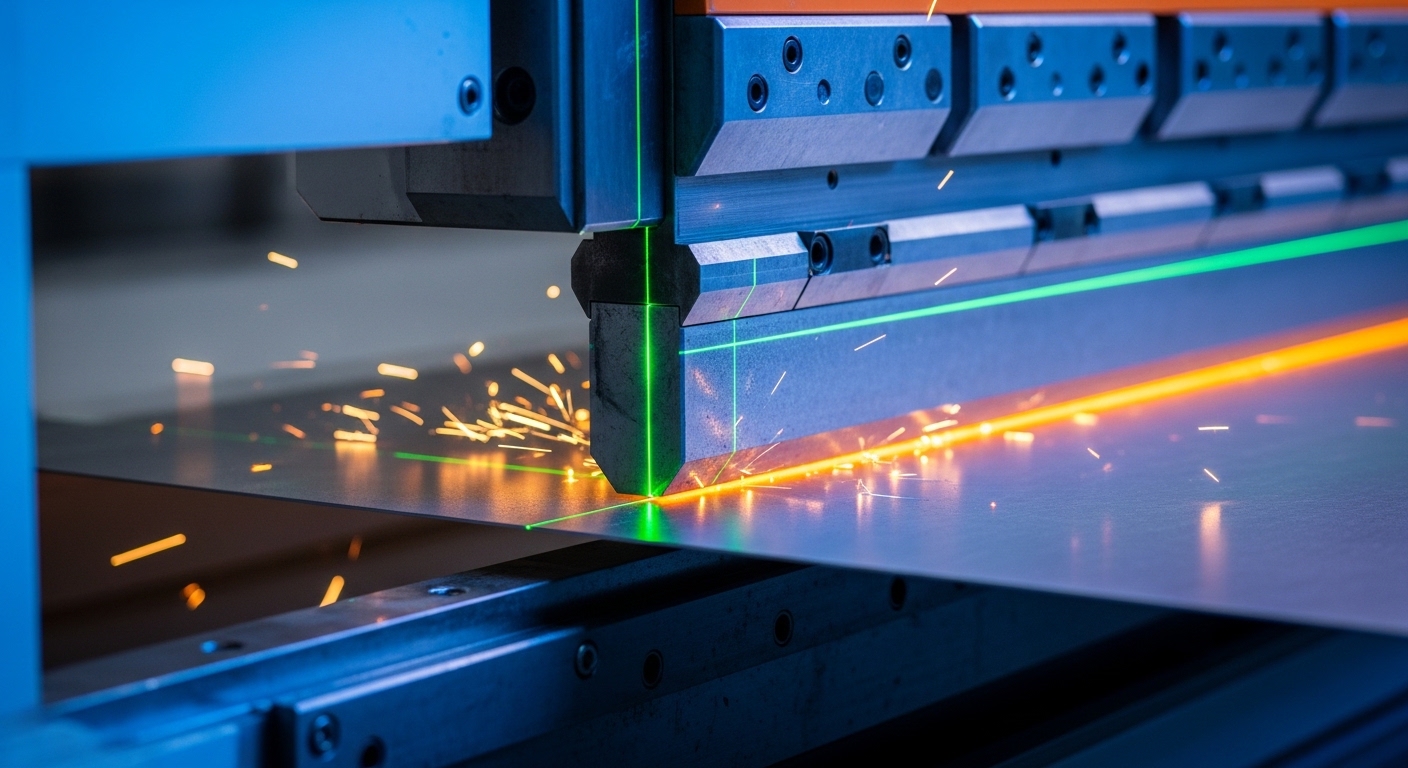
These systems feature dual optical sensors positioned to observe both legs of the bend. As the metal begins to deform, high-speed cameras capture the profile, and optical triangulation algorithms calculate the exact bend angle in milliseconds. This creates a closed-loop control system. If the predictive model forecasts a 90° bend, but the sensor detects an 89.6° angle, the machine adaptively adjusts the ram depth on the fly, without halting production, to achieve the perfect angle.

Precision Benchmarks and Buildability

The integration of predictive kinematics and active optical feedback allows modern manufacturing facilities to consistently achieve angular tolerances of ±0.25° to ±0.5°, and linear tolerances within ±0.1 to 0.2 millimeters.

This level of precision has profound implications for on-site buildability. When metal facade panels, complex corner connectors, and ceiling grids arrive on the construction site with zero angular deviation, the installation teams can assemble them seamlessly. This drastically reduces skilled labor costs, minimizes on-site modifications, and expedites the overall construction schedule.

3 Predictive Kinematics

Metallurgy and Material Science for Exterior and Interior Systems

The selection of the base metal dictates the architectural component’s lifespan, impact resistance, and performance under specific environmental stresses. The two primary alloys utilized in the manufacturing of precision facades, ceilings, and fences are architectural aluminum and galvanized steel.

Galvanized Steel: Strength and Weather Resistance

Galvanized steel is highly favored for exterior applications such as roofing, ventilated facades, and robust fencing systems. The core strength of the steel is protected from oxidation by a metallurgical bonding of a zinc coating. For exterior metalwork, architects strongly recommend using sheet metal profiles with a minimum thickness of 0.45 mm to 0.7 mm.

While sub-0.4 mm sheets might offer initial cost savings, they carry serious risks of structural deformation, excessive noise during heavy rain, and a lack of dent resistance. A thicker metal panel is much harder to dent or puncture, which is critical because surface dents can crack the protective paint or coating, exposing the raw steel underneath to moisture and rapid corrosion. To provide superior surface protection and aesthetic versatility, these steel profiles undergo advanced surface finishing using highly durable polymer coatings or custom RAL color painting, often utilizing technologies like PRINTECH to imitate natural wood textures.

Aluminum: Lightweight and Versatile

Aluminum is frequently specified for complex, lightweight suspended ceiling systems and premium facade cladding. With a density of approximately 2.7 g/cm³—roughly one-third that of steel—aluminum profiles reduce the dead load on the building’s structural framework and facilitate easier on-site handling.

Pure aluminum is highly reactive to oxygen, naturally forming a microscopic oxide layer. To enhance durability and aesthetic appeal, architectural aluminum undergoes anodization or powder coating. In modern ceiling architecture, aluminum is particularly prized because it resists moisture, impacts, and completely prevents mold growth, making it a hygienic, dust-free solution for both commercial offices and healthcare facilities.

4 Predictive Kinematics

Architectural Design Typologies

The physical installation of these metal systems dictates the sequence of construction trades and the final visual impact of the building. Advanced CNC manufacturing enables three primary design typologies.

1. Ventilated Facades and Architectural Louvers

The ventilated facade is a high-performance exterior cladding system where a physical gap is maintained between the building’s structural wall (and insulation) and the outer metal skin. This cavity facilitates natural ventilation, keeping the building cool in summer and dry in winter.

  1. Facade Blinds: Modern systems often utilize “Facade Blinds” or louvers (such as those mounted on ridges). These structures create a clear rhythm of lines and a “living” facade that changes visual appearance depending on lighting and viewing angle.
  2. Engineering Complexity: Beyond aesthetics, these metal slats perform critical functions: they protect the building from direct solar gain, reduce interior overheating, and improve overall energy efficiency. Executing a flawless ventilated facade requires the use of precisely bent structural hat channels, which act as the primary reference datums, ensuring the architect’s intricate design vision is executed accurately over large, undulating surface areas.

2. Suspended Metal Ceilings: 3D Geometric Precision

Metal ceiling systems are experiencing a surge in global popularity, moving far beyond standard flat tiles. Designers are leveraging advanced CNC laser-cutting and automated bending to create bold visual statements.

  1. Computational Unfolding: Creating complex 3D ceiling panels (such as intersecting triangles or radial geometric cubes) requires sophisticated software. Engineers utilize computational geometry solvers and neutral axis algorithms to automate the unfolding of bespoke 3D panels into flat 2D cutting patterns.
  2. Execution: By calculating exact K-factors and material deformation variables, the software ensures that when the CNC press brake folds the flat metal, it perfectly matches the complex 3D ceiling topology required by the architect. These ceilings hide complex HVAC and lighting infrastructure while maintaining an aura of extreme structural precision.

3. Modern Metal Fencing Systems

The residential and commercial fencing market has shifted away from high-maintenance wood or brittle concrete toward highly engineered metal panel systems.

  1. Aesthetic and Function: Modern metal fences (such as horizontal louvered blinds, “Rancho,” or “Horizont” styles) offer total privacy while still allowing for necessary wind permeability.
  2. Installation: Because these systems are manufactured using precision CNC technology from lightweight sheet metal, they exert minimal stress on the ground, frequently eliminating the need for deep, expensive continuous concrete foundations. The components arrive at the site perfectly sized, and many modern designs feature interlocking mechanics that require zero visible fasteners, drastically reducing installation time.
5 Predictive Kinematics

Lifecycle Economics: Capital Expenditure vs. Long-Term ROI

For commercial real estate developers and homeowners alike, the decision to utilize precision architectural metals involves evaluating upfront capital expenditures against long-term operational savings.

While natural wood or basic vinyl might possess a lower initial purchase price, they are biologically active or highly susceptible to UV degradation. Wood requires constant maintenance, sealing, and total replacement cycles every 20 to 30 years. Conversely, high-quality galvanized steel and aluminum facades and fences arrive on-site pre-finished, permanently eliminating the need for repainting budgets.

The true economic value of metal lies in its longevity. Architectural metals boast an economic lifespan exceeding 50 to 100 years. They are impervious to water damage, immune to pest infestations, and highly resistant to severe weather events. In standard Return on Investment (ROI) calculations, the “Annual Net Benefit” of metal systems is highly substantial due to the eradication of ongoing maintenance, making a single, permanent capital investment vastly superior over the lifespan of a property.

6 Predictive Kinematics

Sustainability and Environmental Impact

The global construction industry is under immense pressure to adopt sustainable, high-performance building practices. Architectural metals represent the epitome of the circular economy in construction.

At the end of a building’s operational life, steel and aluminum cladding, ceilings, and fences do not enter the landfill waste stream. They can be reclaimed, melted down, and repurposed indefinitely without any degradation in their metallurgical quality or structural strength. Crucially, the recycling process for aluminum requires approximately 95% less energy than the initial extraction of virgin ore, while recycling steel saves roughly 75% of the energy costs compared to primary production. This closed-loop lifecycle positions architectural metal as a highly sustainable choice for long-term environmental certifications.

7 Predictive Kinematics

Global Fire Codes and Safety Standards

A paramount advantage of metal architectural systems is their inherent non-combustibility. Building codes across the globe mandate rigorous fire-resistance ratings, particularly for high-rise building facades, to prevent rapid flame spread.

In Europe, the EN 13501-1 standard is the definitive classification system for the reaction to fire of construction products. Architectural metals undergo rigorous evaluation, including non-combustibility tests (EN ISO 1182) and gross heat of combustion tests (EN ISO 1716).

  1. Class A1: Solid aluminum and uncoated steel sheets naturally achieve an A1 (completely non-combustible) rating, producing no smoke and no flaming droplets.
  2. Class A2-s1, d0: Aluminum Composite Panels (ACP) utilized in facades must feature a high-mineral, fire-retardant core to achieve the strict A2-s1, d0 classification. This indicates limited combustibility (A2), minimal smoke emission (s1), and zero flaming droplets (d0), making them safe for modern skyscrapers.

Replacing highly combustible timber cladding with classified A1 or A2 metal components inherently lowers the total fire load of a commercial space, protecting occupant life safety and potentially reducing commercial property insurance premiums.

8 Predictive Kinematics

Real-World Applications: Architectural Case Studies

The theoretical benefits of advanced metal fabrication are best understood through their practical application.

Corporate Facades: Parametric Design Integration

At leading metal fabrication plants, such as Mehbud in Ukraine, the relationship between architect and manufacturer has evolved. Architects now deliver complex parametric facade concepts directly to the fabrication floor. Using predictive kinematics and automated CNC press brakes, manufacturers can fold individual metal cassettes with varying geometric angles to create dynamic, fluid building exteriors that were previously impossible or cost-prohibitive to build by hand.

Commercial Interiors: 3D Computational Ceilings

In high-end corporate or retail environments, the demand for striking ceiling architecture requires massive computational power. By engineering domain-driven geometry solvers, fabrication teams can automatically unfold intricate 3D suspended ceiling designs into flat patterns. Once cut, the CNC press brake executes the precise sequence of bends, accounting for material springback perfectly. The result is a seamless, geometric metal ceiling that fits together flawlessly on-site, serving both an acoustic and highly decorative function.

Conclusion

The evolution of architectural metalwork from simple, flat protective cladding to highly engineered, 3D parametric components mirrors the broader evolution of the global construction industry. The modern built environment demands materials that are structurally stable, visually spectacular, and environmentally responsible.

The integration of predictive kinematics in CNC press brakes has unlocked unprecedented levels of precision in sheet metal fabrication. By utilizing advanced algorithms to dynamically compensate for material springback and verifying these models with closed-loop laser optical measurement, manufacturers can now produce flawless aluminum and galvanized steel profiles at an industrial scale.

These precision metal facades, suspended ceilings, and modern fencing systems offer developers and architects a compelling trifecta of benefits. Aesthetically, they enable the sublime, clean lines of geometric architecture. Economically, they offer an immense lifecycle return on investment, boasting a multi-decade operational lifespan that eliminates repetitive maintenance. Environmentally, they represent a triumph of the circular economy while inherently meeting the most stringent global fire codes (EN 13501-1). Ultimately, the pursuit of cutting-edge architectural design is inextricably linked to the mastery of maximal manufacturing precision.

author
Alexander Guk
About the author:

Our expert in fencing structures has over 5 years of experience working at the Mehbud factory. Helps you choose the optimal design and model of fencing according to your needs. Professionally deve...

More
0 0 votes
Article Rating
Subscribe
Notify of
guest
0 Comments
Oldest
Newest Most Voted
Inline Feedbacks
View all comments