
Introduction to Spatial Ceiling Architecture
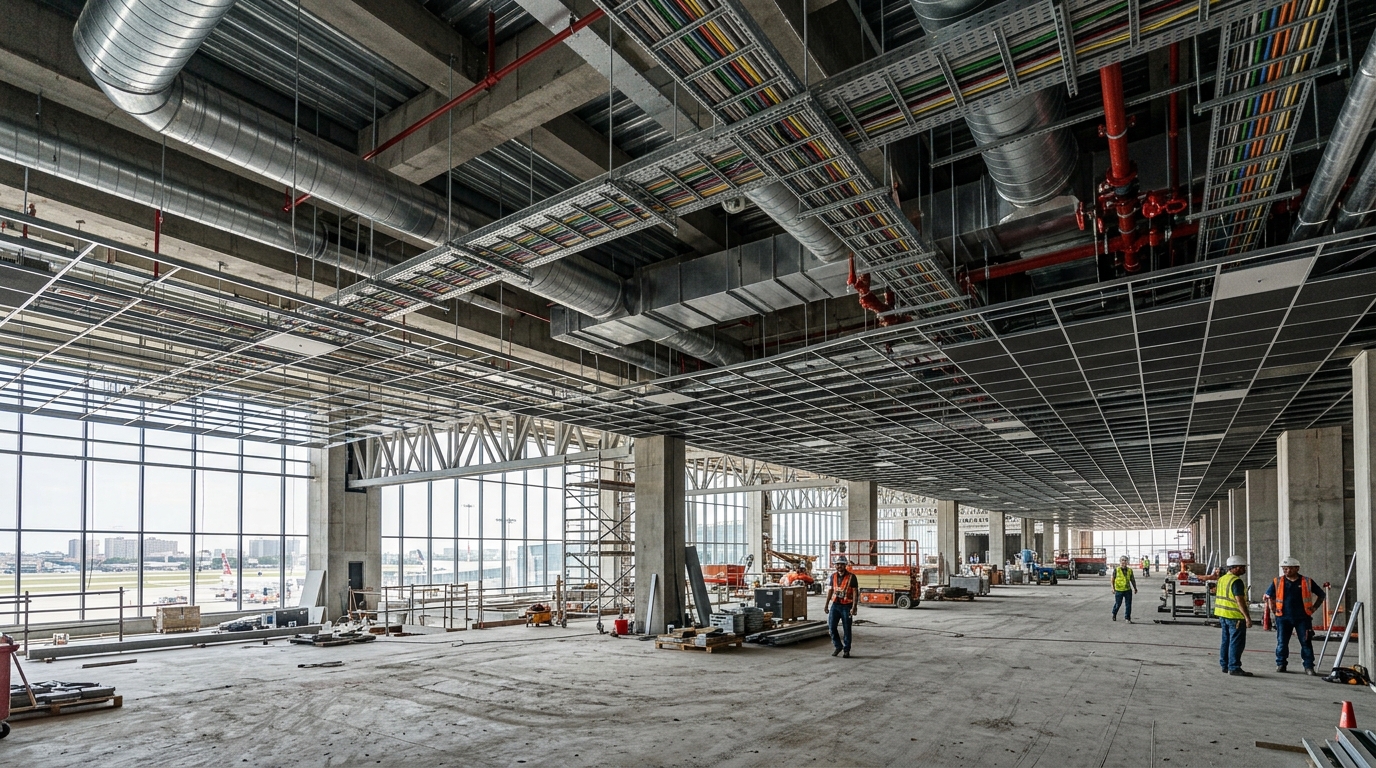
Modern construction engineering and architectural design view ceiling fit-outs in large-scale premises as one of the most complex and multidimensional tasks. Commercial real estate, including large-scale shopping and entertainment centers, logistics hubs, airports, open-plan offices, as well as medical and sports complexes, require conceptually new approaches to organizing interior volume. In accordance with current regulatory frameworks and standardized terminology, suspended ceilings are classified as structural systems fixed below the primary load-bearing slab or deck at a distance of no less than five millimeters. In real construction practice for large-volume premises, this distance is often measured in meters, forming vital technological plenum space. This ceiling void is used for the concealed routing of complex utilities: HVAC supply lines, power and low-voltage electrical networks, and automatic fire suppression piping.
The evolution of building technologies has led to monolithic ceiling solutions gradually giving way to modular suspended systems. This transition is driven not only by aesthetic advantages but also by the rigorous operational requirements imposed on commercial premises. A modern suspended system must be a synthesis of advanced material science and architectural aesthetics, while ensuring unobstructed and rapid access to hidden utilities for regular technical maintenance or modernization. Furthermore, these structures are responsible for solving fundamental microclimate issues, such as ensuring optimal air exchange, forming the necessary acoustic environment, and creating a reliable passive barrier against the spread of open fire in emergencies.
The engineering process of selecting the optimal ceiling system for large areas is a multi-criteria challenge. Designers must perform a comprehensive analysis that includes evaluating the load-bearing capacity of the base slab, calculating visual proportions of the vast space, determining required sound absorption and insulation indices, and strictly verifying material compliance with sanitary and fire safety regulations. On such colossal surfaces, where the total area can measure tens of thousands of square meters, any error in frame geometry or insufficient profile rigidity leads to critical visual deformations and the threat of collapse. Therefore, building codes establish extremely strict limits: the maximum allowable deflection of the structure under its own weight must not exceed 1/250th of the architectural span width. This report aims to provide an in-depth analysis of the morphology of modern suspended ceilings, their physical-mechanical and acoustic characteristics, and a comprehensive assessment of their integration into the regulatory framework of current standards.
Typology and Morphology of Ceiling Systems for Large-Scale Spaces
The modern market of innovative building materials presents a wide spectrum of suspended ceilings, each distinguished by its own architectural morphology, unique physical properties, and specific functional purpose. Systematization of these structures is traditionally based on material science aspects, the configuration of visible modules, and the engineering principles of the load-bearing subsystem. In the context of fitting out large open areas, classic monolithic solutions, such as drywall systems, have significant limitations. Despite the fact that drywall sheets, ranging from six to twelve and a half millimeters in thickness, allow for the creation of complex multi-level and curvilinear volumes with excellent sound and thermal insulation properties, their application in vast commercial spaces is challenging. High dead load, the complexity of installation—which cannot be performed without large crews of specialists—the lack of local access for maintenance, and the tendency to crack over long spans due to inevitable thermal expansions and micro-vibrations of the building itself, make such monolithic systems economically and technologically unjustifiable for industrial or large-scale retail objects. Stretch ceiling constructions made of PVC film or specialized polyester fabric have similar scalability limitations; despite the speed of their deployment, they are unable to ensure structural stability over large areas without installing additional and often undesirable partition profiles. Hence, modular metal systems—including cellular, cassette, and linear (slat) suspended constructions—have become the absolute dominant in commercial and industrial architecture.
Open-Type Cellular (Grid) Systems
Cellular-type ceiling systems represent an ideal synergy of industrial design and high operational performance, earning them the status of one of the most popular solutions for large transit and retail spaces. From an engineering perspective, they are complex modular suspended constructions where the surface is formed by a system of mutually intersecting longitudinal and transverse profiles, creating a continuous field of open cells. The base module (cassette) of such a system turns into a monolithic rigid frame after on-site assembly. Thanks to precision factory production, the edges of every aluminum or steel element are cut at a perfect ninety-degree angle, which completely eliminates uneven gaps between attachment points and guarantees no sagging, even after years of operation. The locking joints are designed so that the installation of a standard 600×600 mm cassette, based on an interlocking groove principle, takes less than five minutes and is carried out with one light press without the use of specialized tools.
Visual depth and the overall architectural perception of a room equipped with such a ceiling critically depend on two geometric parameters: the open cell size and the height of the load-bearing profile. Designers manipulate these values to achieve the desired optical effect. The smallest cells, 50×50 mm, create an optical illusion of a dense, almost closed architectural covering. They ideally conceal massive utilities in the plenum, but their use is accompanied by significantly higher metal profile consumption per square meter, which increases the weight of the structure and the project budget. Intermediate-sized cells—75×75 mm or 100×100 mm—are traditionally considered the most universal standard. They provide an ideal balance between transparency, allowing air and light to circulate freely, and visual structure, masking utilities from the perspective of a person standing on the floor. At the same time, the use of large cells, ranging from 150 to 200 mm, makes the ceiling plane maximally airy, transparent, and visually light. However, this approach places extremely high demands on the installation quality of utilities (cable trays, ducts), as they will remain partially visible to visitors, requiring additional dark-tone painting of utilities or meticulous symmetrical arrangement.
In addition to classic orthogonal structures with square or rectangular panels, advanced production lines can release non-standard architectural solutions. These include curvilinear grids that add extravagance to an interior, and abstract forms built on triangular or polygonal patterns. The ability to freely combine different cell sizes, along with manufacturers’ own powder coating workshops—allowing for polymer coatings of any shade according to the international RAL scale on items up to seven meters long—opens unlimited space for creativity to architects. It is important to note that manufacturers encourage the use of such systems on large areas by offering special reduced object-based pricing for registered projects starting from 200 square meters.
From an engineering perspective, open-type cellular systems have one undeniable advantage: due to the significant open area, they are critical for facilities with high smoke extraction requirements. In case of fire, such a ceiling does not hinder the convective rise of hot gases and smoke to roof exhaust systems, and also facilitates the rapid dispersion of water from automatic fire sprinkler systems.
| Geometric Cell Size (mm) | Cassette Consumption (pcs/m²) | Bottom Profile Consumption (pcs/m²) | Top Profile Consumption (pcs/m²) | 2400 mm Load-bearing Longitudinal Profile (pcs/m²) |
| 50×50 | 2.78 | 11 | 11 | 0.35 |
| 75×75 | 2.78 | 7 | 7 | 0.35 |
| 100×100 | 2.78 | 5 | 5 | 0.35 |
| 150×150 | 2.78 | 3 | 3 | 0.35 |
| 200×200 | 2.78 | 2 | 2 | 0.35 |
The presented calculation specification illustrates the exponential dependence of the number of linear profiles on the chosen cell size. This matrix is a key tool for cost engineers when financially modeling large-scale construction projects, allowing for precise prediction of ceiling material requirements.
Cassette and Tile Metal Systems
Cassette ceilings represent a fundamental classic standard for the design of administrative, office, and commercial premises, providing a strictly formal, concise, and maximally neat architectural appearance. This category of suspended ceilings is formed from smooth or perforated square or rectangular metal panels, which are installed into a pre-mounted suspension system. Constructively, the frame for such cassettes consists of adjustable spring hangers, a system of main and secondary T-shaped runners, and perimeter wall supports. Frame elements form a regular geometric grid, into whose cells the tiles are placed. Such architecture ensures instant access to the plenum space—one simply needs to lift the cassette by hand without using any tools, making this system unrivaled in the conditions of intensive office building operation. Also worth noting is that tile ceilings are characterized by high installation speed and do not require any additional finishing (puttying or painting) after installation.
The overwhelming majority of cassette modules are manufactured on automated lines from high-quality galvanized steel 0.45 mm thick or aluminum strip from 0.3 to 0.5 mm thick. The basic standard size for such panels is 600×600 mm, though to implement specific design concepts, manufacturing enterprises—including domestic plants—can custom-produce reduced format cassettes (300×300 mm) or large-scale rectangular panels (600×1200 mm). In standard basic execution, panels are supplied in pure white, but dedicated powder coating lines allow manufacturers to apply resistant polymer coatings in any color. For creating exclusive interiors that radiate luxury and sophistication, mirrored aluminum cassettes with special galvanic plating, imitating “super-gold” and “super-silver” shades, are used. Such mirrored surfaces effectively expand the spatial perception of rooms with relatively low ceilings and multiply the effectiveness of artificial lighting systems.
A separate technological direction is the perforation of metal cassettes. The perforation process is carried out on high-precision automatic punching lines, which form a uniform grid of small-diameter holes (e.g., 1.8 mm). This processing not only changes the visual texture of the metal, reducing its reflectivity (important to avoid glare in office spaces with computer equipment) but also radically changes the panel’s acoustic properties. A perforated metal plane, in combination with mineral fiber sound-absorption pads placed on the back, becomes an effective tool for combating sound reverberation. Accordingly, cassette ceilings can be smooth, moisture-resistant, anti-static, or specially acoustically adapted.
| Name and Type of Ceiling Panel Coating (600×600 mm size) | Estimated Market Value ($/pc.) |
| Basic smooth panel (galvanized steel / aluminum) in white | 3.3 / 4.9 |
| Colored panel (gray, black, blue, chocolate, “ivory”) | 3.5 / 5.1 |
| Special panel with polymer texture of natural wood | 4.0 |
| Additional panel perforation service (hole diameter 1.8 mm) | Add +50% to base price |
As indicated by the provided economic data, the cost of a cassette ceiling has high elasticity and is strongly dependent on the chosen base material (aluminum costs significantly more than steel), the complexity of the decorative coating, and the presence of perforation. This flexibility allows the system to be adapted to any budget while preserving its main advantages: strength, exceptional moisture resistance, and an extremely long service life in a commercial environment.

Linear Slat and Innovative Cube-shaped Systems
For public facilities and transit zones where architects need to visually change the geometry of a space—for example, to set a dynamic vector of visitor movement in long corridors, airports, or galleries—slat (rail) suspended systems are an optimal and functional solution. The evolutionary development of this direction in building material science has led to the dominance of two main profiles: the innovative cube-shaped slat, which resembles a U-shaped contour in cross-section, and the classic plate slat with an L-shaped section. Plate slats, having a standard height of about 100 mm, are often called screen ceilings or “blinds” type systems because they create the effect of a dense array of vertical blades. Both types of these metal strips, manufactured from high-quality galvanized steel 0.23 to 0.27 mm thick, are mounted on a specially developed universal load-bearing traverse with a base attachment pitch of 52 mm.
Excellent functional performance and load-bearing capacity on large spans are due to the reliable and rigid mechanical connection of external metal cube-shaped profiles with the load-bearing traverse. The use of cube-shaped elements allows engineers to create stunning relief and multi-level effects thanks to the availability of a wide metric range of profiles. Thus, the standard slat width can be 35 or 88 mm, while its height varies in a wide range from 35 to 105 mm. By combining slats of different heights or colors on one load-bearing traverse, designers form unique three-dimensional patterns. A special advantage of slat architecture is the absence of rigid binding to a static square module: if necessary, a slat can be positioned anywhere in the plane, the distance between elements can be changed, or metal strips can even be installed at different angles to each other, which allows for saving free space and avoiding complex cascading hangers.
Moreover, the development of a flexible load-bearing traverse revolutionized ceiling design. Such a traverse, fixed to the base slab on standard hangers, retains the ability to be easily bent by hand directly on the construction site while perfectly holding the set shape. This makes it possible to implement smooth wave-like planes, create vaults, and radius wall-to-ceiling transitions. However, engineers must consider the strict laws of material resistance: the maximum permissible bending radius of a metal traverse inward is strictly limited by the overall dimensions of the cube-shaped slat itself. Thus, for a massive 88 mm wide slat, the maximum calculated bending radius will be R375, whereas for a thin 35×35 mm slat, this figure can be reduced to radius R150, as thicker metal exerts significantly greater resistance to deformation and carries a higher risk of breaking or damaging the polymer coating during stress.
An important acoustic and visual parameter of such open slat systems is the transparency percentage and the calculated effective viewing angle. By changing the installation pitch of the slats on the traverse teeth, one can fully control how much of the plenum space will be visible.
| Metal Slat Width / Fixation Pitch | Transparency at 52 mm tight pitch | Transparency at 104 mm expanded pitch |
| Narrow Slat (35 mm) | 34% open space | 59% open space |
| Wide Slat (88 mm) | Physically impossible to mount | 21% open space |
As the table demonstrates, wide slats (88 mm) at a pitch of 104 mm leave only twenty-one percent of free space, creating an optical illusion of a massive closed ceiling with deep relief, although air continues to circulate freely through the system. Despite visual monumentality, such a ceiling creates minimal loads on the slab. The weight of one linear meter of a 35×35 mm cube-shaped slat is only 0.226 kg, and the reinforced 35×75 mm slat is 0.383 kg. When mounting long strips (standard length is often limited to four meters for ease of transport), special invisible connectors are used, which give the plane necessary monolithicity and rigidity. If, for design reasons, the system is mounted without a wall angle (free edge system), the ends of the slats are neatly closed by special plastic or metal plugs, fixed with high-strength double-sided tape. Thanks to reliable polymer painting, which can imitate textures of elite wood, stone, or metal, such slat ceilings often go beyond interior spaces and are actively used for exterior work: cladding of conceptual facades, equipping open terraces, passages between buildings, entrance groups, and canopies. The main condition for exterior operation remains the preservation of the protective coating’s integrity from mechanical damage during installation procedures.
Architectural and Construction Mechanics: Strict Installation Requirements
The installation of suspended ceiling constructions on colossal areas of industrial or commercial scale is a critical engineering process, which is scrupulously regulated by relevant state building norms (DBN) and industry quality standards. Durability, structural reliability, and operational safety of the entire vast system depend directly on the quality of materials and the professionalism of setting up the load-bearing metal frame. As a rule, the fundamental foundation for fixing all suspended systems is the capital reinforced concrete or metal ceiling slab of the building. In cases of non-standard architecture, partial fixing of suspended ceiling load-bearing elements to the upper parts of wall fencing or to specially designed additional intermediate supports and floor beams is permitted.
The main and indisputable requirement for the frame structure, which is set at the working design creation stage, consists in ensuring its absolute load-bearing strength and spatial stability. The frame must guaranteed withstand the total weight of all suspended ceiling elements (profiles, cassettes, slats, acoustic inserts, and built-in luminaires), completely excluding the probability of deformation or sagging of the plane. Before starting the final installation of visible decorative elements, the plane of the formed frame is subject to mandatory instrumental inspection using high-precision laser levels and measuring devices. Regulatory documentation establishes extremely narrow tolerances for deviations of the formed plane: the vertical or horizontal deviation of the structure must not exceed 1.5 millimeters per linear meter of length and is strictly limited to a maximum value of 7 millimeters over the entire continuous surface of the room, regardless of its total area. Tolerances at the joints of the wall cladding section from the ideal vertical are even stricter—no more than 1 millimeter per meter. Moreover, engineers are required to calculate the maximum permissible deflection of the structure under its own static weight, which cannot exceed 1/250th of the architectural span width. Failure to comply with these millimeter tolerances on large areas leads to the emergence of a “wave” effect, the appearance of visible sagging at joints and spans, peeling of panels, as well as the emergence of vibrations or other dangerous mobility of elements at the points of their attachment to the main frame. During installation, it is categorically forbidden for masters to create horizontal joints of load-bearing parts unless they were previously provided and calculated in the building’s working project.
The cornerstone of safe operation for suspended ceilings is correct spatial management of engineering communications, the arrays of which are traditionally hidden in the ceiling void. Norms categorically forbid the joint fixing of any engineering networks (ventilation ducts, power cable trays, water pipes of fire extinguishing systems, etc.) on common hangers together with decorative ceiling frame elements. All heavy utilities must necessarily be fixed exclusively to the capital foundation of the slab using their own, load-calculated, independent hangers and fastenings. Using a suspended ceiling frame as a support for adjacent engineering systems is a gross violation of construction mechanics, which in conditions of large areas can lead to a chain reaction of destruction and collapse of the entire structure under excessive weight.
Regulatory Framework: Fire Safety and Thermodynamic Testing of Ceilings
Considering the scale and purpose of public buildings, the issue of fire resistance and complex fire protection of suspended systems is regulated at the state level by a series of rigid standards (DSTU) and state building norms (DBN). Security is ensured by reducing the fire danger of materials used, as well as by creating physical obstacles to the spread of fire and toxic smoke. A modern suspended ceiling is classified by experts as a passive element of a fire protection system, which works in a unified complex with active elements, such as deluge systems or innovative fine-water mist fire extinguishing systems, which allow for significantly increasing the actual fire resistance of the building’s metal and concrete structures.
Combustion Chemistry and Building Material Classification
In accordance with the basic standard DSTU B V.2.7-19, all building materials used for finishing are divided by their thermodynamic properties into two macro-categories: non-combustible (NG index) and combustible (G index). Materials classified as non-combustible based on laboratory test results are considered absolutely safe and are not further classified by other negative fire hazard indicators (such as smoke generation speed, toxicity of emitted gases, formation of burning droplets). Combustible materials are subject to further detailed gradation into four functional groups: G1 (materials of low combustibility, which quickly self-extinguish without an external flame source), G2 (moderate combustibility), G3 (medium combustibility), and G4 (highly combustible materials). Belonging to a specific ceiling element (acoustic panel, plastic slat, or film) to one group or another is determined exclusively by the results of standardized fire tests.
The choice of material class for a ceiling plane is rigidly correlated with the functional purpose of a specific room zone and the general volumetric-planning characteristics of the building. The strictest requirements are placed on evacuation paths. Corridors, general lobbies, halls, stairwells, and other transit zones through which organized evacuation of people from the building in case of fire occurs must be finished with suspended ceilings made exclusively from class NG (non-combustible) materials. This indisputable requirement is aimed at avoiding catastrophic scenarios: a non-combustible ceiling guarantees that under extreme temperatures, hot or burning finishing fragments will not collapse on evacuating people, will not block escape routes, and will not become an additional source of toxic smoke. Also, class NG materials are necessarily applied in premises with mass gathering of people and in zones with a high probability of direct contact with an open flame, sparks, or high-temperature industrial equipment.
Depending on the storeyness of the structure, which is classified as low-rise (up to 9 meters high), multi-storey (up to 26.5 meters), increased storeyness (up to 47 meters), or high-rise (over 47 meters), the tolerances for using combustible materials in other zones change. For example, in buildings with a conventional height of no more than 26.5 meters, which have a second or third degree of fire resistance, limited use of ceiling elements from materials of low and moderate combustibility (G1 and G2 groups) is allowed in general-purpose interior spaces. It is important to note that panels made of mineral stone wool based on basalt (e.g., Rockfon systems), which are widely used for sound insulation and do not contain harmful asbestos, often receive a G1 combustibility group certificate, which allows them to be safely integrated into commercial spaces in compliance with all norms. Architectural fire requirements also concern roof and partition systems: fire-resistant walls must exceed the roof by an established height (from 0.3 to 0.6 meters) if the covering elements contain G1-G4 category materials, and may not protrude only on the condition of full non-combustibility (NG) of all roof materials.
Thermodynamic Fire Resistance Tests
In regulatory literature and standards (in particular, DSTU B V.1.1-9:2003, which is harmonized with European norms EN 13964 and suitable for certification purposes), suspended ceilings are classified by their fire-protective capabilities. Distinctions are made between simple fire-protective suspended ceilings, designed to significantly increase the fire resistance limit of the capital floor slab under which they are mounted, and specific fire-resistant suspended ceilings intended for the fire protection of vital space and utilities directly above the ceiling itself. The fire resistance limit of such a structural system is defined as the time interval in minutes from the moment fire exposure begins until the onset of one of the clearly regulated limiting states (loss of integrity, load-bearing capacity, or thermal insulation ability).
The methodology for laboratory thermodynamic testing is extremely complex and requires creating a full-scale physical mockup. A sample for fire testing in a special furnace must consist of three massive steel beams (St 3 grade) of classic I-beam section (profile number twenty). On these metal beams, a heavy reinforced concrete slab with an average thickness of 200 mm (with a tolerance of plus or minus 50 mm) is installed, and directly under this structure, with precise adherence to factory installation technology and fastening specifications, the experimental suspended ceiling is assembled. Samples must have real design dimensions. In cases where the ceiling dimensions exceed the physical capabilities of the furnace (more than 1800×1800 mm), standards allow proportionally reducing the sample area, however, it is categorically forbidden to change the vertical distance from the bottom side of the concrete slab to the ceiling face panel, as this air layer radically influences the thermodynamics of the process.
The test process starts from the moment the powerful gas burners in the furnace are turned on, which create a standard temperature regime according to DSTU B V.1.1-4. Research engineers record the onset of the fire resistance limit state (loss of thermal insulation ability) when the average temperature on the non-heated side of the suspended ceiling (i.e., the surface facing the reinforced concrete slab) exceeds its initial room temperature by a critical 140 degrees Celsius. To record the slightest breakthroughs of the thermal barrier, ultra-sensitive thermocouples are used. Engineers are required to fix the measuring junctions of additional thermocouples in the most vulnerable places of the structure—in areas of so-called “thermal bridges,” which inevitably form at metal guide parts of the frame and massive ceiling attachment points; however, they must be located at a distance of no less than 200 mm from the heated walls of the test furnace itself to avoid errors from direct radiation of the walls. The ability of metal ceilings (e.g., aluminum or galvanized cassettes) to withstand high temperatures without emitting toxic gases makes them an optimal solution according to ecological safety and sanitary standards EN 13964:2014.
Acoustic Physics: Sound Absorption and Fighting Noise Pollution
One of the most serious challenges when designing large commercial spaces is ensuring normative acoustic comfort. Architecture with vast areas of hard, sound-reflecting surfaces (panoramic glazing, polished concrete floors, metal partitions) leads to repeated chaotic reflection of sound waves. This phenomenon creates an effect of strong reverberation (echo) and leads to a significant increase in background noise pollution, which causes rapid psychological fatigue in office employees, shopping center visitors, or terminal passengers. Specific acoustic properties of building materials and the room itself are strictly regulated by state documents (in particular, DBN V.2.2-13 and DBN V.1.1-31:2013), which establish requirements for protecting territories and buildings from noise and regulate the use of specialized sound-absorbing suspended ceilings.
Nature of Acoustic Oscillations and Regulatory Limits
From a physical point of view, noise is viewed as unstable or random acoustic oscillations characterized by constant changes in the amplitude and frequency of the sound wave in the environment. Acoustic calculations in engineering operate with concepts of sound pressure (where the threshold value of sound pressure is 2×10^-5 Pa) and sound power level (where the threshold value is 10^-12 W). Noise levels are measured using decimal logarithms and expressed in decibels (dB). Since the scale is logarithmic, a difference of just a few decibels means a huge change in the physical energy of the sound wave. For example, standard panel houses and commercial floor slabs have a basic sound insulation index of about 52–54 dB, while strict sanitary norms of Ukraine (DBN V.1.1-31:2013) require ensuring a level of 55–58 dB. This relatively small numerical gap in practice determines the critical difference between a state where background noise is “slightly audible” and “distinctly and irritatingly audible”. Analysis also takes into account the tonal character of noise (when the level in a certain one-third octave frequency band exceeds adjacent bands by more than 10 dB, creating a piercing sound) and broadband noise, the spectrum of which covers more than one octave.
In building acoustics, noise is globally divided into airborne and impact. Airborne noise is emitted directly into the space and propagates through the air environment (human voices, music from speakers, hum of ventilation units). Impact noise has a significantly more complex nature: it is emitted by massive building enclosure structures (especially inter-floor slabs, stair flights) during their continuous mechanical excitation by dynamic forces (footsteps, vibration from the operation of heavy equipment, movement of carts). Sound-absorbing room linings (in particular, acoustic ceilings) are designed primarily to reduce the intensity of reflected sound waves from hard surfaces, which allows for radically reducing the level of specifically airborne noise and neutralizing echo. As for heavy impact noise (e.g., stomping from the floor above), a correctly chosen ceiling can only partially dampen it; the fundamental solution to this problem lies in the plane of organizing floating sound-insulating floors directly at the source of vibration above the room.
Material Science and Engineering of Sound-Insulating Constructions
For creating flawless acoustic comfort in conference rooms, private clinics, or elite restaurants, specialized panels are used. They absorb waves by physically converting the kinetic energy of sound into a negligible amount of heat thanks to the complex micro-porous structure of the material. High indicators are demonstrated by lightweight panels (e.g., Rockfon brand products) made of mineral stone wool based on natural melted basalt. Such tiles include finely woven mineral fibers, safe synthetic binders, and hydrophobic additives that prevent moisture absorption. An alternative ecological solution is acoustic panels created on the basis of pressed wood fibers (Kraft WoodAcoustic line), which integrate into a standard T-profile metal ceiling frame in 600×600 or 1200×600 mm formats, providing natural warmth to the room and performing the function of a powerful sound absorber.
The effectiveness of an acoustic system depends not only on the choice of an expensive panel but also on flawless frame engineering. The most common mistake during installation is rigidly attaching the base frame to the ceiling slab without using vibration-insulating elements. In such a case, noise is transmitted by transit directly through the metal profile. The same applies to so-called “acoustic bridges” along the perimeter: if a metal corner touches a monolithic wall without a special polymer damping tape, the entire ceiling perimeter turns into a conductor and amplifier of structural vibration. To achieve a real effect, professionals use a frame system on specialized vibration hangers. A construction filled with mineral wool 100 mm thick with correctly selected density (not lower than 35–40 kg/m³, as excessively light wool works exclusively as a heat insulator, not an acoustic barrier), and covered with a double layer of drywall, is capable of adding 16 to 22 dB to the overall airborne noise insulation index. However, such a massive system has a significant architectural disadvantage: it absorbs from 12 to 20 cm of free room height, which is perfectly acceptable for offices with ceilings over 2.8 meters high, but can become a critical limitation for lower premises. If preserving height is a priority, engineers prefer frameless sound-insulating panels that are attached to the base slab exclusively through resilient rubber gaskets. Such a method allows for achieving a real noise reduction of 10–14 dB with minimal loss of spatial height—five to eight centimeters. For comparison, a standard stretch film ceiling with a thin layer of insulation is capable of providing an increase of only 8–12 dB (at a loss of 6–10 cm of height), while primarily solving the problem of acoustic resonance of the slab itself. When designing such complex acoustic systems, acoustic engineers are guided by DSTU-N B V.1.1-32 methodologies, taking into account the initial acoustic characteristics of the room (before its lining), its complex geometric shape, and the actual physical dimensions of the surfaces.
Specific Operational Conditions: From Medical Wards to Industrial Workshops
The flexibility of modular suspended ceiling architecture allows for their adaptation for premises with the most aggressive or sterile environments, where the use of ordinary gypsum or fabric materials is categorically impermissible.
Sanitary Engineering in Medical and Clean Rooms
In modern medical institutions (operating blocks, intensive care wards, high-tech laboratories, pharmaceutical enterprises), a suspended ceiling completely loses its purely decorative function and becomes a critically important component of the building’s overall sanitary-engineering system. Installation and daily operation of such ceilings is strictly regulated by state acts: DBN V.2.2-3-2007 (design of healthcare institutions), sanitary norms DBN V.2.5-67:2013, and industry technical conditions DSTU B V.2.6-212:2016.
The main requirement for ceiling panels for such institutions is an ideally smooth and absolutely non-porous (closed) macrostructure of the material. This property is intended to completely prevent the accumulation of dangerous dust, dirt micro-particles, as well as the creation of a favorable environment for the multiplication of pathogenic bacteria and fungal colonies. Ceiling systems in hospitals are obligated to easily withstand daily aggressive chemical treatment with concentrated disinfecting solutions, pressure washing, and hard ultraviolet radiation without color degradation or destruction of the metal’s polymer coating. Often, specialized smooth metal cassettes with an integrated antibacterial coating based on silver ions are used, which, thanks to the presence of pressure clips, fit as hermetically as possible to T-frame profiles, creating a reliable barrier between the sterile ward volume and the dusty plenum space.
Industrial Objects and Extreme Environments
Production premises require a different set of physical characteristics from suspended ceilings: extreme mechanical strength, resistance to vibrations from heavy machinery operation, and the ability to withstand chemical corrosion. When choosing a material for equipping a factory workshop, engineers carefully analyze the degree of impact of the aggressive environment: the concentration of acid vapors, the presence of abrasive dust, constant humidity, or extreme temperatures. In order to guarantee durability, domestic metal system production plants propose using thickened panels for such extreme conditions—aluminum alloy up to 0.8 mm thick or reinforced high-quality galvanized steel up to 0.7 mm thick. The metal frame for such panels is additionally reinforced, and the number of hangers is increased to counter constant dynamic vibrational loads.
The ability of aluminum panels to not succumb to the destructive action of rust makes them the only reliable option for lining rooms with constantly high humidity levels, such as sports pools, commercial water parks, large car washes, and open logistics canopies. The washable properties of ceiling elements—the ability to withstand high-pressure water jet cleaning—are an alternative-less requirement for food and meat-processing enterprises, which are governed by strict food safety standards.
Economic Viability and Life Cycle Analysis
Modern architectural approach requires a deep analysis of the Total Cost of Ownership (TCO) of a building over the decades of its operation. A pragmatic calculation convincingly proves that investments in high-tech modular metal or acoustic systems completely justify themselves, despite somewhat higher initial costs compared to traditional drywall finishing. Capital expenditures for purchasing constructions (cassettes, grids, flexible traverses, and profiles) quickly amortize due to the radical reduction in operating costs for the maintenance of a commercial facility.
The main vector of economic rationality lies in the “quick access” concept. On large areas of shopping centers or server rooms, there is often a need for emergency repair: leakage of freon from an air conditioner, replacement of outdated sections of cable lines, inspection of smoke sensors, or optimization of general lighting systems. Building owners equipped with modular ceilings (like Grilyato, cassette, or slat types) need only instruct a technician to set aside a few elements without using special tools. Repair work is performed without dirt, without damage to the paint coating, and most importantly, without the need to completely close the commercial zone to visitors for a long time. The procedure of opening and subsequent restoration of the ceiling geometry takes a matter of minutes.
Another weighty argument in favor of such solutions is the full interchangeability of standardized elements and the system’s repairability. In case of local mechanical damage or water flooding, only the specific ruined panel or slat section is subject to replacement, not the entire large-scale ceiling plane. Besides, steel and aluminum, from which the overwhelming majority of metal suspended systems are made, belong to materials that undergo 100% recycling. This fully corresponds to modern global standards of “green” construction, reduces the carbon footprint of the object, and helps developers receive prestigious ecological quality certificates for commercial real estate.
Conclusions
Fitting out suspended ceiling space in large-area premises is an extremely complex multi-vector task, which requires architects and engineers to synthesize artistic taste with precise mathematical calculation of construction mechanics. A modern commercial ceiling has long gone beyond the limits of simple decorative covering: it is a high-tech multifunctional screen, hiding gigantic volumes of engineering communications, actively participating in ventilation and smoke extraction processes, forming a favorable acoustic microclimate, and being a reliable thermodynamic barrier against the spread of fire.
The choice between cellular, linear slat, or closed cassette systems must be carried out on the basis of deep analysis of the object’s functional purpose. Open-type systems (such as Grilyato cells or cube-shaped slats) ensure unrivaled visual lightness of architecture, allowing air and light to circulate freely, which makes them the undisputed leader for equipping shopping-entertainment galleries and modern transport hubs. In contrast, closed modular cassettes and specialized acoustic tiles remain the gold standard for open-plan office centers, medical laboratories, and educational institutions, where strict sanitary-hygienic tolerances and the need for quenching noise pollution are critical parameters.
Flawless and scrupulous adherence to strict regulations of state building norms (DBN) and industry standards (DSTU) during the design and installation of systems (taking into account millimeter tolerances for metal deformation, correct application of exclusively non-combustible materials on mass evacuation routes, and adherence to the methodology of independent utility mounting) is the only foundation for durability, reliability, and operational safety of large-scale structures. The synergy of creative architectural thought and pragmatic engineering discipline allows for the creation of modern spaces, which not only impress with their visual perfection but also meet the highest world standards of engineering quality and life safety.
Related articles
How much does it cost to install a turnkey suspended ceiling?
Read a detailed breakdown of suspended ceiling installation costs, as well as useful lifehacks for reducing the installation price, in our new article below.
Lining of roof overhangs and other structures
What roof overhangs are and why they need to be lined. What functions roof overhang lining performs in different categories of buildings.
The architectural and engineering paradigm of modern metal mirrored ceilings
Modern metal mirrored ceilings: cassette, panel, and linear systems. Explore their architecture, materials, acoustics, and visual space expansion.