
1. Introductory Analytics: Materials Science Philosophy and the Paradox of Sustainable Development
The global construction sector currently accounts for approximately 40% of the world’s energy consumption and is one of the largest sources of greenhouse gas emissions. In the context of unprecedented climate challenges and the depletion of natural resources, the development of infrastructure based on the principles of sustainable development has evolved from an optional choice into a critical necessity. Within this discourse, the choice of materials for outdoor enclosure structures—residential, commercial, and industrial fences—plays a disproportionately large role given the massive volumes of their use worldwide.
For decades, consumers and architects have held a deeply rooted belief that bio-based materials are automatically more environmentally friendly than industrial alloys. Wood is traditionally perceived as an unconditionally “green” choice, primarily due to its capacity for carbon sequestration during tree growth and the renewability of forest resources. In contrast, steel is often associated with energy-intensive extraction processes and a high initial carbon footprint. However, a comprehensive scientific approach known as Life Cycle Assessment (LCA) reveals a much more complex environmental picture.
Applying the “cradle-to-grave” methodology, environmental efficiency is determined not only by the production stage but also by the cumulative costs of maintenance, durability, frequency of complete replacement, toxicological impact on local ecosystems, and the possibility of full integration into a circular economy at the end of the useful service life.
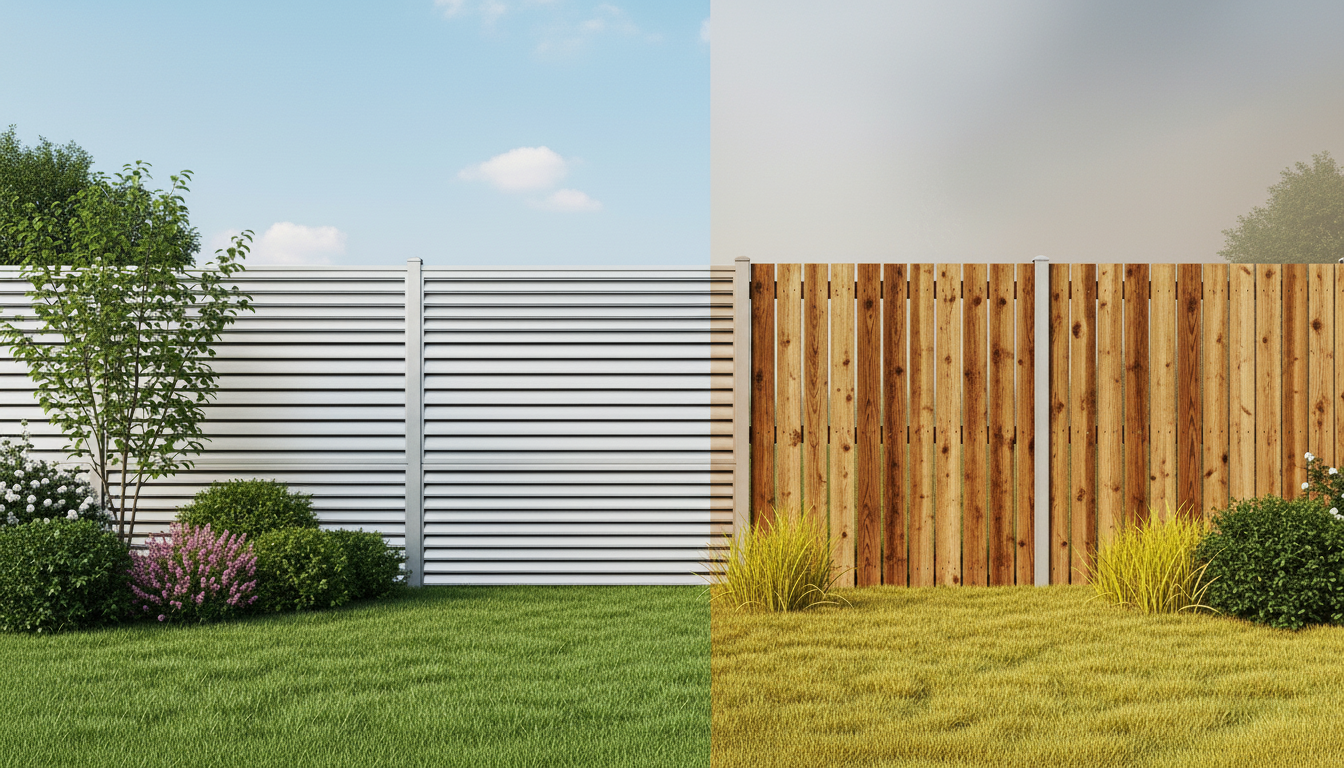
This report offers an in-depth comparative analysis of the life cycle of a metal fence (galvanized with a powder coating) and a wooden fence (chemically treated) with a time horizon of 20 years. It is exactly at this time mark that wood reaches the limit of its functional existence and requires massive chemical support or disposal, whereas steel continues to function. The results prove that the initial biogenic advantage of wood is negated by its operational drawbacks, making modern steel significantly more beneficial for the environment.
2. Life Cycle Assessment Methodology according to ISO 14040/14044 Standards
To avoid greenwashing, the comparison of materials relies on standardized protocols of the International Organization for Standardization (ISO), which regulate the principles of LCA.
2.1. Life Cycle Structure
The life cycle is broken down into several fundamental stages:
- Production stage: Covers raw material extraction (timber harvesting or scrap metal collection), transportation, and the actual industrial production (sawing, steel melting, galvanizing).
- Construction stage: Includes delivery to the site and the installation process.
- Use stage: Accounts for the impact of the material during use (chemical leaching), regular maintenance (painting), repairs, and replacement of elements.
- End-of-life stage: Covers dismantling, waste transportation, sorting, and recycling, or final disposal in landfills.
- Potential beyond the system boundaries: Evaluates credits and burdens from reuse in circular economy models.
2.2. Environmental Impact Indicators
The analysis focuses on a complex of environmental threats:
- Global Warming Potential: Measured in carbon dioxide (CO2) equivalent.
- Acidification Potential: Measured in sulfur dioxide (SO2) equivalent. Evaluates the ability of emissions to cause acid rain.
- Eutrophication Potential: Characterizes the excessive enrichment of water bodies with nutrients.
- Ecotoxicity: Assesses the toxicological impact of chemical emissions on flora and fauna.
- Photochemical Ozone Creation Potential: Measured by the impact of volatile organic compounds (VOCs) that form ground-level ozone (smog).
- Abiotic Resource Depletion: Consumption of non-renewable mineral resources.
2.3. Definition of the 20-Year Functional Unit
The functional unit is the provision of the barrier and aesthetic functions of a linear meter of fencing over 20 years. Wood used outdoors has an average service life of 15–20 years, even under intensive chemical treatment. On the other hand, a metal fence demonstrates structural integrity for over 30-50 years without the need for functional replacement. In a 20-year scenario, a wooden fence accumulates massive maintenance costs and risks of complete replacement, while steel remains static in its environmental costs.

3. Extraction Phase, Processing, and Embodied Carbon
The primary production stage of a fence creates its embodied carbon—the sum of all greenhouse gas emissions prior to delivery to the construction site.
3.1. Wood: Biogenic Carbon vs. Logging Realities
The advantage of wood is its ability to act as a carbon sink. Approximately half of the dry mass of wood fiber is pure carbon. However, this biogenic credit heavily depends on forest management practices. For commercial production, fast-growing softwood is predominantly used, grown using clear-cutting methods. Such practices lead to a loss of forest carbon stocks at a rate of 20-30%. When a forest is clear-cut, a huge amount of carbon from the soil is rapidly released into the atmosphere, negating the material’s benefits. Furthermore, timber extraction disrupts the integrity of terrestrial ecosystems, affecting the habitats of dozens of animal species (including the red wolf and salamander).
3.2. Steel: Energy Intensity of Production and the Triumph of Secondary Recycling
Producing steel from virgin ore requires colossal amounts of energy and generates significant volumes of anthropogenic CO2. However, the modern steel industry is a global leader in recycling. In developed economies, the majority of structural steel is manufactured using electric arc furnaces, where scrap metal is used as the raw material. Producing steel from scrap consumes 70-75% less energy compared to extraction from ore. Metal recycling reduces CO2 emissions by 60-80% and decreases overall water consumption by 40%. The environmental costs of steel production are amortized over its long life in a closed loop.
4. Chemical Modification of Materials
The functionality of an outdoor fence is determined by its resistance to weathering. Modification processes shape the toxicological profile of the materials.
4.1. Wood: The Necessity of Toxic Impregnation
Untreated softwood quickly rots in moist conditions. To extend its life, the wood is subjected to deep impregnation with biocidal solutions, transforming a natural material into a chemical composite. Previously, the leader in preservation was chromated copper arsenate (CCA), but due to evidence that arsenic and hexavalent chromium leached into the soil, its use in residential areas was banned. Newer water-based alternatives (alkaline copper quaternary or copper azole) eliminated arsenic, but the concentration of copper in them increased significantly. Modern treated wood is a source of a highly aggressive toxic element for aquatic ecosystems and soil microorganisms, significantly increasing ecotoxicity.
4.2. Steel: Galvanization and Powder Metallurgy
Protecting steel does not require biocides or neurotoxins; its only enemy is oxidation. The first level of protection is hot-dip galvanizing, where zinc acts as a barrier and a sacrificial anode. Zinc oxide is a natural mineral, safe for the environment in microdoses. The second level is powder coating. It radically outperforms liquid paints for wood from an environmental perspective. Powder paints contain no chemical solvents, have zero emissions of VOCs, and do not form hazardous air pollutants. Excess powder is collected and reused (up to 97-99% efficiency), reducing waste generation to an absolute minimum. The carbon footprint of powder coatings is 10-15% lower than that of traditional paints.
5. Use and Maintenance Phase (20-Year Horizon)
During its service life, a wooden fence creates an avalanche of environmental costs.
5.1. Degradation Dynamics and Replacement Risks
Despite chemical treatment, wood absorbs moisture, leading to swelling and cracking. The most critical point is the contact area with the ground, where posts often fail after 10-15 years of service. If a fence requires the replacement of rotten elements, its initial embodied carbon is doubled. In contrast, a steel frame does not rot and provides unprecedented resistance to loads, eliminating the risk of replacement for 30-50 years.
5.2. Maintenance and the Hidden Impact of Emissions
For wood to last 15-20 years, it must be coated with a stain or sealant every 2-3 years. Over 20 years, this amounts to 6-10 full painting cycles. Traditional products contain high levels of VOCs, which evaporate and form toxic smog. Metal panels are completely inert and only require periodic washing with water, which means zero VOC emissions throughout the entire service life.
6. Ecotoxicity and Continuous Chemical Leaching
Precipitation partially dissolves the chemicals in the upper layers of treated wood and carries them into the soil at the base of the fence. During operation, there is an intensive wash-off of copper and other preservatives. Once in the soil, these heavy metals do not break down; they accumulate and become lethal to soil microorganisms, and are also washed into water bodies. This constant toxic pressure forms the high ecotoxicity of wood. Steel with a polymer powder coating is hermetically sealed and safe for the soil.
7. End of Life and the Circular Economy
The final stage reveals the deepest environmental conflict between the materials.
7.1. Wood: The Hazardous Waste Disposal Crisis
After 20 years, a wooden fence turns into construction debris, which is often classified as hazardous waste. Burning old boards in open fires is prohibited due to the formation of highly toxic gases and ash containing heavy metals. Treated wood cannot be safely composted, so its recycling rate is a meager 1-5%. Most of this waste is buried in landfills, where it generates methane and forms a toxic leachate, poisoning groundwater.
7.2. Steel: 100% Integration into the Circular Economy
Steel is the absolute flagship of the circular economy. When the life cycle of a metal fence comes to an end, it is 100% recyclable and can be melted down an infinite number of times without any loss of properties. The risk of waste generation is minimized, as the collection of over 85-95% of used steel is highly incentivized. Every kilogram of recycled scrap metal saves primary energy and prevents new CO2 emissions.
8. Comprehensive Comparative Analysis (Summary Matrix)
| Life Cycle Stage | Impact Indicator | Wooden Fence | Metal Fence (Steel) |
| Raw Material Extraction | Impact on biodiversity | High: Clear-cutting destroys species habitats. Loss of soil carbon. | Minimal: Due to the use of up to 90% scrap, ore extraction is minimized. |
| Production | Energy intensity and embodied carbon | Low primary: Wood stores carbon, but preservative production adds costs. | High initial: However, energy intensity is reduced by 75% thanks to secondary raw materials. |
| Chemical Treatment | Process toxicity | High: Working with carcinogens or high doses of toxic copper. | Low: Powder coating without solvents. Zero VOCs. |
| Use Phase | Degradation dynamics and ecotoxicity | High: Constant leaching of copper into the soil. Toxin accumulation under the fence. | Zero: The coating is hermetic. Zinc oxide is safe for soil in microdoses. |
| Maintenance | Resource consumption and emissions | Critical: Requires stain application. Cumulative VOC emissions form smog. | Zero: “Set it and forget it” architecture. Zero chemical costs. |
| Service Life | Risk of replacement (over 20 years) | High: Posts rot in 10-15 years. Full replacement doubles the carbon footprint. | Zero: Service life is 30-50+ years without replacing parts. |
| End-of-Life | Impact of waste on the environment | Catastrophic: Landfilling generates methane and toxic leachate. | Flawless: 100% recycling without quality loss in a closed loop. |
9. Conclusions
A deep analysis of Life Cycle Assessment (LCA) data demonstrates the necessity of abandoning superficial material labeling. Wood becomes an outdoor building material only through massive chemical intervention.
The primary advantage of wood in carbon sequestration is irrevocably negated by a cascade of environmental penalties over 20 years: the destruction of ecosystems during logging, the continuous leaching of fungicidal compounds into the soils, a short life cycle, constant maintenance causing air pollution, and an unsolvable crisis of toxic waste disposal in landfills.
In contrast, steel offers a perfect model of environmental rationality. Thanks to a high percentage of secondary scrap use, the steel industry has sharply reduced its initial carbon footprint. These initial costs represent a one-time investment. For decades, a metal fence remains absolutely inert: it does not poison soils, emit volatile compounds, or require chemical care. At the end of its life cycle, steel is 100% subject to recycling and returns to economic circulation, supporting the ideology of the circular economy. From the perspective of responsible consumption, modern steel is unquestionably a more beneficial choice in the long term.
Related articles
Fence Installation on Challenging Soils: Foundation Mistakes and Solutions
Installing fences on difficult soils: foundation mistakes, frost heave, pile selection, and drainage. Expert tips for a durable enclosure.
Comprehensive design of metal fencing systems for pet safety: engineering, architectural, and veterinary aspects
How to choose a safe fence for dogs and cats? Analysis of modern metal fencing: reliable protection against climbing, digging, and injuries.
Types of fence posts
An analysis of the most important requirements for fence support posts, and an evaluation of the pros and cons of the most popular options.