
Ukraine’s DBN V.1.2-10:2021, Protection against noise and vibration, replaced the 2008 edition and took effect on 1 September 2022. If speech builds up and lingers inside a room, investigate absorption. If words carry into a neighbouring room, investigate sound insulation and the paths around the separating construction. These questions require different evidence from a ceiling supplier.
Which Ukrainian standards apply?
DBN V.1.2-10:2021 sets out the basic requirements for protection from noise and vibration in buildings. Clause 6.5 of the official reference text addresses the absorption data needed for design. DBN V.1.1-31:2013 covers noise protection design for buildings and sites. Select requirements by room use, source and transmission path. Older project files may still refer to the 2008 edition. On projects outside Ukraine, identify the locally applicable rules separately.
Echo, sound transmission and vibration
| What you hear | What to assess | First observation |
|---|---|---|
| Conversations blur together in a hard-surfaced room | Reverberation time by frequency | Where speech is hardest to understand and how occupied the room is |
| Words carry through from the next office | The dividing construction and flanking paths | Door seals, service penetrations and the shared ceiling void |
| A low hum starts when the fan runs | The source and structure-borne vibration | Operating mode, supports and rigid connections |
| Footsteps are audible below | Impact sound and junctions | The slab and floor build-up above |
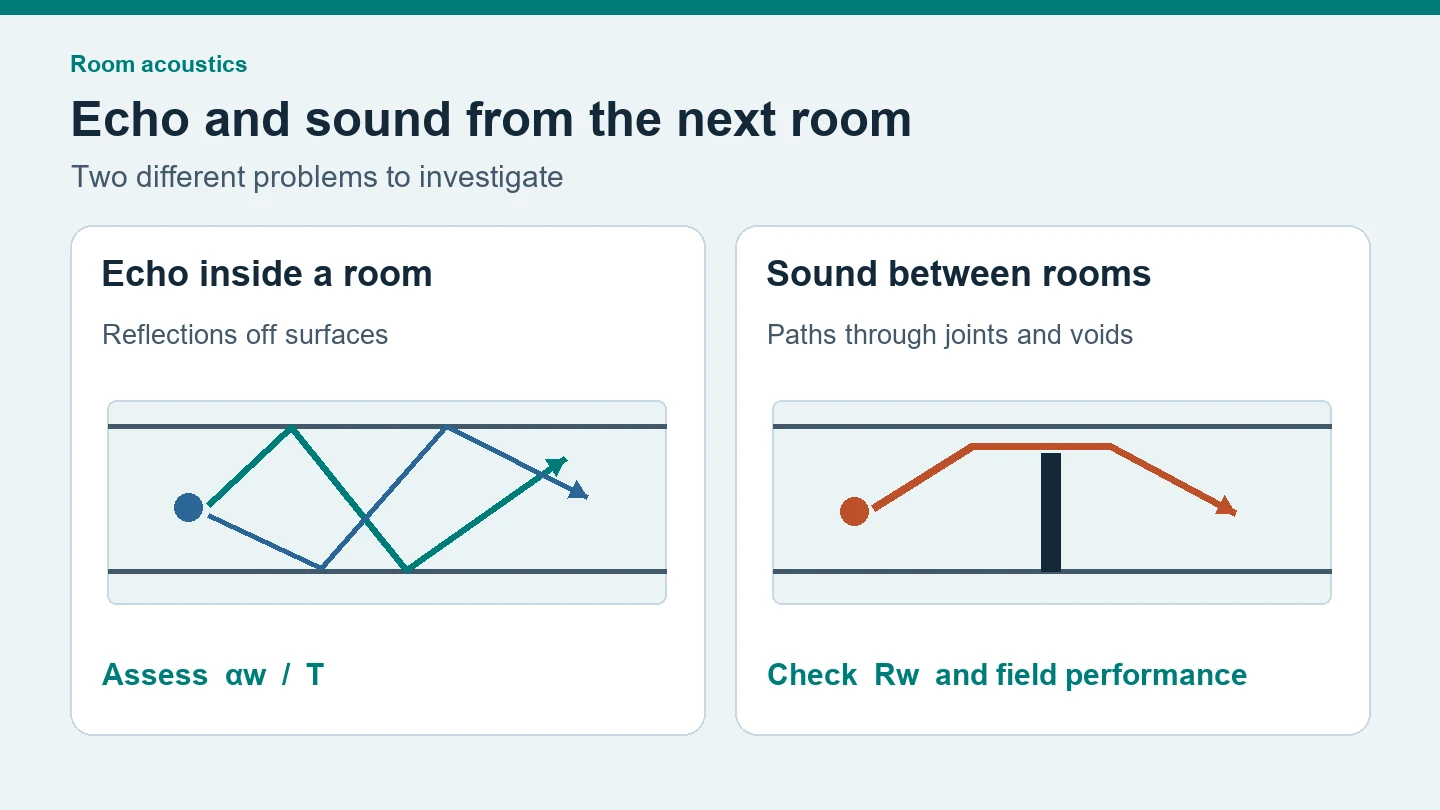
αw is a weighted sound absorption coefficient for the tested assembly. Rw, in decibels, is a laboratory rating of airborne sound insulation for the separating element. Flanking paths can affect performance in the finished building. Reverberation time T is measured in seconds. An absorption coefficient does not convert into a decibel improvement in insulation or a percentage reduction in noise.
Two tested ceiling assemblies
The Rockfon Blanka technical data show two assemblies with nominally 20 mm panels. Both the edge detail and overall suspension height differ, so compare the published assemblies as a whole. Absorption is measured under ISO 354, and the practical αp figures and weighted αw rating are determined under ISO 11654.
| Published arrangement | 125 Hz | 250 Hz | 500 Hz | 1000 Hz | 2000 Hz | 4000 Hz | αw |
|---|---|---|---|---|---|---|---|
| A24 edge, 20 mm panel, 200 mm suspension height | 0.60 | 0.90 | 1.00 | 0.90 | 1.00 | 1.00 | 1.00 |
| B edge, 20 mm panel, 20 mm suspension height | 0.10 | 0.25 | 0.70 | 0.95 | 1.00 | 1.00 | 0.55 |
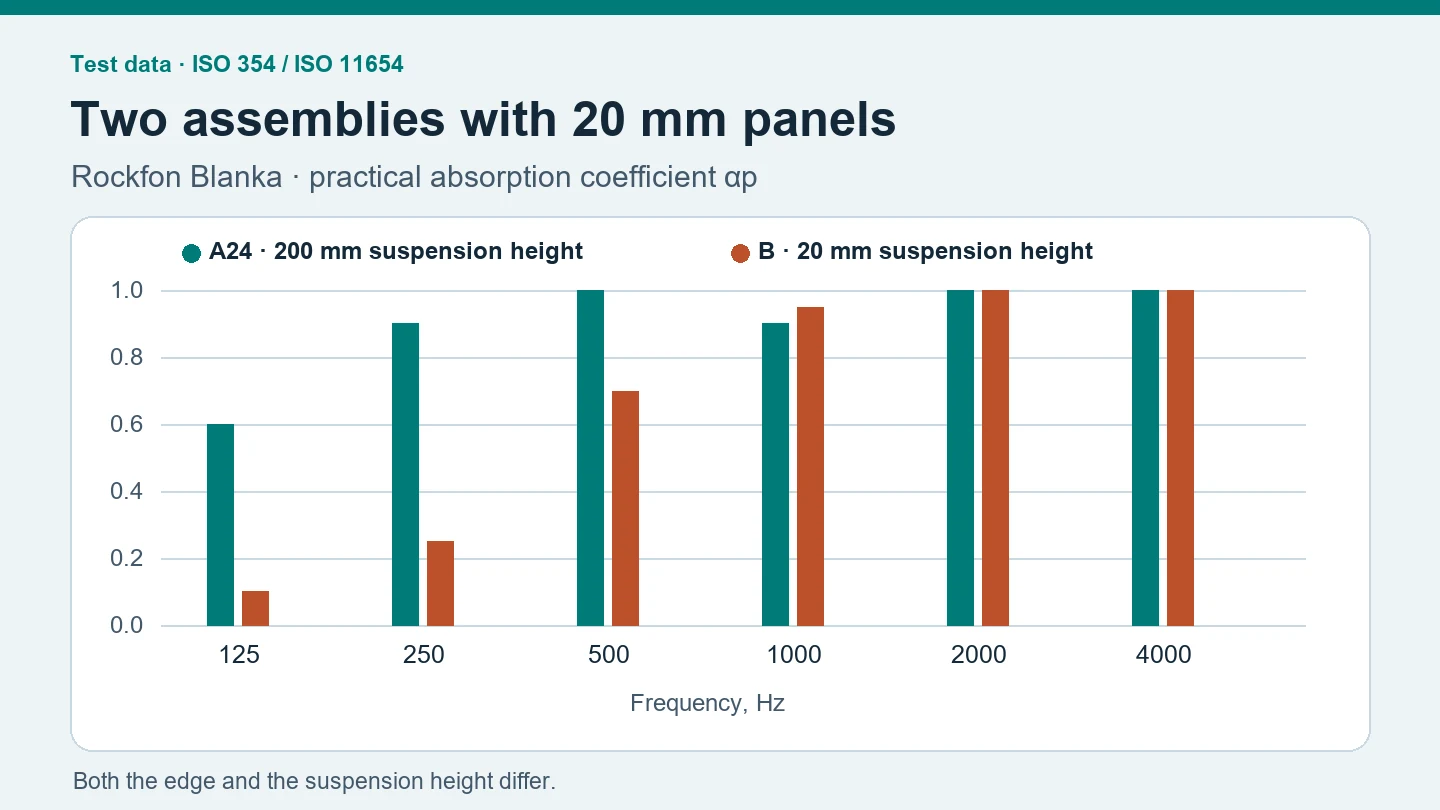
Worked example. At 250 Hz, 30 m² of ceiling contributes approximately 30 × 0.90 = 27 m² or 30 × 0.25 = 7.5 m² of equivalent absorption area, respectively. To estimate reverberation for the whole room, combine its volume, geometry, other finishes, furniture and occupancy using an appropriate acoustic model.
What to put in the specification
- Describe the use case. In an eight-person meeting room, clear speech inside and privacy outside are separate performance objectives.
- Record the room dimensions, available suspension height, treatment area and interruptions for lights and grilles.
- Ask for octave-band absorption data, edge detail, overall suspension height, assembly build-up and the relevant test or datasheet reference. For perforated metal, verify the perforation, backing and cavity treatment.
- Agree on acceptance conditions in advance. For room-to-room sound insulation, include partitions, doors, ventilation and penetrations in the coordination review.
Ceiling sound absorption coefficients and material selection.
Frequently asked questions
Can perforated metal reduce echo? Yes, where the perforated panel, acoustic backing and cavity form an assembly suited to the room. Use tested data for the chosen build-up.
Will an acoustic ceiling stop footsteps from upstairs? Identify the transmission paths first. Impact sound often requires looking at the floor above and its junctions as well as the ceiling below.
The cover is an AI-generated illustration.
Related articles

Ukraine’s Roof Design Standard DBN V.2.6-220:2017: Falls, Drainage and Details
A practical guide to Ukraine’s roofing standard: check falls, drainage, parapets and penetrations, with a 180 m² catchment example and handover checklist.
Autumn 2024 Construction Exhibitions
We’ve prepared a list of key exhibitions to visit this autumn!