2. The Anatomy of Error in Metal Construction
To fully appreciate the mitigation strategies offered by BIM, it is necessary to first deconstruct the taxonomy of failure in traditional metal construction. “Error” in this context is a multifaceted phenomenon that extends beyond simple dimensional inaccuracies to encompass sequencing failures, chemical incompatibilities, and information asymmetry.
2.1 The Financial Physics of Rework
Rework is the single largest contributor to waste in the construction industry. In traditional workflows, rework typically accounts for up to 12% of the total project cost. In the context of metal structures, this cost is often magnified due to the high value of the materials and the specialized labor required for rectification. A steel beam fabricated 20mm too long cannot be simply “cut to fit” without compromising its engineered connection details and fire-rated coatings.
The “40% reduction” statistic derived from industry reports represents a composite improvement across several vectors:
- Direct Rework Costs: Firms integrating reality capture and scan-to-BIM workflows report reductions in rework costs by up to 40% of the total project budget allocated to rectification.
- Schedule Adherence: Onsite errors invariably lead to schedule slippage. BIM-driven projects show a reduction in schedule overruns by 20-30%, as the “stop-work” events caused by major clashes are eliminated during the design phase.
- Information Latency: Traditional projects suffer from a lag in information transfer, leading to the installation of obsolete designs. BIM reduces Requests for Information (RFIs)—a proxy for confusion—by 25%, ensuring that the “single source of truth” is accessible to the installer.
2.2 Geometric Incompatibility and the “Clash”
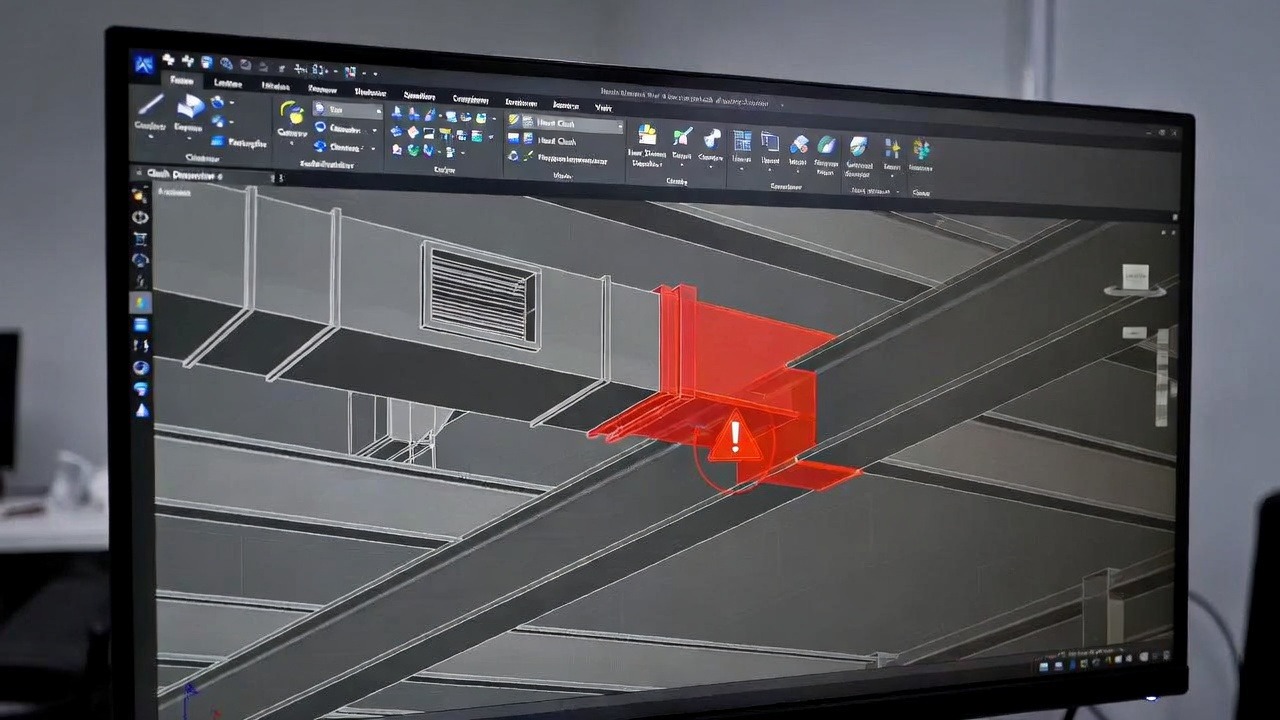
The most visible manifestation of error is the geometric clash. In a non-BIM environment, structural steel, mechanical ductwork, and architectural facades are often designed on separate 2D layers. When these systems converge in the physical reality of the site, they compete for the same space.
- Hard Clashes: These are physical intersections, such as a steel girder penetrating a ventilation shaft. In traditional workflows, these are often discovered only when the crane is holding the beam in place, leading to immediate work stoppages.
- Soft Clashes: These involve clearance violations. For example, a steel connection may technically fit, but its placement might block the access required for a torque wrench or a welder’s equipment. BIM facilitates “clearance modeling,” treating the empty space required for installation as a physical object that can be checked for interference.
2.3 The Invisible Errors: Tolerance and Environment
Beyond geometry, errors in metal construction often involve the violation of physical or environmental constraints.
- Tolerance Accumulation: Concrete structures typically have tolerances of ±20mm, while structural steel requires ±2mm. A major onsite error occurs when steel is fabricated to theoretical dimensions that do not match the “as-built” concrete reality. This discrepancy forces site crews to engage in ad-hoc field modifications—reaming holes or forcing connections—which effectively degrade the structure’s integrity.
- Environmental Mismatch: A critical, often delayed, error is the specification of materials ill-suited to the local atmospheric environment. Installing standard galvanized steel in a marine environment (C5 category) constitutes a design error that results in rapid corrosion. Traditional 2D documentation rarely carries the environmental metadata necessary to flag this mismatch automatically.
2.4 Data-Driven Failure Analysis
The cost of these errors is not linear. The “1-10-100 Rule” in construction suggests that an error costs $1 to fix in the design phase (Screen), $10 to fix during fabrication, and $100 to fix on site. BIM’s primary economic contribution is shifting the discovery of these errors to the $1 phase. Analysis of large-scale infrastructure projects reveals that digital coordination can identify thousands of critical clashes. For instance, a rail infrastructure project in Asia utilized BIM to detect over 3,000 conflicts before ground was broken. The resolution of these errors in the digital realm saved an estimated 12% of construction costs, confirming the high leverage of pre-construction validation.