Soundproofing of Metal Facades: Comprehensive Engineering-Acoustic Analysis, Materials Science, and Regulatory Framework
Generic selectors
Exact matches only
Search in title
Search in content
Post Type Selectors

Soundproofing of Metal Facades: Comprehensive Engineering-Acoustic Analysis, Materials Science, and Regulatory Framework

May 5, 2026
5  

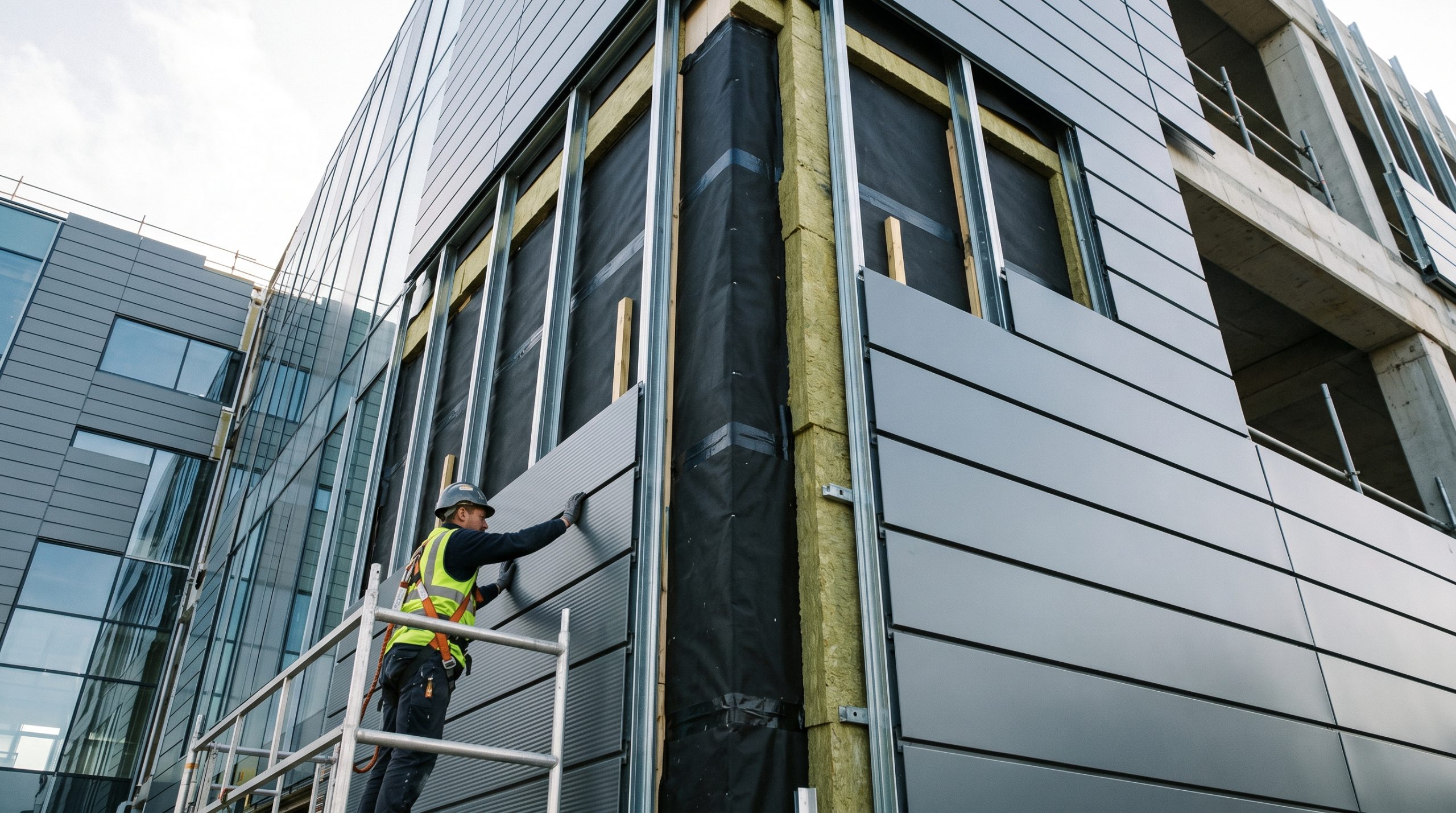
Modern trends in urban architecture and construction dictate the use of light, durable, and technological materials, among which metal facade systems (metal cassettes, aluminum composite panels, linear panels, corrugated sheets, and sandwich panels) take leading positions. Due to their undeniable advantages in protecting buildings from aggressive atmospheric influences, ease of installation, relatively low weight, and wide aesthetic variability, such envelopes have become the standard for commercial, industrial, and residential development. However, despite the structural and economic advantages, the use of sheet metal as an external enclosing contour creates a serious engineering challenge from the point of view of building physics — high acoustic conductivity and a tendency to intensive resonance.

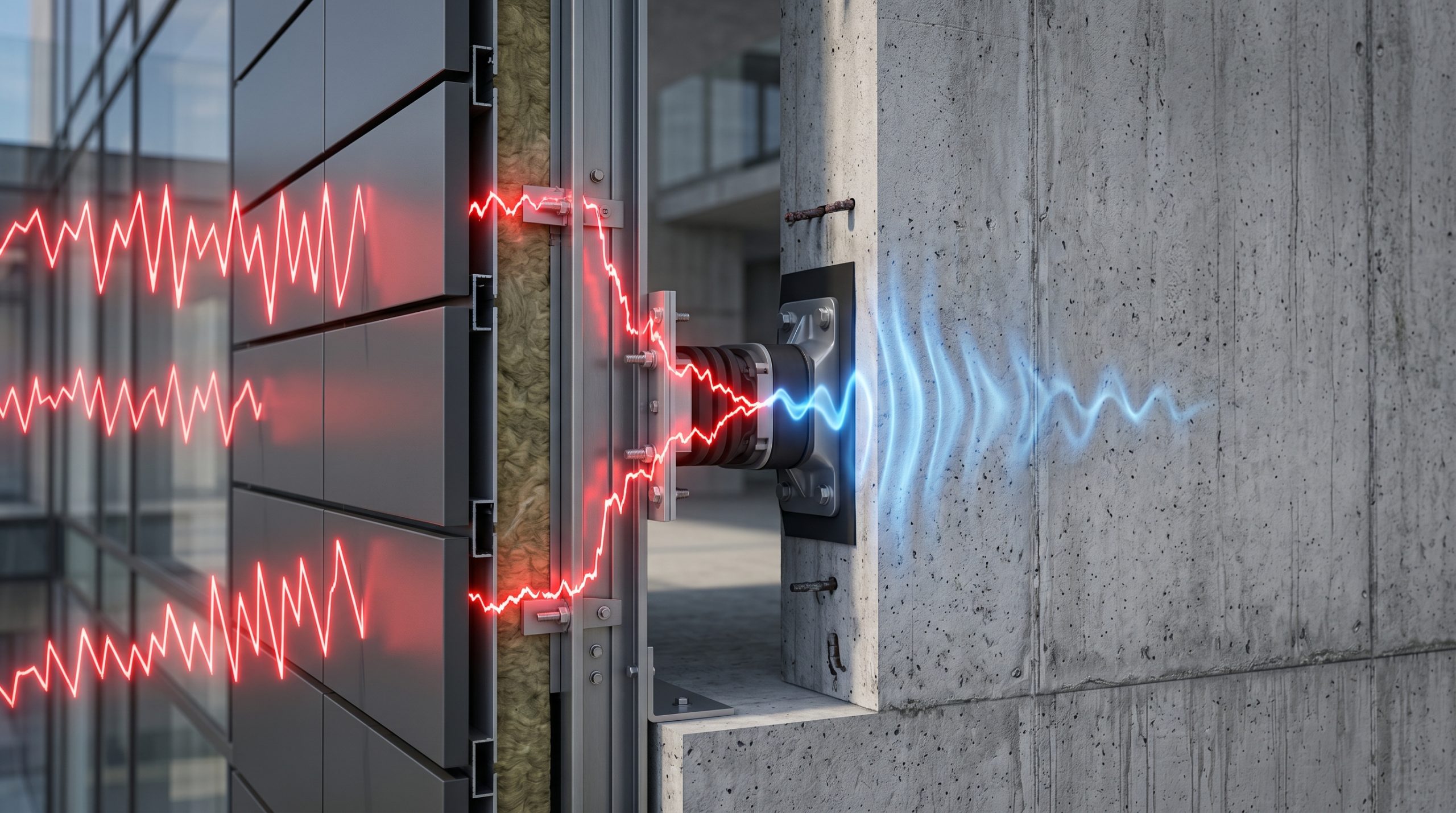
The rigidity of metal combined with its low internal damping (internal friction) causes the facade to function as a giant membrane-resonator. Under the influence of external exciters, such as raindrops, hail, strong wind gusts, or intense traffic flow, the metal surface generates bending waves that unhinderedly transmit acoustic energy into the structure. If there are no specialized layers in the path of these vibrations capable of absorbing and dissipating mechanical energy, sound is transmitted through the fastening subsystem to the load-bearing walls in the form of structural noise, as well as directly into the internal premises of the building in the form of secondary airborne noise.

Designing effective soundproofing of metal facades requires the application of multilayer engineering solutions and a deep understanding of wave physics. The comprehensive approach is based on the physical principle of “mass – elasticity – mass”, where materials with radically different densities, structures, and dynamic modulus of elasticity are used to minimize the transmission of acoustic energy across the entire frequency spectrum. The soundproofing strategy cannot be limited to a single material; it necessarily includes vibration isolation of framing systems, increasing the surface mass of cladding elements using heavy membranes, and integrating fibrous sound-absorbing materials into the ventilation gap.

1 Zvukoizolyatsiya metalevykh fasadiv scaled

Physics of Sound and Vibration Wave Propagation in Metal Envelopes

To effectively eliminate the problem of noise penetration and ensure acoustic comfort in the building, it is necessary to clearly understand the acoustic mechanisms of interaction of sound waves with rigid obstacles. Metal facade structures (for example, closed or open type cassettes, Ruukki Liberta linear panels) are exposed to three main types of sound loads, the mechanisms of which differ significantly from each other.

First, the building is exposed to airborne noise. Sound waves from external sources (highways, railways, industrial enterprises, aviation transport) propagating in the air hit the external metal panel. According to the mass law, the acoustic insulation of a single-layer partition depends on its surface mass. Since metal cassettes and corrugated board usually have a thickness of 0.5 to 1.5 millimeters, their surface mass is insufficient to effectively reflect low-frequency and medium-frequency sound waves. The panel partially reflects the sound and partially begins to oscillate under the influence of acoustic pressure. These vibrations are transmitted to the air layer in the ventilated gap, and then to the insulation layer and the load-bearing wall.

Second, a critical problem for metal envelopes is impact noise (or structural). This type of noise occurs upon direct mechanical contact of external objects with the facade. The most common and annoying case is the impact of raindrops or hail. Metal, being an isotropic material with an extremely high modulus of elasticity, instantly reacts to such micro-impacts, creating high-frequency bending waves running across the entire plane of the panel. Due to the lack of internal damping in the crystal lattice of steel or aluminum, these vibrations do not decay on their own and overcome the plane of the material without losses. Sometimes this sound becomes so loud that staying in the building becomes physically and psychologically uncomfortable.

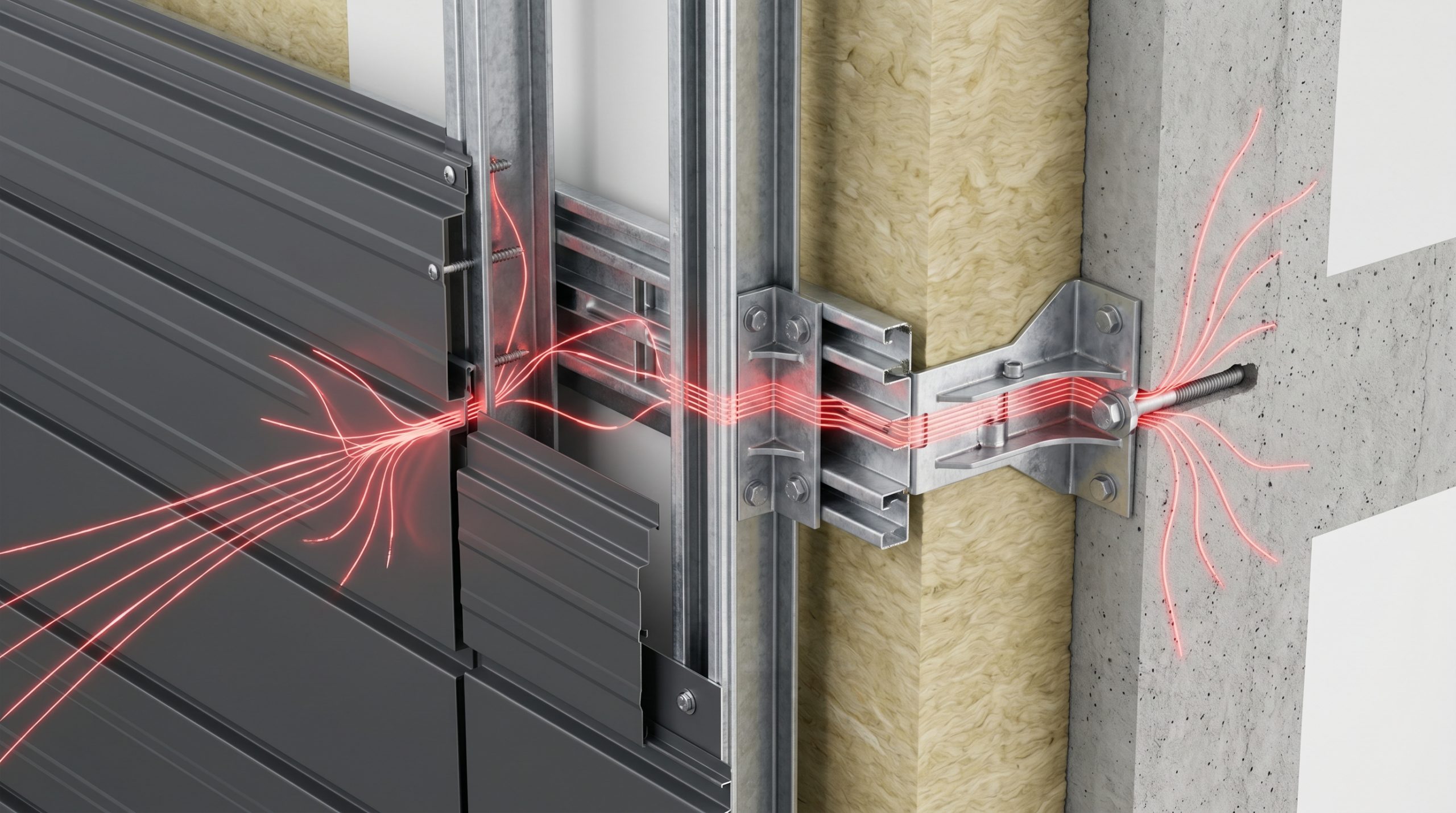
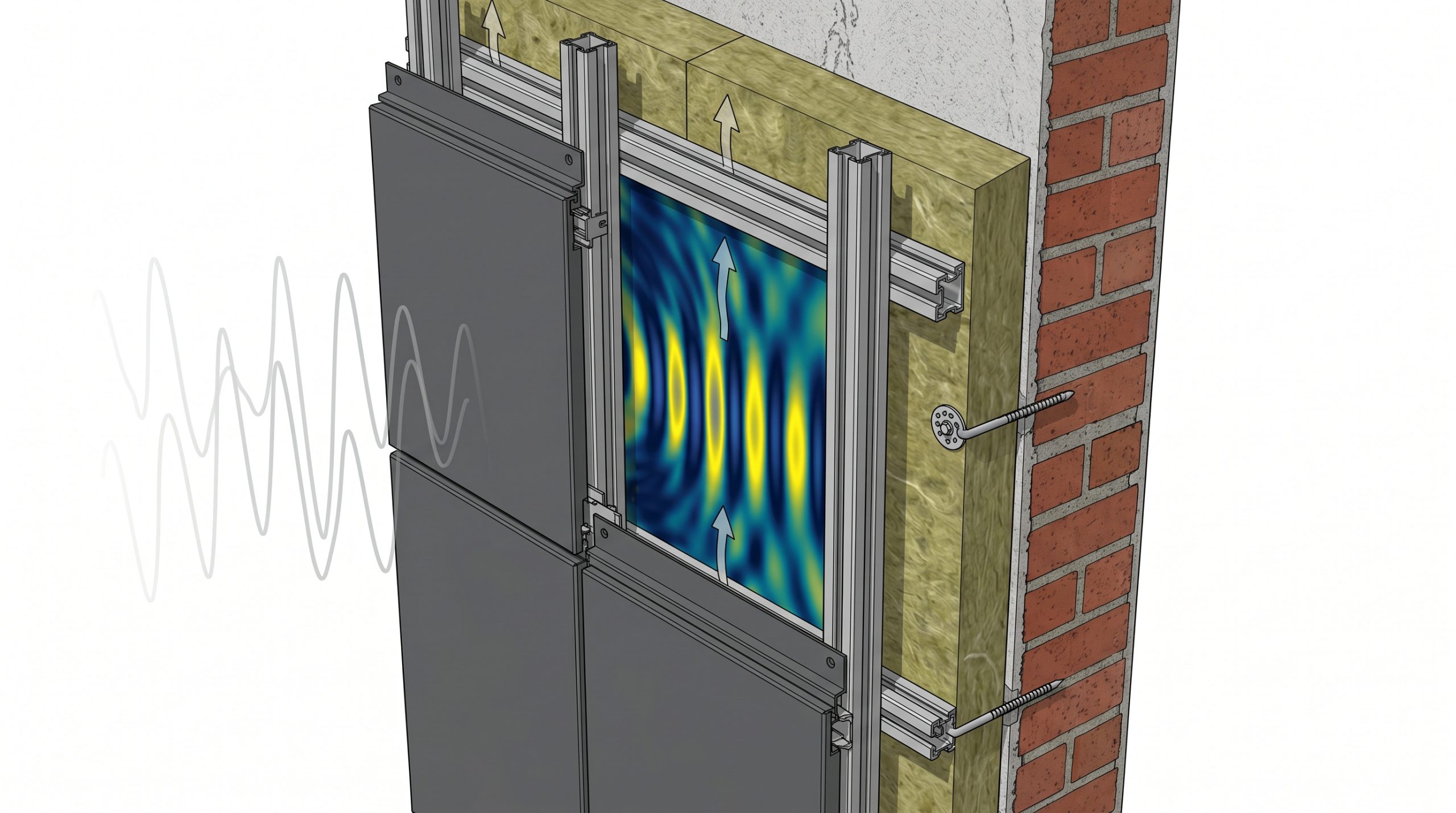
Third, acoustic energy penetrates the building through flanking transmission, also known as the problem of acoustic bridges. This is the path of structural vibrations propagation through rigid mechanical connections of the structure. In ventilated facade systems, such bridges are metal brackets and guide profiles (horizontal, vertical, or cross). Vibrations of the cladding are transmitted through rivets or self-tapping screws to the subsystem, and then through steel anchors directly into the load-bearing structure (brickwork, reinforced concrete, aerated concrete block), which radiates them into the room in the form of secondary airborne noise.

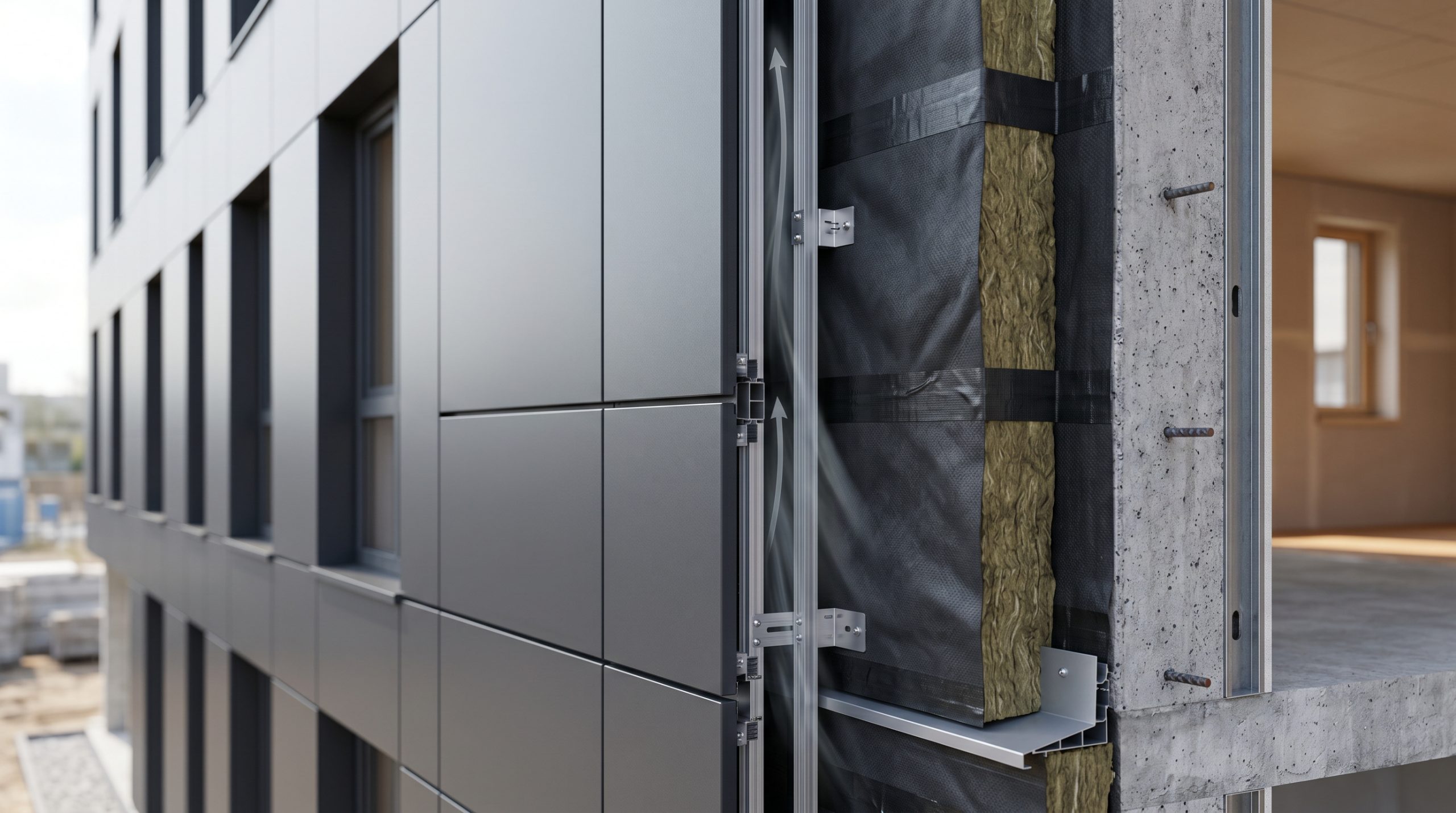
The lack of specialized water- and wind-protective membranes, the use of too thin or insufficiently dense insulation, as well as an improperly or incorrectly mounted facade pie lead to the fact that the empty ventilation gap begins to work as an acoustic resonance chamber. Acoustic energy accumulates in these cavities, standing waves amplify certain frequencies, transforming the facade into an amplifier of external noises.

2 Zvukoizolyatsiya metalevykh fasadiv scaled

Regulatory Framework for Architectural Acoustics in Ukraine

The design of acoustic protection of facade systems in Ukraine is not an arbitrary process; it is strictly regulated by state building codes. The basis of the regulatory framework governing these issues consists of standards for the protection of territories, buildings, and structures from noise and vibration. These documents establish maximum permissible noise levels for various types of premises, territories, as well as minimum requirements for sound insulation indices of external and internal enclosing structures.

Permissible Sound Pressure Levels and Evaluation Criteria

Parameters subject to strict regulation are divided depending on the nature of the noise. The normalized parameters of continuous noise are sound pressure levels and equivalent sound pressure levels in octave bands with geometric mean frequencies of the normalized range from 31.5 to 8000 hertz, as well as the overall sound level in decibels. For non-continuous noise, which is most often generated by transport, climatic phenomena, or engineering equipment, the assessment is carried out by equivalent and maximum sound levels.

The fundamental rule of the standards is that noise is considered to be within the norm exclusively provided that none of the specified sound pressure parameters in any octave band exceeds the established limits. This places extremely high requirements on the resulting soundproofing of the facade, especially in conditions of dense urban development or near highways, where the equivalent level of external traffic noise can stably reach significant values.

If engineering equipment is installed in the building (for example, pumps, elevators, or massive forced ventilation systems), rooms with intensive noise sources are prohibited from being located under, above, or next to residential zones.

Calculation and Requirements for the Resulting Soundproofing of External Walls

The normative parameter used to assess the facade’s ability to withstand the external environment is the resulting sound insulation index from traffic noise. Ukrainian regulations detail a complex calculation algorithm and requirements for external enclosing structures, which require taking into account the multi-component nature of the facade.

The external enclosure is considered as a composite structure consisting of elements with different soundproofing capacities — the blind part (directly the wall, insulation, metal cladding) and translucent elements (windows, stained glass windows, doors). The resulting value of sound insulation is calculated taking into account the proportions of the areas of windows and walls in the total area of the facade of a given room. The detailed methodology of such calculations includes frequency characteristics of airborne noise insulation.

In addition to baseline values, acoustic engineers must apply special correction factors. Corrections are added to the baseline normative values depending on the ratio of the total area of the external enclosing structure to the floor area in the given room.

Ratio of the total area of the external enclosing structure
to the floor area
Correction, decibels
2.5 and more

+4

2.0

+3

1.6

+2

1.3

+1

1.0 and less

0

This mathematical dependence means that the larger the area of the facade (and, accordingly, the area of sound radiation) relative to the volume and floor area of the room, the stricter the requirements for the insulation of each square meter of this structure. In addition, a critically important rule is established for designers of metal facades: normative values of sound insulation for external blind walls (without windows) must be taken 10 decibels higher than the corresponding indicators for walls with windows. A similar strict requirement applies to combined roof coverings.

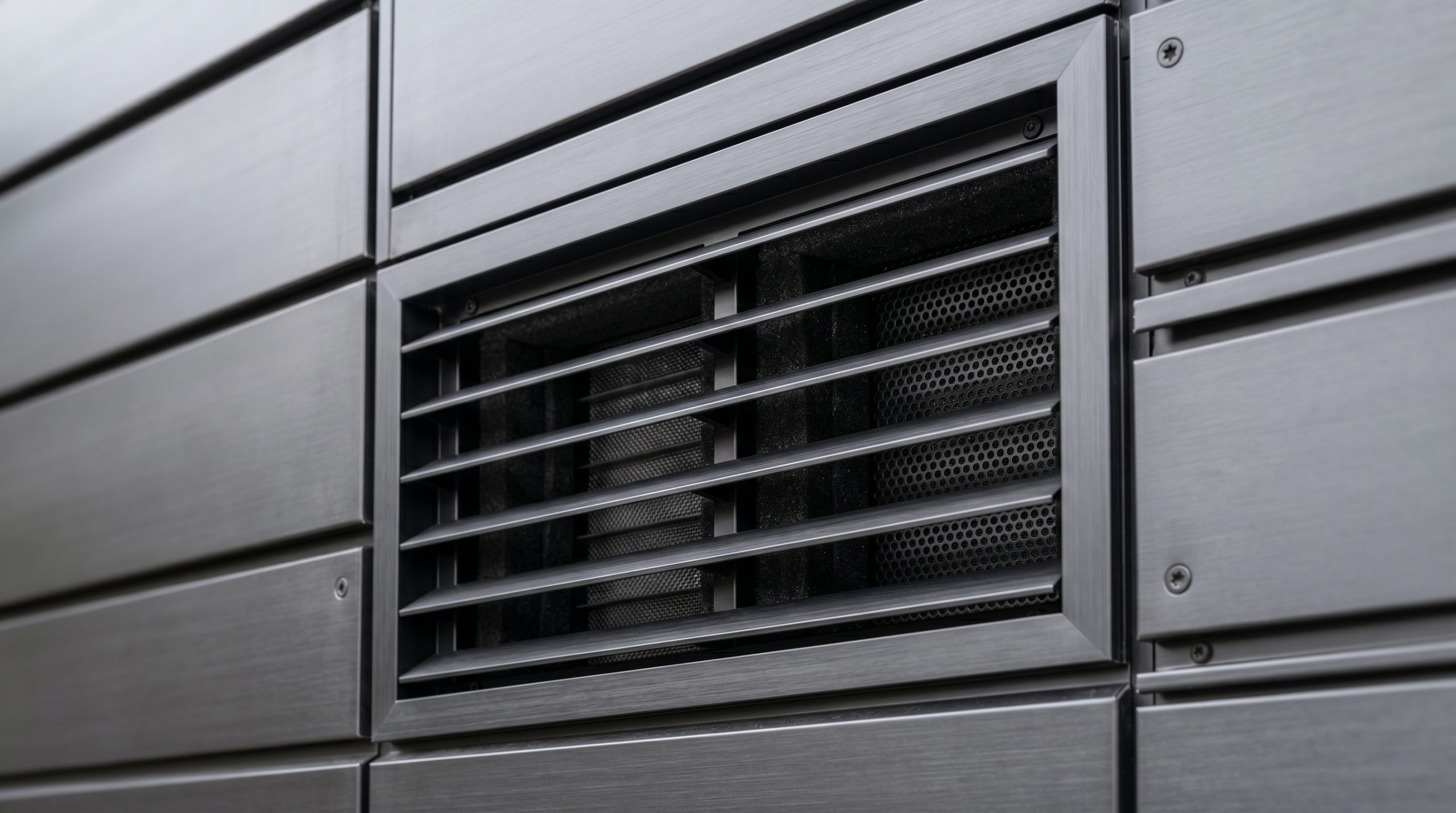
The norms pay special attention to ventilation issues. The soundproofing parameters of the facade are checked and accepted for the closed state of windows only when the building is equipped with central or local forced ventilation or air conditioning systems. If the building provides only natural exhaust ventilation, the facade must necessarily be equipped with special supply ventilation devices (wall ventilators) with a noise attenuation function.

3 Zvukoizolyatsiya metalevykh fasadiv scaled

Materials Science: Viscoelastic Soundproofing Barrier Membranes

To achieve strict normative sound insulation indicators (where a sound reduction index of more than 50-60 decibels is required for a complex wall), traditional methods of increasing wall thickness are insufficient. About 95 percent of materials classified in the mass market as soundproofing (various polyethylene foams, cork underlays, polystyrene foams) are actually only light sound-absorbing or heat-insulating materials. They are not capable of cutting off or reflecting low-frequency acoustic noise, and their use requires the installation of extremely thick framing systems, which steals usable space.

One of the most innovative and effective solutions to combat the resonance of metal facade cassettes and corrugated sheets is the use of heavy viscoelastic synthetic membranes of the latest generation. This category includes the Spanish membrane Tecsound, the StopZvuk line of materials, and the Spanish membrane Danosa.

Unlike porous materials, these mineral membranes function as a powerful acoustic barrier of the reflective type. The secret of their effectiveness lies in their chemical composition: the base of the membrane is a synthetic polymer that is extremely saturated with a fine-dispersed mineral — aragonite. Thanks to this formulation, the material acquires an extremely high bulk density, which is about 1900 kilograms per cubic meter, which is comparable to the density of concrete.

With such colossal density, the membranes are produced in the form of very thin sheets (from 2.6 to 14 millimeters thick). For example, a membrane only 5.3 millimeters thick has a surface mass of as much as 10 kilograms per square meter. At the same time, the materials are absolutely free of harmful bitumen, rubber, or lead, and are environmentally friendly and safe for health.

Technical indicator Characteristics of viscoelastic membranes (based on Tecsound)
Bulk density

1900 kilograms per cubic meter

Intrinsic insulation coefficient

28 – 30 decibels (for the material itself)

Elasticity

High flexibility, does not break when bent down to -20 degrees

Flammability group

Hard-to-ignite, low-combustible, self-extinguishing materials

Hydrophobicity

Does not absorb moisture, not prone to rotting and mold formation

Mechanism of acoustic action of membranes on a metal facade: When a soundproofing membrane is applied directly to the inner (back) side of a metal cassette, linear panel, or corrugated sheet, a fundamental change in surface physics occurs.

First, the surface mass of the thin cladding increases significantly. According to the basic mass law in acoustics, doubling the mass of a partition leads to an increase in sound insulation by 6 decibels. Applying a heavy mineral mass to a light metal sheet instantly increases the overall airborne noise insulation coefficient of this element, effectively blocking the penetration of low-frequency noises.

Second, the viscoelastic nature of the polymer matrix acts as a powerful vibration damper. Bending waves arising in rigid metal tend to spread over the entire area of the cassette. However, since the metal is now rigidly glued to the viscous polymer, the energy of these waves is transferred into the polymer layer. There, due to the internal friction of macromolecules, the kinetic energy of vibration is transformed into a microscopic amount of thermal energy and dissipated. This process completely eliminates structural resonance, the “humming” or “drum” effect, making the metal roof or facade acoustically “dead”, like a stone.

4 Zvukoizolyatsiya metalevykh fasadiv scaled

Materials Science: Sound-Absorbing Fibrous Materials (Insulation)

The presence of a dense fibrous material in the design of a ventilated facade is an absolutely mandatory engineering requirement for both thermal insulation and sound insulation. The most important role in combating airborne noise inside the ventilation gap is played by insulation based on mineral wool (basalt or fiberglass), for example, as part of complex systems like Decor or similar solutions from TechnoNICOL, Kingspan, etc.

The acoustic operating principle of mineral wool is based on its specific morphology — the presence of a huge number of open, interconnected microscopic pores between chaotically intertwined mineral fibers. Sound waves, having passed through the external metal cladding, penetrate into the thickness of the material, causing the air molecules inside these pores to oscillate. The viscous friction of air against thin, elastic mineral fibers leads to dissipation — the scattering of acoustic energy and its irreversible conversion into heat. Thanks to this, mineral wool simultaneously acts as a thermal insulator and prevents the spread of noise through the enclosing walls.

For the insulation to act as a full-fledged sound absorber, design engineers must adhere to several strict installation rules:

  1. Layer thickness: A thin or low-quality insulation does not solve the problem of low-frequency noise, but only partially reduces the mid- and high-frequency spectrum. For a real, noticeable reduction in noise, the minimum recommended thickness of the mineral wool layer should be at least 200 millimeters.
  2. Multi-layering and staggering: The laying of the wool should be carried out in several layers with mandatory staggering of joints. This is done to prevent the formation of through gaps between the slabs, which will become direct “sound bridges” and cold bridges, negating the entire insulation effect.
  3. Laying density: The slabs must be laid as tightly as possible to each other and to the guide profiles, leaving no voids.
  4. Protective membranes: For mineral wool to retain its declared acoustic and thermal properties (for example, a thermal conductivity coefficient of 0.037 watts per meter-kelvin for felt), it must be absolutely dry. To do this, it is mandatory to protect it with a vapor barrier film from the inside and a wind and hydro-protective membrane on the side of the facade ventilation gap. The latter not only protects against external moisture and condensation but also prevents the blowing out of mineral fibers by intense airflows in the ventilation gap, and also contributes to the overall attenuation of sound waves.
5 Zvukoizolyatsiya metalevykh fasadiv scaled

Acoustic Sandwich Panels and Perforated Systems

For specific objects with an extremely high level of noise pollution, where a traditional metal facade with insulation cannot ensure the normative parameters of silence, designers use specialized solutions — acoustic metal sandwich panels and perforated cassettes. Such systems are indispensable for protecting buildings located along major automobile and railway highways, near airports, stadiums, sports grounds, as well as for cladding industrial enterprises.

A recognized example of such an engineering solution on the domestic market are acoustic sandwich panels of the TPK Acoustic series. Their design fundamentally differs from conventional sandwich panels in that the external metal layer facing the noise source is not continuous.

Design features of perforated panels:

  1. Perforated facing: One of the metal facings (most often painted in light colors according to the RAL standard) has a uniform perforation with holes ranging from 3 to 5 millimeters in diameter. The main rule of operation is that the panels are always installed with this perforated side facing the noise source.
  2. Acoustic membrane: Directly behind the perforated metal, there is a special acoustic fiberglass membrane that prevents the insulation from spilling out and creates initial resistance to sound waves.
  3. Core: The space between the facings is filled with high-density acoustic mineral wool, which acts as the main sound-absorbing element.
  4. External (back) facing: A continuous metal profiled sheet that provides rigidity to the structure and reflects the remnants of acoustic energy back into the insulation.

The mechanism of operation of such a panel is based on the principle of Helmholtz resonators. Sound waves are not reflected from flat metal (creating an echo and amplifying the noise on the street) but freely penetrate through the perforation holes inside the structure. There, the acoustic energy is “trapped”: it repeatedly reflects off the internal continuous facing and is intensely dampened in the thickness of the mineral wool. Thanks to this synergy, the industrial noise insulation index for such panels is a stable 32 decibels and above. The panels are available in a wide range of thicknesses (from 60 to 240 millimeters), which allows you to choose the optimal solution for both thermal and sound insulation of a specific object.

Similar physical principles are applied in other specialized structures, such as aluminum honeycomb perforated panels or wedge-shaped sound-absorbing wedges used in anechoic chambers.

6 Zvukoizolyatsiya metalevykh fasadiv scaled

Structural Vibration Isolation: Mounting Subsystems for Ventilated Facades

As noted earlier, the weakest acoustic point of any metal facade is its mounting subsystem (metal framing). If a facade bracket is attached to a wall with a steel anchor without specialized vibration isolation, it will guaranteed and losslessly transmit structural vibrations from the cladding into the building’s load-bearing structures. An air gap and the best mineral wool turn out to be powerless because the sound bypasses them along the metal guides (flanking path).

Characteristics of Facade Subsystems

A standard ventilated facade system is mounted using strong galvanized or aluminum brackets, as well as horizontal and vertical guide purlins (angle purlins, U-shaped, and omega profiles). The length of cantilever brackets is carefully selected depending on the thickness of the insulation layers and the curvature of the wall. Such subsystems are designed for enormous static and dynamic loads, including the weight of heavy cladding, strong wind loads, and the movement of airflows in the ventilation gap.

Thermal Breaks and Specialized Elastomeric Tapes

To fundamentally prevent the occurrence of “cold bridges” between a metal facade bracket and a load-bearing wall, a standard polymer thermal break is massively used. However, rigid polymer has too high a dynamic modulus of elasticity, so ordinary thermal pads are absolutely insufficient for serious acoustic protection — they hardly dampen low-frequency vibrations.

Modern frame soundproofing technology requires the mandatory use of specialized elastomeric materials, the benchmark for which are soundproofing tapes of the Vibrofix Norma series.

Characteristic Vibrofix Norma soundproofing tape
Material

Foamed chemically cross-linked polyethylene with a closed-cell structure

Tape thickness

3, 5, 8 millimeters

Bulk density

32 kilograms per cubic meter

Modulus of elasticity

0.5 megapascals

Thermal conductivity coefficient

no more than 0.031 – 0.033 watts per meter-kelvin

Operating temperature range

from -45 to +85 degrees Celsius

Impact noise reduction index

24 decibels (for a 5-millimeter thick tape)

Vibrofix Norma is a group of self-adhesive tapes. The presence of a closed-cell structure in chemically cross-linked polyethylene guarantees hydrophobicity, high resistance to corrosion and temperature extremes, and most importantly — stable behavior of the material under continuous static and dynamic loads without loss of acoustic properties.

Thanks to an optimally calculated modulus of elasticity, these tapes act as a mechanical low-frequency filter. The soundproofing tape is glued directly to the support part of the facade bracket or applied along the entire length of the metal guide profiles before securing them with metal anchors to the wall. This ensures full acoustic decoupling of the subsystem from the load-bearing structure of the wall, significantly reducing the local impact noise transmission index.

Professional Anti-Vibration Mounts (Vibration Hangers)

For objects with heightened or critical requirements for silence (recording studios, cinemas, restaurants, meeting rooms), ordinary tape pads may not be enough. In such cases, designers use specialized anti-vibration mounts (vibration hangers), such as the Vibrofix series or the StopZvuk line.

The design of professional vibration hangers is significantly more complex. They consist of a metal U-shaped bracket, inside which a high-tech microporous polyurethane elastomer (most often the patented Sylomer material is used) with a precisely calculated resistance to loads is integrated. The steel anchor passes exclusively through this elastomeric block, so the metal bracket does not touch the load-bearing wall directly at any point. Depending on the weight of the system and the level of low-frequency noise, specific models are selected: universal (for example, StopZvuk M-22) or reinforced. Such complex mounting assemblies effectively cut off powerful low-frequency vibrations, allowing the structural noise level on the frame itself to be reduced by an additional 8-15 decibels even before the sound reaches the mineral wool.

7 Zvukoizolyatsiya metalevykh fasadiv scaled

Technological Protocols for the Installation of Soundproof Ventilated Facades

Even the most expensive acoustic materials will not work if errors are made during construction and installation works that lead to the formation of sound bridges. Proper installation technology for facade systems plays just as fundamental a role as the materials themselves. The sequential work scheme for creating an acoustically protected facade is as follows :

  1. Marking and surface preparation: The load-bearing wall is carefully cleaned and marked taking into account the pitch of the guide profiles. All cracks in the wall must be sealed with sealant to prevent sound leakage.
  2. Acoustically decoupled installation of brackets: Holes are drilled according to the markings for the installation of facade anchors. Before fixation, a vibration isolation tape or specialized polymer thermal pad must be placed between the plane of the facade and the heel of the bracket. This is critically important for minimizing deformations from temperature differences and blocking the transmission of vibrations.
  3. Laying sound-absorbing insulation: Acoustic mineral wool slabs are threaded onto the installed brackets and fixed with plastic dish-type dowels. The material should be laid extremely tightly to each other.
  4. Installing a protective membrane: A high-quality wind- and hydro-protective vapor-permeable membrane is fixed over the insulation, which protects the mineral wool from moisture and airflows, preserving its acoustic properties.
  5. Installing the guide frame: Guide profiles are mounted on the brackets using stainless steel rivets or self-tapping screws.
  6. Damping the metal cladding: Before the final installation, a heavy viscoelastic membrane is glued as a continuous carpet to the back (inner) side of the metal facade cassettes. This permanently dampens the ringing effect from rain and adds massive soundproofing to the facade.
  7. Fixing the cladding cassettes: Metal cassettes or composite panels are mounted to the frame profiles with the mandatory preservation of the ventilation gap (between the wind barrier and the cladding). The assembly starts from the bottom part of the facade.
8 Zvukoizolyatsiya metalevykh fasadiv scaled

Synergistic Effect and Operational Durability of the Building

The design and careful installation of soundproofing systems on metal facades should be viewed not only as an expense to achieve acoustic comfort but also as a strategic capital investment that radically improves the entire lifecycle and economics of the building.

The synergy of thermal and acoustic insulation, achieved through the use of a thick multi-layer array of mineral wool, wind barrier membranes, and elastomeric thermal breaks in fastenings, provides a number of critically important operational advantages :

First, energy savings and return on investment. A high-quality acoustic facade is simultaneously a top-class thermal barrier. By eliminating cold bridges and increasing the overall thermal efficiency of the building envelope, a grandiose reduction in heating costs in winter and air conditioning in summer is achieved.

Second, a healthy microclimate. The correct vapor-permeable soundproofing structure eliminates the problem of the so-called “dew point.” The walls stop freezing, which makes the formation of condensation on their inner surface impossible. As a direct consequence, the threat of dangerous black mold and pathogenic fungi developing inside the premises disappears forever.

Third, the durability of load-bearing structures and the facade. Acoustic vibration pads under the brackets play a double role. Besides providing a mechanical break for sound waves, they work as compensators for thermal deformations. Under the influence of sun rays and winter frosts, metal constantly expands and contracts. Elastomers relieve this mechanical stress from the anchor nodes, preventing the destruction of brickwork or concrete. On the other hand, the rigid outer metal envelope with a glued heavy membrane reliably protects the inner insulation layers (wool) from blowing, ultraviolet light, and precipitation, extending the warranty period of operation for the load-bearing walls of the facade.

10 Zvukoizolyatsiya metalevykh fasadiv scaled

Conclusions

Soundproofing of modern metal facades is a complex multi-factor engineering task. It requires a filigree combination of the principles of building acoustics, thermodynamics, modern polymer materials science, and strict architectural design. Reliable insulation protecting residents from the aggressive noise pollution of megacities or the impact of bad weather physically cannot be realized through the application of just one material.

According to a detailed analysis of the Ukrainian regulatory framework and the fundamental physical principles of sound wave propagation in solids and gases, achieving a high index of resulting protection and completely eliminating structural and airborne noise is possible exclusively with the combined use of three key system components:

  1. Damping high-frequency and structural resonances of metal (mass law and internal friction) is realized by applying heavy viscoelastic membranes (like Tecsound with ultra-high density) to the back of the cladding, which localize the kinetic energy of impact and permanently rid the facade of the “drum” effect.
  2. Dissipation of mid- and low-frequency airborne acoustic waves in the ventilation gap is achieved using a continuous layer of fibrous mineral wool insulation of sufficient thickness (at least 100-200 millimeters with staggered joints), or, for specific infrastructure projects, by using specialized acoustic metal sandwich panels with perforation and Helmholtz resonators.
  3. Mechanical vibration isolation of the load-bearing frame (blocking flanking noise transmission) is carried out with the mandatory use of professional anti-vibration mounts (with elastomers such as Sylomer) and elastic pads made of cross-linked polyethylene (such as Vibrofix Norma), which do not allow the vibrations of facade panels to reach the load-bearing walls of the building.

Only unconditional, comprehensive compliance with the installation technology is capable of ensuring the stable normative indicators of silence laid down in state building standards. Such a scrupulous approach transforms a light metal facade from a potential acoustic resonator and a source of discomfort into a reliable, energy-efficient, and durable shield that creates a flawless microclimate inside the structure.

author
Alexander Guk
About the author:

Our expert in fencing structures has over 5 years of experience working at the Mehbud factory. Helps you choose the optimal design and model of fencing according to your needs. Professionally deve...

More
0 0 votes
Article Rating
Subscribe
Notify of
guest
0 Comments
Oldest
Newest Most Voted
Inline Feedbacks
View all comments