Analytical Report: TOP-7 Critical Mistakes in Designing Metal Fences for Large Industrial and Commercial Perimeters
Generic selectors
Exact matches only
Search in title
Search in content
Post Type Selectors

Analytical Report: TOP-7 Critical Mistakes in Designing Metal Fences for Large Industrial and Commercial Perimeters

May 4, 2026
5  

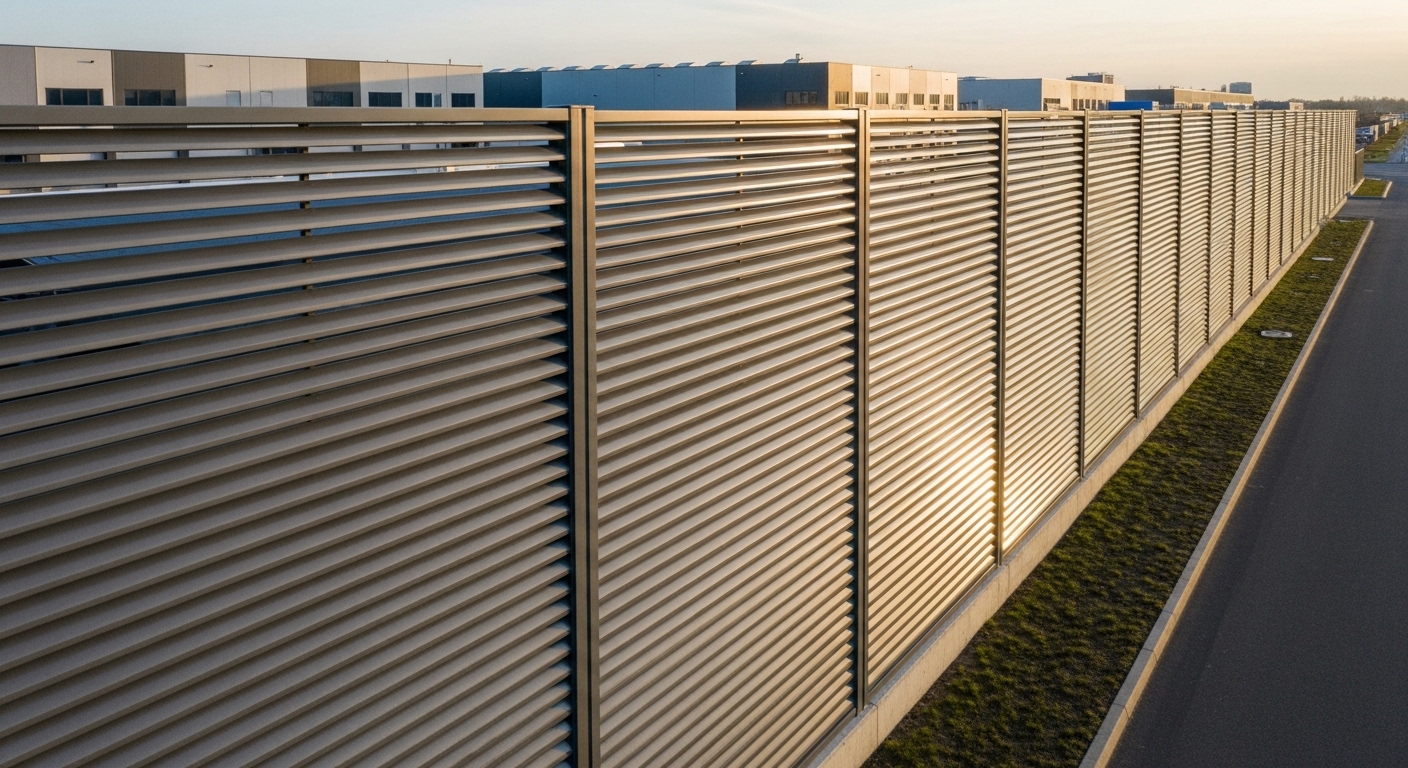
Designing and constructing metal fences for large territorial perimeters, such as industrial facilities, logistics centers, critical infrastructure territories, military bases, and commercial areas, is a complex, multidimensional engineering task. In the modern paradigm of architectural and industrial design, a fence is no longer seen as a simple physical barrier. Today, it is a complex structural and security system subjected to the constant and simultaneous impact of dynamic aerodynamic loads, static stresses, thermodynamic fluctuations, and complex anthropogenic factors. The growing number of physical security threats, particularly a 25% increase in incidents at commercial and industrial sites in recent years, dictates the need for unprecedented attention to every stage of creating a protective perimeter.

An analysis of the operational reliability of large-scale fencing systems convincingly shows that the vast majority of deformations, structural failures, or fatal security breaches occur not due to the poor quality of the metal panels or posts themselves, but as a result of fundamental methodological and calculation errors made during early engineering conceptualization, geodetic surveys, and the development of an integrated security model. The massive scale of these sites, where perimeter lengths can vary from a few hundred meters to tens of kilometers, creates a multiplier effect for any local mistake. An incorrectly calculated wind load on a single span leads to metal fatigue along the entire line; ignoring geological conditions during foundation laying results in massive structural tilting after the very first winter season; the absence of thermal expansion calculations or errors in the architecture of access control systems generate colossal financial losses in repair work. Furthermore, such miscalculations create critical vulnerabilities in the defense infrastructure that intruders can exploit.

Considering that the average cost of mitigating a security breach in the industrial sector exceeds 5.5 million US dollars , and the costs for basic repairs of an improperly installed fence range from 15 to 35 dollars per linear foot , preventive engineering analysis becomes a key tool for optimizing capital and operational expenses. This document offers a comprehensive expert analysis of the seven major and most costly mistakes in designing metal fences for large perimeters. The analysis is based on a deep understanding of the physical and mechanical nature of each problem, an assessment of its immediate and delayed consequences, and the provision of professional engineering and design solutions that comply with modern global norms and standards, including the American ASCE 7 standard, Eurocodes, and State Building Codes (DBN).

TOP 7 Critical Mistakes in Designing Metal Fences

Mistake 1. Ignoring or Incorrectly Calculating Aerodynamic and Wind Loads

Physical Nature of the Problem and Regulatory Gaps

The most common, systemic, and simultaneously most destructive mistake is the intuitive perception of a metal fence as a static and visually “transparent” structure that supposedly does not experience significant environmental impacts. In a real physical model, fences are thin, vertically oriented structures with varying degrees of porosity. When airflow passes around and through them, complex pressure differentials and high-turbulence zones are formed. The laws of aerodynamics cause the emergence of powerful differential forces: the wind creates positive pressure on the windward plane of the panel and simultaneously a suction effect on the leeward plane.

According to fundamental regulatory documents governing construction design, wind load is the primary factor determining structural integrity, support cross-section profiles, and fence architecture. Calculating this load is not a constant; it requires complex mathematical modeling that accounts for local topography, structure height, and permeability.

Decomposition of Wind Load Parameters

To determine the total force acting on each panel and transferring to the load-bearing posts, engineers use a system of specific coefficients. Ignoring even one of them leads to a critical underestimation of the load.

Parameter Description and physical meaning Typical value range Consequences of ignoring
Basic wind speed Wind speed in the region, measured at a height of 10 meters above the ground in open terrain. 30-50 m/s Inability to determine the basic kinetic pressure of the air flow.
Height exposure factor Accounts for wind speed increasing with height from the ground surface. 1.0 – 1.3 Destruction of upper sections of tall industrial fences.
Wind gust factor Accounts for dynamic wind pulsation and the flexibility of the metal structure itself. 0.85 – 1.15 Fatigue failure of metal due to cyclic microdeformations.
Topographic factor Determines local wind acceleration on hills or ridges. 1.0 – 1.2 General collapse of perimeter sections running along hillcrests.
Wind directionality factor Accounts for the angle of incidence of the air flow. Typically 0.85 Overloading of corner support nodes.
Pressure coefficient For thin vertical elements, accounts for the suction effect on the leeward side. -0.7 to -0.9 Tearing panels out of fastenings in the direction opposite to the flow.

Table 1: Basic variables for calculating wind load according to industry standards.

Exposure category deserves special attention. Regulations distinguish between urban development with obstacles, open terrain, and the coasts of open bodies of water. A metal fence with identical specifications installed in an urban zone can withstand winds for decades, but the same fence on a coastline will fail very quickly due to higher dynamic pressure. The degree of panel solidity also directly correlates with the impact force: a “solid” fence takes 100% of the wind force, while a lattice structure lets some of the flow pass through.

Mechanical Consequences of the Mistake: Shear, Overturning, and Deflection

The distributed aerodynamic load creates two critical stresses :

  1. Shear Force: A horizontal force vector near the base that tends to “shear” the profile at the foundation level.
  2. Overturning Moment: A rotational force acting like a lever, trying to rip the post out of the ground.

Without a detailed recalculation of these factors, an error occurs in determining the post spacing. Using a standard spacing for high-wind zones results in the load collection area becoming too large. This leads to exceeding the serviceability limit state (the standard for strength is a deflection limit of L/200, where L is the post height). Exceeding this limit disrupts perimeter electronic systems and causes plastic deformation of the metal.

Engineering Solutions and Optimization Algorithms

  1. Dynamic adjustment of step-intervals: In high-risk zones, the distance between posts must be reduced to distribute the wind energy.
  2. Adaptive profile selection: The post profile should be chosen based on the mathematical modeling of bending moments.
  3. Laboratory certification: Commercial fencing systems must undergo field testing to withstand both design and structural loads.
1 Mistake

Mistake 2. Geotechnical Miscalculations: Foundation Architecture and Embedment Depth

Mechanics of Soil, Water, and Concrete Interaction

Even a flawlessly calculated profile loses its meaning if the underground portion is designed in violation of soil mechanics laws. The foundation is the anchor holding the entire structure. The most frequent mistakes are insufficient drilling depth and incorrect geometric shape of the monolith.

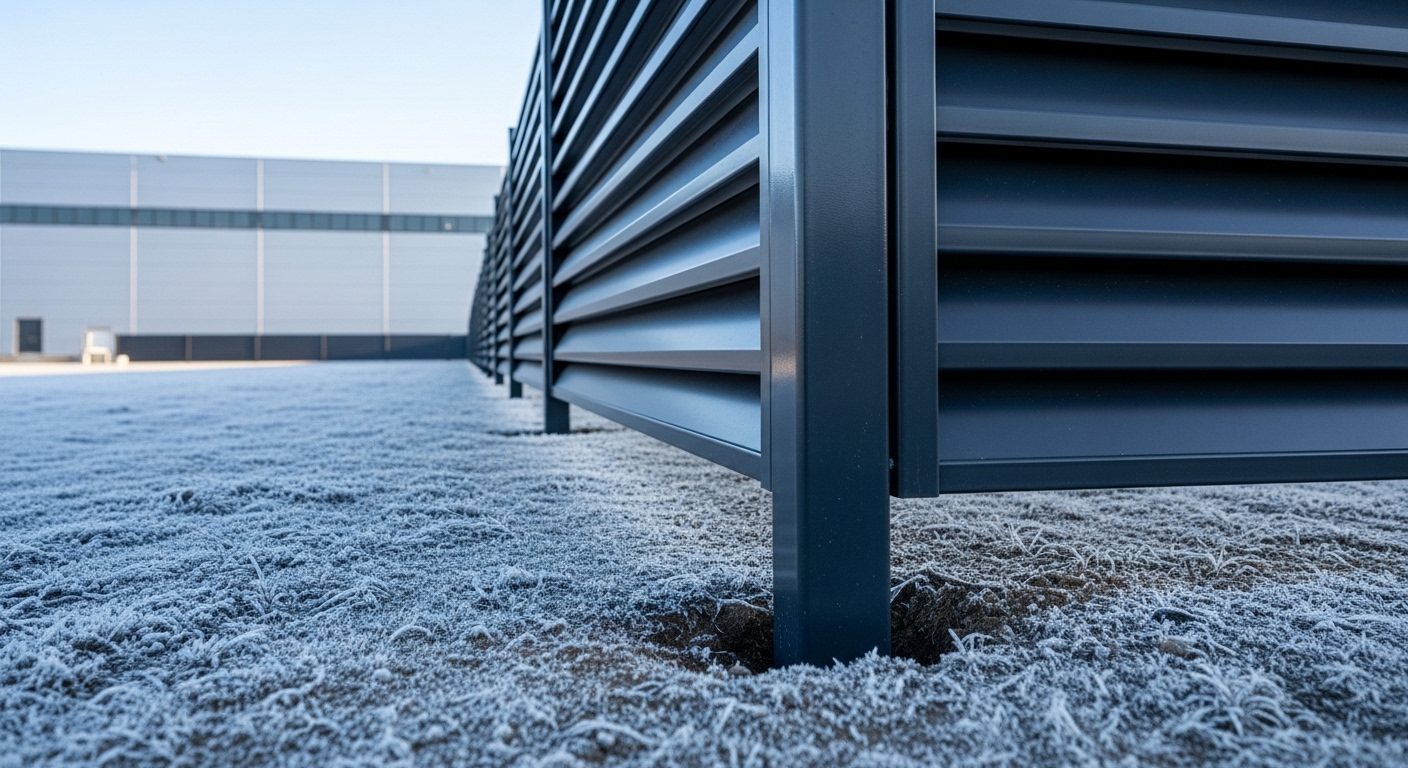
A metal fence faces its real test of strength after the very first winter, during the spring thawing of soils. This process triggers the mechanism of frost heaving. Water in clay soils crystallizes upon freezing, expanding in volume. If the foundation depth is less than the soil freezing depth, the water acts as a powerful hydraulic jack, pushing the post upward. This causes sections to take on a wave-like shape, gates stop closing, and electronic sensors trigger false alarms.

The Geometric Paradox of the “Inverted Cone”

Very often, a hole is formed so that it narrows towards the bottom, creating an inverted cone shape. When the surrounding soil freezes and expands, it exerts colossal pressure on these sloped walls, literally squeezing the foundation up to the surface. Another mistake is forming a wide concrete “threshold” around the post at ground level, which serves as an ideal application point for vertical forces from below.

Engineering Solutions and Geospatial Adaptation

  1. Deep positioning: The base of the foundation must lay below the local soil freezing level by a minimum of 20-30 centimeters.
  2. Cylindrical or anchor geometry: The walls of the drilled hole must be strictly vertical. An optimal solution is creating an expansion at the bottom, turning the foundation into an anchor.
  3. Mandatory geotechnical expertise: The engineer must rely on a geological survey report, as different rocks have varying resistance to lateral sliding and bearing capacity.
2 Mistake

Mistake 3. Thermodynamic Blindness: Linear Thermal Expansion of Metal Structures

The Physics of Thermal Expansion and the Illusion of Rigidity

Metal structures appear absolutely static, but all building materials undergo significant thermodynamic deformations. Ignoring this physical law is a recipe for inevitable disaster. As the ambient temperature changes, the kinetic energy of the metal’s crystal lattice atoms changes. An increase in temperature leads to material expansion (an increase in volume and linear dimensions), and a decrease in temperature leads to its contraction.

The quantitative change in the linear dimension of a structure depends on the initial length of the continuous fence section, the temperature amplitude (difference between the extreme minimum and maximum), and the individual linear thermal expansion coefficient of the specific material.

Material Coefficient (per 1 degree Celsius) Length change of a 100 m panel with a 60-degree difference
Carbon steel 11.7 * 10^-6 ~70 mm (7 cm)
Aluminum alloys 23.0 * 10^-6 ~138 mm (13.8 cm)

Table 2: Comparative characteristics of thermal expansion for key fencing materials.

Cumulative Destructive Impact Over Long Distances

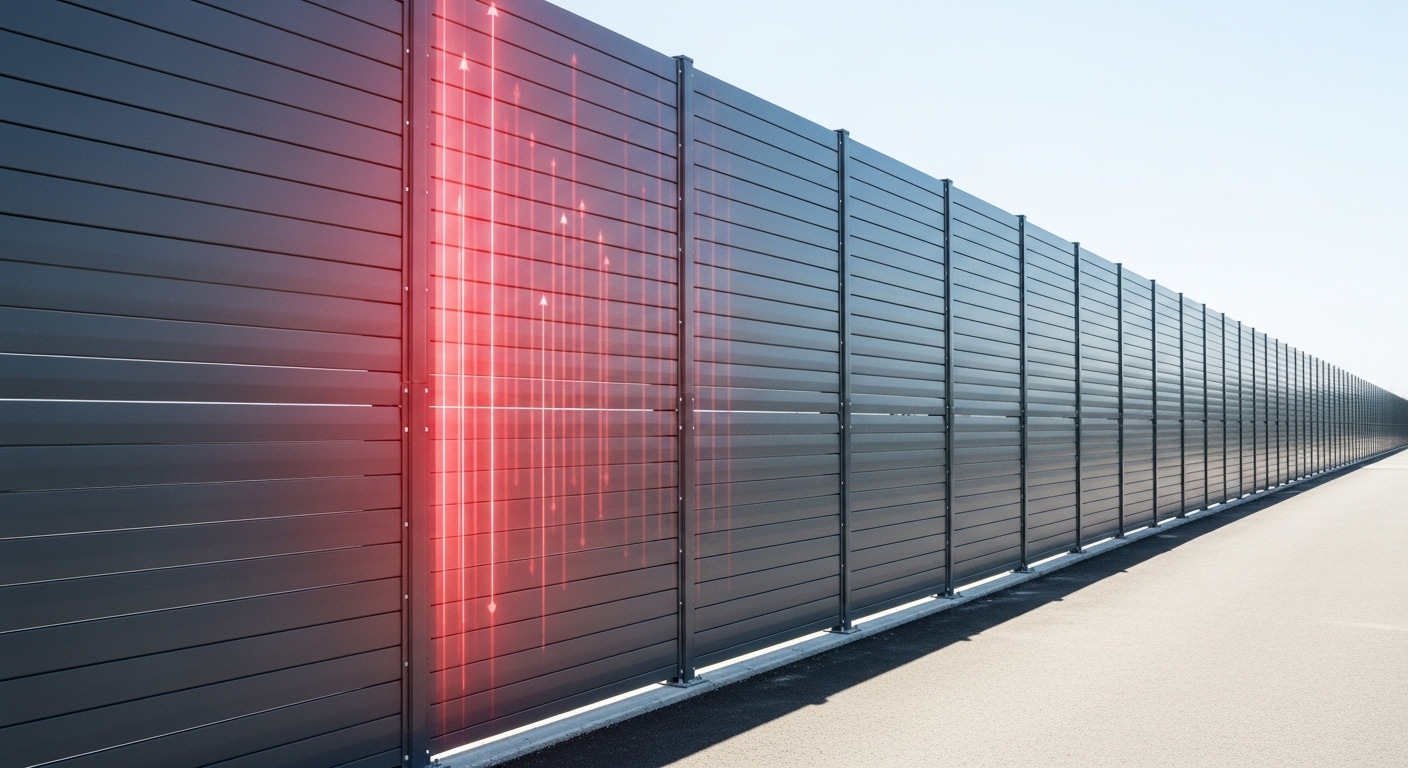
On short sections, this movement is measured in millimeters and absorbed by gaps. However, an industrial facility’s fence can be a continuous structure hundreds of meters long. Dark surfaces act as solar collectors, and in summer, the metal’s temperature can significantly exceed the air temperature. Winter frosts form the lower limit, so the annual amplitude can reach 70-90 degrees Celsius.

Since the ends of the fence are fixed by corner posts in concrete, the structures have nowhere to expand. The energy transforms into internal stresses: steel bolts are sheared, welded seams crack, and the fence plane itself bends into snake-like waves.

Engineering Solutions and Compensation Systems

  1. Expansion joints: Even in favorable climate zones, steel fences should not be continuous for distances exceeding 100-150 meters. Slip joints that allow sections to lengthen independently are installed in these areas.
  2. Flexible mounting nodes: Using oval holes in brackets allows bolts to slide as the metal expands.
  3. Non-rigid linear connection: “Sleeve-tube” joints or U-bolts are used, fixing the tube vertically but leaving a degree of freedom for horizontal sliding.
3 Mistake

Mistake 4. Inadequate Spatial Adaptation to Geomorphology: The Problem of Slopes and Inclines

Terrain Vulnerability and Perimeter Breaches

Large perimeters are rarely located on perfectly flat landscapes. A common mistake is attempting to install standard rigid rectangular panels on complex terrain without proper adaptation.

If a panel is mounted horizontally on a sloped surface, a wedge-shaped gap forms under its lower edge. This creates ideal conditions for unauthorized access: intruders can easily crawl under the fence. Furthermore, these gaps serve as migration paths for wild fauna, regularly causing false alarms in security systems. Attempting to solve the problem by burying the metal in the soil leads to waterproofing degradation and blocks natural water drainage.

Methodological Approaches

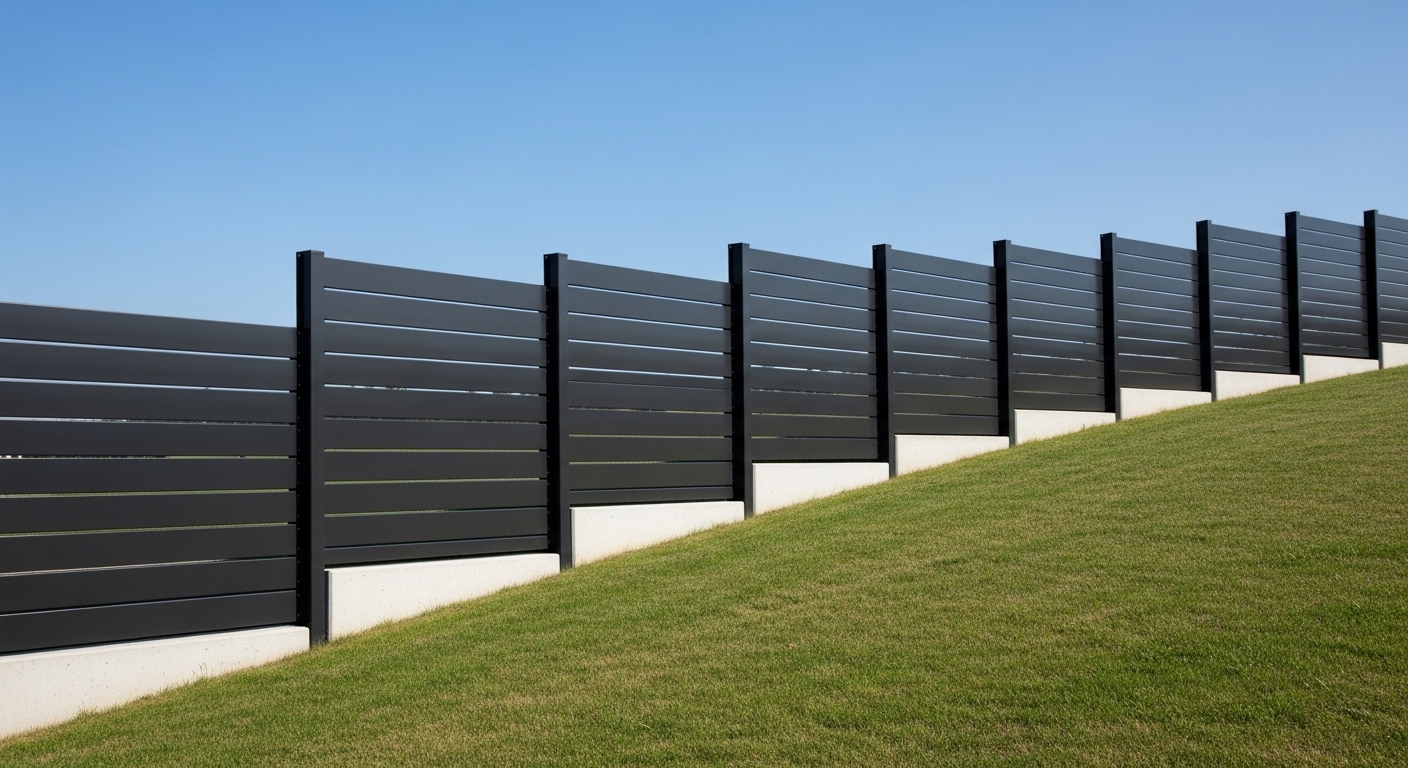
  1. Stepped installation: Each individual panel is installed strictly horizontally, but the next one is attached higher or lower relative to the previous one. Visually, the top line resembles stairs. The downside is that triangular gaps form under each panel on slopes.
  2. Contour installation: Specially designed movable joints or hinged meshes are used. Vertical support posts remain perpendicular to the horizon, while horizontal rails tilt parallel to the ground angle. The advantage is a perfect fit to the ground without gaps.
Criterion Stepped installation Contour installation
Top line aesthetics Stepped Smooth, parallel to the terrain
Ground fit Triangular gaps are formed Full fit without gaps
Security level Low High

Table 3: Comparative characteristics of fence installation methods on complex terrain.

Engineering and Landscape Solutions

If a stepped installation is used, eliminating vulnerabilities under the fence requires designing continuous reinforced concrete strip foundations or short retaining walls exactly along the perimeter line. This completely closes access for digging, stabilizes the soil, and protects the lower edge of the metal from moisture. Alternatively, composite filler boards or compacted soil berms are used.

4 Mistake

Mistake 5. Shortsightedness in Choosing Anti-Corrosion Systems and False Life-Cycle Economy

The Chemistry of Destruction and the Financial Illusion of Savings

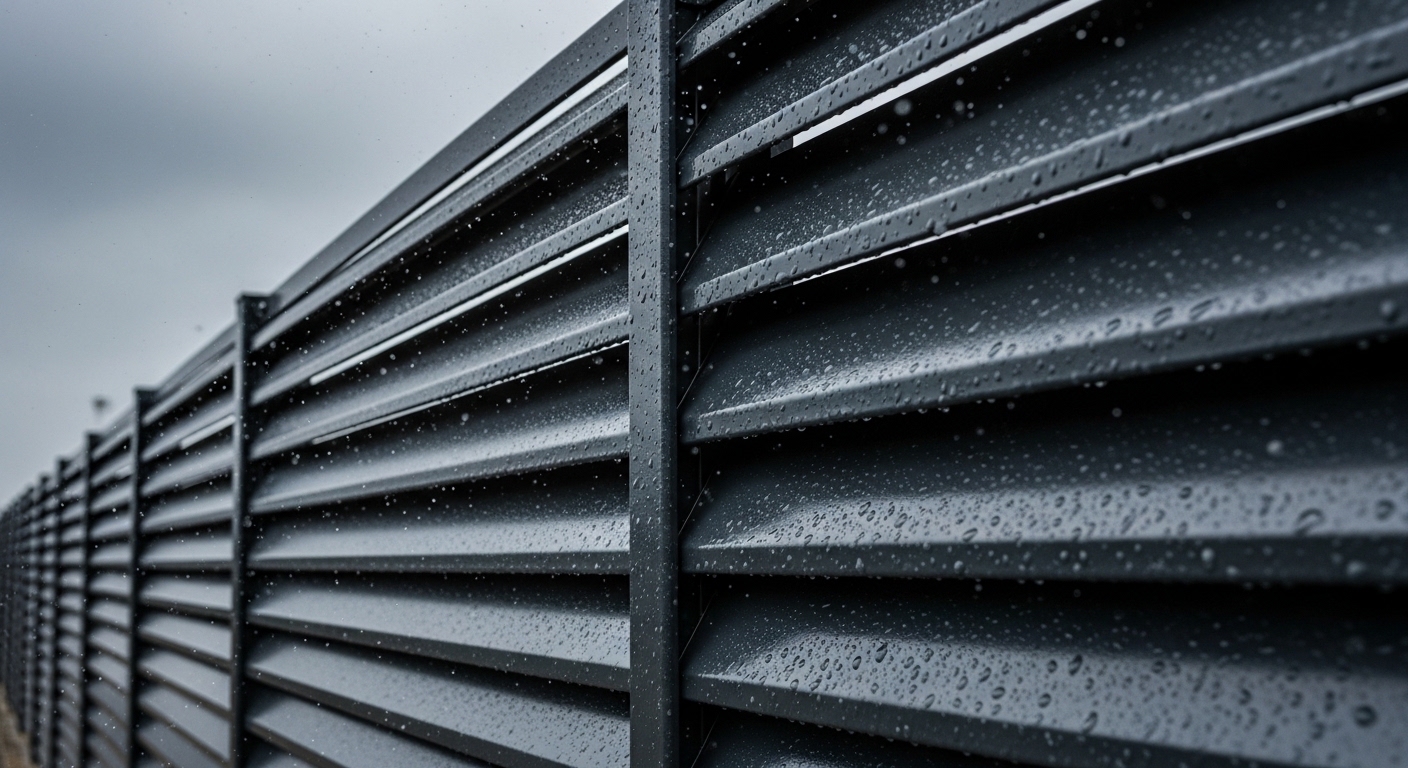
A metal fence is exposed to atmospheric precipitation, ultraviolet radiation, temperatures, and chemically active impurities. Attempting to minimize initial construction costs by choosing the cheapest metal surface coating is a massive mistake.

This strategy turns into a financial disaster during the operational phase. Metal fences without effective treatment last a third as long. When corrosion damages 40-50% of the metal’s cross-sectional area, the structure loses its strength, and any repair loses its meaning—a complete perimeter replacement is required.

Typology of Coatings: From Cosmetics to Cathodic Protection

A fundamental mistake is misunderstanding the difference between barrier and sacrificial methods of steel protection.

  1. Electro-galvanizing: An electrolysis method during which a very thin layer of zinc settles on the steel surface. Its use for exterior industrial perimeters is unacceptable as the layer oxidizes quickly.
  2. Hot-dip galvanizing: Immersing the steel structure into a bath of molten zinc at high temperatures. A metallurgical reaction occurs, forming “sacrificial” protection. If a deep scratch appears on the fence, the zinc around it oxidizes first, preventing the steel from rusting.
  3. Polymer coatings and powder coating: Create a durable polymer layer that isolates the metal. They provide aesthetics but work exclusively as barrier protection: as soon as the polymer is damaged, the steel begins to rust.

Life-Cycle Cost Analysis

For top-tier facilities in harsh climates, engineers use duplex protection systems. This method combines hot-dip galvanizing for cathodic protection with a subsequent powder coat or polymer layer to create an impenetrable chemical and physical barrier. This synergy guarantees an operational life of over 50 years.

5 Mistake

Mistake 6. Isolated Approach to Security: Violating Zoning and Integration Principles

The Conceptual Mistake of the Autonomous Barrier

The deepest methodological mistake is perceiving a metal fence as a self-sufficient security tool. In the field of professional physical security engineering, a reliable perimeter is viewed as an integrated architectural system.

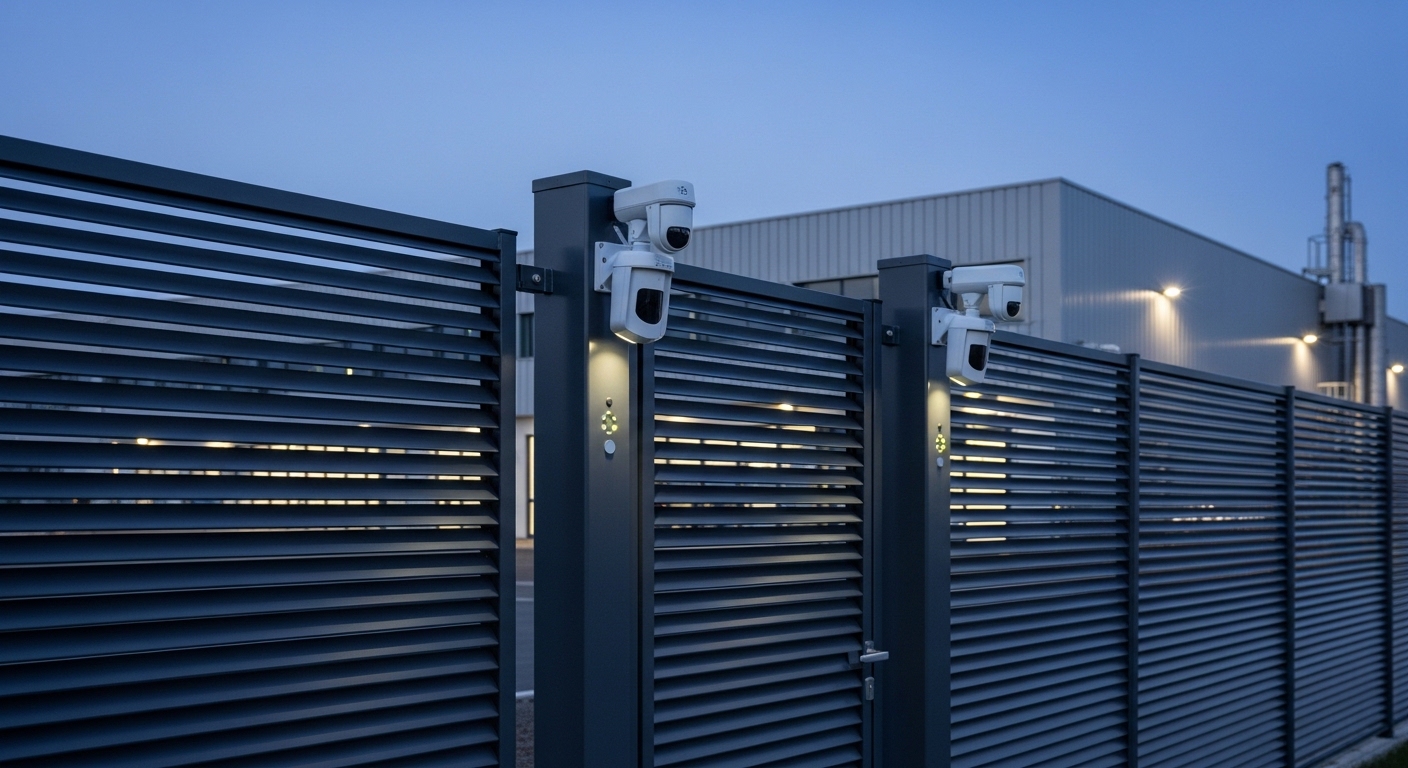
There are no fences that are 100% impossible to overcome. An effective protection paradigm is built on the Detect – Delay – Respond concept. The fence serves exclusively as a delay function. If this physical barrier is not paired with a detection system and a response procedure, the intruder gains unlimited time to bypass it.

Errors in Zoning Architecture and Sensor Placement

  1. Linear sensor placement: Placing vibration cables exclusively on the fence line itself. The system generates an alarm only when the intruder is already interacting with the barrier. Professional security doctrine demands standoff situational awareness: sensors must monitor the approaches to the fence in advance.
  2. Operational bottlenecks: Designing access points without analyzing traffic flows. If gate architecture creates traffic jams, personnel will start disabling automated gates, creating holes in the defense.
  3. Insufficient setback: Placing the fence flush against critical buildings ignores the possibility of vehicular ramming. The fence must form a deep buffer zone.
  4. Weak access control: Using only physical locks instead of electronic systems with license plate recognition.

Implementing Controlled Access Zones

The concept of defense in depth is used to solve these problems. The facility’s territory is divided into several concentric layers: exterior territory, perimeter line, internal buffer zone, critical building shell, and its internal premises. Each subsequent layer requires a higher level of authorization.

6 Mistake

Mistake 7. Ignoring Legal Boundaries, Underground Utilities, and State Building Codes

Geodetic and Legal Disasters During the Layout Phase

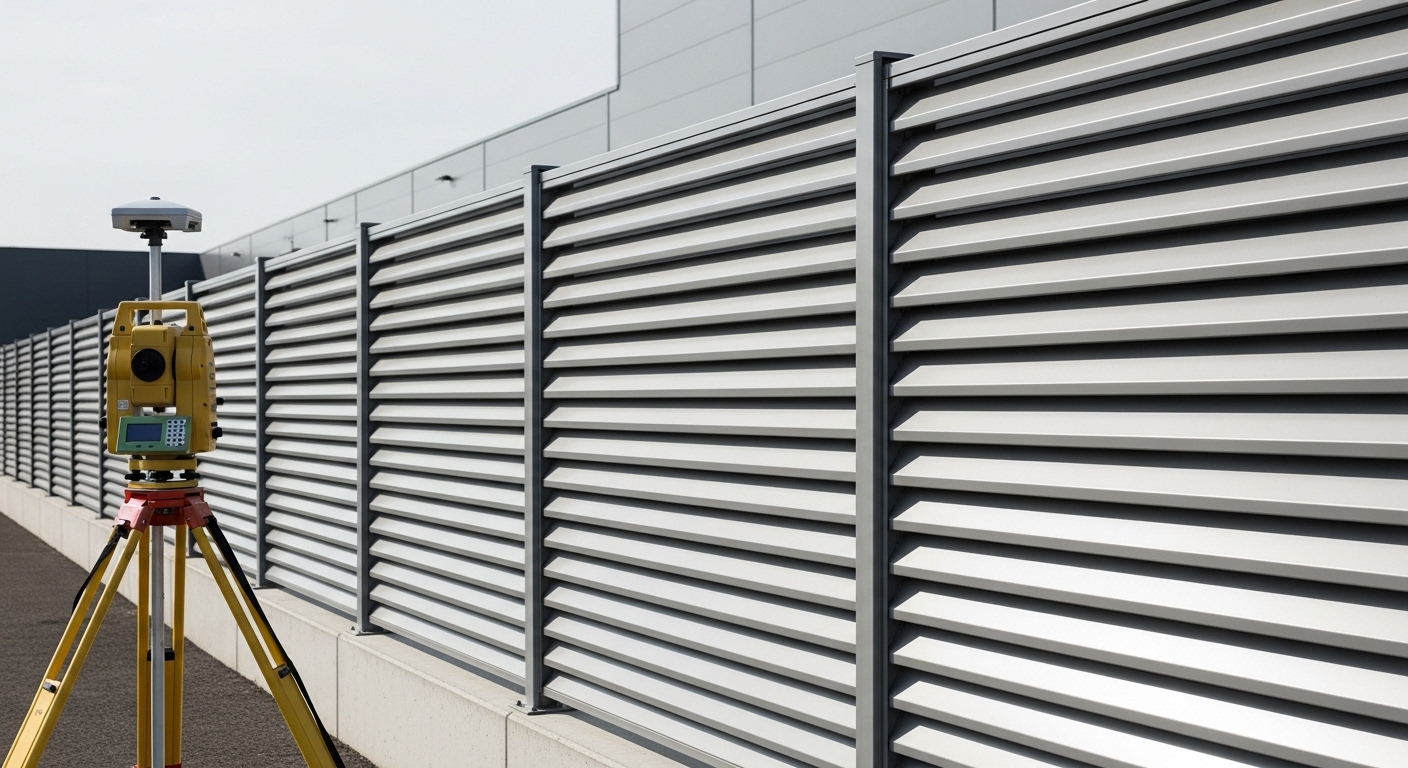
Attempting to start earthworks without conducting a high-resolution topographic survey and obtaining permits is a direct path to man-made accidents or the forced dismantling of structures.

  1. Blindness regarding utility networks: Drilling foundation holes poses a danger if the route intersects unaccounted underground utilities. Damaging a gas pipeline or high-voltage cable results in multimillion-dollar fines and threatens builders’ lives. Design must be accompanied by accurate tracing of underground assets.
  2. Property line violations: An error in positioning the fence even a few centimeters into neighboring territory constitutes illegal land seizure. This ends in lawsuits and orders to dismantle the built system, known as the costly do-over effect.

Compliance with State Building Codes and Fire Safety

The design of industrial fences is strictly regulated by standards. Under heightened threat conditions, special attention is given to the safety of personnel evacuation. A fence must not become a trap during extreme situations.

  1. Evacuation routes cannot be blocked by uncontrolled sections. A closed perimeter must be integrated with emergency release systems (locks must switch to a fail-safe open mode in case of power loss).
  2. Pedestrian gates and vehicle gates on evacuation routes must open exclusively outward.
  3. Drainage collectors (large-diameter pipes) serve as ideal tunnels for infiltrating the territory. They must be blocked with welded metal grates or equipped with specialized sensors.
7 Mistake

Designing and erecting metal fences for strategic perimeters is a complex process. It requires design engineers to possess deep expertise in structural mechanics, geotechnics, thermodynamics, and physical security architecture. A detailed analysis of the outlined mistakes proves that any attempt to save resources during the initial design stage inevitably results in an exponential increase in costs during the operational phase.

Each of the analyzed mistakes generates a dangerous chain reaction. For example, a weak foundation affected by frost heaving leads to leaning posts; this deformation jams the mechanisms of expensive automated gates; broken gates cause traffic jams, and personnel are forced to leave them open, resulting in theft and sabotage. Considering that the average cost of mitigating the consequences of a breach is estimated in millions of dollars, the price of an initial engineering mistake is catastrophic.

Only the involvement of qualified teams, investments in geotechnical planning, the use of reliable anti-corrosion systems, adherence to state building codes, and the implementation of a comprehensive security paradigm can guarantee long-lasting and flawless perimeter protection for a facility.

author
Alex Z
About the author:

Oleksandr — Digital Marketing Expert for Construction & Manufacturing Industries Oleksandr is a seasoned digital marketing specialist, delivering powerful results for the construction and manuf...

More
0 0 votes
Article Rating
Subscribe
Notify of
guest
0 Comments
Oldest
Newest Most Voted
Inline Feedbacks
View all comments