
Introduction to the Architectural Symbiosis of Space and Nature
In the paradigm of modern urban planning and architectural design, biophilic design emerges not as a temporary aesthetic trend, but as a fundamental interdisciplinary approach aimed at restoring the lost connection between humans and the natural environment. Historically, the era of industrialization led to the alienation of urban spaces from biological rhythms. Metal, concrete, and glass became symbols of dominance over nature, associating with coldness, rigidity, and detachment from the organic world. However, the evolution of materials science, the development of parametric modeling technologies, and a deep understanding of the psychophysiology of space have fundamentally changed this concept. Today, innovative metal solutions serve as the most reliable, flexible, and durable framework for integrating living systems and natural patterns into the built environment.
The synergy of metal and biophilia creates a unique architectural symbiosis. On the one hand, nature requires a solid foundation to exist in an aggressive urban environment—reliable supports for vertical landscaping, drainage systems, and protective screens. On the other hand, metal, thanks to modern processing methods (laser cutting, perforation, thermal texture transfer), acquires the ability to imitate organic forms, diffuse light like tree canopies, and improve the acoustic comfort of a space. This multidimensional integration occurs on several interconnected levels: visual (through the imitation of natural textures and colors), structural (through the recreation of biomorphic and fractal forms), functional (through engineering support for living walls and microclimate management), and sensory (through the control of thermal, air, and sound flows).
Research on the impact of this architectural approach on humans proves that spaces which harmoniously combine technological excellence with natural motifs can significantly reduce stress levels, improve cognitive functions, and enhance overall well-being. Extrapolating this data to the scale of commercial and residential real estate, it can be argued that the use of environmentally conscious metal structures has not only humanistic but also profound economic justification, increasing the value of objects and optimizing their operational costs. Further in this study, we will examine in detail the mechanisms by which perforated facades, slatted ceilings, acoustic systems, and gabion fences embody the principles of biophilia in real architectural practice.
Theoretical Foundation: Fourteen Patterns in Metal Architecture
The fundamental theory of biophilic design, systematized by leading researchers in the field of sustainable architecture, relies on fourteen key patterns. These patterns are algorithms for creating spaces that satisfy the instinctive human need for contact with the biosphere. They are classified into three main categories: Nature in the Space, Natural Analogues, and Nature of the Space. An analysis of modern engineering practices shows that the properties of metals and their processing methods allow for the implementation of each of these patterns with a high degree of efficiency.
Nature in the Space: Direct and Multisensory Contact
This category encompasses the physical, visual, and sensory presence of natural elements or the imitation of their dynamic qualities in the built environment.
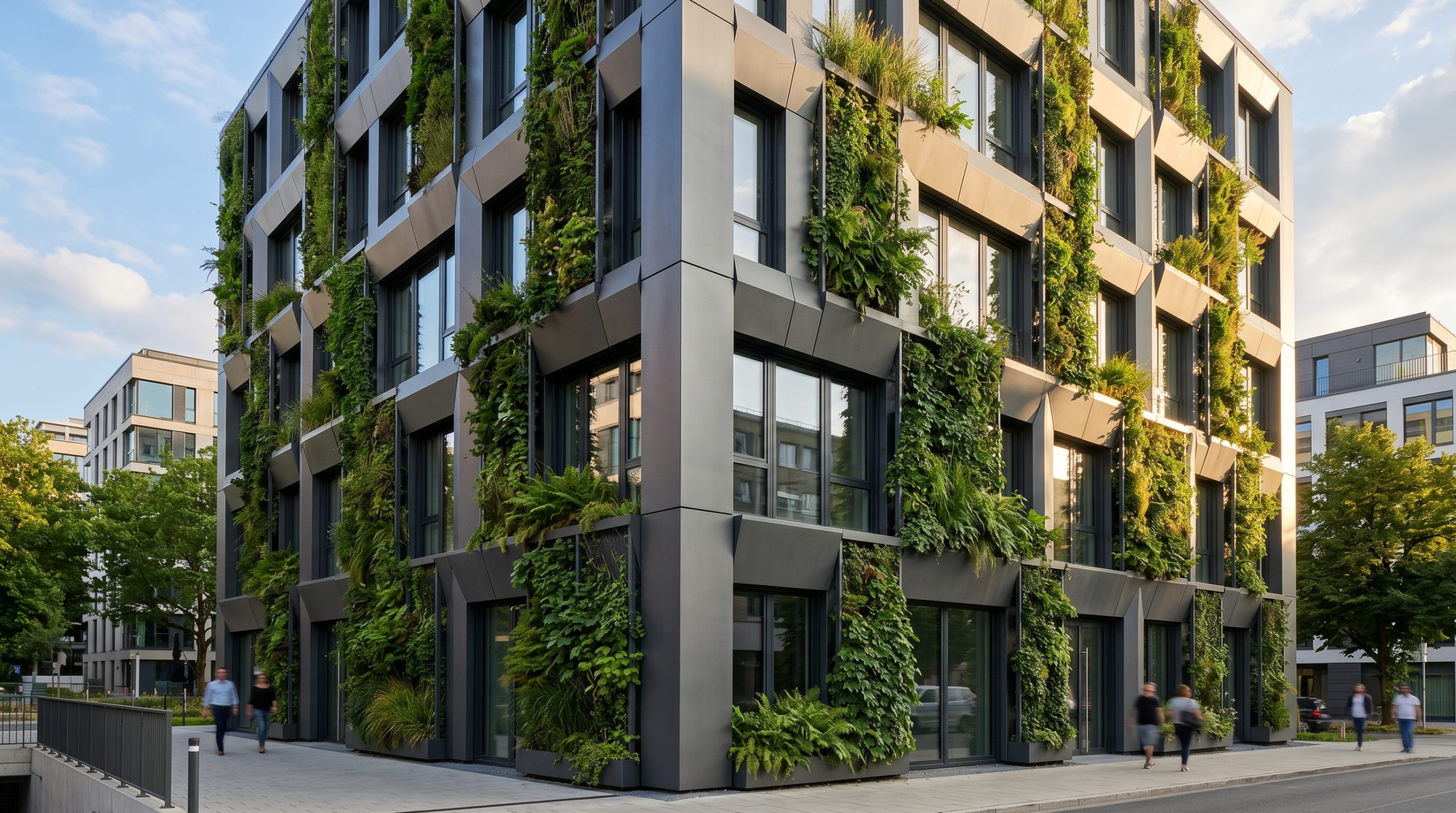
- Visual Connection with Nature: This pattern involves creating conditions for continuous observation of living nature elements. Architectural metals play the role of an invisible yet powerful foundation here. Stainless steel cable systems and welded metal meshes create a large-scale basis for vertical landscaping systems. They allow vegetation to seamlessly wrap around building facades, fences, or internal partitions, providing humans with visual contact with living flora even in a densely built metropolis.
- Non-Visual Connection with Nature: This refers to experiencing nature through hearing, smell, or touch. In urbanization conditions, the biggest stressor is technogenic noise. Metal acoustic panels with special perforation and sound-absorbing backing can transform the acoustic environment. They absorb echoes and harsh industrial sounds, creating a soft, muffled soundscape that psychologically associates with the quietness of a natural landscape, such as a forest. Moreover, air passing through living walls on metal frames is filled with natural aromas.
- Non-Rhythmic Sensory Stimuli: Nature is characterized by unpredictability—a sudden movement of leaves, the play of light on water. The use of thin, flexible metal elements (e.g., hanging chains or lightweight aluminum slats) that respond to the slightest air movement allows for integrating this pleasant kinetic unpredictability into facades and interiors.
- Thermal & Airflow Variability: The sensation of temperature changes and airflows reminiscent of a gentle breeze. Perforated facades and metal sunshades are algorithmically designed to optimize building aerodynamics. Depending on the perforation density, the metal envelope modulates airflows, creating zones with different microclimates and providing natural room ventilation.
- Presence of Water: Water is the most potent biophilic element. Metal structures (e.g., bowls, guide profiles made of stainless steel or copper) serve as the ideal channel for creating indoor waterfalls or rain walls. The ability of metals like copper or brass to change color under the influence of moisture only enhances the visual effect.
- Dynamic & Diffuse Light: This pattern recreates the lighting conditions under tree canopies. Laser cutting of metal sheets allows for the creation of incredibly complex, multi-layered screens. Sunlight or artificial light passing through the geometric or organic openings of these screens creates dynamic shadow patterns on walls and floors that change throughout the day with the movement of the sun.
- Connection with Natural Systems: Demonstrating seasonal changes and ecological cycles. The use of weathering steel (Corten) is a prime example. The rust that covers the facade over the years reflects the passage of time and weather conditions, firmly anchoring the object to its environment and era.

Natural Analogues: Indirect Recreation and Metaphor
This group of patterns operates with metaphors—using non-living, artificial materials to imitate forms, textures, and sequences inherent in nature.
- Biomorphic Forms & Patterns: Moving away from rigid rectangular geometry in favor of organic lines. Metal, due to its plasticity and modern cutting and forming technologies, allows for the creation of elements that imitate cellular structures, leaf veins, hybrid neural networks, or spider webs. Such metal facades or furniture inserts visually soften the space.
- Material Connection with Nature: Humans subconsciously prefer materials that feel authentic and have their own history. Although metal undergoes complex industrial processing, its perception can be “naturalized.” Applying polymer coatings that realistically imitate wood texture (thermal texture transfer technology) combines the psychological comfort of viewing wood with the operational durability of aluminum or steel. Furthermore, the natural patina of copper or brass is perceived as the noble aging of a natural material.
- Complexity & Order: Natural landscapes are characterized by a high level of fractal complexity (e.g., tree branches repeating the shape of the trunk), which simultaneously possesses clear internal order. Metal suspended ceiling systems, particularly multi-level slatted ceilings installed with varying pitches, recreate this hierarchical complexity. The observer’s eye reads the order in the arrangement of the slats, while the depth of the ceiling space creates an intriguing multidimensionality.
Nature of the Space: Psychological and Emotional Perception
These patterns relate to how humans position themselves in space on the level of basic survival instincts and comfort.
- Prospect: The need to have an unobstructed view of the territory to assess the situation and plan actions. Large glazing areas are a standard solution, but they create insolation problems. Metal perforated panels with a high percentage of open area resolve this dilemma: they do not block the view from inside the building but protect against direct sunlight, maintaining a sense of broad perspective.
- Refuge: The need for a safe place from which one can observe the environment while remaining unseen or protected. Dense metal partitions with laser cutting, balcony screens, and deep metal canopies create such safety zones within open office or urban spaces.
- Mystery: The promise of additional information that can be obtained by moving deeper into the space. Translucent metal meshes or complex gabion walls partially conceal what lies behind them, encouraging exploration and forward movement.
- Risk/Peril: A sense of controlled danger that stimulates dopamine release. The use of sturdy metal grating as flooring for bridges or cantilevered observation decks over a void creates an illusion of weightlessness and risk, although the physical and mechanical properties of the metal guarantee absolute safety.
The External Envelope: Facades and Integrated Living Ecosystems
The external envelope of a building is not just a protective barrier; it is the interface between the artificial interior climate and the unpredictability of nature. In the context of biophilic architecture, metal facades have transformed from solid, insulating planes into complex, interactive, and adaptive systems.
Engineering of Vertical Landscaping and Cable Systems
Vertical landscaping, or the creation of “living walls,” is the most direct embodiment of biophilia in dense urban development. This architectural technique maximizes the use of scarce vertical space, turning blank building walls, industrial facilities, and concrete fences into multidimensional green panels. Implementing such projects requires a material with exceptional load-bearing capacity, resistance to biological degradation, and the ability to withstand constant exposure to moisture and root systems. Metal is an irreplaceable choice.
Metal spatial structures and cable systems most often serve as the foundation for climbing and trailing plants (such as decorative ivy, various types of clematis, Virginia creeper, honeysuckle). Designing such systems is a complex engineering task. As the biomass grows, not only does the static load from the plant itself increase, but so do the wind and snow loads on the facade. Therefore, the key element here is the stainless steel cable.
According to engineering standards, stainless steel cables of type DIN 3055 or DIN 3060 are used for these purposes. These products are manufactured through the multi-stage drawing of wire rods made from special grades of alloy steel—AISI 304 (also known as A2) or AISI 316 (A4).
- AISI 304 Steel Grade: This is the baseline solution for most architectural tasks. It demonstrates high resistance to freshwater and general atmospheric impacts, maintaining structural integrity for decades.
- AISI 316 Steel Grade: This is a premium solution for extreme conditions. By adding molybdenum to the alloy, this metal becomes absolutely immune to pitting and crevice corrosion. Cables made from this steel can perform without degradation under the influence of salty sea fog, acidic urban precipitation, or alkaline environments. The operational temperature range for this material is impressive: it withstands stable heating up to 250 degrees Celsius and only begins to experience critical property loss at around 950 degrees.
Structurally, these cables feature a specific weave, such as 6×7 or 7×19 (seven strands with nineteen wires each), ensuring an ideal balance between tensile strength and elasticity. Available diameters range from fine 1-millimeter threads for light plants to massive 25-millimeter ropes capable of withstanding breaking forces of dozens of tons. Geometric meshes are created from these cables, which are attached to facades using spacer brackets, creating an air gap between the wall and the vegetation. This gap is critically important to prevent moisture accumulation on the main wall and to ensure ventilation.
For more complex compositions involving species unable to cling to supports independently (ferns, various succulents, epiphytes, mosses), modular metal structures (vertical greening modules) are applied. These are specialized panels or cassettes (e.g., Green Block systems) that contain substrate pockets and have integrated drip irrigation and excess water drainage systems hidden within the metal frame.
The functional and ecological benefits of such living facades on a metal base go far beyond aesthetics:
- Microclimatic and Thermodynamic Regulation: The plant cover, along with the air gap, acts as a dynamic thermal insulator. During summer heat, leaves absorb solar radiation for photosynthesis, preventing the overheating of the building’s metal or concrete structures. The transpiration effect (water evaporation by plants) additionally cools the adjacent air. In winter, this structure reduces heat loss and protects the facade from cold winds.
- Acoustic Barrier: The urban environment produces vast amounts of low-frequency and high-frequency noise. The biomass of the living wall combined with the complex topography of the metal frame acts as a powerful sound insulator, scattering and partially absorbing sound waves.
- Ecological Revitalization: Living walls perform the function of biofilters. The leaves trap fine dust particles and absorb toxic volatile organic compounds from the air, enriching it with oxygen. This directly affects the productivity and somatic health of people located near or inside such facilities. Additionally, proper acoustics and the aesthetic pleasure of viewing living nature act as natural antidepressants.
Perforated Architecture and Parametric Design
Another powerful direction in facade solutions is the use of perforated facades, which represent individualized exterior cladding systems. In these systems, smooth metal transforms into a functional membrane through strategically designed holes of varying shapes, sizes, and densities.
What makes such facades “individualized” and deeply integrated into the concept of biophilia? First, the use of parametric design technologies. With the help of special mathematical algorithms, complex geometries, such as gradient perforation, are created on the plane of the metal sheet. It can imitate the clustering of leaves on a tree or water flows. This tool optimizes hole placement not only for visual beauty but also for precise calculation of light transmission (creating dynamic lighting effects indoors) and control of airflows around the building.
The materials science base for perforated facades is impressively diverse. The choice of a specific metal dictates both the aesthetic appearance and the functional durability of the object. The generalized characteristics of the primary metals for architectural perforation are provided in the table:
| Material Type | Key Properties and Advantages | Biophilic and Architectural Application Specifics |
| Aluminum alloys | High lightness, absolute resistance to humid air, excellent corrosion resistance, and overall cost-effectiveness. | Ideal material for creating large-scale multi-layered sunshades on commercial buildings. The material’s lightness minimizes the load on the foundation. |
| Corten steel | Formation of a strong rust layer (patina) that halts further corrosion. Exceptional resistance to atmospheric impacts. | Integrates the building into the natural landscape through the “weathering” effect. Symbolizes the flow of time, forming an industrial-natural aesthetic. |
| Stainless steel | Maximum structural strength, resistance to mechanical damage, and aggressive chemical environments (especially grade 316). | Used for luxury facades, complex artistic installations, and objects in coastal or highly urbanized zones. |
| Copper and Brass | Ability to develop a noble oxide patina (from golden to deep green and brown hues). | Forms a premium, evolving appearance. Often applied in historical reconstructions or high-end retail. |
To ensure the durability of metal panels that lack the natural ability to patinate (like Corten or copper), advanced surface treatment methods are used. Anodic oxidation creates an extremely hard crystalline film on the aluminum surface, multiplying its resistance to scratches and wear. Polyvinylidene fluoride (PVDF) spraying or polyester powder coating creates a barrier highly resistant to ultraviolet radiation, sharp temperature changes, dirt, and chemical reagents, which is the norm for modern cities.
In the residential and commercial construction sector (warehouses, workshops, private villas), metal composite panels are also actively used. These panels, typically ranging from 14 to 25 mm thick (standard 16 or 20 mm), consist of an outer metal layer and an inner high-density polyurethane insulation core (about 40 kg/m³). The outer layer of such panels can undergo thermal texture transfer processing, allowing for detailed imitation of wood grains, natural stone cuts, or brickwork. This helps create a traditional or ecological visual style while combining it with the high energy efficiency and fire resistance inherent in metal structures.
Internal Topography: Metal Ceilings and Acoustic Management
The principles of biophilia are equally vital in shaping interior spaces. The architect’s task here is to create an environment that visually, tactilely, and acoustically resembles a safe natural landscape. Thanks to innovations in materials science, modern metal solutions, notably slatted ceilings, can satisfy these complex demands, surpassing even natural materials in operational characteristics.
The Multidimensionality of Slatted Ceilings
Metal slatted ceilings have evolved from simple concealing structures into powerful tools of spatial design. One of the brightest examples is the cube-shaped slatted ceiling. The distinct feature of this structure is the use of U-shaped profiles made of high-quality galvanized steel with a polymer coating, aluminum, or stainless steel.
The main architectural advantage of slatted ceilings compared to traditional solid partitions (e.g., drywall or cassette) is the unlimited possibilities for parametric modeling and creativity. By using various slat sizes, varying their height, width, and mounting intervals on the load-bearing profile, a designer can create deep, voluminous structures that replicate the fractal complexity of nature. Furthermore, the use of special flexible traverses allows for moving away from strict straight lines and installing slats along curved trajectories. This enables the formation of wavy, organic shapes on the ceiling that resemble the movement of water, sand dunes, or the curves of geological strata, directly appealing to the pattern of biomorphic forms.
Metal slats have successfully expanded beyond horizontal planes and are actively used as decorative wall cladding. This solution makes it possible to create visual accents in living rooms or bedrooms, form expressive reception areas in commercial spaces, and visually zone large open-plan rooms without building solid partitions.
The Economics and Durability of Wood Imitation
The visual presence of wood in an interior is one of the most powerful biophilic triggers. However, natural wood has several drawbacks: it is hygroscopic, prone to deformation with changes in humidity, poses a fire hazard, and requires regular application of chemical protective agents (varnishes, antiseptics, flame retardants). The use of metal slats with wood imitation solves this problem.
Thermal texture transfer technology (sublimation) allows for transferring a highly detailed image of wood grains (e.g., “Carini Walnut” or “Larch” shades) directly into the polymer coating of the metal slat. As a result, a product is created that merges the warm aesthetic of nature with the uncompromising practicality of metal. Such metal elements retain their geometry and appearance for decades (the guaranteed service life is around 25 years), are resistant to moisture, mechanical damage, and, most importantly, are fireproof. Maintenance is reduced to a simple wipe-down of the surface without the need to restore the paint layer.
The economic efficiency of such solutions is also attractive. Below is a summary cost table for cube-shaped metal slats of various sizes, enabling architects to optimize their budget by manipulating the volume of the ceiling space :
| Slat cross-section size (W x H) | Base cost of slat (₴ per unit) | Cost of connecting profile (₴ per unit) |
| 35 x 35 mm | 75.55 | 41.95 |
| 35 x 55 mm | 89.19 | 49.55 |
| 35 x 75 mm | 108.16 | 60.08 |
| 35 x 105 mm | 143.32 | 79.66 |
| 88 x 35 mm | 98.93 | 54.98 |
| 88 x 55 mm | 116.84 | 64.93 |
| 88 x 80 mm | 156.16 | 86.74 |
For classic cube-shaped profiles with wood imitation (series width 9 mm and height 40 mm), the pricing policy varies depending on the module length: from 17.81 UAH for a 600 mm long element to 71.2 UAH for a 2400 mm element (incl. VAT). This modularity significantly speeds up and simplifies installation, which is performed by snapping the profiles onto load-bearing traverses without the use of complex tools. Another vital function of such ceilings is the concealment of communications: ventilation ducts, fire suppression pipes, and cable routes are easily hidden behind the slatted structure while remaining instantly accessible for inspection by simply dismounting one slat.
Acoustic Comfort as an Integral Component of Biophilia
Shiny metal surfaces and large expanses of glass in modern interiors breed a serious problem: acoustic discomfort. Smooth metal has a high density and acts as a perfect reflector of sound waves, resulting in multiple echoes (high reverberation time) and a reverberation effect in the room. In a natural environment, sound quickly dissipates among uneven terrain, leaves, and soft soil. To replicate this psychologically comfortable acoustic environment, specialized acoustic metal ceilings and panels have been developed.
The mechanism of their operation relies on a combination of perforated metal sheets and the use of a special sound-absorbing backing (usually non-woven acoustic fleece or mineral fiber panels) bonded to the internal side. When a sound wave encounters such a barrier, it does not reflect entirely. A portion of the sound energy passes through the precisely calculated perforation holes (acting as Helmholtz resonators) into the porous structure of the backing. There, through the friction of air molecules against the fibers, the sound energy is converted into slight thermal energy, effectively dampening the echo.
Measuring the acoustic effectiveness of materials is typically done using the Noise Reduction Coefficient (NRC). A comparative analysis demonstrates the high efficiency of precisely metal solutions:
| Material / Construction Type | Sound Absorption Coefficient (NRC) | Acoustic Class | Application Specifics and Physical Properties |
| Perforated metal + acoustic backing | 0.70 – 0.90 | C to A | Provides excellent absorption at mid-high frequencies (human speech, office noise). Has an exceptionally durable, easy-to-clean surface. Capability for algorithmic perforation tuning to achieve a 0.90 rating. |
| Perforated wooden panels + backing | 0.50 – 0.80 (up to 0.90 only with micro-perforation) | C to B (A possible) | Complex and expensive micro-perforation is required to retain the solid wood look. Typical holes degrade the aesthetics. The material is prone to mechanical wear and moisture deformation. |
| Perforated gypsum boards (with fleece) | 0.50 – 0.85 | C to B | Standard solutions provide a low level of absorption (0.5-0.7). The material is fragile, vulnerable to impacts and moisture, complicating its use in high-transit zones. |
Furthermore, the design of the perforation patterns on acoustic panels can serve the architect’s aesthetic objectives. Modern equipment allows for creating holes of varying diameters such that from a distance they form cohesive artistic compositions—outlines of trees, abstract organic shapes, or complex geometric gradients. Thus, a single building element concurrently fulfills three needs: the physical strength of metal, a biophilic visual effect, and superior acoustic environment control. In symbiosis with other materials (brick, glass, live plants), metal acoustic partitions and slatted ceilings transform a sterile commercial space into a comfortable, human-centric environment.
Boundary Ecology: Fences, Gabions, and Landscape Synthesis
In a historical context, fences served a strictly utilitarian and defensive function, acting as a solid visual and physical barrier between private property and the outside world. However, the concept of sustainable and biophilic landscape design fundamentally alters this paradigm. Modern boundary structures are viewed not as barriers but as “ecotones”—transitional zones that smoothly integrate the object’s architecture into the overall natural landscape, ensuring harmony between boundaries and nature. Gabion fences and artistic perforated metal fences are the cutting-edge tools of such integration.
The Philosophy and Mechanics of Gabion Structures
Gabion fences (for instance, systems produced under the SELECT GABION brand) serve as a striking illustration of the synergy between brutal metal and raw natural materials. Technologically, a gabion is a rigid spatial framework (mesh or basket) welded from thick steel wire. This wire mandatorily undergoes intensive hot-dip galvanization or is coated with polymer anti-corrosion mixtures to prevent oxidation. The internal volume of this structure is densely packed with natural material: crushed granite, river pebbles, basalt rock, quartzite, or even recycled glass or brick.
The unique biophilic and engineering properties of gabion fences include the following:
- Drainage and Ecological Succession: Unlike monolithic reinforced concrete walls or solid corrugated sheets, which disrupt the natural hydrology of the plot by blocking groundwater and airflow, gabions are highly permeable. Water passes freely through the crevices between the stones. Over time, soil particles, pollen, and seeds carried by the wind inevitably accumulate in these micro-cavities. This creates an ideal environment for the development of mosses, lichens, and resilient vascular plants. Thus, over the years, the austere engineering structure literally sprouts with life, merging with the landscape.
- Thermal Inertia and Microclimate: The massive volume of natural stone inside the metal mesh acts as a substantial thermal battery. During a summer day, the stones absorb and accumulate solar radiation, preventing excessive heating of the adjacent air. At night, as the temperature drops, the gabion slowly releases the accumulated heat. This thermal variability effect creates a favorable microclimate for growing sensitive plants right next to the fence while maintaining comfortable conditions for humans, embodying one of the core patterns of biophilia.
- Visual Complexity and Contrast: The combination of perfectly straight, precisely calculated lines of the steel frame (order) and the chaotic, jagged, random texture of the natural stone (complexity) generates a powerful aesthetic effect, directly activating the “Complexity and Order” pattern. Moreover, gabions excellently absorb street noise due to their mass and inhomogeneous reflection surface.
Laser-Cut Metal Screens in Landscape Design
Another trend in boundary architecture is the application of modular metal fencing panels subjected to high-precision laser cutting. CNC laser cutting technology allows for transferring any vector design onto steel or aluminum sheets. In the context of biophilia, these are most often floral motifs: tree shadows, intertwining vines, tropical leaves, or the abstract geometry of honeycombs.
Designing such fences concurrently with the general landscape plan provides architects with numerous advantages :
- Flexible Privacy Control: By varying the percentage of open area (perforation) on different sections of the fence, one can block the view from the roadway side while leaving semi-transparent screens facing a neighboring park or garden, thereby maintaining a visual connection with nature.
- Light and Shadow Dynamics: Metal screens with natural patterns act as light filters. During sunrise and sunset, rays of light passing through the openings cast complex moving shadows onto perfectly manicured lawns or courtyard paving, compensating for the lack of actual trees on newly developed or small plots.
- Foundation for Biocoenosis: The textured structure of laser-cut fences provides ideal anchor points for climbing plants, gradually turning the metal screen into a full-fledged green trellis that complements the overall landscape composition.
Current trends prove that a fence is no longer just a partition. In combination with black metal frames, wooden inserts, and living nature, it becomes an intelligent design element capable of serving as a backdrop for the garden or an independent art object.
Ecological Lifecycle and Material Sustainability
The profound philosophy of biophilic design lies not only in the visual imitation of nature but also in minimizing the negative impact on it throughout the object’s entire lifecycle. It is in this aspect that architectural metals (aluminum, copper, alloy steels) outperform many traditional building materials, including synthetic polymers and even chemically treated wood.
The fundamental ecological advantage of metals is their infinite recyclability. Unlike composite facade systems based on fiberglass or complex plastics, which mostly end up in landfills at the end of their service life, steel and aluminum can be melted down and reused countless times without any loss of their physical or mechanical properties. The disposal of metal slatted ceilings, facade cassettes, or cable systems after a building’s demolition is a highly profitable process that supports the circular economy. Furthermore, extracting and recycling secondary aluminum requires only 5% of the energy expended on primary production from bauxite.
Regarding copper, its lifecycle as a roofing or facade material is one of the longest in the construction industry. Copper’s durability even surpasses the lifespan of premium natural slate, which can last from 75 to 200 years. Over time, copper forms a protective layer (patina) that requires absolutely no maintenance, painting, or cleaning, reducing the use of chemical care products to zero for hundreds of years.
Another critical aspect is indoor air quality. Most modern wood-based sheet materials (MDF, particleboard, plywood) used for wall or ceiling finishes employ formaldehyde resins and glues. Over their operational life, they emit hazardous volatile organic compounds. Metal furniture facade panels, slatted ceilings, and acoustic partitions are devoid of this drawback. They are entirely chemically inert, emit no toxins, do not support combustion, do not promote mold growth in damp rooms, and create the clean, hypoallergenic microenvironment required for a healthy biophilic interior.
Conclusion: Shaping the Architecture of the Future
A synthesis of the presented research data and engineering practices suggests that the historical juxtaposition of industrial metallurgy against fragile living nature is an outdated concept. Under conditions of total global urbanization, increased building density, and inevitable climate change, the integration of biophilic design approaches using state-of-the-art metal solutions is not merely a matter of high aesthetics but an instrumental necessity for ensuring the survival and psychological health of humanity in urban ecosystems.
Metal acts as a reliable, durable, and architecturally flexible framework that orders, supports, and protects delicate natural processes. Molybdenum-infused stainless steel cable systems enable vegetation to safely climb dozens of meters, transforming rigid skyscraper facades into multifunctional green oases that filter migratory dust and optimize thermal flows. Modern perforated facades and metal acoustic ceiling systems successfully take on the functions of non-visual biophilia—manipulating light to cast complex shadows and dampening sound as effectively as forest landscapes do, thereby reducing sensory overload.
Innovative thermal texture transfer technologies applied to slatted ceilings and facade panels expand architects’ abilities to satisfy the instinctive human craving for natural wood while avoiding the operational downsides of organic materials and mitigating the ecological burden of deforestation. Concurrently, the re-evaluation of boundary architecture through the application of gabion fences and laser-cut modules erases rigid, aggressive barriers between private developmental territories and the global landscape, fostering the creation of continuous ecological corridors.
Thus, combining metal with the principles of biophilia is a highly technological and deeply humanistic tool. It enables spatial planning professionals to implement the fourteen patterns of connection with nature at any scale: from an acoustic panel in an office space and a textured slatted ceiling to grandiose vertical forests on skyscraper facades. This symbiosis guarantees the creation of a sustainable, durable, and adaptive environment where engineering power does not suppress nature but is harmoniously subordinated to its laws and the interests of humanity.
Related articles
Top 7 Companies to Buy Gabions in Ukraine: Ranking of Trusted Manufacturers
Rating of reliable manufacturers. Price comparison, expert tips on wire thickness and stone selection for durability.
Warranty for metal structures in Ukraine: Legal regulation, engineering standards, and judicial practice
Metal structure warranties in Ukraine: Legal regulation (10 years), DBN standards, ISO corrosion protection, fireproofing, and how to file defect claims.
Top companies performing foundation works in Kyiv
Rating of TOP foundation work companies in Kyiv 2026. Current prices, contractor comparison, market analysis, and expert advice on choosing a reliable foundation.