
The Paradigm Shift in 21st-Century Railway Infrastructure
The role of railway terminals in the structure of the modern city has undergone a fundamental transformation over the past two decades. While in the 19th and 20th centuries, railway stations served a predominantly utilitarian function as points of arrival and departure, acting as a kind of industrial gateway, the modern paradigm has transformed them into complex, multifunctional public spaces. An analysis of global urban processes indicates that the successful integration of a transport hub into the urban fabric becomes a catalyst for the economic development of surrounding areas, a benchmark for energy efficiency, and a model of universal design. Given these trends, the creation of modern railway stations requires architects and engineers to adopt a synergistic approach that combines the preservation of historical heritage, the implementation of innovative environmental technologies, and the guarantee of absolute inclusivity.
Global challenges, such as rapid urbanization, the climate crisis, and rising demands for social equality, have forced European countries to reconsider their approaches to the design and modernization of infrastructure. Modern reconstruction of historical terminals is not just about upgrading tracks or cosmetic repairs to waiting areas. It is a profound process of space re-conceptualization, where the station acts as an urban hinge, stitching together districts previously torn apart by railway lines. Studying how leading European architectural studios and engineering consortia have resolved these conflicts provides invaluable experience for Ukraine. Our state, standing on the threshold of large-scale post-war reconstruction, has a unique opportunity to implement the highest global standards while bypassing the stage of obsolete solutions.
This study analyzes seven outstanding European projects of railway terminal modernization in detail. Each of these sites demonstrates a unique approach to solving logistical, engineering, environmental, and social problems, offering ready-made paradigms for the transformation of the domestic transport system. Particular attention is paid to aspects of energy autonomy, integration into the urban planning context, and the implementation of barrier-free standards, which are critical for the Ukrainian reality.
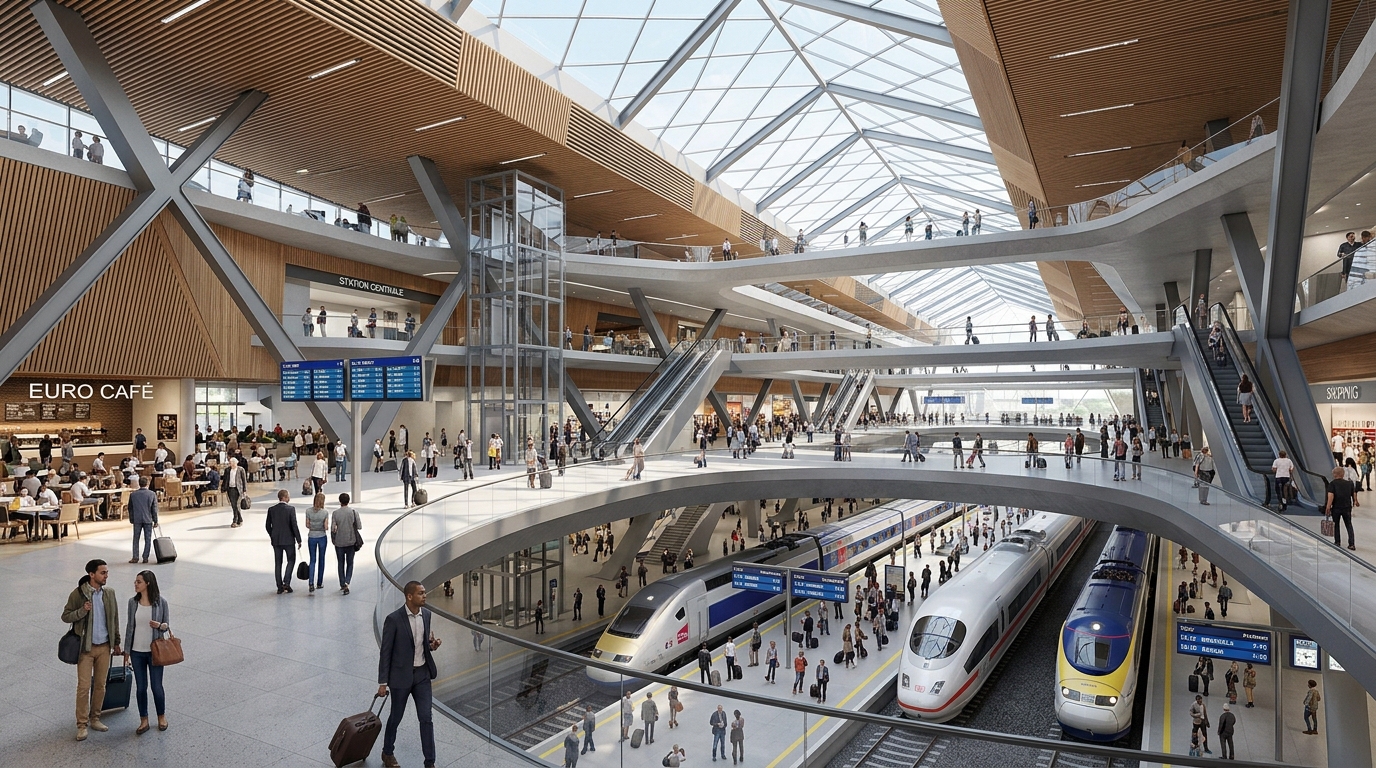
Theoretical Basis: Transit-Oriented Development and Multimodality
Before turning to a detailed analysis of specific cases, it is necessary to define the theoretical framework within which modern infrastructure facilities operate. The concept of transit-oriented development involves the creation of compact, pedestrian-friendly, multifunctional urban spaces around transit hubs. Multimodality becomes a key criterion for success: the station is no longer viewed solely as a railway facility; it becomes a point of seamless intersection for high-speed trains, urban subways, trams, buses, micromobility transport, and pedestrian arteries.
European experience proves that a terminal’s throughput depends less on the number of platforms and more on the efficiency of human flow distribution. Avoiding intersecting routes, intuitive navigation through architectural sightlines, and the use of natural lighting for passengers’ psychological comfort—all form the foundation of modern design. At the same time, the integration of renewable energy sources, such as solar panels and geothermal heat pumps, turns buildings from major energy consumers into active participants in the city’s energy market. These theoretical foundations find their practical realization in the examples provided below.

Rotterdam Centraal: Synthesis of Urban Landscape and Renewable Energy
The comprehensive transformation of Rotterdam Centraal in the Netherlands, carried out by a consortium of Benthem Crouwel Architects, MVSA Architects, and West 8, has become a symbol of the city’s progressive vision for urban development. The new terminal was conceptualized not only as a highly efficient logistical hub but also as a full-fledged public space that bridges the historical gap between different parts of Rotterdam.
The architectural expressiveness of the project is built on a play of contrasts between the building’s various facades, responding to different urban contexts. On the city center side, the station features a grand, monumental entrance, organically framed by natural wood and high-quality glass. The use of wooden surfaces in the interior has a clear psychological justification: this material is intended to soften the industrial scale of the structure, creating a warm, welcoming atmosphere for travelers that contrasts with the cold metal of traditional stations. Conversely, the exterior canopy is made of stainless steel, forming a bold, futuristic silhouette against the backdrop of modern skyscrapers for which Rotterdam is famous.
Spatial organization within the terminal is based on the principles of intuitive navigation. A wide, open concourse, free from unnecessary visual barriers, allows passengers to navigate with ease. High ceilings and clear sightlines ensure that travelers can effortlessly find ticket offices, retail areas, and paths to the platforms, avoiding feelings of overcrowding even during peak periods. This seamless blend of practicality and elegant design makes the station equally comfortable for daily commuters and tourists leisurely exploring the city.
However, the greatest achievement of Rotterdam Centraal is its environmental strategy, demonstrating a deep understanding of the principles of energy sustainability. The shape of the grand roof was dictated not only by aesthetic considerations but also by rigorous calculations of solar insolation. Integrated into the roof, which has a total area of 28,000 square meters, are more than 130,000 photovoltaic panels covering about 10,000 square meters of surface. Engineers approached the design with a high level of foresight: they analyzed not only current solar incidence angles but also modeled shadows from high-rise buildings planned for construction around the station in the coming decades.
This approach makes the Rotterdam Centraal roof one of the largest examples of solar panel usage at a railway station, not only in the Netherlands but in all of Europe. Thanks to this massive generation, total carbon dioxide emissions associated with the facility’s energy consumption have been reduced by eight percent. The building’s environmental profile is complemented by energy-saving lighting systems and rainwater harvesting technologies, highlighting the architects’ commitment to the ideas of environmental responsibility.
| Characteristic | Rotterdam Centraal Parameters |
| Total roof area | 28,000 m² |
| Solar coverage area | 10,000 m² |
| Number of solar panels | Over 130,000 units |
| CO2 emission reduction | 8% of total energy consumption |
| Main materials | Wood, glass, stainless steel |
King’s Cross: Digital Engineering and Preservation of Grade 1 Heritage
In London, the regeneration of King’s Cross station has become one of Europe’s most ambitious projects, combining the preservation of historical heritage with ultra-modern infrastructure. The historical building, designed by the eminent engineer Lewis Cubitt in 1852, had remained one of the least attractive parts of central London for decades, suffering from chaotic extensions and logistical bottlenecks. A transformation costing over £500 million (the total regeneration budget was about £547 million) required a delicate balance between conserving a Grade 1 protected object and the needs of a hub serving 50 million passengers annually.
A key architectural intervention was the creation of the new Western Concourse, designed by John McAslan + Partners in collaboration with Arup engineers. Instead of intervening in the original building structure, the architects erected a gigantic single-span covered space of 7,500 square meters next to it. The roof of this concourse is a wave-like steel diagonal lattice structure weighing 985 tons, rising to a height of 20 meters and spanning 150 meters in width. This architectural gesture allowed for the reorientation of passenger flows to the west, which in turn enabled the demolition of ugly extensions in front of the southern facade and the exposure of Cubitt’s original brickwork, creating a new urban plaza: King’s Cross Square.
Realizing such a project within a functioning station required an unprecedented level of digital coordination. The design team used MicroStation software to create a federated 3D model, consolidating data from numerous disciplines. This helped avoid clashes during construction, guaranteed no disruptions to subway and mainline train services, and met strict English Heritage requirements. A separate complex stage involved acoustic modeling in the Western Concourse and developing a migration strategy for telecommunications networks. Fourway designed over 10 new rooms for communications equipment, ensuring a phased system transfer without service interruptions for passengers or operators.
The King’s Cross environmental strategy covers both local innovations and large-scale corporate initiatives. Directly on the station’s historical glass vaults, Romag installed 1,392 special laminated photovoltaic modules with a total area of over 2,300 square meters. These BIPV (Building-Integrated Photovoltaics) elements, where solar cells are bonded to glass and protected by a layer of Tedlar polymer, generate 175,000 kWh of electricity per year, reducing carbon emissions by over 100 tons annually.
On a macro level, operators entered into a 15-year Virtual Power Purchase Agreement (VPPA) with Shawton Energy. Since space for generation on the station grounds themselves is limited, renewable energy is supplied from a remote 28-acre solar farm, where 14,000 panels with a total capacity of 8.6 MW are installed. This agreement secures about 40% of the annual electricity consumption for the entire King’s Cross complex, saving 2,100 tons of carbon emissions annually. Furthermore, Buro Happold engineers developed a recycling system that uses waste heat from office building air conditioning systems to provide hot water to neighboring residential buildings, aiming to reduce energy intensity by over 50% by 2035. At the landscape design level for King’s Cross Square, the GreenBlue Urban StrataCell modular soil management system was used, which withstands massive structural loads while leaving 94% of the volume free for tree root development, providing greenery over underground tunnels.
Utrecht Centraal: Philosophy of a Single Roof and Passenger Flow Decompression
Utrecht Centraal station is the largest and busiest transit hub in the Netherlands. Originally built to handle 35 million passengers annually, it gradually became overloaded, serving 88 million travelers per year with a trend for further growth. To resolve this capacity crisis, Benthem Crouwel Architects applied a radical approach of spatial decompression and multimodal consolidation.
The primary conceptual solution was the creation of a massive wave-like roof measuring 250 by 95 meters, which serves as a single umbrella covering the entrances to railway, bus, and tram platforms. Thanks to this structure, the entire terminal was transformed into a single, light-filled space functioning more like a covered city square than a classic transit building. To enhance this impression, the architects consciously used specific paving characteristic of outdoor plazas and developed a lighting system that imitates an urban environment.
Transparency became a key tool for visual space expansion. Massive glass facades hang from the enormous roof like sheer curtains, providing passengers with an unobstructed, direct view of trains moving below and a panoramic view of the city skyline. At the same time, the interior of the concourse was intentionally left restrained in color and style. The architects held the idea that the station should draw its vibrancy and dynamics from the crowd of passengers, navigational boards, and traffic movement, without overloading the space with extra decor.
An important part of urban integration was correcting historical planning errors. Previously, the station was structurally integrated with the Hoog Catharijne shopping center, creating confusion in navigation and forcing passengers to wander through shopping mazes. During the reconstruction, the station was physically separated from the commercial complex. Now, it is flanked by two spacious open city plazas, ensuring a smooth transition between the city and the infrastructure. Two clearly articulated entrances logically direct passengers directly to the historical city center or the Jaarbeurs exhibition complex, making navigation intuitive and straightforward.
Gare de Strasbourg: Structural Glazing as a Tool for Non-Invasive Restoration
The modernization of the station in Strasbourg (France) is a textbook example of how to integrate advanced technologies into architectural heritage without destroying it. The need for expansion arose in 2005 due to the city’s integration into the TGV high-speed train network on the Paris-Munich route. The main problem was the station building itself—an outstanding monument of Neo-Renaissance architecture built in 1883 by Berlin architect Johann Eduard Jacobsthal as a symbol of the German presence in Alsace, which was under strict state protection.
The studio AREP (architects Jean-Marie Duthilleul and Jean-François Blassel), together with RFR Ingénieurs, proposed the concept of a “glass cocoon” or a water drop. Instead of reconstructing or destroying historical walls, they built a colossal self-supporting steel and glass canopy in front of the massive stone facade. This elliptical structure covers an area of about 6,000 square meters, reaching 120 meters in length and 25 meters in height and width. This approach allowed for expanding the useful area of the station, protecting the facade from atmospheric effects, and simultaneously maintaining its visibility from any point in the adjacent Place de la Gare.
From an engineering perspective, the project became a real breakthrough in structural glazing. For the first time on such an unprecedented scale, cold-bending technology for laminated safety glass (LSG) was used. Unlike traditional hot-molding in ovens, cold-bending allows for a perfectly smooth surface. This completely eliminated undesirable optical distortions, anisotropy, and reflections, guaranteeing the perfect transparency of the dome. The load-bearing frame is formed by 16 main arches spaced 9 meters apart, connected by horizontal struts (Fink trusses) every 4.5 meters.
The environmental and climatic efficiency of this shell is no less striking. The glass units consist of several high-tech layers: an external 6mm ultra-clear tempered glass with a double black-and-white screen print, a middle polymer layer for solar radiation control, and an internal layer of low-emissivity (low-E) glass. This complex “sandwich” functions as a passive climate system. Thanks to well-thought-out natural aeration, the buffer zone under the glass does not overheat in summer (there is no greenhouse effect), while in harsh Alsatian winters, it retains heat, forming a comfortable transitional microclimate for passengers before they step outside.
Antwerpen-Centraal: Vertical Stratification of Space and Tunneling
Antwerp Central Station (Belgium), inaugurated in 1905 and designed by architect Louis Delacenserie, is often called a “railway cathedral” thanks to its monumental dome, lush Neo-Renaissance decor, and Byzantine motifs. However, at the end of the 20th century, this architectural gem faced an existential logistical problem: the station was a dead-end. All trains arriving in Antwerp had to stop, change direction, and depart via the same tracks, making it impossible to integrate the city into the rapidly growing European network of high-speed through-trains between Amsterdam, Brussels, and Paris.
The solution to this problem by NMBS and Infrabel engineers became a masterpiece of underground construction. The decision was made not to relocate the station outside the center but to transform it vertically. A 3.8-kilometer tunnel was bored under the existing historical building, and a multi-level stratification of platforms was created, turning the terminal into a complex four-story logistical mechanism. Now the station functions on three platforms at different depths:
- Level +1: Preserved original historical hall and six dead-end platforms under massive steel trusses.
- Level -1: Four new dead-end tracks for local and regional connections, finished in brick.
- Level -2: A deep through-level with tracks for international high-speed trains (such as Thalys), which now pass through the city in transit at speeds of up to 120 km/h.
Executing such massive excavation work directly beneath an architectural monument required extreme precautionary measures. Engineers used advanced vibration damping technologies, reinforced foundations with reinforced concrete shells, and ultra-precise laser measurement systems during tunnel boring. Thanks to this, the majestic dome and facades remained absolutely untouched. Work lasted for eleven years and, most importantly, did not stop passenger traffic.
In parallel with the underground work, architects carried out a meticulous restoration of the ground level: stone surfaces were carefully cleaned, the iron roof structure was repaired and painted, and stained-glass windows were restored. To connect the new underground levels with the historical hall, a new atrium was created, providing all levels with natural light and ventilation, while a complex system of escalators guarantees seamless movement for 50,000 daily visitors. This reconstruction is a benchmark example of how engineering boldness can ensure infrastructure efficiency without compromising historical heritage.
Wien Hauptbahnhof: Geothermal Innovations and Comprehensive District Regeneration
Vienna Central Station (Wien Hauptbahnhof) is an outstanding example of creating transport infrastructure from scratch on the site of outdated facilities. Opened in 2015, it replaced two former dead-end terminals (South and East), becoming a central through-hub connecting four main European lines. Thanks to 16 tracks and 15 platforms, it serves approximately 268,000 passengers and 1,100 trains daily, making it the busiest in Austria.
The project, developed by a consortium featuring architects Ernst Hoffmann, Theo Hotz Partner Architekten, and Albert Wimmer, is distinguished by its expressive architecture. The complex is dominated by a grand diamond-shaped roof with an area of 25,000 square meters, made of glass and steel. Its wave-like, translucent structure not only creates a dynamic visual image but also provides energy-efficient covering with optimized natural light. When designing the interiors, the main goal was to prevent the formation of “blind spots” that could provoke criminal activity. Therefore, halls and stairs were designed to be as wide and well-lit as possible, without dark corners or narrow passages, and glass inserts in the floor allow daylight to reach even the underground garages.
However, Vienna Station’s greatest achievement is its integration into the city’s sustainable development strategy. The facility functions not just as a consumer of resources, but as an integrated energy hub. In the 100-meter North Hall and other zones, a floor heating and cooling system is implemented, powered by geothermal energy, while ventilation is automatically regulated by CO2 sensors. This strategy extends beyond the building itself: in 2024, the covering of the neighboring Vienna West Station with a massive 25,500-square-meter photovoltaic system was announced.
An even deeper innovation is the launch of a joint venture between OMV and Wien Energie called “deeep.” The goal of this project is to scale deep-water geothermal generation technology around urban hubs. Heat is extracted from underground formation waters, transferred through massive heat exchangers and heat pumps into the district heating network, after which the cooled water is returned underground in a sustainable, open-loop closed cycle. There are plans to create up to 7 geothermal plants with a total capacity of 200 MW. By 2028, the deeep system should provide heat to 20,000 households, with prospects for expansion to 200,000 units, supporting Vienna’s goal to reach climate neutrality by 2040. The station also served as an anchor for large-scale urban regeneration: around it, on 109 hectares of former industrial land, the eco-friendly Sonnwendviertel district was built with 5,000 apartments and significant commercial space.
| Indicator | Wien Hauptbahnhof and Vienna Infrastructure Statistics |
| Passenger flow | 268,000 people daily |
| Infrastructure | 16 tracks, 15 platforms, 1100 trains/day |
| Main roof area | 25,000 m² (diamond-shaped structure) |
| Geothermal network capacity (deeep project) | 200 MW (target indicator) |
| Revitalization zone (Sonnwendviertel) | 109 hectares, 5,000 apartments |
Gare de Mons: Urban Bridge and Spatial Stitching of Torn Territories
The railway station in Mons, Belgium, designed by star architect Santiago Calatrava, is one of Europe’s most modern infrastructure facilities. The project, development of which began after winning a contest in 2004, was finally completed and inaugurated in early 2025, immediately receiving recognition from the Prix Versailles as one of the seven most beautiful railway hubs in the world.
The conceptual foundation of Gare de Mons goes far beyond traditional transit functions. For decades, railway tracks had formed a deep wound on the city’s body, tearing it into two isolated parts: the historical center and the new northern district of Grands Prés. Santiago Calatrava conceptualized the new structure as a grand “urban bridge,” intended to stitch this territorial fragmentation together. The heart of the complex is a monumental overhead gallery (distribution hall) 165 meters long and 15 meters high, spanning directly over the railway tracks.
This elevated passage functions as a full-fledged urban promenade street. Thanks to the continuous panoramic glazing of the facade, passengers maintain constant visual contact with the city on both sides, which significantly reduces the psychological “severing” effect inherent in large infrastructure. At ground level, architects provided for complex topographic integration: a series of terraces and squares smoothly compensates for elevation changes between the existing urban fabric and platform level.
Over the 350-meter-long platforms unfolds Calatrava’s signature ribbed canopy of white-painted steel and glass. The roof geometry is characterized by a clear hierarchy of primary arches and secondary transverse ribs. Beyond aesthetic perfection, this shape fulfills important acoustic and climatic functions. The open structure facilitates the dissipation of noise from trains in lateral directions, preventing the echo effect (reverberation) inside the facility. The glass units have special frit for modulating sunlight and managing glare, while hidden technical bridges are integrated into the canopy body, allowing service crews to maintain lighting and drainage without stopping train movement.
Gare de Mons demonstrates absolute multimodality: it combines 7 railway tracks, 29 bus stops, taxi ranks, parking areas, and developed infrastructure for micromobility. The space includes over 2,100 square meters of retail space, 3,500 square meters of offices, and 12,000 square meters of landscaped zones. Intuitive navigation is ensured by well-thought-out sightlines and is supplemented by tactile paving for the visually impaired. Thus, the architect succeeded in turning an infrastructure hub into a full-fledged civic monument and a catalyst for the district’s economic revival.
The Inclusivity Imperative: Experience for Ukraine in Post-War Recovery
A deep analysis of European practices is critically necessary in the context of infrastructure transformation, which is currently being carried out by Ukrzaliznytsia. Faced with unprecedented challenges due to full-scale war and a sharp increase in the number of people with disabilities, the company launched a large-scale strategic program, “Barrier-Free Railway,” in 2023. This concept envisions not piecemeal improvements but a systemic approach, the goal of which is to make the passenger’s entire journey, from buying a ticket in the mobile app to boarding the train, completely unobstructed.
Large-scale reconstructions require significant financial investment, and Ukraine is actively attracting European experience and resources. An important milestone was the signing of a statement of intent to conclude a grant agreement for a total of €54 million (of which €41 million is directly from the European Commission through the EBRD) during the URC2024 Ukraine Recovery Conference in Rome. From this budget, €10 million is targeted at implementing infrastructure barrier-free accessibility at stations, €3 million for support programs for veteran railway workers, and the remaining funds cover other critical needs, including the deployment of over 800 mobile shelters at stations across the country.
A fundamental structural problem of Ukrainian railway stations is the discrepancy between the height of platforms and the floor level of modern train cars. Historically, most platforms in Ukraine were built to a standard height of 200 millimeters from the rail head. This creates an insurmountable physical barrier, several steps high, for people using wheelchairs, parents with strollers, the elderly, and passengers with heavy luggage. Solving this problem requires radical rebuilding of capital structures.
Architectural Solutions for Ukrainian Stations: From Kyiv to Lviv
Kyiv-Pasazhyrskyi Central Station, the last large-scale modernization of which took place over twenty years ago in 2001, has become the main testing ground for implementing new accessibility standards. During the 2001 reconstruction, only two out of fourteen platforms (Nos. 1 and 14) were raised to a high standard, while the rest remained difficult for people with limited mobility to access.
Now, with financial support from the EBRD, a capital reconstruction of the second platform (serving tracks No. 2 and No. 3) has begun. The project envisions a strategic solution—raising the platform level from the existing 200 mm to the normative 1100 mm. This change will allow leveling the platform surface with the rolling stock floor, guaranteeing passengers boarding and disembarking without height differences or the need for outside assistance. In addition, the project provides for radical improvement of vertical mobility: the installation of modern elevators and escalators for descending directly from the concourse (the passage connecting the Central and Southern stations) to the platform. Construction is scheduled for completion at this stage by the beginning of 2027, after which, assuming further funding, phased modernization of all remaining low platforms is planned.
The station in Kyiv has already become a model for implementing inclusive services. It is equipped with a specialized barrier-free waiting area with direct access to trains, children’s play areas, and adapted restrooms. For passengers with visual impairments, navigation is provided by tactile tiles and special acoustic orientation beacons at entrances, and for people with hearing impairments, station staff are equipped with tablets providing translation into Ukrainian Sign Language. Interestingly, solving logistics in the western underpass encountered a complex architectural challenge: massive historical stairs at the southern exit made integrating an elevator impossible without destroying a significant portion of the city plaza. Instead of aggressively intervening in the structure, company architects made a more rational decision: to outfit a completely new barrier-free entrance from the other side.
European experience working with heritage (using examples from Strasbourg or Antwerp) proved extremely relevant for the Main Railway Station in Lviv. The building is a historical architectural monument, where punching through capital walls to mount traditional elevator shafts is categorically forbidden or strictly regulated. As an innovative alternative, engineering groups developed designs for installing special curved, extremely gentle ramps of great length. Their specific geometry allows reducing the incline angle to comfortable levels without the need to expand platform dimensions or destroy historical ceilings.
It is also worth noting social resilience: even in Kharkiv, despite constant threats and shelling, a new specialized zone for passengers with disabilities was recently opened, which emphasizes the priority of the social component in crisis conditions. Furthermore, for stations where platform spatial configuration temporarily makes using stationary ramps impossible, 50 special mobile lifting platforms for boarding passengers in wheelchairs have been deployed throughout the country. The human factor is complemented by a “station assistant” service, which can be called via special buttons located in critical transit nodes. And digital inclusivity is maintained by adapting the carrier’s mobile app to the needs of blind users, guaranteeing an unobstructed start to the journey even at the booking stage.
| Inclusivity Criterion | Implementation Parameters (Ukraine Experience) |
| Height of modernized platforms | 1100 mm (instead of the old 200 mm) |
| Funding for barrier-free programs | €10 million (within the framework of the €54 million EBRD grant) |
| Navigation for visual impairments | Tactile tiles, acoustic beacons |
| Navigation for hearing impairments | Tablets with Ukrainian Sign Language |
| Adaptation of historical stations (Lviv) | Integration of gentle curved ramps instead of destroying walls |
Strategic Conclusions and Recommendations
A deep analysis of the design experience of the TOP 7 most modern railway stations in Europe unconditionally proves that the viability of transport infrastructure today is measured not only by its linear throughput but also by the space’s capacity for social adaptation, its environmental footprint, and its level of integration into the urban environment. The cases cited offer an exhaustive methodological guide and experience for Ukraine in the process of post-war renewal.
First, the spatial planning paradigm must move away from the concept of isolated infrastructure islands. European analogs, such as Gare de Mons or Rotterdam Centraal, prove that a transit hub must function as an urban bridge, eliminating “grey zones” of alienation along tracks and turning them into safe, light-filled public plazas.
Second, the implementation of universal design must become an unshakable basis for any subsequent modernization. Strategic decisions at Kyiv station to raise platforms to the normative 1100 millimeters are a key infrastructure shift. As the experience of London and Antwerp testifies, the most complex inclusive infrastructure (elevator shafts, escalators, gentle ramps) can be delicately and effectively integrated even into the highest categories of historical heritage protection, provided advanced methods of digital space modeling are used.
Third, energy autonomy of transport hubs is becoming a national security imperative. The Austrian experience of implementing deep geothermal generation in Vienna and Dutch solutions for mounting massive solar power plants on station roofs demonstrate that infrastructure can turn from a passive consumer into an active energy donor for surrounding residential areas. For Ukraine, where the resilience of critical infrastructure has acquired existential significance, using flat platform roofs for solar generation (BIPV) and entering into agreements for the purchase of renewable energy should become a basic component of the technical task when designing any reconstructions. Implementing these multidimensional European approaches guarantees the transformation of Ukrainian railway stations into modern, sustainable, and humane centers of urban life in the 21st century.
Related articles
Top 7 Companies to Buy Gabions in Ukraine: Ranking of Trusted Manufacturers
Rating of reliable manufacturers. Price comparison, expert tips on wire thickness and stone selection for durability.
Warranty for metal structures in Ukraine: Legal regulation, engineering standards, and judicial practice
Metal structure warranties in Ukraine: Legal regulation (10 years), DBN standards, ISO corrosion protection, fireproofing, and how to file defect claims.
Top companies performing foundation works in Kyiv
Rating of TOP foundation work companies in Kyiv 2026. Current prices, contractor comparison, market analysis, and expert advice on choosing a reliable foundation.