
The Evolution of Commercial Space and the Financial Paradigm of Sustainable Design
The modern commercial real estate market of Ukraine in 2025–2026 shows signs of a profound qualitative transformation. Despite challenging macroeconomic conditions, the retail sector is undergoing an intensive revitalization stage, as confirmed by statistical data. In 2025 alone, over 47,000 square meters of new retail space were commissioned in the commercial real estate market in Kyiv and the regions. Furthermore, developers announced large-scale plans: an additional 250,000 square meters within 14 new shopping malls are expected to be commissioned by the end of 2025, and the opening of an extra 280,000 – 290,000 square meters of retail space is planned for 2026. At the same time, market saturation remains relatively low — about 150–170 square meters per 1,000 inhabitants, which is twice as low as the European average. This deficit creates fierce competition for quality locations and stimulates the development of street retail through the renovation of the secondary property fund.
The sustainable consumption segment — second-hand store chains, vintage boutiques, and upcycling centers — is gaining particular importance in this context. Statistics indicate an unprecedented scale of the industry: second-hand goods account for over 54% of the total volume of finished light industry imports into Ukraine. In recent years, hundreds of thousands of tons of used clothing have been imported into Ukraine, making the country the third-largest importer of such goods in the world, behind only Pakistan and Malaysia. This colossal turnover requires fundamentally new spatial, logistical, and architectural solutions. From spontaneous sales points, the industry has evolved into high-tech commercial spaces. Modern sustainable consumption stores are well-equipped retail spaces in shopping malls with a high level of specialized presentation that challenge traditional retail.
The importance of modern design for financial institutions, developers, and investment funds today cannot be overstated. Investors view the architectural concept of an asset as a key factor in its liquidity. In conditions where the average rental rate reached $17.00 per square meter in Kyiv and $11.12 in Lviv , every square meter of the sales floor must generate maximum profit. This is achieved not only through the product assortment but also through the customer experience, operational expenses optimization (OPEX), and the implementation of energy-efficient technologies. Banks and funds increasingly finance retail projects with ESG (Environmental, Social, and Corporate Governance) criteria in mind. Building innovations in retail, such as obtaining international ecological certificates BREEAM or LEED, are becoming markers of a project’s financial reliability.
In this paradigm, architectural solutions require a holistic approach. The use of modern materials and technologies, particularly products from the domestic factory PJSC “Mehbud” (metal ceilings, ventilated facades, fences), becomes an absolute necessity. Metal, unlike concrete, has a high recycling potential; structures made from it are lighter, faster to assemble, and allow the implementation of the most complex parametric shapes. Below is an expert top rating of Ukrainian and international second-hand companies shaping a new aesthetic of sustainable consumption through the prism of advanced architectural and building achievements.
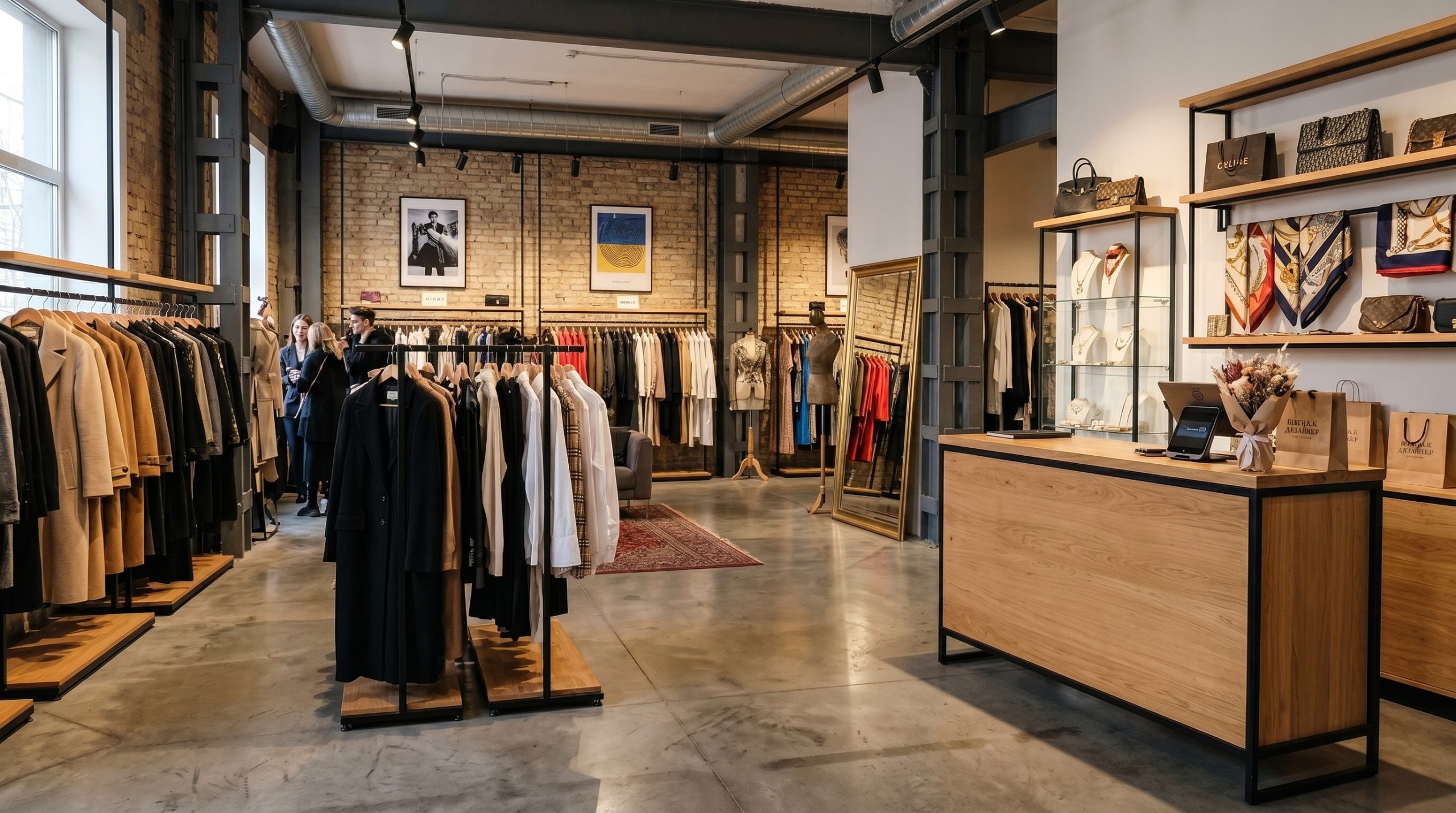
TOP Sustainable Consumption Chains: Company Rating and Architectural Analysis
№1 – “Laska” Charity Store (Laska Store)
Architectural Profile: The “Laska” charity store, founded in 2011, is a pioneer of the conscious consumption philosophy in Ukraine. The company went beyond the traditional second-hand format, creating a space where 70-80% of items are donated to charity, and 20-30% form a commercial fund to maintain the project. The architectural concept of the main flagship space at 3 Lypynskoho Street in Kyiv is an outstanding example of socially responsible design. The renovation project, developed by the leading architectural bureau “Prototyp,” is based on two fundamental principles: transparency of the process and purity of form. Instead of standard commercial shelving, the architects integrated a massive multi-functional table into the space, which acts as the central core, organizing customer flow. The most innovative solution was the use of semi-transparent movable partitions that visually separate the sales floor from the clothing sorting area, turning a utilitarian logistical process into a performance.
Building Achievements: Considering that over 883,850 kg of clothing passed through “Laska’s” logistical capacities , the structural decisions of the premises required creating a wear-resistant infrastructure. The modernization of the venue took place according to the principle of minimal intervention into the historical fabric of the building: high-quality elements of the old space were preserved, which corresponds to the sustainable design paradigm. An inclusivity concept was applied: the space is adapted for free access with pets.
Engineering Systems:
The functioning of a textile reception center requires non-standard climate solutions. The building’s engineering systems include an enhanced supply and exhaust ventilation capable of effectively removing micro-dispersed textile dust. Particular attention was paid to architectural lighting — track systems with a high color rendering index were utilized.
Mehbud Conceptual Design for “Laska” Charity Store
Description: Visualization of how a top second-hand chain of Ukraine can integrate premium ceiling systems. For the minimalist interior of the “Laska” store, a conceptually ideal solution is the T-shaped rack ceiling from the PJSC “Mehbud” factory. This architectural system forms a distinct geometry due to its unique vertical profile with a height of 42, 68, or 105 mm and a width of 34 mm. Made of eco-friendly aluzinc or steel with a polymer coating, such a ceiling creates a complex play of light and shadow. It not only emphasizes the purity of form established by the “Prototyp” bureau but also perfectly conceals the massive ventilation ducts of the sorting area while leaving quick access to them. This innovative solution embodies a balance between industrial aesthetics and refinement.

№2 – “Humana” Chain
Architectural Profile: The international chain “Humana” has been one of the most powerful players in the Ukrainian market since 2003. The geography of its presence covers dozens of cities. The company’s architectural profile is subordinated to strict standards of operational efficiency. The main concept is creating an open space (open-space) with maximum aisle width, which is determined by the logistics of a constant, cyclic renewal of the assortment. Interior design features are streamlined to functional minimalism: homogeneous bright flooring, modular rail systems. Exterior solutions are standardized with corporate colors for immediate brand recognition in any urban environment.
Building Achievements:
The company operates hundreds of facilities of various types — from the ground floors of residential complexes to detached commercial pavilions. Building innovations in “Humana” retail lie in the ultra-high speed of retrofitting secondary real estate. The use of dry construction technologies and modular suspended systems allows the launch of new branches in record-breaking timeframes.
Engineering Systems:
Given the high traffic density during new collection arrival days, structural solutions provide for the reinforcement of inter-floor ceilings to absorb peak dynamic loads. Climate control systems are implemented on the basis of inverter rooftop air conditioners or ducted split systems.
Mehbud Conceptual Design for “Humana” Chain
Description: Architectural solutions in street retail using modern exterior technologies. To unify the heterogeneous facades of leased premises for “Humana” across Ukraine, the installation of cassette facades from the “Mehbud” factory is proposed. This curtain wall ventilated facade (NVF) is mounted on top of existing walls, hiding the defects of old buildings without requiring capital repairs of the load-bearing structures. This ensures a reduction in wall heating during summer heat, saving up to 25-30% of electricity on air conditioning. Metal cassettes manufactured by Mehbud are reliably protected against corrosion and preserve the intensity of corporate colors for decades, forming a neat urban landscape.
№3 – “Econom Class”
Architectural Profile: The “Econom Class” chain, which began its development in Kharkiv in 2006, carried out a large-scale expansion, counting over 140 facilities across the country. This is a classic example of rigid commercial space segmentation. The architectural concept is built around the differentiation of two zones with different psychological impacts on the buyer: the weight-based sales zone and the “Luxury” class goods department. While the weight zone is designed as a warehouse space with utilitarian lighting, the “Luxury” zone acquires the features of a concept store.
Building Achievements:
The company is an active player in the large-scale space rental market. Reconstruction projects usually relate to the revitalization of former Soviet department stores, service centers, or industrial workshops. Structural materials are chosen based on extreme wear resistance criteria. Industrial polymer (epoxy) floors are poured in the sales areas to withstand high abrasive loads from shopping cart wheels.
Engineering Systems:
The large scale of the properties dictates the need to implement engineering equipment dispatch systems. Special attention is paid to security systems: facilities are equipped with complex video surveillance systems integrated into the architecture of the under-ceiling space, as well as modern sprinkler firefighting systems.
Mehbud Conceptual Design for “Econom Class”
Description: Visualization of large-scale retail space equipment using a rack suspended ceiling from the “Mehbud” factory. For vast sales areas with weight-based sales departments and a “Luxury” zone, the durability, acoustic comfort, and aesthetic flexibility of ceiling systems are critically important. The installation of a Mehbud metal rack ceiling with a rack width of 150, 210, or 310 mm and an individual lamella length from 1.0 to 12.0 m allows for completely avoiding visible joints over large areas. The lamellas are made of galvanized steel (0.45–0.7 mm thick) with a polymer coating, stainless steel (0.45–0.8 mm), or aluminum (0.5–0.8 mm), which makes the structure extremely moisture-resistant and durable. For the premium “Luxury” zone, the option of laminating Mehbud racks with a wood texture is an excellent match, emphasizing the interior’s color and creating a cozy atmosphere. The closed-type construction ensures a tight fit of the racks, reliably hides utilities, and allows for the easy integration of rectangular or circular light fixtures, while simultaneously guaranteeing fast dismantling for engineering systems maintenance.
№4 – “Obnova Euroshop”
Architectural Profile: The “Obnova Euroshop” chain is a flagship in integrating second-hand and stock clothing into the ecosystem of high-class classic shopping centers. The architectural profile of the chain resembles European department stores. Design concepts involve creating a “shop-in-shop”: the space is divided into separate boxes and zones for clothing, underwear, accessories, and bookstore departments. Clean lines, multi-layered lighting, and premium finishing materials dominate the interior.
Building Achievements: Placement in modern shopping malls requires the company to comply with the strictest developer standards, many of which are oriented toward the international green building certification BREEAM. In the process of equipping the premises, certified construction materials with zero volatile organic compounds (VOC) content, energy-saving double-glazed windows for internal partitions, and eco-friendly paints are used.
Engineering Systems:
Integration into the engineering backbone of the shopping mall allows the use of advanced energy-efficient technologies. Ventilation of the premises is implemented through VAV systems, which use CO2 sensors to regulate the fresh air supply only to those areas of the store with the highest number of customers.
Mehbud Conceptual Design for “Obnova Euroshop”
Description: Demonstration of premium architectural solutions in retail: integrating a cube-shaped rack ceiling from the Mehbud factory into the interior of “Obnova Euroshop.” In order to emphasize the status of the boutique and blur the line between stock and premium brands, a Mehbud cube-shaped ceiling is the perfect choice. Its volumetric, relief profile visually deepens the space, creating a chamber atmosphere. This metal ceiling blends flawlessly with accent lighting and helps conceal the powerful engineering networks of a modern shopping mall, maintaining the flawless aesthetics of the sales floor.
№5 – “Baul” Hypermarket Chain (Baul)
Architectural Profile: The “Baul” company positions itself as a clothing hypermarket and operates in the large-format “big-box” segment (large-area assets), strategically choosing densely populated areas of Kyiv. The architecture of these facilities is monumental — large-span structures with a minimal number of internal supports. The main design feature is a unique color system for visual navigation through the space: each department and price category is indicated by price tags and elements of the corresponding color. The interior serves as a neutral backdrop for this navigation.
Building Achievements:
Managing spaces from 1,500 to 3,000 square meters requires an industrial approach. Modernization projects for such facilities focus on the structural reinforcement of metal roof trusses, allowing them to withstand significant snow loads. Modern sandwich panels are applied for the thermal insulation of large exterior wall areas.
Engineering Systems:
The thermodynamics of large-volume rooms is a highly complex engineering task. To prevent air stratification, destratification systems (ceiling fans) are used. The distribution of treated air is carried out through innovative textile air ducts.
Mehbud Conceptual Design for “Baul” Chain
Description: Comprehensive modernization of “big-box” format facilities using reliable fencing systems. For organizing logistical unloading zones for heavy vehicles, the optimal construction solution is the installation of metal fences “Gorizont MAX” or noise protection fences from the Mehbud factory. These durable architectural structures fully isolate operational processes from the eyes of visitors and provide critically important acoustic comfort for residents of adjacent multi-story buildings. The use of modern Mehbud fences solves a common urban problem of conflict between active street retail and quiet residential areas.
№6 – “Tyuk” Chain
Architectural Profile: The “Tyuk” chain deliberately distances itself from the mass market, forming the aesthetic of a “niche vintage boutique.” The assortment is focused on selective branded clothing. Accordingly, the architectural approach fully meets premium retail standards. The space is designed on the principle of a gallery: minimal density of product display, use of art objects, integration of stylish mannequins, and creation of instagrammable photo zones. Natural and tactile materials dominate the interior.
Building Achievements:
The company chooses locations in creative clusters or historical city centers. Structural works on such facilities require jewelry precision. Projects often include delicate restoration of old brickwork and the preservation of authentic vaults. This is a textbook example of adaptive reuse, where historical heritage becomes part of a modern brand.
Engineering Systems:
A premium experience is formed by imperceptible engineering systems. Air conditioning is implemented through hidden slot diffusers. Scent marketing systems and special sound-absorbing panels that dampen echo have been introduced.
Mehbud Conceptual Design for “Tyuk” Chain
Description: Innovative exterior solutions for street retail from a Ukrainian manufacturer. For “Tyuk” boutiques, the use of a unique facade “Blinds Standart” on a comb from “Mehbud” is suggested. Inclined metal lamellas create an effect of mysterious semi-transparency: from the street, the store looks respectable and secure. Most importantly, the blinds facade from Mehbud reliably protects exclusive vintage items in windows from the harmful effects of ultraviolet light and sun fading, while not blocking natural light and maintaining perfect ventilation.
Macroeconomic and Engineering Context: The Future of Retail Architecture
Analyzing the TOP second-hand chains of Ukraine, we can state an unprecedented evolutionary leap in approaches to the design and operation of commercial real estate. The industry, which ensures the turnover of over 54% of finished light industry imports , has finally emerged from the shadows and become a powerful driver of construction innovations, generating demand for quality materials and complex engineering solutions.
Table. Key market indicators shaping architectural trends in 2025-2026:
| Economic and Construction Indicator | Indicator / Value (2024-2026) | Impact on Retail Architecture and Building Solutions |
| Rental Rates (Average) | Kyiv: $17.00/m²; Lviv: $11.12/m² | The high cost of spaces stimulates space optimization and the use of energy-efficient products from the Mehbud factory to reduce operational expenses. |
| Commissioning of New Shopping Malls (2025-2026) | 250,000 m² (2025); ~290,000 m² (2026) | Chains (like Obnova) integrate into Class A shopping malls, which requires the implementation of premium ceiling solutions. |
| Retail Space Saturation | 150–170 m² per 1,000 residents | An acute deficit of spaces encourages developers toward deep renovation (retrofitting) of the old fund. |
| Ecological Certification | Growing demand for BREEAM standard | Transition to resource-saving materials (steel, aluminum subject to 100% recycling), rejection of toxic finishes. |
| Residential Construction (as Infrastructure Driver) | 6.73 million m² (2024), growth forecast for 2025 | The growth of new residential complexes generates demand for street retail on ground floors, requiring effective noise and vibration isolation from residential zones. |
Energy Efficiency, Thermodynamics, and Sustainable Development in Retail
Today, “green architecture” and sustainable development are not a marketing tool, but an economic necessity and a prerequisite for obtaining financing. The construction or reconstruction of facilities for the retail of eco-conscious goods conceptually requires the use of materials that comply with the philosophy of a circular economy. Unlike concrete and reinforced concrete, which have an extremely high carbon footprint and are difficult to dispose of, metal structures are the epitome of sustainable design.
Innovative building solutions in modern retail are based on the laws of building physics. Curtain wall ventilated facades (NVF) create an air gap between the wall and the cladding. This ensures effective heat and mass transfer: moisture is unhinderedly removed from the insulation, increasing the overall thermal resistance of the enclosing structure. In summer, such facade systems block direct solar radiation on the walls, allowing to save up to 25-30% of electricity on air conditioning.
The use of metal frames, ceilings, and facades allows for the implementation of a closed lifecycle of a building: steel and aluminum can be remelted multiple times without losing strength characteristics. The implementation of such solutions directly affects the facility’s eligibility to receive prestigious LEED or BREEAM certificates, which radically increases its capitalization and investment attractiveness on the European market.
Conclusions
The analysis of the infrastructure of Ukrainian second-hand chains undeniably proves that this segment of retail is experiencing an architectural renaissance. From the socially oriented conceptual spaces of the “Laska” charity store with their semi-transparent partitions and inclusive design, to the large-scale hypermarkets of the “big-box” format “Baul” and multi-brand integrations in Class A shopping malls by “Obnova Euroshop” — the market demonstrates the highest level of maturity.
Architectural solutions in the retail of sustainable consumption in 2025-2026 focus on three pillars: energy efficiency, adaptive reuse of buildings, and environmental friendliness of materials. A successful financial model of a modern store is impossible without space optimization and creating a unique customer experience. In this process, the use of advanced domestic developments, in particular products of PJSC “Mehbud” (T-shaped rack ceilings, cube-shaped rack ceilings, rack suspended ceilings, curtain wall ventilated cassette facades, blinds facades, metal fences), plays a form-shaping role. They not only ensure flawless, premium aesthetics and durability but also comply with the strictest global criteria of sustainable development, turning secondary consumption stores into true masterpieces of modern commercial architecture.
Related articles
Top 7 Companies to Buy Gabions in Ukraine: Ranking of Trusted Manufacturers
Rating of reliable manufacturers. Price comparison, expert tips on wire thickness and stone selection for durability.
Warranty for metal structures in Ukraine: Legal regulation, engineering standards, and judicial practice
Metal structure warranties in Ukraine: Legal regulation (10 years), DBN standards, ISO corrosion protection, fireproofing, and how to file defect claims.
Top companies performing foundation works in Kyiv
Rating of TOP foundation work companies in Kyiv 2026. Current prices, contractor comparison, market analysis, and expert advice on choosing a reliable foundation.