
Fundamental Aspects of Industrial Safety in Metal Forming
The modern paradigm of industrial production is based on the inseparable connection between technological efficiency and the absolute safety of human capital. In the mechanical engineering, aerospace, construction, and instrument-making industries, sheet metal forming processes play a key role, for which powerful press brakes are used. These massive hydraulic or mechanical installations are designed for the precise bending of steel, aluminum, and other metal sheets of various thicknesses, allowing the creation of cladding elements, body parts, tanks, and complex facade systems. However, the colossal kinetic and potential energy generated by this equipment turns it into a zone of increased occupational risk.
The physical nature of the bending process requires the application of forces measured in tens, and sometimes hundreds of tons per meter of workpiece length. The operator’s interaction with a machine of this class is inevitably accompanied by the risk of body parts getting into the working area between the moving upper tool and the stationary lower support. Statistics on occupational injuries irrefutably prove that relying solely on the human factor — the worker’s attentiveness, reaction speed, or experience — is a systemic error. Psychophysiological fatigue, the monotony of operations, and a decrease in concentration inevitably lead to incidents if the machine is not equipped with active accident prevention means.
A comprehensive approach to occupational safety requires the implementation of a multi-level defense hierarchy. This hierarchy begins at the engineering level, where optoelectronic space control systems (laser guards) and sensors for internal monitoring of hydraulic lines play a major role. These systems act proactively, neutralizing operator errors by instantly blocking dangerous movements of mechanisms. The next, no less important level is passive biomechanical protection, which is provided by personal protective equipment, primarily specialized safety footwear. Only the synergistic interaction of intelligent electronics, reliable hydraulics, and high-quality gear can create an environment in which the risk of severe injuries is reduced to a statistical minimum.
This analytical report details the mechanisms of hazard occurrence, the physical operating principles of modern protective devices, as well as the requirements for the materials and design of personal protective equipment used in metalworking shops.
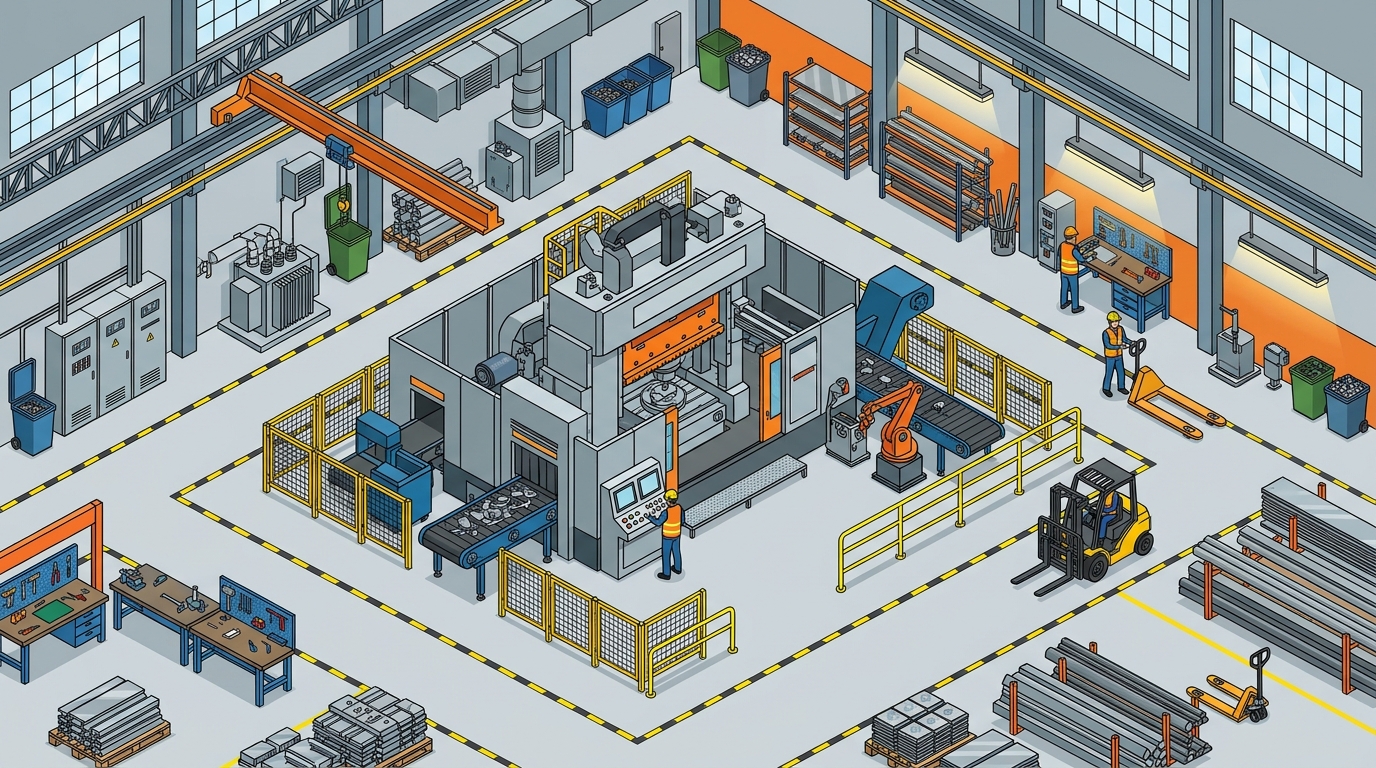
Phenomenology and Biomechanics of Occupational Risks in Metal Forming
To develop effective methods of countering workplace injuries, it is necessary to deeply understand the morphology of hazards arising when working with sheet metal and press equipment. The main threat is generated in the zone of direct contact of the tools — the punch (the protruding element moving from above) and the die (the support with a recess corresponding to the specified bending shape). At the moment the punch descends onto the die, a so-called “crush zone” is created. The speed of free fall or accelerated approach of the tool is extremely high, and if the operator’s fingers or hands end up in this zone at this moment, the machine will inflict irreparable injuries, up to traumatic amputation.
Aside from the direct threat from the moving parts of the press, the processed material itself poses a complex physical risk. Sheet metal often has extremely sharp edges, especially if it underwent a stage of chopping on guillotine shears or laser cutting prior to bending. The presence of nicks, microscopic chips, and burrs on the edges of the sheet significantly increases the severity of potential injuries. Upon contact of such an edge with unprotected skin, deep cuts or lacerations occur. The specificity of these wounds is that they are almost always contaminated with metal dust particles, industrial oils, and cooling fluids, which sharply increases the risk of infection and requires specialized medical treatment.
The dynamic behavior of the metal sheet during bending creates an additional hazard vector, known as the edge whiplash effect. When the punch presses the central part of the sheet into the die, the free edges of the material held by the operator move upward in an arc with great speed and force. If the worker assumes an incorrect position, leans too close to the working area, or improperly positions their hands on the workpiece, this sudden movement can deliver a powerful blow to the face, chest, or forearms. That is why safety rules require that large-area sheets be supported using special roller tables, and that the operator avoids placing their hands on top of the sheet, supporting it exclusively from below.
The impact of chemical and microscopic factors should also not be underestimated. During the preparation of the metal, its cutting, and grinding, a huge amount of fine particles rises into the air of the working area. This metal dust can get onto the mucous membranes and cornea of the eye, causing acute inflammatory processes. Prolonged inhalation of such dust leads to the accumulation of heavy metals in the lung tissue, which becomes the cause of chronic respiratory diseases. Furthermore, the presence of combustible dust combined with sparks that may occur during grinding, or static electricity, creates prerequisites for local flare-ups or even volumetric dust explosions.
Thermal and electrical risks complete the hazard picture. Touching heated equipment elements or parts that have undergone preliminary high-temperature processing causes deep burns. Since press brakes are powerful consumers of electrical energy, any damage to the insulation of power cables, malfunction of grounding circuits, or unauthorized access to distribution boards can lead to a high-voltage electric shock. The consequences of such electrical injuries range from muscle spasms to cardiac arrest, which requires flawless compliance with electrical safety protocols and regular checking of the building’s lightning protection and grounding systems.

Architecture of Spatial Protection: Optoelectronic Systems and Laser Guards
The realization of the impossibility of completely eliminating risks through personnel training alone led to a revolution in engineering control systems. Historically, mechanical grilles or two-hand control panels were used to protect the operator’s hands, forcing the worker to keep both hands on the buttons while the press was descending. However, such methods drastically reduced productivity and made it impossible to perform many technological operations where the operator is forced to support the sheet metal directly near the die. The integration of optoelectronic safety devices became the solution to this problem.
Modern light barriers and laser systems are the pinnacle of the evolution of active press brake safety. The principle of their operation is based on forming a continuous grid of light beams between the transmitter and the receiver. If any foreign object, for example, a human finger or hand, crosses at least one of these beams, the receiver detects the interruption of the optical connection and instantly generates an electronic blocking signal. This signal goes to the machine’s main controller, which issues a command to the hydraulic valves for the emergency braking of the ram.
The highest level of protection is provided by specialized multi-point laser systems developed exclusively for press brakes. Unlike static light curtains, which simply enclose the perimeter of the machine, these laser detectors are mounted directly on the moving upper beam (ram) of the press and move along with the tool. Laser beams scan the space just a few millimeters below the tip of the punch. Thus, the system creates a dynamic protective screen that constantly stays ahead of the descending tool. This provides effective protection for the operator’s hands, allowing them to be in close proximity to the die for precise workpiece positioning.
The technical characteristics of such systems are impressive in their accuracy and reliability. Thanks to the use of a laser light source, the detectors are capable of recognizing obstacles from four millimeters in size, while ignoring the natural industrial vibrations of the machine bed. The response time of the system from the moment the beam is interrupted to the signal for braking is two to five milliseconds, which is a critically important indicator for stopping a multi-ton mass moving at high speed.
To ensure flawless operation under industrial shop conditions, these devices are designed with multiple redundancies. They use dual-channel safety transistor outputs with positive polarity; this means that even in the event of a short circuit or failure of one of the electronic components, the system will automatically switch to a blocking state, preventing the press from starting work. According to international regulations, such systems are classified under the highest safety categories (Category 4) and safety integrity levels (SIL 3). The enclosures of the optical elements have a degree of protection against dust and water jets of no less than IP65, which protects delicate optics from metal shavings and industrial aerosols, and their operating temperature range allows exploitation from zero to fifty degrees Celsius.
One of the biggest engineering challenges in the development of such systems was the need to teach the electronics to distinguish a human hand from the metal sheet itself, especially when bending complex-shaped parts. For example, if an operator is manufacturing a deep box-shaped part, the side walls that were bent in the previous step will inevitably intersect the laser beam while the punch is descending for the next bend. To resolve this collision, an intelligent muting function, or “box mode,” was developed. Thanks to this function, the system analyzes the geometry of the beam interruptions and allows the machine to continue moving if it recognizes the profile of a metal part, while keeping the protection against atypical obstacles, such as fingers, active.
In addition, laser protection is closely integrated with the press speed control system. The descent of the punch occurs in two stages: rapid approach (where the risk of injury is maximal) and slow working stroke (the actual bending of the metal). The laser system controls the space during the rapid approach. At a distance, which is usually set to five millimeters from the sheet surface (the speed switching point), the press speed sharply decreases to safe values, and the laser protection is temporarily deactivated to allow the tool to touch the metal without generating false alarms. This gap is so small that a human finger physically cannot fit there, which guarantees the continuity of the safety cycle.
The installation and operation of such systems require high qualifications. Changing the geometry of the working area, for example, a reverse installation of the punch (turning the tool one hundred and eighty degrees with the front side away from the operator to avoid collision with the already formed flanges of the part), requires mandatory calibration of the laser receivers to maintain protective properties. Any attempts by the operator to arbitrarily turn off protective devices, change their settings to speed up the work cycle, or work on a machine with a faulty signaling system are a gross violation of labor discipline and are strictly prohibited by occupational safety rules.
Intelligent Hydraulic Monitoring: Pressure Sensors and Overload Prevention
The circulatory system of any press brake is its hydraulic drive. It converts the electrical energy of the motors into colossal mechanical force by compressing and pumping industrial oil. The working pressure in such systems can reach hundreds of atmospheres. Under such conditions, any anomaly in the hydraulic circuit — whether it’s a sharp spike in material resistance or a ruptured hose — poses an extreme danger both to the structural integrity of the machine itself and to the lives of the workers.
The main tool for monitoring the state of this energy system is high-precision industrial pressure sensors. These compact electronic-mechanical devices are mounted directly into pipelines, manifolds, and shut-off valves of hydraulic cylinders using standardized threaded connections (e.g., half-inch size) and multi-pin protected connectors. The main task of the sensor is continuous real-time measurement of fluid pressure and conversion of this physical quantity into a standardized analog signal, which is instantly read by the central microprocessor of the machine.
In the context of ensuring safety, information from pressure sensors is used for several critically important functions. The most important of them is protection against mechanical overload. Situations often arise when the operator can make a mistake: input incorrect metal thickness parameters into the control system, choose a die unsuited to the force, or accidentally feed two metal sheets into the working area instead of one. If the press attempts to perform bending under such conditions, the material resistance will exceed the calculated strength limits of the machine bed or tools. This will lead to the deformation of the machine’s metal beams or, much worse, to the explosive shattering of the brittle hardened metal of the punch, the fragments of which will fly around the shop at tremendous speed.
To prevent such a catastrophe, press control systems are equipped with modules for protection against current overloads and short circuits. These modules, using sensors based on magnetic effects (the Hall effect), can detect an abnormal load increase in the electrical circuits feeding the hydraulic pumps. Concurrently, pressure sensors record an atypically steep gradient of oil pressure increase. As soon as the indicators approach the critical limit, the intelligent controller instantly opens the emergency pressure relief valves, dropping the system pressure to zero, and retracts the ram to a safe upper position.
The second extremely important function of pressure sensors is ensuring the perfect parallelism of the tool movement. Most press brakes are driven by two independent powerful hydraulic cylinders located at the edges of the upper beam. If the pressure in these cylinders differs by even a fraction of a percent, the massive beam will begin to skew. A skew not only leads to product defects but also creates enormous asymmetrical stresses in the machine bed, causing microcracks in the metal. The pressure sensors in each of the cylinders continuously transmit data to the controller, which adjusts the oil flow hundreds of times a second via fast-acting proportional servo valves, guaranteeing absolute synchronization of efforts.
In accordance with occupational safety regulations, the condition of the hydraulic system is subject to strict visual and instrumental control. Operating pressure gauges must always be functional and verified. It is forbidden to operate the press if the hydraulic cylinders leak working fluid through the seals, as a pressure drop can lead to an involuntary lowering of the multi-ton ram under its own weight. The presence of an alarm system indicating the status of working tables, intensifiers, and pressure readings is a mandatory condition for admitting the machine to operation.
Passive Safety and Biomechanical Protection: Specialized Work Footwear
The safety hierarchy in production assumes that even the most advanced electronic systems can fail or be insufficient in cases where the risk is related not to the operation of the machine itself, but to the environment. The press brake operator constantly manipulates heavy metal sheets, changes massive steel tools (dies and punches), and moves around the shop floor, which can be covered with sharp metal scraps and remnants of lubricants. Under such conditions, the worker’s feet become the most vulnerable target for injuries. The use of specialized safety footwear is not just a recommendation, but a legislatively mandated requirement that forms the final, vitally necessary line of personal defense.
The modern philosophy of protective footwear design relies on strict international standards that detail the requirements for impact resistance, puncture resistance, and resistance to aggressive chemical environments. The fundamental element of any safety footwear is the reinforced toe cap. This structural element is built into the toe part of the boot and is designed to protect the phalanges from being crushed in the event of falling heavy loads. According to industrial standards, a certified toe cap must be guaranteed to absorb impact energy of up to two hundred joules (which corresponds approximately to the fall of a twenty-kilogram steel weight from a height of one meter) and withstand static compression with a force of up to ten kilonewtons.
Materials science offers two main solutions for manufacturing toe caps. Traditional steel inserts provide phenomenal strength and the slimmest profile, however, they make the footwear heavier and have high thermal conductivity, which leads to the rapid freezing of toes in cold rooms. An innovative alternative is composite toe caps made from reinforced polymers or Kevlar. They are significantly lighter, absolutely do not conduct cold or heat, are dielectrics, and are not detected by metal detectors, while fully meeting the strict requirements for protection against impact loads.
The next critically important factor is the architecture of the sole. In a shop where metal is cut and bent, the floor is a source of constant danger due to the presence of sharp shavings, expanded metal, or nails. To eliminate the risk of the foot being pierced through, metalworking footwear is equipped with anti-puncture insoles. These insoles can be made of a flexible steel plate (maximum protection) or multi-layered synthetic ballistic fabrics, which provide better sole flexibility and thermal insulation.
Additionally, the sole performs the function of stabilizing the worker on slippery surfaces. Spills of hydraulic oil are a typical problem near press equipment. The soles of safety footwear are molded from polyurethane or nitrile-rubber elastomers, which do not degrade under the influence of petroleum products (oil and petrol resistance) and feature a complex, deep tread pattern providing a maximum grip coefficient, preventing falls when moving heavy workpieces. In cases where the worker is exposed to the risk of static electricity shock, the footwear must have antistatic properties (with electrical resistance ranging from hundreds of kilo-ohms to tens of mega-ohms), allowing safely discharging the charge accumulated on the body to the grounded floor, preventing sparking and damage to the machine’s electronic components.
To facilitate the selection of equipment, a clear classification system has been developed that codes the set of protective properties of the footwear. Understanding this grading is key to ensuring an adequate level of safety:
| Protection Level | Characteristics of Integrated Properties | Recommended Operating Environment |
| Basic Level | Presence of a rigid toe cap for protection against impacts and compression. Open heel area, no antistatic or water resistance requirements. | Minimal risk zones where there is only a probability of dropping light tools. |
| First Level | Protective toe cap, fully enclosed heel part with energy absorption function (shock absorption when walking), antistatic properties, oil-resistant sole. | Dry metalworking, storage facilities with flat concrete floors without sharp debris. |
| First Level with Anti-Puncture | All characteristics of the first level, supplemented by an integrated anti-puncture insole in the sole. | Dry shops with the presence of metal shavings, sheet metal scraps, or construction debris on the floor. |
| Second Level | First-level properties combined with a special treatment of the upper material (usually hydrophobic leather), which prevents moisture from penetrating the boot. | Production areas with elevated humidity, places with regular use of water cooling. |
| Third Level | Maximum comprehensive protection: hydrophobic upper, antistatic properties, protective toe cap, shock-absorbing heel, anti-puncture insole, and a massive sole with a deep, aggressive tread. | Heavy metalworking, work in damp, aggressive environments, open-air assembly sites, extreme conditions. |
For press operators, it is most practical to choose footwear with anti-puncture protection (first level with anti-puncture or third level), as the risk of stepping on a sharp metal remnant is constant. Comfort and ergonomics also play a crucial role: for the warm season, light ventilated sneakers with composite inserts may be suitable, while for winter, insulated boots with a frost-resistant sole that does not lose flexibility in the cold are necessary. Improperly selected, heavy, or tight footwear causes chronic foot fatigue, which reflexively reduces the worker’s attention and indirectly provokes accidents.
Ergonomics, Lighting, and Spatial Organization of the Workplace
Ensuring safety is impossible without creating a proper ergonomic environment. The physical space around the press brake must be organized in such a way as to minimize unnecessary movements, physical overexertion, and the operator’s psychological discomfort.
A fundamental requirement is high-quality lighting. The working area, especially the space between the punch and the die, must be evenly and brightly lit, but the light should not blind the worker’s eyes or create deep shadows that would interfere with the visual control of the bending line.
Special attention is paid to vibration isolation. Massive presses must be installed on specially calculated, carefully aligned vibration-isolating foundations. This prevents the transmission of low-frequency vibrations from the moving masses of the machine to the shop floor and building structures, significantly reducing the vibrational load on the workers’ musculoskeletal system. The floor in the working area must be absolutely flat, without potholes, height differences, and slippery spots, and it is recommended to lay dielectric rubber mats near the control panels for additional protection against voltage breakdown and to reduce foot fatigue.
Manipulations with heavy sheet metal are a source of increased risk of spine and joint injuries. To feed long and heavy metal sheets into the working area, it is mandatory to use auxiliary equipment: roller tables, supporting consoles, and guide rulers. If it is necessary to move massive assemblies or tooling boxes using rollers (skids), it is forbidden to adjust these rollers with the feet under the load, and the ends of the rollers should not protrude from under the load by more than forty centimeters.
Strict regulations apply to the appearance and clothing of the operator. The worker is obliged to wear work clothes that fit tightly to the body. Clothes must be buttoned up completely, have no hanging belts, loose ends, or torn areas that could get caught in rotating mechanisms or jammed in the press. The use of ties and scarves is strictly prohibited. Hair must be securely hidden under a headpiece (beret, cap, or hard hat). Safety glasses and sturdy gloves are a mandatory attribute when feeding metal to prevent cuts and protect eyes from scale or shavings. It is important to note that if the operator temporarily switches to working on rotating machines (e.g., drilling machines), the use of gloves is strictly prohibited due to the deadly risk of them getting wound onto the spindle, however, for working specifically on the press brake, gloves are mandatory.
Emergency Response Algorithms and Maintenance
The reliability of the technological process does not exclude the occurrence of emergency situations, so every worker must possess clear algorithms of action under emergency conditions. The most important element of manual safety control is the presence of emergency stop buttons on the machine and on the remote foot pedals. These buttons traditionally have a mushroom shape, are painted bright red, and are designed in such a way that they can be pressed instantly without aiming. Upon their activation, the power circuit is broken, and the press must perform emergency braking of moving masses, completely stopping within a time frame of two to six seconds.
Any anomalies in the operation of the equipment are grounds for immediately stopping the machine. Such signs include: the appearance of an atypical knock, strong vibration, a change in the tone of motor noise, sparking, overheating of bearings, or the appearance of a specific smell of burning insulation or smoke. In such cases, the operator must turn off the power and call maintenance personnel. If an electric motor overheats, it must be left to cool naturally; it is strictly forbidden to try to cool heated units with water, snow, or wet rags, as this will lead to thermal shock of the metal or a short circuit.
Fire safety in the metalworking shop has its own specifics. In the event of a fire in the electrical cabinets of the press, cables, or hydraulic oil, firefighting is permitted exclusively using carbon dioxide or powder fire extinguishers, sand, or asbestos blankets. The use of water to extinguish electrical installations is strictly prohibited due to the extreme risk of electric shock.
Maintenance, cleaning the machine of shavings, lubricating moving parts, changing tools, and adjusting sensors must be carried out exclusively provided the motor is completely stopped. At the same time, the main switch on the electrical cabinet of the press must be switched to the off position and locked with a key to prevent accidental start-up of the machine by another worker during repair work. Removal of metal scraps and shavings from the working tables should be done using special hooks, scoops, or wire brushes, and under no circumstances with bare hands or with the help of compressed air, which can blow hazardous dust throughout the premises.
In the event of an accident, the primary task is to isolate the dangerous zone from unauthorized persons and immediately provide first aid to the victim. The scene of the incident should be left unchanged for further investigation into the causes of the accident, provided that this does not pose a threat to other workers.
The organizational component of safety stipulates that only persons who have reached the age of eighteen, passed a medical examination, and completed special training are allowed to work on presses. Repeated occupational safety briefings must be conducted at least once every three months, and knowledge of regulations and electrical safety rules must be checked annually.
Conclusions
The operation of powerful metalworking equipment is inextricably linked with managing extreme physical forces that pose a constant threat to human life. The comprehensive analysis conducted proves that solving the problem of occupational injuries on press brakes is impossible through fragmented measures. Success is guaranteed exclusively by deep, multidimensional integration of three fundamental levels of defense: spatial optoelectronic control, internal hydraulic monitoring, and passive biomechanical protection of personnel.
The introduction of intelligent light barriers, in particular laser detectors moving with the tool, marked the transition from passive guarding to active prevention. The ability of these optical devices with millisecond reaction times to recognize danger, differentiating it from the technological processes of forming complex parts, made it possible to eliminate the conflict between safety and labor productivity. Concurrently, high-precision pressure sensors perform the function of the machine’s internal guards. Continuously analyzing the state of the hydraulic system, they block the development of emergency situations associated with overload or desynchronization of mechanisms, preventing not only the destruction of expensive equipment but also the fatal consequences of the sudden release of mechanical energy.
However, the laws of physics and the unpredictability of the production environment demand that every worker be physically protected. The falling of massive steel forms, constant contact with sharp metal scraps, and the presence of industrial oil residues on the floor make specialized safety footwear a critical barrier. The mandatory presence of impact-resistant toe caps, anti-puncture insoles, and oil-resistant treads turns footwear from an element of clothing into a highly technological means of health preservation.
Ultimately, the technical perfection of any protective systems remains powerless without strict production discipline, proper ergonomic organization of the workspace, and rigorous compliance with emergency response algorithms. Occupational safety in metalworking is the result of daily, systemic interaction of smart machines, high-quality personal protective equipment, and conscious, qualified personnel, united by a single goal: preserving human life in the process of creating industrial goods.
Related articles
Thin-sheet metal: main varieties on the Ukrainian market
Use of thin-sheet metal. Forms of metal products. Materials and their features.
Painting sheet metal: important nuances
We will discuss metal painting technologies and the key aspects of the painting process itself below in our article.
Digital Transformation of Construction Measurements: An In-Depth Study of Ruler Apps, Spatial Scanners, and Their Impact on Construction Economics
How are AR apps and 3D scanners transforming construction? Explore mobile tools, error economics, and seamless data integration with CAD & BIM.