
A 20 cm layer of snow at an average density of 250 kg/m³ has a mass of 50 kg per square metre. Spread evenly over a 3 × 6 m carport, that is 900 kg. Two roofs can carry very different amounts of snow even when the layers look equally deep. On a carport next to a taller building, the weight can also be concentrated in a strip beside the wall.
How to estimate the weight of snow on a roof
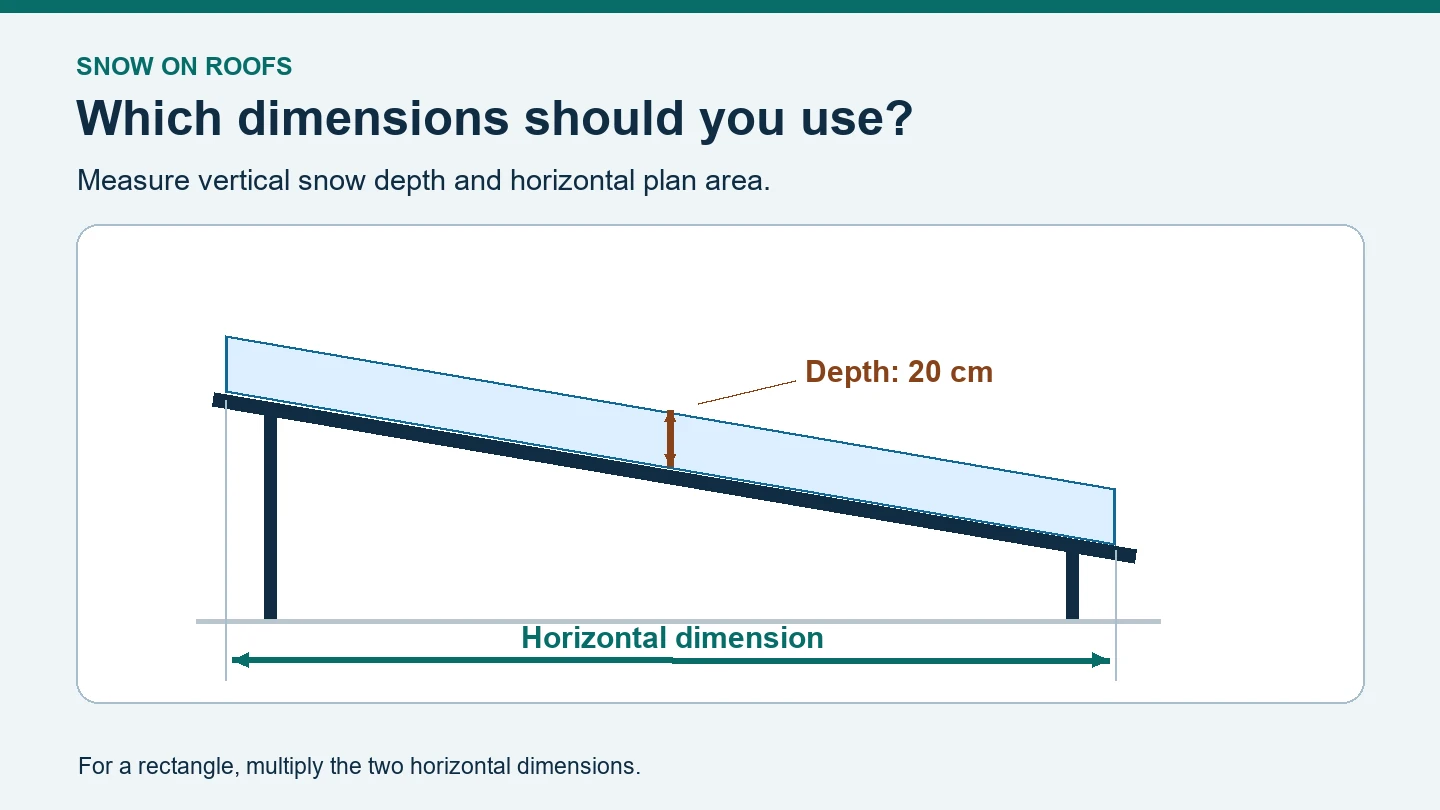
Multiply the vertical depth in metres by the average density in kilograms per cubic metre. The answer is mass per square metre of horizontal area. To find the total for an approximately uniform area, multiply by its area in plan. For a sloping roof, use the footprint as viewed from above, rather than the area measured along the roof surface. Keep metres and centimetres consistent throughout the calculation.
Worked example: 20 cm of snow on a 3 × 6 m carport
- Convert depth: 20 cm = 0.20 m.
- Apply the assumed density: 0.20 m × 250 kg/m³ = 50 kg/m².
- Find the horizontal area: 3 m × 6 m = 18 m².
- Multiply: 50 kg/m² × 18 m² = 900 kg of snow. The roof and frame have their own weight, which the structural assessment considers separately.
| Snow depth | Assumed average density | Mass per square metre | Total over 18 m² |
|---|---|---|---|
| 20 cm | 100 kg/m³ | 20 kg/m² | 360 kg |
| 20 cm | 250 kg/m³ | 50 kg/m² | 900 kg |
| 20 cm | 400 kg/m³ | 80 kg/m² | 1,440 kg |
These are demonstration values. If you know the depth but have no representative density measurement, calculate several scenarios to see how much the result changes. The highest value in the table is simply one scenario. For imperial reference, 50 kg/m² corresponds to about 10.2 psf under standard gravity.
How to estimate density or use snow water equivalent
Density equals the mass of a sample divided by its volume. To demonstrate the method at ground level, use a container of known volume. Weigh the snow and subtract the empty container. Two litres of snow weighing 0.50 kg give 250 kg/m³. Judge whether the sample represents the whole layer you want to understand: loose snow on top and a hard crust below may carry different amounts of water per unit of volume.
Snow water equivalent (SWE) is the depth of water that would remain if the snow melted without loss. Each millimetre of SWE represents about 1 kg/m². A measured SWE of 50 mm therefore represents about 50 kg/m². A weather station reports a measurement under its own conditions. Wind, sunshine, runoff and sliding can make snow depth and density on a roof different from conditions at the station or in a yard. Use a safe viewpoint for photos, and leave any required roof measurements to a qualified person. National Weather Service snow measurement guidance.
What changes during a thaw or rain-on-snow event?
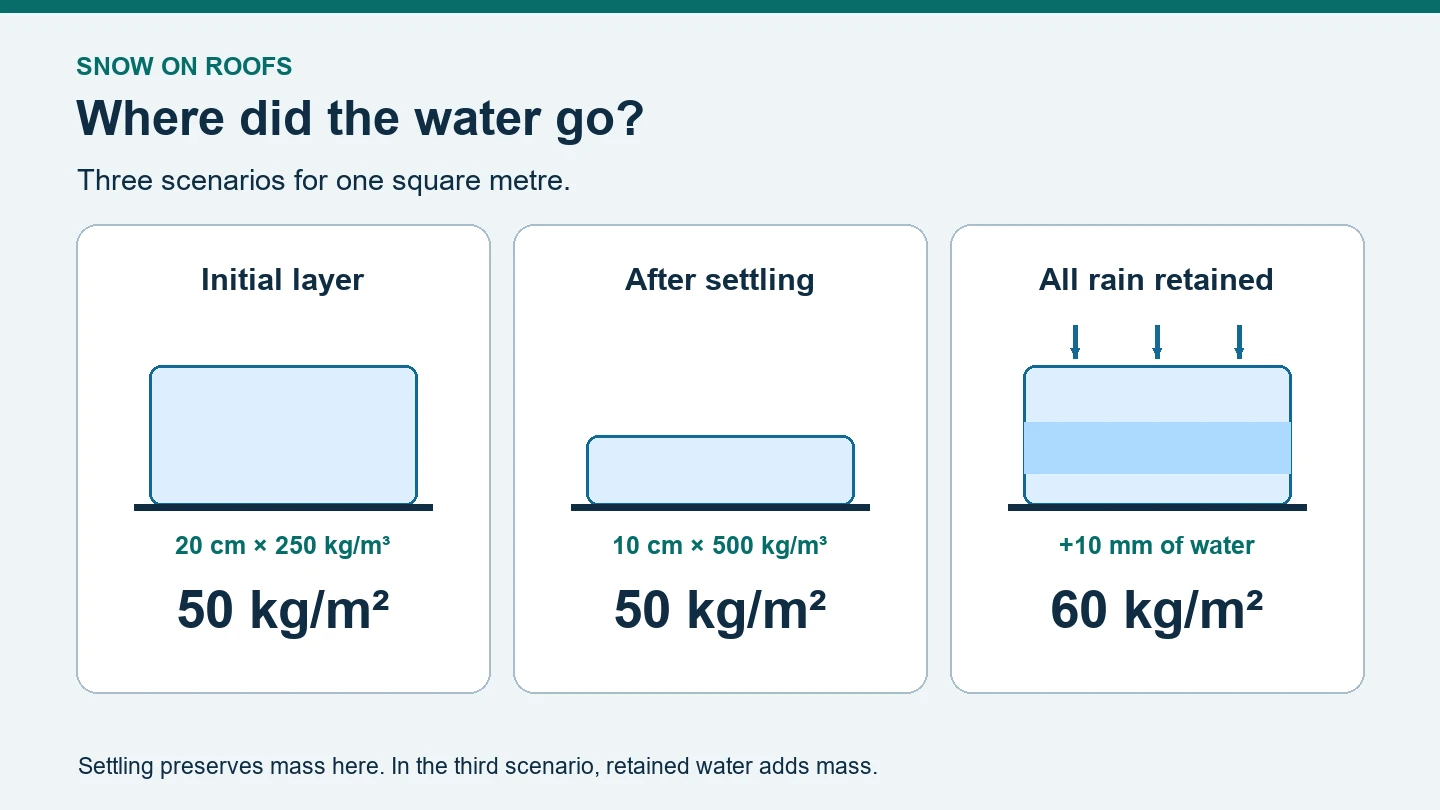
Watch what happens to the water. If the same snow pack settles from 20 cm to 10 cm with no gain or loss, it retains the same mass: 0.20 × 250 = 0.10 × 500 = 50 kg/m². If meltwater drains away, the mass falls. If the snow and roof retain all of a 10 mm rain event in the measured area, the retained water adds about 10 kg/m². In the example, that gives 60 kg/m². Actual retention depends on the snow pack, roof geometry and drainage.
After a thaw followed by a freeze, look from a safe place for ice blocking gutters or outlets. Snow, ice and retained rainwater may collect in different parts of the roof. The FEMA Snow Load Safety Guide explains how these conditions influence roof snow loads. Our roof drainage guide shows how to trace runoff paths and identify low points.
Why a snow drift beside a taller wall matters
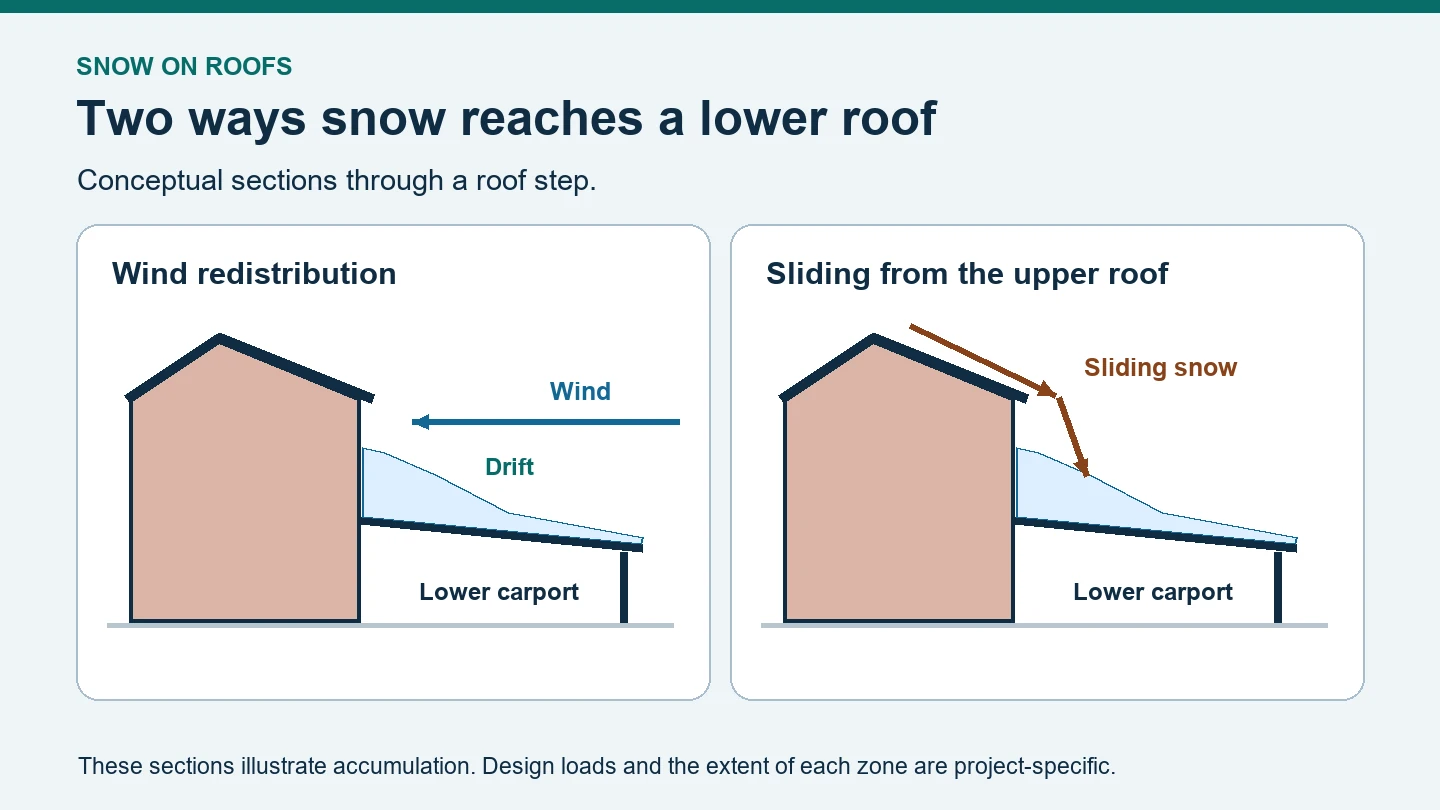
Wind can move snow across the upper and lower surfaces. Where the roofs change level, snow can form a drift on the lower roof beside the wall. Snow may also slide off the upper slope and land on the carport. An engineer considers drifting and sliding separately and checks which cases apply to the building. A roof elevation and a photo showing where the upper slope falls are useful inputs.
Same total mass, different distribution
Take the same 18 m² carport. Assume snow near the wall averages 40 cm over 6 m², and the remaining 12 m² average 10 cm. At an illustrative density of 250 kg/m³, the strip beside the wall carries 100 kg/m² and the rest carries 25 kg/m². The total remains 900 kg, but the strip carries twice the 50 kg/m² average. The example shows why a single roof-wide figure cannot describe the local demand on a panel, purlin, connection or support.
Estimated snow mass and structural design loads
Mass per area is expressed in kg/m². Structural load per area is a force, expressed in Pa, kPa or psf. Multiplying 50 kg/m² by standard gravity and converting from pascals gives about 0.49 kPa for the weight of the example layer.
For design, the engineer starts with the local ground snow load and follows the applicable building rules to determine roof load cases. These can account for roof slope and shape, unbalanced snow, drifts at height changes and other conditions. Load combinations, the load path and the existing structure’s condition also matter. In Ukraine, consult DBN V.1.2-2:2006 with Amendments 1 and 2, Section 8, the locality values in Annex Е and the roof step diagram in Annex Ж. Elsewhere, use the rules adopted in that jurisdiction. A ground snow value from one country or location cannot be treated as the roof’s capacity somewhere else.
What to send to an engineer about an existing carport
Provide the location, dimensions in plan, roof slope and clear spans. Take a photo that shows the adjacent building and roof height difference. Gather drawings, product specifications or installation records if available. Include photographs of the roof panels, purlins, beams, post bases, bracing and connections to the wall. Note corrosion, replacement cladding and any later alterations. If snow consistently collects in one place, photograph the same viewpoint after different storms.
Keep people out from under the roof and away from a potential slide zone if you notice new sagging, distortion or connection movement. Arrange a professional inspection. Keep off a snow-covered roof and avoid adding weight to see what it can carry.
If the problem you noticed during a thaw was dripping rather than deformation, document when it happens and check our guide to condensation and leaks under metal roofs.
Frequently asked questions
How much do 10 cm and 20 cm of snow weigh?
At an average density of 250 kg/m³, they have a mass of 25 and 50 kg/m² respectively. Use data for your snow layer if you need a closer estimate.
Does snow get heavier when it settles?
Settling alone reduces the depth and raises density while preserving mass. Retained rain can add mass. Drainage or loss of snow reduces it.
Can a carport carry 900 kg of snow?
Capacity depends on the frame, connections, foundations, condition and load distribution. Give the engineer both the total estimate and the location and extent of any drift, along with the carport’s construction details.
Related articles

Natural and Artificial Stone Suppliers for Facades and Interiors: TOP 10 Companies in Ukraine
Top 10 natural and artificial stone suppliers in Ukraine. Detailed comparison of importers and manufacturers, pricing guide, and selection tips.
“Nothing Happened.” Why Crews Stay Quiet About Construction Near Misses
What a construction near miss is, why a crew may stay quiet and what to put in a report. Includes a fictional example and follow-up steps.
Tired, Stressed or Burned Out? Three Stories from an Architecture Studio
Three stories from an architecture practice, WHO guidance and RIBA survey findings. Spot recurring workload conflicts and make a practical change.