
New windows can get wet on the room-side glass, between the panes, or on the trim and wall around the frame. Wipe one small area of the room-side glass with a dry tissue. A clear streak tells you the moisture was on that surface. When the haze remains, check whether it is outside or genuinely inside a sealed insulating glass unit. Damp trim calls for a different inspection that includes the window-to-wall joint and possible rain entry.
Three places to look first
| What you see | Possible explanation | First check |
|---|---|---|
| Droplets on the room-side pane, often near the bottom edge | Humid indoor air cooled to its dew point at the glass | Photograph and wipe one area, then record room temperature and relative humidity |
| Haze or droplets behind the accessible glass surfaces | If the moisture is within a sealed unit, its edge seal may have failed | Check the accessible surfaces and contact the installer or manufacturer with photos |
| Wet jamb, trim, sill or drywall return | A cold surface, air leakage, runoff from the glass or rain entering the opening | Mark the first wet point and compare cold dry weather with wind-driven rain |
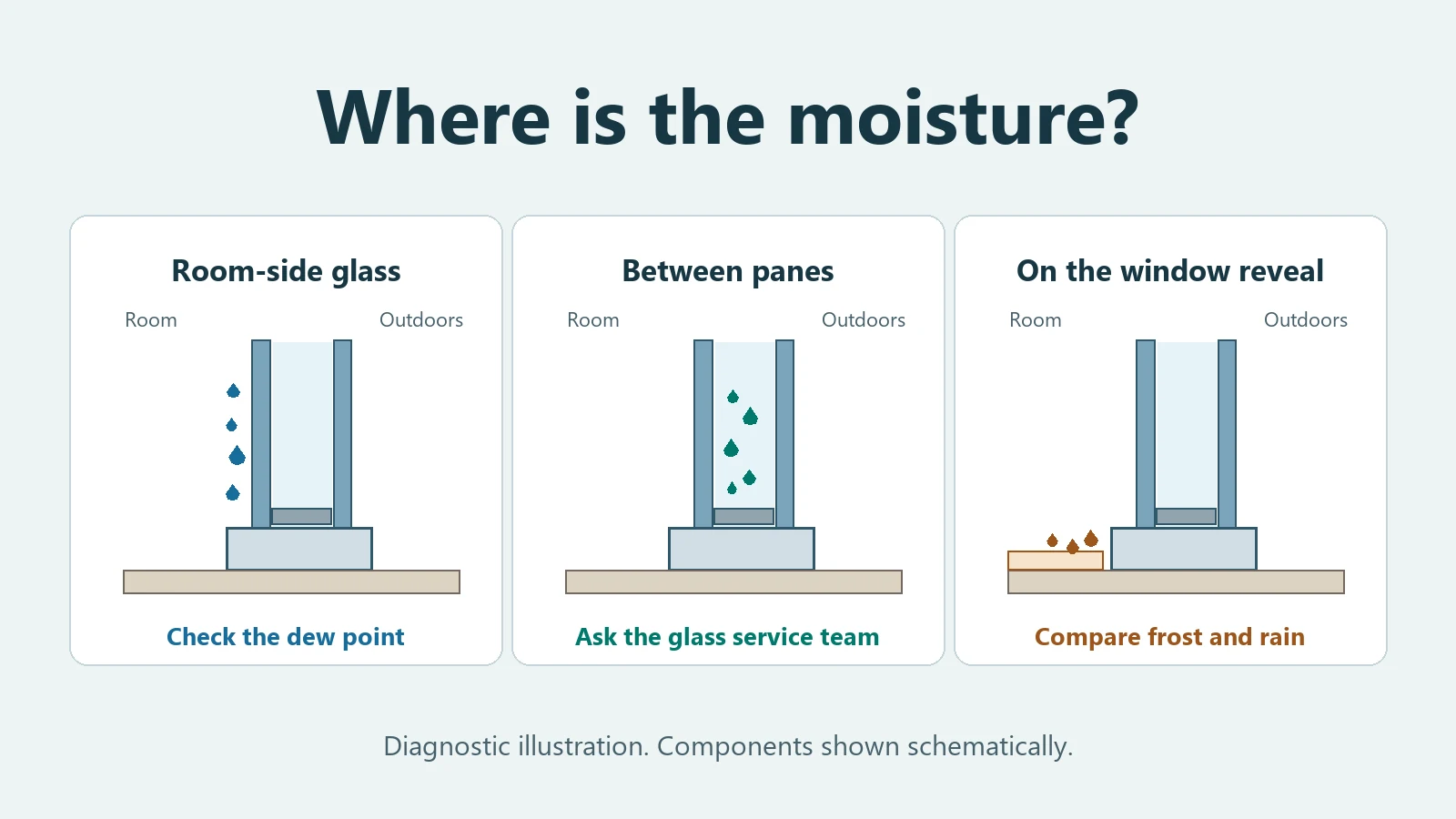
A tissue test helps locate the moisture
Photograph the haze first. Wipe one short stripe from inside the room, then take the same photo. If the haze remains, it may be on the outdoor face, inside the unit, or be dry residue. Observe the outdoor face only from an accessible position. Ask the installer to check inaccessible exterior glass. Outdoor condensation can form on a cool, still morning and clear later in the day, including on a normally operating window. Andersen’s exterior condensation guide.
1. Condensation on the room-side glass
The dew point is the temperature at which air with a given moisture content becomes saturated. If the glass surface cools below that point, droplets can form. Take a worked example at 68°F (20°C) and 60% relative humidity. The dew point is about 54°F (12°C), so a lower glass edge at 50°F (10°C) can become wet. With the air still at 68°F and humidity at 45%, the dew point falls to about 46°F (7.7°C). At the same glass temperature the risk drops. The numbers illustrate the mechanism. Actual glass temperature depends on the window, outside weather and indoor air movement. Magnus approximation used for the calculation.
The lower edge of a pane can be cooler than the center. Closed blinds, a deep sill or large furniture can restrict warm air movement near the glass. Showering, cooking, indoor drying and newly applied finishes can raise room humidity. After replacement, tighter windows may reduce incidental air leakage. Note whether the problem appears in one room or several, then compare similar weather and household activity. NFRC on condensation at the frame, edge and center of glazing.
Dry the surface. Record temperature and humidity in the occupied area away from the heater, direct sun and wet glass. Use the installed drying and exhaust ventilation as intended. Check whether raising a blind or removing an obstruction changes how often the pane wets. The U.S. EPA gives 30–50% RH where possible as general moisture-control guidance. An appropriate winter humidity level depends on climate and how cold the building surfaces get. Reflective glass can mislead an infrared thermometer. Ask for a reliable surface measurement if the result matters for a claim. EPA moisture guidance.
2. Fog or droplets between panes
A sealed insulating glass unit, or IGU, has a sealed space defined by the panes and their edge system. Confirmed moisture in that space is a reason to inspect the unit for seal failure. It may be more obvious at certain times of day. Take a straight-on photo and an oblique photo in daylight. Tell the service team which surfaces you wiped, if safe to access, and when the fog returns.
Ask the supplier to confirm the location and whether the affected IGU can be replaced in its sash. Have the order date, label photo and warranty terms on hand. A storm window, secondary panel or other non-sealed assembly behaves differently. Verify the glazing construction before assuming the sealed unit has failed. Leave dismantling, drilling and seal work to the service team. Government of Canada guide to condensation on sealed units and storm windows.
3. Wet trim or a damp window reveal
During a cold, dry spell, repeated wetting in the same corner can point to a cold surface or an air leak near the rough opening. Check whether water from the pane is also reaching the sill. A technician can compare surface temperatures, insulation continuity and air sealing. After wind-driven rain or thaw, note the first wet spot and time. Have the installer trace the window head, jamb and sill flashing and how they meet the wall’s water-control layer. Entry can occur away from the visible stain. U.S. Department of Energy guidance on window flashing · Documented window leakage case.
Photograph the joint before repairs. Keep frame drainage openings clear and have the path assessed before new sealant is added. For the interaction between cladding and the opening, see our guide to window and metal façade interfaces.
Photos and notes to send the installer
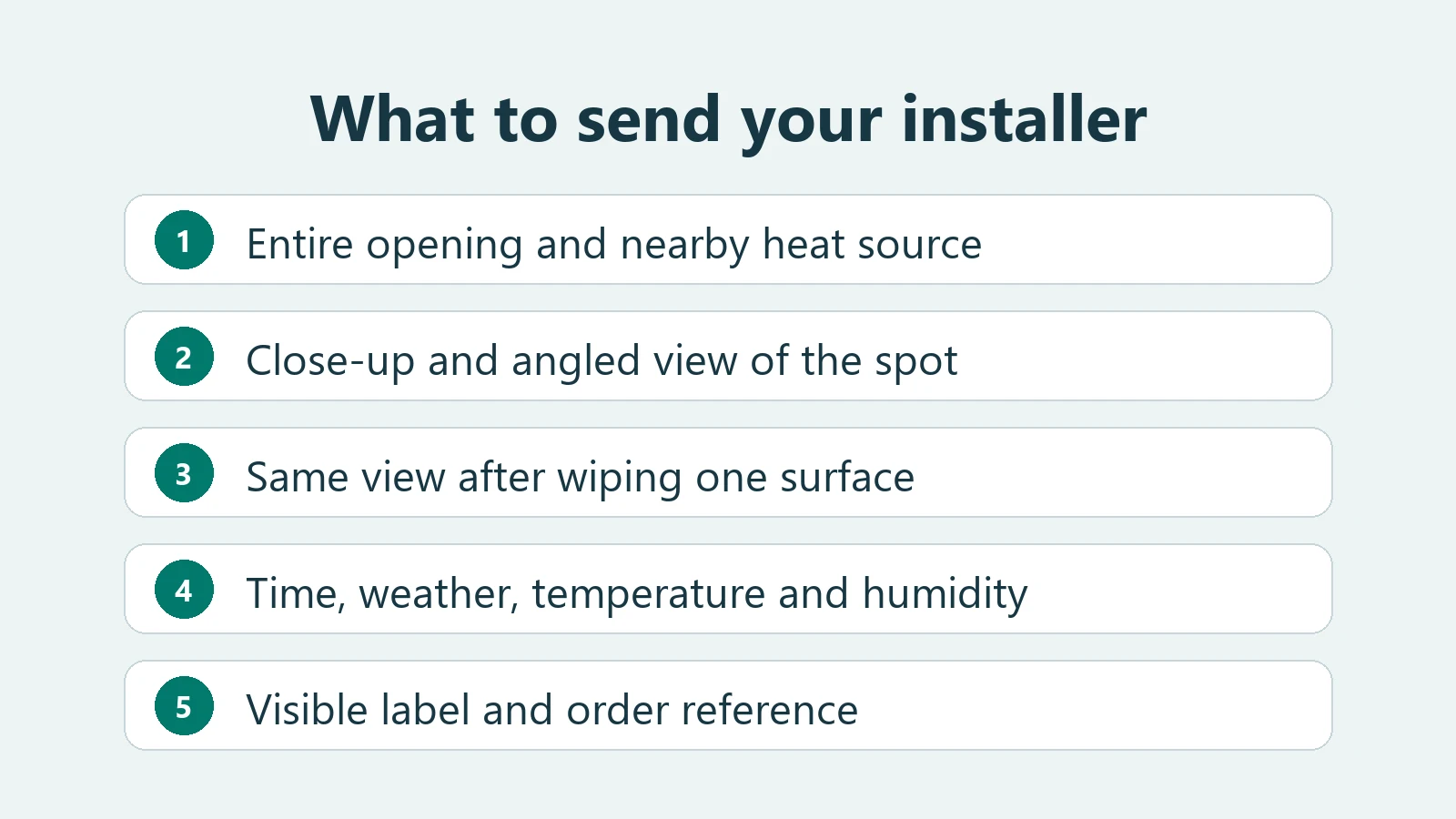
- Wide view of the entire opening, including the sill, trim and nearest heater or air outlet.
- Close-up and angled photo of the moisture before wiping. Mark where it starts.
- Same view after wiping the accessible glass. Say which side you checked.
- Time, recent weather, indoor temperature and RH. Include cooking, showering or heating changes when relevant.
- Photo of any accessible label and the installation or order reference. Share address and serial details privately.
Example message: “The lower right corner first became damp after wind-driven rain. I dried the room-side glass, and the wall return stayed wet. I’ve included before-and-after photos, weather notes and the order number. Could you check the sill and the opening’s drainage?”
Does fogging mean the whole window needs replacing?
Many window systems permit replacement of the affected IGU after seal failure is confirmed. Damp trim may instead require work on the joint, drainage or indoor conditions. An inspection and the installer’s warranty determine the appropriate remedy.
Cover: AI-generated illustration.
Related articles

7 Ukrainian-Language YouTube Channels for Building and Renovation
Seven Ukrainian-language channels for house design, renovation and tools, with practical video examples and guidance for choosing useful advice.
TOP-5 Swiss Watch and Premium Accessory Salons in Ukraine
Top 5 Swiss watch boutiques in Ukraine: boutique architecture, historic locations, service standards, and 2026 market trends.
Metal Galvanizing: Technologies, Differences, and Coating Selection
How hot-dip galvanizing, electrogalvanizing, coil sheet coatings, and zinc-rich paints differ. Comparison, technology selection, and quality inspection.