Galvanizing protects steel from corrosion with a zinc coating. Hot-dip galvanizing, electrolytic zinc plating, and painting with zinc-rich materials are different technologies that cannot be considered interchangeable. Sheet facade elements, welded structures, and scratch repairs each require different solutions.
Commercial descriptions often use the terms “galvanizing” and “zinc plating.” To avoid misunderstandings, an order should specify the exact process, base material, coating type, and acceptance criteria. The word “galvanized” alone is not enough to determine layer thickness, durability, or suitability for specific service conditions.
How a Zinc Coating Protects Metal
Zinc acts as a barrier between steel and the environment, and under suitable conditions also provides sacrificial, or cathodic, protection: the zinc corrodes preferentially, helping protect the steel near small exposed areas of the substrate. Over time, corrosion products form on zinc in the atmosphere, which can develop into a protective patina. These mechanisms are explained by the American Galvanizers Association in its guide on zinc corrosion protection for steel.
This does not mean that any damage is harmless or that corrosion is completely ruled out. Performance depends on the amount and condition of the zinc, time of wetness, salts, pollutants, and joint design. The properties of the metal itself and the differences between zinc, its compounds, and paints are covered in the article on zinc and its use for steel protection.
Contacts between dissimilar metals also matter. Improperly selected fasteners, constant condensation, or water accumulation can degrade coating performance. For such assemblies, it is essential to consider the causes of galvanic corrosion and ways to limit it.
Comparison of Zinc Protection Application Methods
| Technology | Principle and Typical Application |
|---|---|
| Hot-dip | The prepared item is immersed in molten zinc. A solution for parts and structures whose geometry is suitable for the process. |
| Continuous coil line | A steel strip passes continuously through molten zinc. Sheet metal products are then fabricated from the coated material. |
| Electrogalvanizing | Zinc is electrochemically deposited from an electrolyte. Used for suitable parts with an agreed thickness and post-treatment. |
| Zinc-rich paint | Zinc dust is suspended in a binder. Used in paint systems and for approved repairs. |
| Thermal spraying | Molten zinc particles are sprayed onto a prepared surface. The item does not need to be immersed in a bath. |
| Diffusion | Zinc interacts with the surface during controlled heating in a powder medium. |
Hot-Dip Galvanizing: Fabricated Items and Coil Sheet
Galvanizing After Fabrication
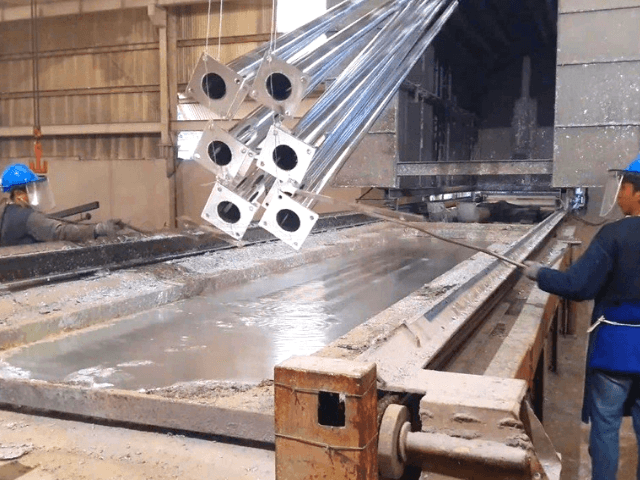
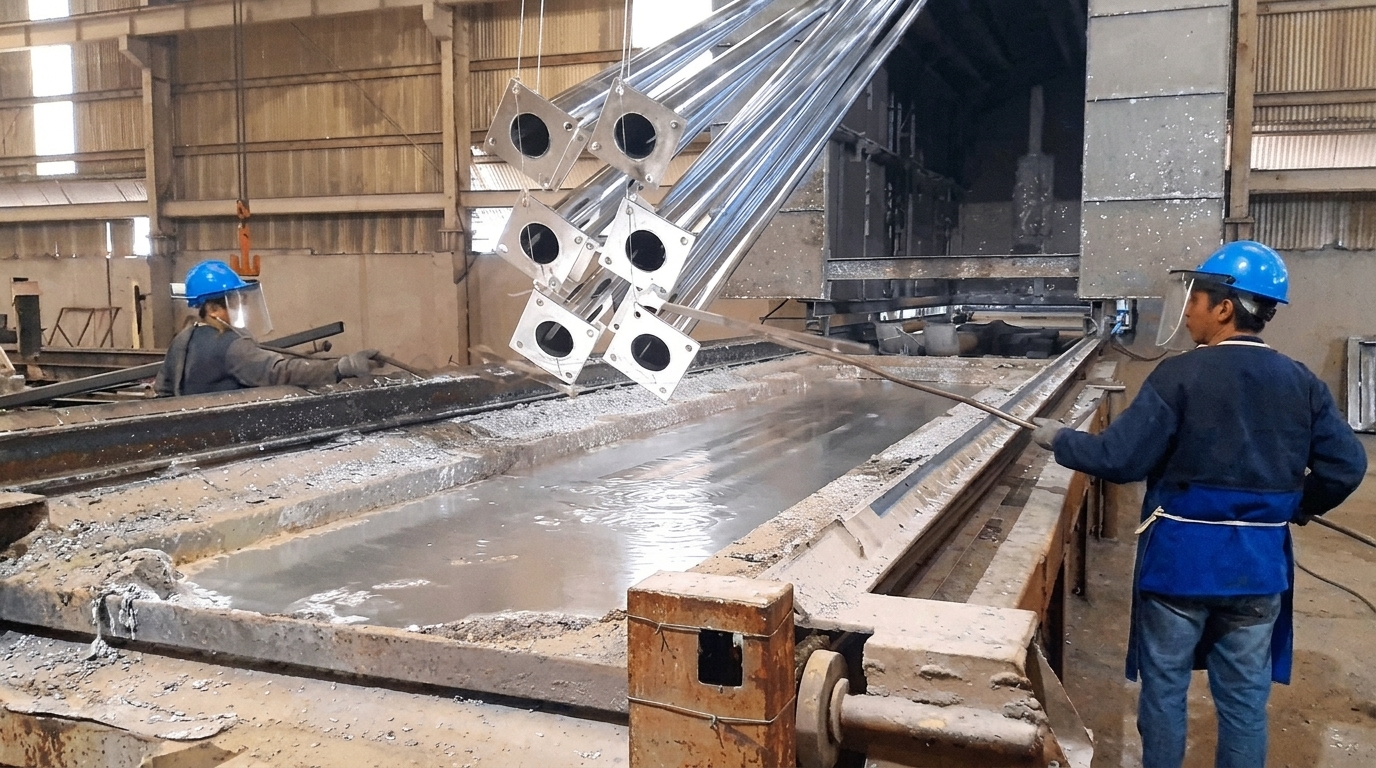
In batch hot-dip galvanizing, a prepared steel part is immersed in a bath of molten zinc. A metallurgical reaction occurs between the steel and the coating. Surface cleaning is a critical part of the process: contaminants prevent proper coating formation, as emphasized in the AGA overview of batch hot-dip galvanizing.
Suitable welded elements, fences, posts, and other structures can be treated this way. Before sending items to the plant, dimensions, weight, steel composition, vent and drainage holes, melt drainage capability, and post-heating geometry requirements must be agreed upon. Hollow or complex items require review by a process engineer; simply fitting into the kettle is not a sufficient criterion.
General properties and test methods for such coatings are specified in ISO 1461:2022 for hot-dip galvanized fabricated iron and steel articles. Its scope explicitly excludes continuously galvanized sheet, wire, and mesh. Therefore, coating requirements for a fabricated structure should not be automatically applied to coil-coated steel.
Continuous Galvanizing of Sheet Steel
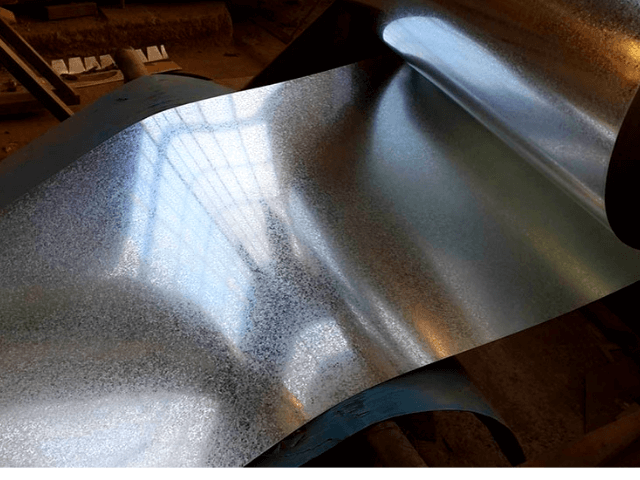
On a continuous line, steel strip undergoes surface preparation, coating, and post-treatment operations before being supplied in coils or sheets. This is the material used for many bent and roll-formed building components. Controlling coating weight with gas “knives” is part of strip coating regulation, not a universal “drying” step for any galvanized part.
Technical delivery conditions for continuously hot-dip coated steel flat products for cold forming are established by EN 10346:2015. This standard covers various metallic coatings, so the exact type must be specified in project documentation. Referencing an international or European standard does not in itself make it mandatory for every Ukrainian project: the applicable document and edition are agreed upon in the project and supply contract.
Z275 is a coating mass designation, not 275 micrometers. In the SSAB Domex 220GD galvanized steel table, Z275 indicates a minimum total zinc mass on both surfaces of 275 g/m² and an approximate thickness per side of 20 µm. This is an example of a specific designation: inspection conditions and distribution between sides are verified against the standard and material certificates.

“Cold Galvanizing”: What Zinc-Rich Paint Provides
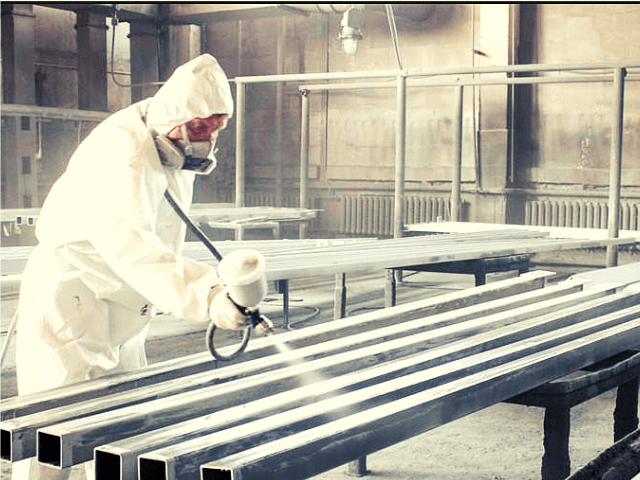
This term usually refers to applying a zinc-rich paint or coating. Zinc dust is dispersed in an organic or inorganic binder. The layer is applied according to the specific product’s instructions, such as by brush or spray. AGA describes zinc-rich paints separately, distinguishing them from hot-dip galvanizing.
Such materials can be useful as a primer in a multi-coat system or for approved touch-up of damaged areas. They make it possible to treat accessible surfaces of an already installed structure. However, a “cold galvanizing” label does not prove equivalence to a hot-dip coating, nor does a high zinc percentage alone guarantee protection quality.
In the technical data sheet, check substrate preparation, zinc content and how it is stated, dry film thickness, number of coats, application conditions, curing/recoat intervals, and compatibility with the topcoat. It is important to distinguish between the zinc content in the dry film and in the wet formulation in the can. A surface may appear dry before it is ready for the next coat or service load.
Electrogalvanizing: Electrochemical Deposition
During electrogalvanizing, or electrolytic zinc plating, metallic zinc is deposited from an electrolyte onto the surface of a prepared part under an electric current. This is not anodizing: depositing a layer of another metal and forming an oxide layer on the base material are distinct processes.
The technology is used for appropriate product ranges where tight dimensional tolerances, surface appearance, and overall system protection are critical. Orders specify thickness, measurement locations, post-treatment requirements, and corrosion testing. Uniform thickness in every recess of a complex part should not be promised without verifying actual results.
As of November 2026, it is important to account for standard revisions: ISO 2081:2025 replaced the 2018 edition and covers a specific scope—electroplated coatings of zinc with supplementary treatments containing chromium(VI). It should not be cited as a universal standard for all modern electrogalvanizing. For other systems, the supplier must specify the applicable standard.
Thermal Spraying and Diffusion Galvanizing
Thermal spraying, or metallizing, involves applying molten metal particles onto a prepared surface. It can be useful for large structures that cannot be immersed in a galvanizing kettle. Surface preparation, thickness, sealing, and topcoats are defined by the selected coating system.
Thermal diffusion galvanizing, or sherardizing, forms a zinc-iron diffusion coating in a controlled powder medium. It should not be described as simply melting powder and pouring it over the part. The principles of both methods are outlined in the International Zinc Association overview of zinc coatings; specific process parameters are verified against technical documentation.
Each of these methods has its own applications. Choosing one based solely on its name or marketing claims of the “strongest layer” is incorrect: part compatibility, process availability, and verified acceptance criteria are required.
How to Choose a Coating for a Building Product
Start with the operating conditions: exterior or interior, sheltered or exposed to rain, with regular drying or continuous moisture. Account for salts, industrial pollutants, dissimilar metal contacts, and accessibility for inspection and maintenance.
Fabricated structure: fabrication and welding → surface preparation → specified galvanizing → coating inspection.
Product from pre-coated sheet: strip coating → coil or sheet supply → cutting and forming → inspection of edges, bends, and surface.
These are simplified workflows. Painting sequences and other operations depend on the specific material and product.
Three Practical Scenarios
- Facade flashing or abutment trim. Check the base steel grade and thickness, metallic coating type and mass, bendability, and protection of the visible surface.
- Welded steel component. Agree on post-fabrication galvanizing, vent and drainage holes, surface accessibility, and dimensional inspection.
- Localized coating damage. Assess the substrate condition and defect boundaries, then select a repair material and procedure per the system manufacturer’s guidelines.
For decorative components, zinc protection is often part of a multi-layer system. Topcoat selection, surface preparation, and compatibility are explained in the article on polymer coatings for sheet metal. Additional paint requires proper preparation of the galvanized surface rather than simply applying it over any shiny sheet.
When ordering “Mehbud” bent facade profiles, provide joint drawings, material specifications, lengths, quantities, and visible-side requirements. Coordinate the coating together with geometry, fasteners, and service conditions. The examples above illustrate technology selection and do not describe a specific production line at the plant.
What to Check During Acceptance
- Material certificates and exact coating designation, standard, or agreed specification.
- Coating mass or thickness measured by the appropriate method—these values are not interchangeable without defined conversion conditions.
- Coating continuity and the condition of surfaces, edges, holes, and bends against order criteria.
- Part geometry, assembly fit, and absence of unapproved damage.
- Storage, installation, repair, and maintenance procedures. Warranty periods are verified against supplier terms rather than inferred solely from the technology name.
Frequently Asked Questions
Are galvanizing and zinc plating the same thing?
In service descriptions, these terms can be used ambiguously. When ordering, clarify whether the process is hot-dipping, electrolytic deposition, or another technology. The name must be accompanied by a coating specification.
How does hot-dip galvanizing differ from electrogalvanizing?
In hot-dip galvanizing, the item contacts molten zinc; in electrogalvanizing, zinc is deposited from an electrolyte using electric current. They involve different process conditions and part requirements. Results are compared based on the specified system and service environment.
Does “cold galvanizing” replace hot-dip galvanizing?
Not automatically. Zinc-rich paint is a distinct material intended for a defined protection or repair system. Surface preparation, dry film thickness, compatibility, and environmental suitability must be confirmed.
What does Z275 mean on galvanized sheet?
For the relevant zinc coating, it designates a minimum total coating mass on both surfaces of 275 g/m² under specified test conditions. It does not mean a thickness of 275 µm, nor is it a standalone service-life guarantee.
Can galvanized metal be painted?
Yes, using a compatible coating system after proper surface preparation. The cleaning method, primer, and topcoat are selected based on the condition of the zinc and the coating manufacturer’s recommendations. Without this, adhesion failures may occur.
How long does a zinc coating last?
There is no single service life for all products. Durability depends on coating type and mass, environment, time of wetness, mechanical damage, structural design, and maintenance. A specific project requires an assessment of the selected system.
Related articles
Sheet Metal Processing Equipment: Types and Selection
Guillotine shears, corner notching machines, folding machines, press brakes, and roll forming lines: what they do, how to choose a production routing, and how to check…
Why a Funnel Is Cut from a Sector: Three Sheet Metal Flat Patterns
See why a funnel develops into a sector, a mitered pipe makes a wavy edge and a square-to-round duct transition uses triangulation. With video and a…
How to Choose Gates for a House: 6 Practical Tips
How to choose gates for a private house: materials, sliding vs. swing designs, infill, automation, and backup power. Six practical tips, measurement guide, and FAQ.