Market Analysis and Pricing for Ceiling System Installation in Key Regions of Ukraine: Kyiv, Lviv, Dnipro (2026)
Generic selectors
Exact matches only
Search in title
Search in content
Post Type Selectors

Market Analysis and Pricing for Ceiling System Installation in Key Regions of Ukraine: Kyiv, Lviv, Dnipro (2026)

May 18, 2026
2  

1. Macroeconomic Landscape and Its Impact on the Construction Industry

As of 2026, the construction and finishing works market in Ukraine is in a state of deep structural transformation, driven by a complex superposition of global economic trends, national demand stimulation programs, and an acute local resource deficit. Analyzing the interior solutions segment, particularly how prices for ceiling installation are formed, requires a comprehensive approach that goes far beyond a simple comparison of construction crews’ price lists. This market is a highly sensitive indicator of the overall state of the economy, as it accumulates the cost of imported raw materials, energy resources, logistics expenses, and the dynamics of skilled labor wages.

The fundamental factor determining pricing policy in 2026 is the unprecedented rise in energy costs on the global market. According to the World Bank’s macroeconomic forecasts, global energy prices show a 24% increase in 2026, which is an absolute maximum since the crisis year of 2022. This jump has a direct and very severe multiplier effect on the entire range of construction materials. The production of plasterboard plates requires high-temperature gypsum calcination, the extrusion of aluminum profiles for shadow gaps is an extremely energy-intensive process, and the synthesis of polyvinyl chloride (PVC) for film coatings is directly dependent on the cost of hydrocarbons. Accordingly, forecasts and the reality of the domestic market indicate that the overall cost of basic construction materials in 2026 has increased by 8-12%. Organizations providing stable supplies, such as the “Park Plus” company, are forced to adapt their supply chains and price offers (cement, rolled metal, insulation) to the new realities, recommending that developers and contractors switch to wholesale purchases and careful spring budget planning.

Parallel to cost inflation, there is a powerful stimulation of consumer demand, which, according to analysts, has grown by 10-15%. The main driver of this growth is the state affordable mortgage lending program “eOselia”. Since the beginning of 2026 alone, 3,106 Ukrainian families have used this program, resulting in the injection of over 6 billion hryvnias into the residential real estate market. The dynamics of loan issuance remain extremely high: in just one week of May 2026, 157 new loans were issued for a total amount of 312.9 million hryvnias.

The geographical and structural distribution of these financial injections perfectly correlates with regional price anomalies in the repair services market. The largest number of mortgage loans is concentrated in the capital region (Kyiv region — 45 loans per week, city of Kyiv — 36) and in the west of the country (Lviv region — 14, Ivano-Frankivsk — 12). Attracting such significant funds to specific urban hubs creates a local shortage of available construction crews. Moreover, the distribution by property type — 93 loans for primary market housing (of which 63 properties are under construction) and 64 loans on the secondary market — forms two parallel markets for finishing works. The primary market generates demand for large-scale roughing-in works (installation of complex frames, soundproofing), while the secondary market stimulates services for dismantling old structures and quick cosmetic updates. The increase in building material prices has already led experts and market participants to openly state the need for a proportional adaptation of the “eOselia” program limits, as the allocated amounts are often insufficient for full-fledged repairs at current rates.
montazh steli 4

2. Personnel Crisis and Its Impact on Technological Choices

The second most significant factor shaping the market in 2026 is the deep demographic and personnel crisis in the construction industry. Despite the fact that general business sentiment has improved somewhat due to demand stabilization, the shortage of qualified performers remains a critical problem. Statistical surveys indicate that almost a quarter (25%) of construction and repair companies expect a reduction in the number of employees in the coming months, and only slightly more than half predict keeping their current staff.

This shortage of labor radically changes approaches to pricing and technology selection. In a classical economic model, the cost of a service is determined by the balance of supply and demand. However, in conditions of a shortage of painters, plasterers, and high-altitude installers, contractors are forced to maximize their margins by optimizing time costs. Technologies requiring lengthy “wet” processes are artificially made more expensive for the end consumer to encourage them to switch to fast modular solutions.

To understand this dynamic, it is necessary to examine in detail the technological features of the three main types of ceilings that dominate the Ukrainian market.

2.1. Drywall Systems: The Labor-Intensity Crisis

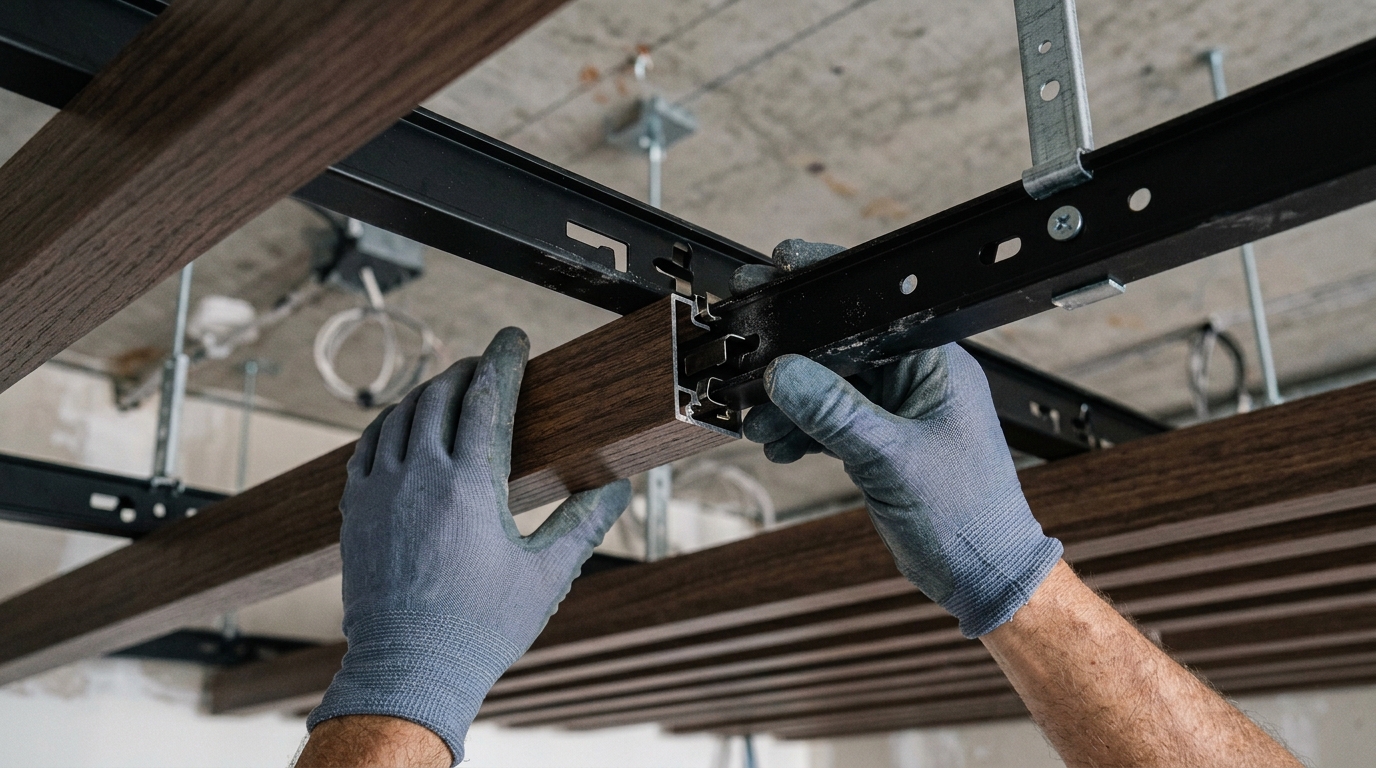
Drywall (plasterboard) ceilings were historically considered the gold standard for major renovations, but in 2026 they have become a premium product not because of the cost of the boards themselves, but due to the colossal labor intensity of the process. Professional installation requires strict adherence to engineering standards: creating a reinforced metal frame that technologically should not be rigidly tied to load-bearing walls (to avoid cracks during building settlement), precisely calculating the distance between hangers according to static load tables, and ensuring technological gaps. In addition, a mandatory procedure is the milling of non-factory edges of the boards for proper compensation of the reinforcing tape thickness at the joints (except for double-layer installation).

After the frame and boards are installed, the longest stage begins — painting works. These include priming the ceiling (which costs 20–40 UAH/m²), applying several layers of putty with intermediate sanding (130–180 UAH/m²), and final multiple painting (90–130 UAH/m²). Each of these stages requires technological pauses for drying. As a result, the process of creating such a ceiling stretches out over weeks, which, given the personnel shortage, is a highly inefficient use of human resources for the contractor.

2.2. Stretch Systems: Speed as the Main Asset

In contrast to traditional methods, stretch structures allow for a radical reduction in the crew’s time on site. The installation of a standard single-level ceiling is usually carried out during the day and takes only 1 working day, while complex multi-level systems require 1-2 days. A huge advantage is the ability to mount the canvas at any final stage of the renovation — furniture, wall finishes, and floor coverings are not damaged, as there is no sanding dust or risk of paint spills.

The only significant technological limitation is the need to heat the air in the room to 50°C using heat guns to give the PVC film elasticity. Because of this, experts strongly recommend removing indoor plants and interior items that require a special temperature regime from the room for the duration of the work. Thanks to this efficiency, a single two-person crew can cover up to 5-6 objects per week, which explains why construction companies actively promote this particular type of finish, offering competitive prices. There are also fabric and seamless materials, for which experts often recommend glossy textures if seams are unavoidable.

2.3. Cassette Suspended Systems (Armstrong)

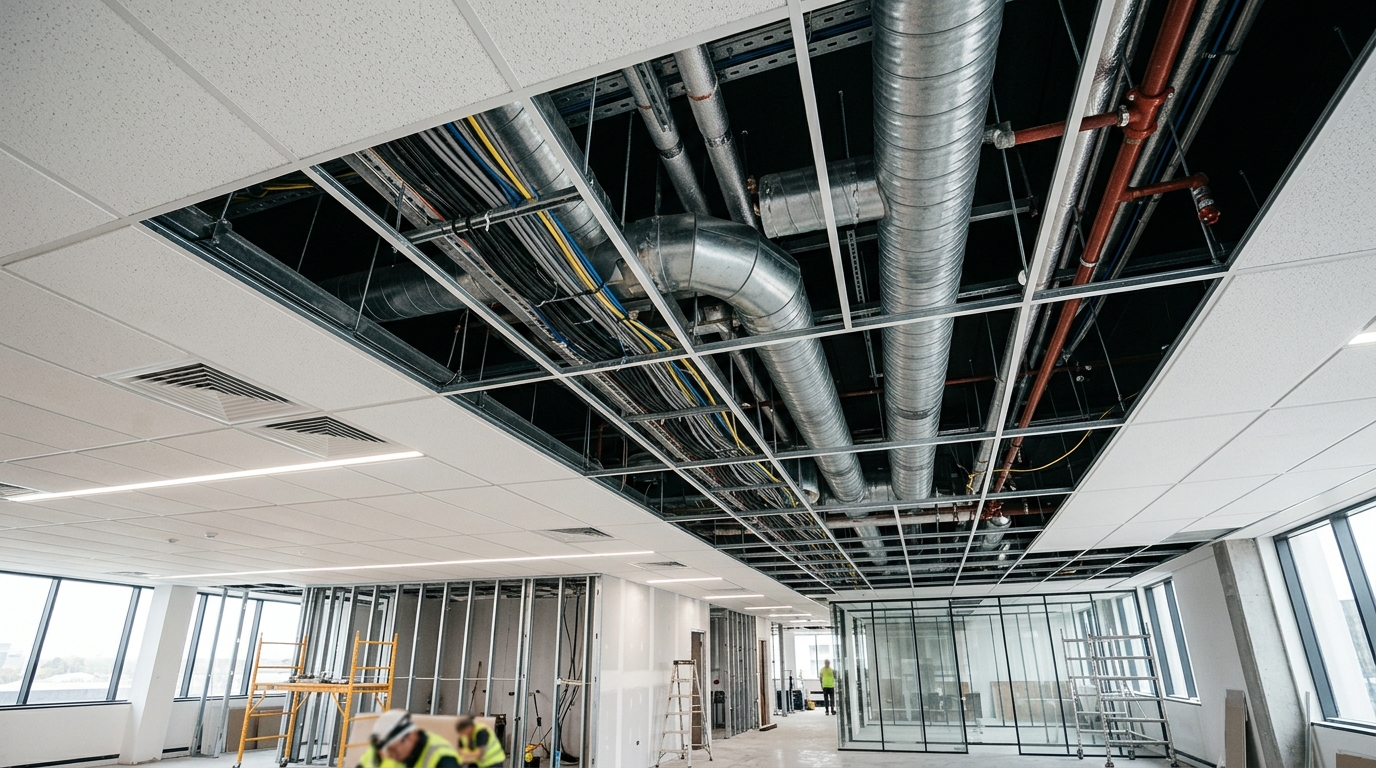
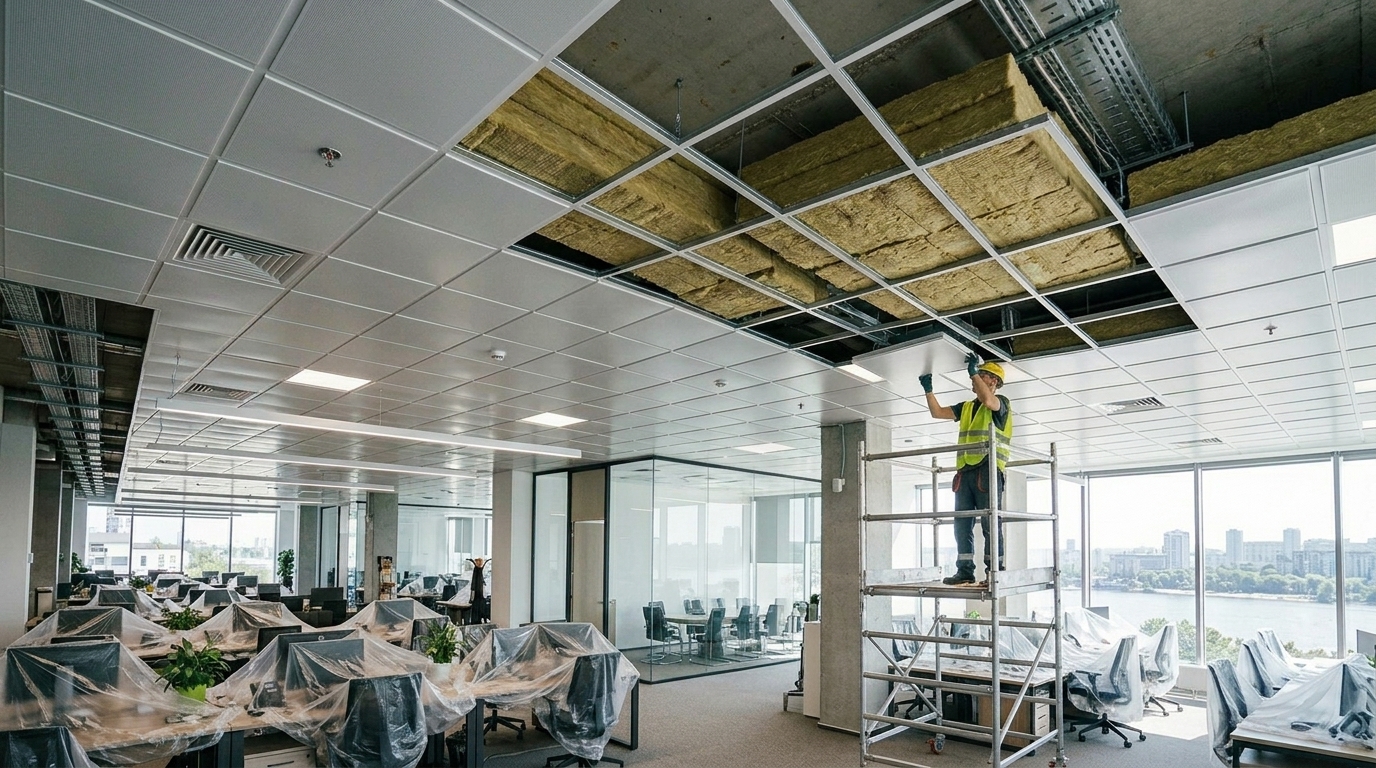
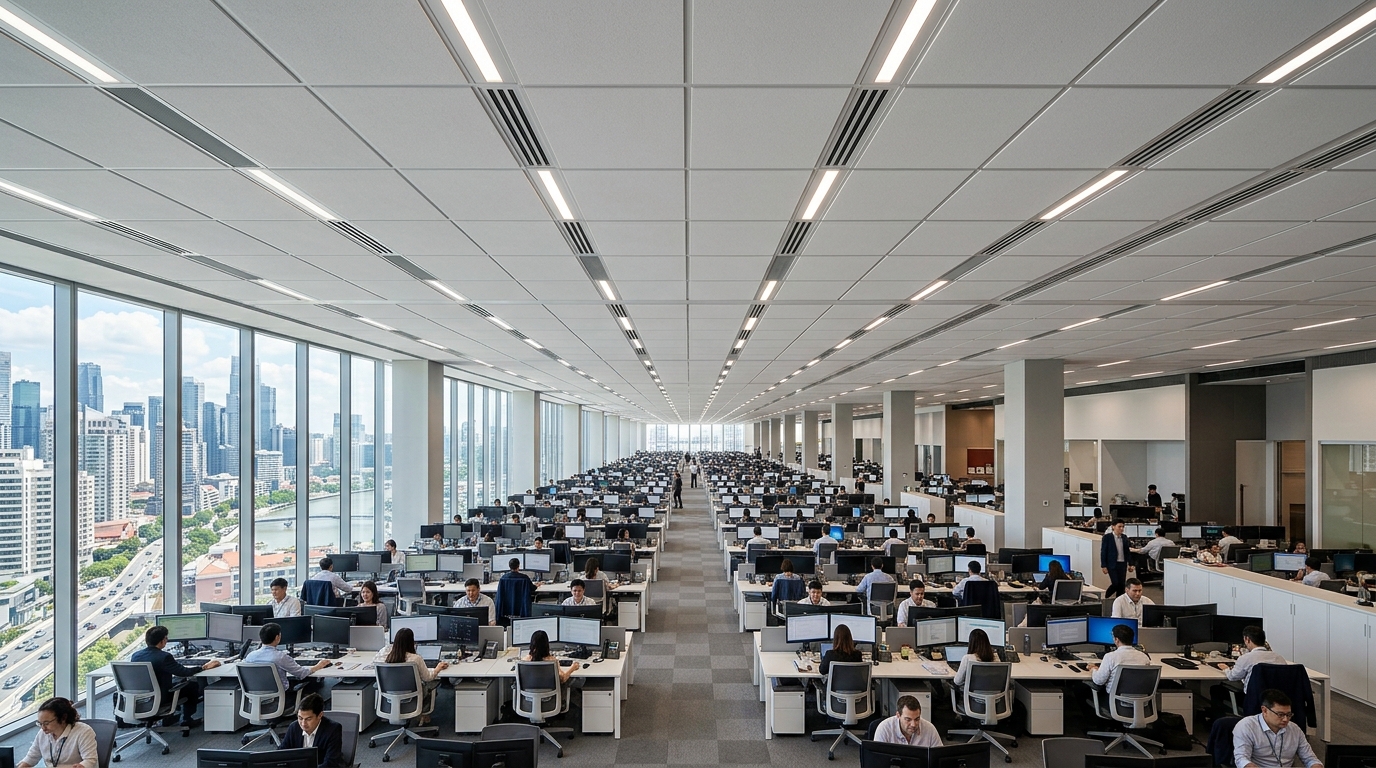
Armstrong type ceilings occupy a specific commercial and industrial niche. They consist of an open metal frame (T-profile) into which mineral fiber or metal tiles are placed. The main advantage of this technology is 100% instant access to the ceiling void (ventilation ducts, electrical trays, fire extinguishing systems). In 2026, these systems remain the uncompromising standard for offices, coworking spaces, shopping centers, and revitalized industrial zones in major cities. Their installation is dry, clean, and fast, and the pricing is the most predictable among all types of works.

montazh steli 7

3. Regional Analysis: The Capital Market (Kyiv)

The Kyiv market in 2026 is the most capitalized, innovative, and differentiated in Ukraine. A massive number of mortgage loans (81 loans per week in the city and region) generates a continuous stream of orders both in new residential complexes (for example, waterfront apartments with promenades, which became a trend in 2026 ) and in the old housing stock.

3.1. Cost of Stretch Ceilings in Kyiv

In the capital, there is a clear division into basic, middle, and premium segments. Basic level works for stretching a regular PVC film start from 250–350 UAH/m². However, an analysis of specialized companies’ profiles shows that the average check is about 370–523 UAH/m², and for complex architectural shapes or the use of specific canvases, the price easily reaches 700 UAH/m².

A unique feature of the capital’s market is the widespread use of comprehensive “turnkey” packages with a regressive pricing scale depending on the square footage. The cost, which includes the canvas, mounting profile, decorative insert, processing of 4 corners, and labor, is:

  1. For micro-spaces (up to 5 m², e.g., bathrooms) — 1430–1480 UAH/m².
  2. For small rooms (up to 10 m², kitchens, corridors) — 1170–1380 UAH/m².
  3. For standard rooms and living rooms (up to 30 m²) — 1090–1300 UAH/m². This approach by contractors makes deep economic sense: logistics costs around Kyiv (fuel, vehicle depreciation, time in traffic jams) make traveling to a small site unprofitable at standard per-square-meter rates. Therefore, the margin is embedded directly into the high base rate for small areas.

3.2. Prices for Drywall Works

Drywall works in Kyiv are the indicator of the highest cost for manual labor. The minimum price for installing only the metal frame and boarding starts from 250 UAH/m², while the cost of the materials themselves (profile, hangers, drywall, screws) is from 140 UAH/m². The average market range for the work of a qualified craftsman fluctuates from 300 to 510 UAH/m², with an upper limit of up to 700 UAH/m² for complex geometries. The average market cost of 143 UAH/m² claimed on some aggregators is purely a marketing marker to attract attention and reflects only the simplest operation (e.g., screwing a board to an already finished surface), without factoring in the frame creation.

A full cycle of painting works (priming, puttying, taping joints, final painting) adds another 240 to 350 UAH/m² to the estimate. Comprehensive “turnkey” drywall works in apartments and offices in Kyiv officially start from 400 UAH/m² (mostly this is the rough stage), but in practice, the final perfectly painted “square” costs the client over 1000–1200 UAH. Dismantling old drywall structures is billed separately and is about 130 UAH/m² , which is highly relevant for the secondary market, where the “eOselia” program is actively utilized. Additionally, capital craftsmen offer the installation of OSB boards on the ceiling (280 UAH/m²) and on walls (270 UAH/m²) , which is often used in wooden frame construction in the Kyiv suburbs.

3.3. Innovations: Light Lines and Shadow Gaps (Premium Segment)

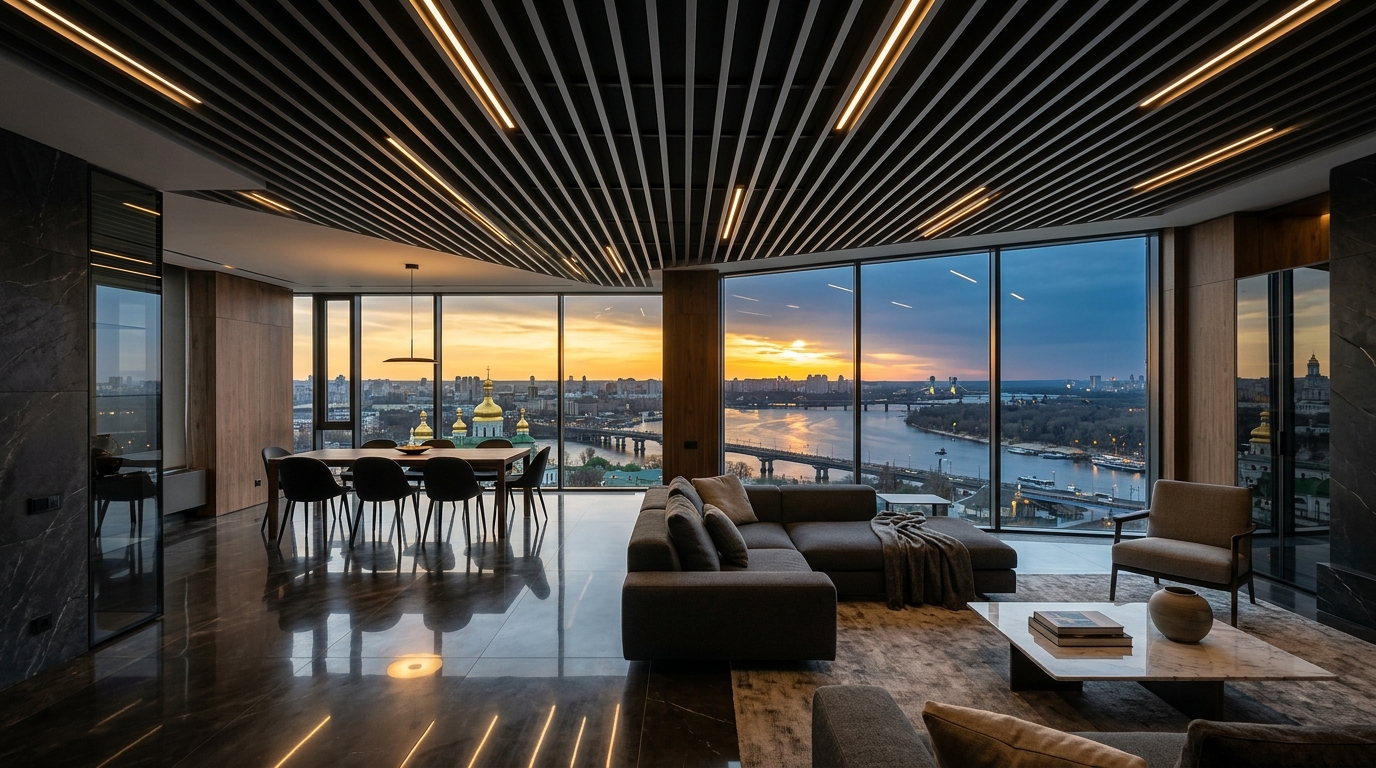
It is in Kyiv that the demand for innovative design solutions is concentrated. The trend of 2026 is the rejection of central chandeliers in favor of integrated light lines, and the rejection of ceiling baseboards in favor of shadow gaps.

Light lines are implemented using special profiles into which linear LED strips or modular lighting systems are mounted. They can be straight, curved, or form complex geometric shapes (contour lighting around the perimeter creating a “floating” structure effect). The price of such a solution in Kyiv starts from 1200 UAH per linear meter including installation. In a room with a 16-meter perimeter, the lighting contour alone will cost almost 20,000 UAH, moving these projects into the elite category.

Regarding the junction with the walls, the classic black or white rubber insert-plug is losing popularity. It has been replaced by the shadow profile. An analysis of the components market demonstrates the high cost of these aluminum systems: a shadow profile for drywall (model Pr-2030) costs 155 UAH/lin.m, a profile for stretch ceilings (Pr-3161) — 236 UAH/lin.m, and a drywall ceiling profile (Pr-D1020) — 195 UAH/lin.m. Profiles with the ability to integrate LED backlighting (Pr-1601) are priced at 180 UAH/lin.m solely for the metal. According to calculations by Kyiv companies, the total estimate for arranging a shadow ceiling in an average room is about 9620 UAH, while more complex solutions with integrated inserts and backlighting reach 13130 UAH.

montazh steli 8

4. Regional Analysis: Western Hub (Lviv)

The Lviv market in 2026 demonstrates the highest level of price dispersion (spread) and the greatest detail in price lists among all cities in Ukraine. This is due to the unique architectural specifics of the city, where Austrian and Polish buildings with high ceilings (often over 3.5 meters) and complex stucco coexist with mass-produced Soviet panel houses and modern residential complexes. Although fewer loans are issued in the Lviv region under the “eOselia” program than in the capital (14 per week ), the high purchasing power of the local population and the presence of a significant pool of qualified restorers form a stable market.

4.1. Maximum Segmentation of Suspended Systems

The general price range for stretch ceilings in Lviv is between 350 and 700 UAH/m². However, construction service aggregators record an incredibly detailed price gradation depending on material specifics. Some craftsmen indicate a basic promotional installation cost of 45 UAH/m² , which is a classic lead generation tool — this amount reflects exclusively stretching the canvas onto an already prepared and separately paid frame.

Actual starting prices for materials and labor (based on May 2026 data) look like this:

  1. Fabric suspended ceilings (eco-friendly breathable material) — from 80-90 UAH/m².
  2. Matte PVC ceilings (classic standard) — from 95 UAH/m².
  3. Satin ceilings (with a slight silky sheen) — from 110-115 UAH/m².
  4. Special effects (“Starry sky” system with fiber optics) — from 115 UAH/m².
  5. Glossy ceilings (visual expansion of space) — from 125 UAH/m².
  6. French premium ceilings — from 135 UAH/m².
  7. Two-level suspended systems — from 120-125 UAH/m².
  8. Multi-level structures — from 130 UAH/m².
  9. Ceilings from translucent canvas with internal illumination — from 145 UAH/m².

It is important to note that in Lviv, craftsmen actively offer services for decorating classic interiors. Price lists include the installation of foam ceiling molding (up to 80 mm thick) and polyurethane molding (up to 100 mm) on straight surfaces without painting, puttying and painting of moldings, installation of standard moldings, and even the creation of complex gypsum stucco around the perimeter. The number of corners, the geometry of the room, and the quality of the canvas are key factors capable of doubling the initial estimate.

4.2. Working with Drywall, Wood, and Commercial Systems

The cost of installing drywall on the ceiling in Lviv ranges from 350 to 700 UAH/m², with an average value of about 525 UAH/m². This is slightly higher than the average in Kyiv. Examples from real orders show that installing a multi-level ceiling in a typical panel house with an area of 15-20 m² costs approximately 7720 UAH (which is about 386–514 UAH/m² strictly for installation works). The high price is explained by the fact that in the old housing stock, walls rarely have perfect geometry, which complicates setting up laser levels and fastening guide profiles.

A separate Lviv trend is the reconstruction of attics in the central part of the city. This stimulates demand for installing wooden batten frames over beams for subsequent wood paneling (costs about 4000 UAH for 35 m², or ~114 UAH/m²), as well as installing OSB boards or plywood.

In the commercial segment of Lviv, Armstrong ceilings are actively installed (a total of 119 market offers at a price of 180–400 UAH/m² ). Real deals are recorded: installation of guides and mineral tiles for an area of 15 m² is estimated at 3400 UAH (~226 UAH/m²), and spot repairs (replacing tiles, adjusting the frame) on a 10 m² area cost 800 UAH. Works on replacing LED panels in existing structures are also performed. For bathrooms and commercial loft spaces, Griliato cellular metal ceilings are frequently ordered. The complex of works, which includes dismantling old plastic paneling and installing Griliato in a minimum area (e.g., a 2 m² bathroom), is billed very highly — around 3500 UAH (1750 UAH/m²), confirming the rule of high margins for small jobs. Additionally, cassette and mirrored ceiling installation services are offered.

Competition in Lviv has formed a civilized service market. The cost of a master’s visit to evaluate a site is 150 UAH, but it is annulled (becomes 0 UAH) if the customer agrees to the execution of works. Specialists (for example, Vitaliy Z., Yuriy D., Oleksii K.) undergo passport data verification on platforms, and services provide a compensation guarantee of up to 1000 UAH in case of poor-quality work or damage to property.

montazh steli 7

5. Regional Analysis: Industrial Pragmatism (Dnipro)

The Dnipro market in 2026 is radically different from Kyiv and Lviv. There is no hype here around premium light lines or complex stucco. The city, being a powerful industrial and logistics center, focuses on speed, durability, energy efficiency, and rational budget use. The absence of Dnipro from the list of leaders under the “eOselia” program removes speculative pressure from the local repair services market, making pricing more stable and tied strictly to material costs.

5.1. Utilitarian Drywall and Energy Savings

The cost of installing drywall on ceilings in Dnipro is the least volatile among major cities, ranging from 330 to 650 UAH/m², with a median rate of 470 UAH/m². Price lists of local contractors (e.g., craftsman Serhiy Kryazh) show a strict pricing logic where every additional plane or curve has a clear tariff :

  1. Drywall installation on a straight wall — 405 UAH/m².
  2. Installation on a straight ceiling — 470 UAH/m².
  3. Installation of partitions with double-sided cladding — 525 UAH/m².
  4. Installation of semicircular structures on walls — 617 UAH/m².
  5. Installation of semicircular structures (radial partitions) — 710 UAH/m².

A critically important feature of the Dnipro market is the massive demand for internal insulation of premises during ceiling and wall installation. The population’s reaction to the 24% rise in global energy prices manifests in an effort to minimize heat loss in panel and brick houses. The service of insulating the above-ceiling or behind-wall space with a single layer of mineral wool costs an additional 175 UAH/m², and insulation with extruded polystyrene (styrodur) is estimated at 147 UAH/m². This integration of processes allows customers to optimize their overall renovation budget.

5.2. Dominance of Cassette and Stretch Systems in Commercial Real Estate

The average cost of stretch ceilings in Dnipro is fixed at 413 UAH/m². This figure is balanced and reflects the cost of a high-quality canvas without excessive markups for a “capital” contractor brand.

However, the real calling card of the Dnipro repair market is the Armstrong suspended ceiling segment. Due to the presence of a large number of warehouse, retail, and administrative spaces, this type of ceiling is in huge demand. The price corridor for installing an Armstrong system in the city is from 180 to 300 UAH/m², with an average check of 227 UAH/m². This rate is one of the most attractive in Ukraine, driven by intense competition among crews that specialize exclusively in large-area commercial objects. Like in Lviv, Dnipro craftsmen provide services for rough ceiling preparation: installing wooden batten frames costs 193 UAH/m², and ceiling cladding with OSB boards or plywood is 270 UAH/m².

montazh steli 5

6. Comparative Analytics and Data Structuring

To gain a holistic understanding of the price dynamics among the three key agglomerations, it is practical to consolidate the disparate data into a single analytical table. The figures below (as of May 2026) reflect the range and average market prices (UAH/m²) excluding the cost of the materials themselves, except where “turnkey” is indicated.

Table 1. Comparative Cost of Installing Basic Ceiling Systems (Kyiv vs Lviv vs Dnipro)

Type of ceiling system and works Kyiv (range / average) Lviv (range / average) Dnipro (range / average) Economic insight
Stretch ceilings (basic PVC installation) 250 – 700 / ~523 80 – 700 / ~350 350 – 550 / 413 The widest range in Lviv is due to deep division into textures (fabric, satin, gloss). Kyiv leads in the maximum threshold.
Stretch ceilings (premium “turnkey” for small areas <5m²) 1430 – 1480 Data scattered Data unavailable Regressive pricing in the capital to compensate for craftsmen’s logistics costs.
Drywall ceilings (frame and board installation only) 300 – 700 / 510 350 – 700 / 525 330 – 650 / 470 Dnipro demonstrates the highest price pragmatism. Lviv outpaces Kyiv due to the complexity of working in historic buildings (high ceilings, uneven walls).
Armstrong ceilings (commercial segment) 180 – 400 / ~290 180 – 400 / ~250 180 – 300 / 227 Price stability. Dnipro has the lowest average check thanks to high demand and fierce competition among commercial contractors.
Specific works (OSB / Wooden battens) 280 (OSB) ~114 (battens) 270 (OSB) / 193 (battens) High demand for attic and rough-in works in all regions as a method to reduce the cost of the basic slab.

In addition to basic installation, associated works have critical significance for the final estimate. Understanding the cost of these processes is key to understanding why drywall is losing out to stretch films in the mass market.

Table 2. Cost of Associated Painting and Insulation Works (UAH/m²)

Type of associated works Cost (average range) Technological significance and impact on final estimate
Dismantling old ceilings 130 Relevant for the secondary market (“eOselia” program). Increases the preparation budget by 15-20%.
Ceiling priming 20 – 40 Necessary for adhesion. Cheap procedure but requires a technological pause for drying.
Ceiling puttying (multiple layers) 130 – 180 The most labor-intensive process. Gypsum mix costs increased by 8-12% in 2026.
Ceiling painting 90 – 130 The final stage for drywall ceilings. Requires high qualification to avoid roller streaks.
Insulation (Mineral wool / Styrodur) 175 / 147 Active trend in Dnipro amidst a 24% rise in energy prices.

Data Analytics: Correlations and Deviations

Comparing data across the tables clearly demonstrates that the final cost of a square meter of ceiling is the sum of numerous variables. If a client in Kyiv chooses drywall, they will pay 510 UAH for installation, 30 UAH for priming, 150 UAH for puttying, and 110 UAH for painting. Total: 800 UAH/m² strictly for worker wages. Adding material costs (from 140 UAH/m²), the final price exceeds 1000 UAH. On the other hand, a stretch ceiling in the same Kyiv will cost on average 523 UAH/m² (often already including basic level material). The economic feasibility of the choice is obvious for the customer, especially if the budget is limited by preferential mortgage caps.

7. Trends and Innovations in 2026: Bionics, Ecology, and Lighting Design

The cost of repair works is determined not only by macroeconomics but also by shifting consumer paradigms and aesthetic preferences. In 2026, Ukrainian interior designers shaped several powerful trends that directly impact ceiling installation technology.

Eco-design and natural materials. The global demand for sustainability stimulates a shift away from cheap toxic plastics. Although certified PVC films are safe, the premium segment sees a shift towards breathable fabric ceilings (offered in Lviv from 80-90 UAH/m² for basic materials ) and a return to perfectly puttied drywall covered with eco-friendly water-based paints on a latex or silicone base. Using natural wood (batten frames, paneling, plywood) is again relevant not only for rough works but also as a final decorative element.

Bionic forms and complex geometry. Designs for small apartments and studios (popular among “eOselia” borrowers) increasingly utilize bionic (natural, flowing) shapes to visually soften the space. Implementing such streamlined architectural shapes on a ceiling is an extremely difficult engineering task. Flexible arched drywall or milling of standard boards is used for this. As the analysis of the Dnipro market showed, installing semicircular structures commands the highest price — from 617 to 710 UAH/m². This moves bionic design into the category of expensive custom solutions.

Light lines and the rejection of central lighting. Traditional chandeliers have finally lost their footing in modern projects. They are replaced by built-in track systems and light lines integrated into stretch or drywall ceilings. Linear LED strips or modular fixtures are placed along straight or curved lines, providing uniform diffused light. Contour lighting around the perimeter is also popular, creating an illusion of weightlessness. Geometric light patterns act as independent decorative elements. The cost of such a solution is significant: from 1200 UAH per linear meter with installation , making lighting one of the most expensive items in the overall room renovation budget.

Shadow gaps as the new junction standard. The evolution of the joint between wall and ceiling has led to the complete abandonment of foam moldings or plastic plugs in modern interiors. An aluminum shadow profile allows leaving a technological gap (shadow seam) 5-7 mm wide, thanks to which the ceiling visually does not touch the walls. The cost of the aluminum profiles themselves fluctuates from 155 to 236 UAH per linear meter depending on the configuration (for drywall or stretch film). A profile capable of enclosing an LED strip (Pr-1601) costs 180 UAH/lin.m. As a result, the total cost of a shadow stretch ceiling for a standardized room reaches 9620 UAH, whereas standard installation with a rubber insert would be significantly cheaper, and integrating the shadow gap with complex lighting pushes the estimate to 13130 UAH.

montazh steli 9

8. Conclusions and Strategic Recommendations

The in-depth analysis conducted on the ceiling system installation market in Kyiv, Lviv, and Dnipro for 2026 provides a clear vision of the industry’s current state and forecasts its near-term prospects. The market functions under the heavy pressure of two opposing vectors: on one hand — a rapid 10-15% growth in demand stimulated by the state “eOselia” mortgage program, and on the other — an 8-12% inflation in materials, a 24% global hike in energy costs, and an acute shortage of qualified personnel.

  1. Polarization of Regional Markets. Pricing has definitively lost any unified national character.

    • Kyiv focuses on high speed and premium innovations (shadow profiles, light lines). The capital’s logistics and operational costs force contractors to apply high regressive tariffs (up to 1480 UAH/m² turnkey) for small-area projects.

    • Lviv is the market for the most complex custom solutions. The presence of historical buildings and high aesthetic demands generate the widest spectrum of offerings: from cheap basic canvas stretching (from 45 UAH/m²) to expensive multi-level drywall systems (over 525-700 UAH/m²), integration of stucco, Griliato, and restoration work with wood.

    • Dnipro acts as a stabilizer and an industrial standard. The absence of excessive mortgage-driven market overheating keeps prices predictable (drywall — 470 UAH/m², stretch — 413 UAH/m²). High demand for Armstrong systems (227 UAH/m²) and associated insulation with styrodur or mineral wool reflects the population’s pragmatic approach to real estate maintenance.

  2. Technological Determinism. The personnel deficit (25% of companies expect staff reductions) kills the profitability of lengthy painting processes. Craftsmen deliberately raise prices for priming, puttying, and painting, encouraging customers to switch to fast PVC stretch systems that can be installed in 1 day. Drywall, as a method of creating flat planes, is gradually being pushed out, retaining its niche for complex bionic geometry, curtain niches, and soundproofing enclosures.

  3. Adaptation of Financial Models. For the end consumer (especially “eOselia” borrowers), it is critically important to understand that the allocated mortgage caps may be insufficient to realize complex design projects due to the substantial price hikes for aluminum components and LED lighting.

In the long term, players in the construction market must heed the recommendations of leading suppliers: plan the volume of works for the spring period before the peak construction season starts, optimize logistics through wholesale material purchases, and factor into estimates the risks of further electricity cost increases, which will inevitably be reflected in the prices of rolled metal and dry construction mixes. Only such a comprehensive, analytically grounded approach will allow both contractors and clients to effectively manage renovation budgets amid the turbulent economic conditions of 2026.

author
Alexander Guk
About the author:

Our expert in fencing structures has over 5 years of experience working at the Mehbud factory. Helps you choose the optimal design and model of fencing according to your needs. Professionally deve...

More
0 0 votes
Article Rating
Subscribe
Notify of
guest
0 Comments
Oldest
Newest Most Voted
Inline Feedbacks
View all comments