Architectural Synergy: Strategies for Selecting Fencing Structures to Match Your Home’s Style
Generic selectors
Exact matches only
Search in title
Search in content
Post Type Selectors

Architectural Synergy: Strategies for Selecting Fencing Structures to Match Your Home’s Style

June 17, 2026
5  

Introductory Concept of Spatial Zoning

In the era of modern construction and landscape architecture, enclosing structures have definitively lost their exclusively utilitarian status as a primitive physical barrier. Today, a fence serves as a fundamental architectural element that performs the complex function of a transitional zone between the public space of the street and the intimate environment of a private household. It forms the primary visual impression, sets the spatial rhythm, and emphasizes the stylistic orientation of the main building. Architectural dissonance between the facade of a residential complex and its external boundary can negate the aesthetic value of even the most sophisticated architectural project. This is precisely why the process of choosing a fence design requires a deep understanding of the laws of proportion, material science, and visual harmony.

Each dominant architectural style, be it monumental classicism, organic modern, or technological high-tech, dictates its own strictly regulated rules regarding material usage, spatial geometry, color schemes, and visual permeability. Designing an ideal fence must address multifaceted tasks: from providing acoustic insulation, protection from wind loads, and ensuring privacy, to integrating security systems and landscape lighting. This report presents a comprehensive expert analysis of fence selection methodology in the context of three main architectural directions, with a deep dive into the physical and mechanical properties of materials, the psychophysiology of color, and the economics of structural life cycles.

Architectural photo modern estat… 202606150825

Engineering and Spatial Principles of Architectural Unity

The successful implementation of a perimeter fence project is based on the concept of spatial continuity. The fence should be perceived not as an alien object, but as a logical morphological extension of the residential building. To achieve this architectural seamlessness, specialists rely on three fundamental parameters: scale, rhythm, and material consistency.

The scale of the structure determines the ratio of the fence’s height and massiveness to the volumes of the main building. For massive multi-story mansions with high plinths, it is appropriate to use tall, capital walls made of brick or natural stone, which balance the overall architectural mass. In contrast, lightweight houses with panoramic glazing require visually permeable, ethereal structures. According to engineering standards, the optimal height of a protective system ranges from 1800 to 2000 millimeters, although technical capabilities allow for structures from 300 to 3000 millimeters in height. Exceeding these figures without architectural justification transforms the plot into an enclosed space, negatively impacting insolation and natural aeration of the area.

Rhythm is formed through the mathematically precise alternation of support pillars, infill sections, and voids. The distance between individual infill elements, such as metal slats or wooden planks, creates the visual tempo of the structure. The recommended interval between planks should not exceed 50 millimeters, and the minimum gap should be no less than 20 millimeters. Ignoring these parameters, for example, with smaller gaps, the structure will, from a certain distance, merge into a solid blank wall, losing its decorative effect and aerodynamic permeability.

Material consistency requires the use of materials in the fence’s finish that either duplicate or harmoniously complement the house’s facade. For instance, if the exterior facade features clinker brick or basalt, these same materials should be integrated into the fence’s support columns or plinth. This approach creates the effect of an architectural ensemble where each element supports the overall idea.

Residence front elevation fence 202606150825

Monumental Aesthetics: Classical Architectural Style

The classical architectural direction embodies symmetry, stability, restrained luxury, and fidelity to tradition. Houses built in this style are distinguished by clear geometric proportions, the presence of columns, bas-reliefs, stucco, and the use of natural stone and heavy brick. Accordingly, a fence for a classical estate should wordlessly convey a sense of immutability, security, and the high social status of the owner.

Stone and Brick Monoliths: Technology and Execution

Dominant materials for creating classical enclosing systems include high-quality clinker brick, natural stone, and architectural concrete that imitates these materials. Such structures belong to the category of capital constructions, guaranteeing the highest level of safety and durability.

Brick fences are rightfully considered the standard of classical architecture. They are impervious to rapid fashion changes and are remarkably durable. Provided all building codes are adhered to during installation, the service life of a brick fence exceeds fifty years. This material demonstrates exceptional resistance to mechanical damage, extreme frosts, summer heat, and provides unparalleled sound insulation from the street environment. The construction of a clinker brick fence is a complex technological process. The material has a low water absorption rate, so specialized building mixtures are required for laying, not standard cement-sand mortars, which can lead to efflorescence on the surface. In addition, craftsmen must provide a material reserve of about five percent for trimming when forming pillars and corners. The recommended distance between brick supports usually ranges from two to three meters, depending on the mass of the infill sections and the wind load of the region.

The use of natural stone, such as granite, basalt, or porphyry, elevates the construction into the premium real estate segment. The extremely high cost of such fences is dictated not only by the price of the raw material itself but also by the colossal labor intensity of stonemasons who form intricate patterns from crushed or “wild” stone. Such stone fences create the atmosphere of a true ancestral castle and perfectly complement classical mansions.

An economical and practical alternative to natural materials are sectional fences made of architectural concrete. Classical concrete fences are made in a solid style, without excessive ornamentation. Their strictness and simplicity perfectly match the canons of traditional design. Modern casting technologies allow for the creation of concrete panels with a brickwork or crushed stone texture. This solution adds solidity to the property, creates an impression of thoroughness, but at the same time spares the owner the need for complex maintenance and significantly shortens construction times. Classical concrete fences gain particular expressiveness from pillars decorated with elements of Greek or Roman architectural orders with massive pylons.

The Art of Artistic Metal Forging

The most exquisite, expensive, and complex option for decorating a classical estate is a forged fence. Forged fences transform the property boundary into an intricate metal lace, traditions of which date back to the Baroque era of the 17th century. Despite its apparent fragility and visual lightness, such lace is an extremely reliable barrier. Thanks to the use of modern high-tech alloys and multi-layer anti-corrosion primers, the products of blacksmiths do not succumb to the destructive effects of moisture and retain their original appearance for decades.

From a design and budgeting perspective, metal forged fences are divided into protective and decorative. Protective structures have a minimal number of artistic elements (scrolls, rosettes, spikes), making them stricter, more impregnable, and economically justified for long perimeters. Decorative options, on the other hand, are made according to individual sketches, feature complex artistic design, and a significant amount of manual labor, which drives their high cost.

The installation process of a forged fence is a complex engineering task. It requires ideal site leveling, precise marking, and concreting of metal posts in deep pits. Only after the concrete has fully polymerized are the heavy forged panels attached to the supports using threaded connections or welding. To optimize the overall budget, architects often resort to combining materials: massive pillars are erected from clinker brick or faced with stone, and the spaces between them are filled with elegant forged sections. Such synergy ensures a balance between visual monumentality and spatial lightness.

Palace facade with fence 202606150825

Natural Harmony: Modern Architectural Style

The term “modern” in architectural discourse encompasses both the historical style of the late 19th and early 20th centuries (known as Art Nouveau) and contemporary trends focused on eco-friendliness and minimalism. Unlike the strict symmetry of classicism or the industrial coldness of high-tech, modern modernism chooses the path of unity with nature. This direction is characterized by the use of natural materials, warm color palettes (beige, sandy, ochre, terracotta shades), smooth winding landscape lines, and the visual blurring of rigid spatial boundaries. Space here is dynamic; it “flows” from one zone to another, but maintains a clear functional division with retaining walls and wooden terraces.

Wood as the Embodiment of Organic Architecture

The most organic material for fences in the modern style is wood. A wooden fence creates a feeling of home warmth, coziness, and absolute eco-friendliness. Traditional solid plank fences are gradually becoming a thing of the past, replaced by structures that allow space to “breathe.”

An extremely popular solution are “Ranch” type fences and structures with horizontal “Picket” fencing. In such systems, planks of coniferous or deciduous wood are fixed on load-bearing crossbeams with a certain interval, ensuring partial visual permeability and free circulation of air masses. To preserve and emphasize the unique natural texture of the fibers, instead of dense paints and varnishes, designers use deep impregnations, natural oils, or translucent varnishes. These substances not only form an aesthetic appearance but also protect the wood from the destructive effects of moisture, fungi, and ultraviolet light. An important feature of wooden structures is that they require cyclical restoration, which should be taken into account when planning long-term operating costs.

Gabions and Concrete Minimalism

A new trend in contemporary modernism is the use of gabion structures. A gabion is a strong mesh frame made of double-twisted galvanized wire, tightly filled with natural material: river pebbles, large crushed stone, pieces of glass, or granite stone of various fractions. These structures have colossal weight and stability, do not require a deep strip foundation (thanks to their ability to adapt to soil settlement), and look maximally natural. Gabions are often combined with sections of metal “Blinds” or massive wooden beams. Such a contrast between the rough stone mass and the strict lines of metal or wood creates an unsurpassed architectural effect.

For adherents of stricter lines, the market offers specialized concrete systems designed for the style of modern minimalism and modern. Such fences are assembled from concrete blocks with an perfectly smooth surface, forming a strict geometric pattern of vertical lines. Their installation technology involves the use of special construction adhesive without traditional joint filling. Blocks are stacked one on top of the other, and hidden composite reinforcement is used in special grooves to provide horizontal rigidity. This approach creates the effect of a holistic, indivisible monolith, which, thanks to its restrained design, does not draw attention away from the main building.

Modern residence with wood and 202606150825

Industrial Pragmatism: High-Tech Style

The architectural direction of high-tech is the absolute antithesis of organic modernism. It is a style that consciously declares its detachment from nature and elevates the achievements of technological progress to a pedestal. High-tech is characterized by artificiality, maximum openness of space, a complete absence of decorative excesses, the use of industrial materials, and the dominance of a cold color palette.

The visual language of high-tech is formed through the simplicity of geometric shapes. Straight, sharp, and broken lines dominate the design; the only exceptions are structures made of bent profiles, which, however, are used extremely rarely. The philosophy of the style dictates the rule: the fewer visible details, joints, and connections a structure has, the closer it is to the ideal.

Metal Profiles, Blinds and Louver Systems

The main construction material for high-tech style fences is metal: polished stainless steel, anodized aluminum, or steel with a powder matte coating. These materials guarantee impeccable mechanical characteristics and absolute resistance to corrosive processes, which is critically important for preserving technological aesthetics.

The most sought-after solution is panel steel or aluminum fences based on slats. The classic rectangular profile of the slats allows for the creation of “Ranch” type structures, which appear visually light and airy, but at the same time form a clear boundary for the territory. A special pride of modern industrial design are “Blinds” type fencing systems. They consist of horizontal inclined slats, which provide the property with one hundred percent privacy from the street, but allow the owners to freely see the surrounding space from inside the courtyard. In addition, thanks to rigid fixation in guide profiles, such slats do not create vibrational noise even during hurricane winds and perfectly reflect sound waves from the roadway.

Another characteristic high-tech technique is the use of perforated metal. Panels with a precise geometric pattern of perforations, executed using laser cutting, create a futuristic look and play with light throughout the daylight hours.

Glass and Intelligent Technologies

Since high-tech implies total illumination of space through panoramic glazing of buildings, glass naturally integrates into perimeter fences as well. For safe exterior use, only multi-layered glass (triplex) or tempered glass 8-12 millimeters thick, laminated with super-strong armored films, is used. If transparent glass walls compromise a comfortable level of privacy, frosted or textured glass sections are employed. They effectively conceal the area from prying eyes, while creating the effect of a glowing wall due to light scattering.

The railings and balcony enclosures of the house must also correspond to the general concept, combining stainless steel frames with glass or metal cables. An important feature of high-tech fences is the integration of “smart” technologies: hidden surveillance cameras, biometric locks, automated gates, and architectural lighting using strict graphic lines of LEDs. These elements do not just perform a function, but become a full-fledged part of the decor.

image.png 202606150825

Analytical Comparison of Physico-Mechanical Properties of Materials

To make a rational and technically sound decision, it is necessary to structure data on the physical characteristics and operational features of materials, used in various stylistic directions.

Table 1: Comparative Analysis of Fencing Materials and Their Stylistic Adaptability

Material Basis Target Architectural Style Fundamental Advantages Operational Limitations and Requirements
Clinker Brick and Natural Stone Monumental Classicism, Modern

Highest level of durability (>50 years). Maximum acoustic insulation. Resistance to temperature fluctuations and mechanical damage.

Critical weight requires a monolithic strip foundation with deep embedment. High cost of raw materials and skilled labor.

Artistic Metal Forging Monumental Classicism

Unique aesthetics and exclusivity of pattern. High strength. Does not obstruct insolation of the plot.

Significant cost of manual labor. Lack of privacy from street view. Need for regular renewal of anti-corrosion paint layer.

Wood (picket, beam) Modern, Ecological Direction

Absolute eco-friendliness. Psychological comfort of natural texture. Possibility of visual control of air permeability.

High susceptibility to rot, deformation from moisture, and pest infestation. Strict necessity of cyclical application of protective impregnations and varnishes.

Sheet and Profile Metal (slats) High-Tech, Contemporary Modern

Lightweight constructions. Fire safety. Ease of maintenance (pressure washing). Ideal geometry of lines.

Requires high-quality polymer or powder coating to prevent corrosion. Thin metal is sensitive to localized mechanical impacts.

Gabion Structures Contemporary Modern, Loft

No need for deep concreting. Ability to absorb sound waves. Natural contrast of metal mesh and stone.

Significant dimensions (width) reduce usable yard space. Dust and leaves can accumulate in small mesh cells, making cleaning difficult.

Optical Physics, Coloristics, and the Psychology of Space

The color solution of an enclosing structure is no less influential than its physical form. Color acts on several levels: it changes the optical perception of space geometry, affects the psycho-emotional state of residents, and, as real estate specialists prove, directly impacts the commercial liquidity and market value of a home. According to expert research, a fence forms the very first impression of the owner’s architectural taste.

Psychological Dissonance: Colors That Destroy Architecture

There are coloristic solutions that specialists categorically do not recommend for external fences of private houses.

First and foremost, these are bright red hues. From a psychological perspective, large areas of red act on the nervous system as a powerful irritant, subconsciously associated with danger, aggression, and tension. In a landscape, such a fence looks sharp, draws all attention to itself, and disrupts the harmony of the natural environment.

Dazzling white, despite its elegance in sketches, becomes a real trap in actual use. Any dirt, dust, rain marks, and organic residues are instantly noticeable on a white background. Without weekly thorough washing, such a structure quickly begins to look unkempt, creating an overall impression of neglect for the entire estate.

Neon and acidic tones are also prohibited. They visually “compress” the courtyard’s volume, create the effect of theatrical artificiality, and make the area resemble a temporary set. Furthermore, gaudy multi-colored combinations (creating a “rainbow” effect) indicate excessive individualization, which deters potential buyers and can significantly reduce the market value of the property. Restraint and spatial neutrality allow the property’s price to remain unchanged.

Scientific Approach to Color Selection

The most practical and aesthetically justified colors are those found in nature. Leaders in private construction are deep brown and dark green shades. Green creates an optical illusion of infinite space: merging with lawns and tree crowns, it visually dissolves the boundary of the plot. Brown perfectly complements brick, wood, and stone, emphasizing comfort and stability.

For high-tech and modern minimalism styles, the most relevant are various shades of grey (from light aluminum to dark graphite) and deep black. Such constructions look extremely expensive and stylish, especially when located on a well-lit side. An unconventional but acceptable solution can be dark blue, which allows the house to stand out among neighboring developments.

Table 2: Opto-Physical Properties of Coloristic Solutions and Their Impact

Color Spectrum Psychological Impact Optical Effects and Practicality of Use Architectural Style Correspondence
Light, Pastel Tones Feeling of lightness, openness, and cleanliness. Visually push back property boundaries. Prone to rapid soiling; dust and dirt are highly visible.

Modern, Classic

Dark Tones (black, graphite) Feeling of strictness, security, and exclusivity. Absorb light, make the boundary sharp. Lighten under UV exposure. Best at concealing street dirt (“anti-vandal”).

High-Tech, Contemporary Minimalism

Natural (brown, green) Calming effect, harmony with nature, stability. Blend with the surrounding landscape, expand space. Mask organic pollutants and dust.

Universal, Modern

Bright (red, acidic) Anxiety, tension, discomfort. Fade quickly in the sun (photodegradation of pigments). Narrow space, create an effect of artificiality.

Not recommended by experts

In addition to psychology, it is necessary to consider the physics of ultraviolet radiation’s impact on pigments. Bright colors significantly faster lose intensity (fade) under direct sunlight due to the destruction of polymer bonds in the paint. Dark colors tend to lighten over the years. Furthermore, the object’s location dictates its own conditions: if the facade faces a busy thoroughfare, specialists strongly recommend choosing dark, non-marking colors capable of concealing street smog.

The choice between matte and glossy textures is also important. Matte surfaces are softer, they absorb light and hardly show marks from dried raindrops, making them ideal for rustic or modern styles. Glossy surfaces, on the other hand, reflect light, create glints, and visually expand space, making them indispensable in high-tech aesthetics, especially on metal slats or glass panels.

To add volume to flat structures, the method of color combination is applied. For example, supporting stone pillars are left in light natural tones, while the metal sections between them are painted in dark graphite. This allows breaking the monotony of a long wall and setting a clear architectural rhythm for it.


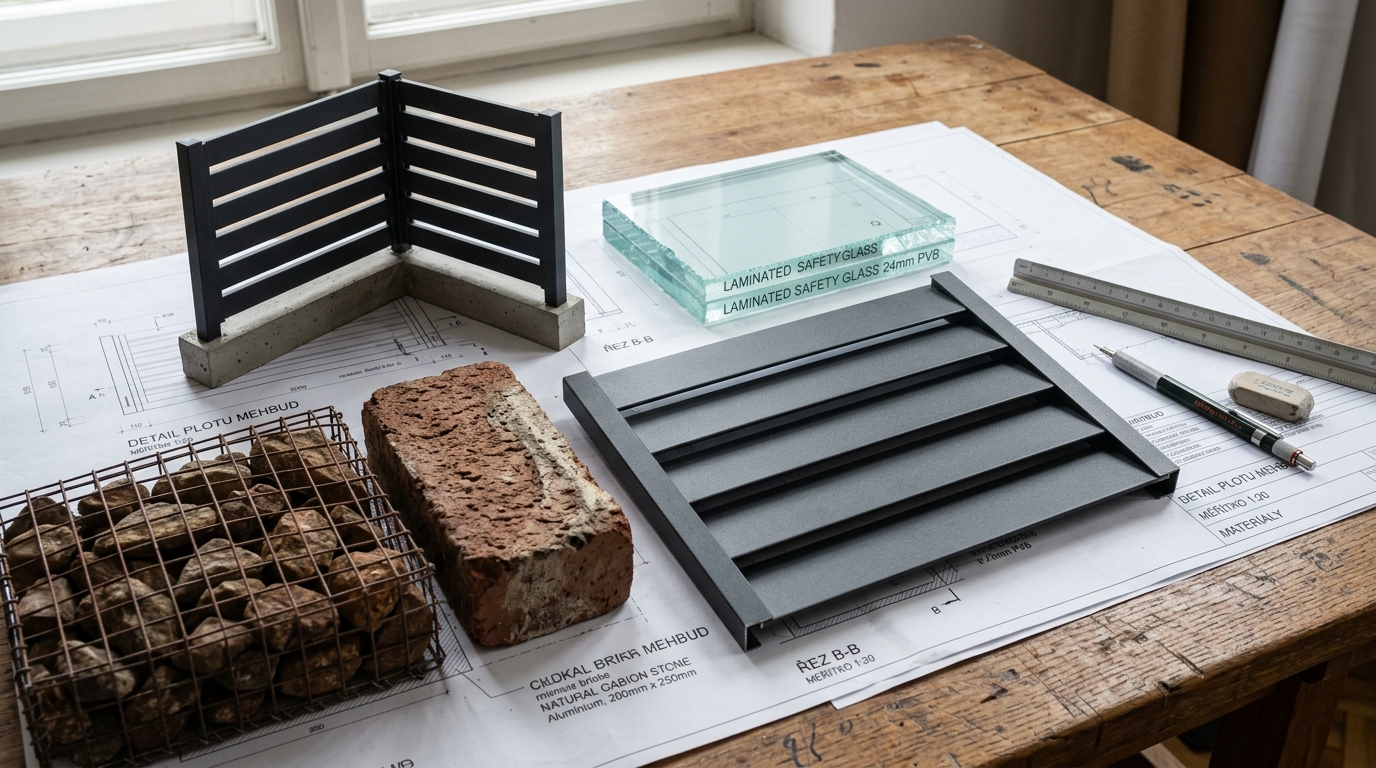
Building material samples on table 202606150825

Bioclimatic Interaction and Landscape Design Synergy

The construction of a fence fundamentally alters the microclimate of a private plot. A solid fence over two meters high can completely block the natural movement of air, turning the yard into a “greenhouse” in summer, or change the aerodynamics in such a way that destructive turbulent eddies will form on the plot. Systems with “Blinds” slats or horizontal “Picket” fencing with technological gaps (up to 50 millimeters) act as aerodynamic diffusers, reducing wind speed but maintaining the necessary ventilation of the territory.

From the perspective of landscape architecture, the fence is the most extensive background for forming green compositions. Modern ecological trends in courtyard design, especially in the modern style, encourage the use of vertical landscaping. The surfaces of wooden fences or retaining walls are ideal for attaching special containers or guiding the growth of climbing plants. Such “green walls” help compensate for the lack of greenery on small plots and significantly improve air quality. If a simple metal mesh is chosen for reasons of economy, the lack of privacy is easily compensated by planting a dense row of thujas or tall shrubs along it.

Water elements also play an important role in the architectural ensemble. Creating a small stream, pond, or fountain near a stone fence enhances the effect of unity with nature, characteristic of modernism, and creates a powerful relaxing acoustic background that effectively masks street noise. By the way, regarding acoustics: solid concrete walls can reflect internal noise, creating an unpleasant echo in the courtyard, while textured surfaces (gabions, crushed stone, or angled slats) act as diffusers, breaking up sound waves and providing acoustic comfort.

Green courtyard with metal fence 202606150825

Economic Modeling of Fence Life Cycle

The selection of a stylistic solution inevitably comes down to financial planning. Professional calculation of fence costs involves analyzing not only capital expenditures at the construction stage, but also assessing operational costs for subsequent maintenance (life cycle).

Premium segment fences (monumental classicism made of wild stone, clinker brick, and intricate forging) require significant initial investments. The main cost item is not even materials, but earthworks and pouring a powerful concrete foundation, without which the structure would simply sink into the ground under its own weight. Added to this is the payment for highly qualified stone masons and blacksmiths. However, from an economic point of view, this is a long-term asset: such structures do not require regular repairs and significantly increase the capitalization and market attractiveness of the property.

High-tech solutions (metal slats like “Blinds”, polished aluminum, panel systems) belong to the medium and high-price segments. Their advantage lies in the speed and technological efficiency of installation (often these are ready-made modules) and the absence of a need for a heavy foundation. The main financial benefit is minimal operating costs. Thanks to polymer or powder coating, such a fence does not require periodic repainting, and its maintenance is reduced to simple pressure washing.

Wooden fences, despite their initial appeal and relatively low construction cost, may prove to be the most expensive in a fifty-year perspective. Wood requires continuous care: cyclical replacement of damaged elements, sanding, treatment with expensive antiseptics, fire-retardant solutions, and application of new layers of varnish or oil. Ignoring these procedures leads to complete degradation of the structure and the need for its dismantling. A modern alternative that allows reducing these costs while preserving the appearance of wood is the use of metal profiles that qualitatively imitate wood texture thanks to sublimation printing technology.

Villa and fence at twilight 202606150825

Final Architectural Synthesis and Recommendations

The process of forming the external boundaries of private property is a complex interdisciplinary task, which integrates the laws of architectural proportions, achievements of modern materials science, engineering mechanics, and the psychology of spatial perception. A fence is not an independent object; it acts as a link between the architectural concept of the building’s creator and the surrounding urban or natural environment. A structure that visually conflicts with the main building can destroy the aesthetics of even the most expensive project.

An analytical breakdown of key stylistic directions allows for the formation of clear vectors for decision-making:

  1. Traditional classical architecture demands corresponding monumentality. The application of clinker brick, textured stone, and exclusive metal forging provides the structure with status, durability, and perfect symmetry, in line with the spirit of historical traditionalism.
  2. Contemporary modernism is oriented towards merging with the biosphere. The choice vector here should be directed towards using materials with warm natural energy — natural wood with minimal chemical treatment, ecological gabions with stone infill, and architectural concrete of restrained forms, harmoniously intertwined with landscape greenery.
  3. The philosophy of industrial high-tech completely rejects retrospective forms. Relevant solutions include “Blinds” systems and “Rancho” type slatted panels made of matte or glossy metal, multi-layered transparent or textured glass, and imperceptible integration of intelligent security and lighting systems.
  4. The color strategy should be based on natural, restrained, or deep dark shades. Avoiding bright, acidic, and irritating colors allows for maintaining visual harmony, protecting the structure from rapid photochemical aging, and ensuring high commercial liquidity of the property.

Flawless results are achieved only through strict adherence to the chosen architectural concept: from the material of the strip foundation to the angle of inclination of the metal slats, creating a unified, logically complete ensemble of living space.

author
About the author:

A marketing and communications expert at the Mehbud factory. Develops the brand, showcasing all the advantages of Mehbud products to clients. Helps you make the right choice by providing consultat...

More
0 0 votes
Article Rating
Subscribe
Notify of
guest
0 Comments
Oldest
Newest Most Voted
Inline Feedbacks
View all comments