
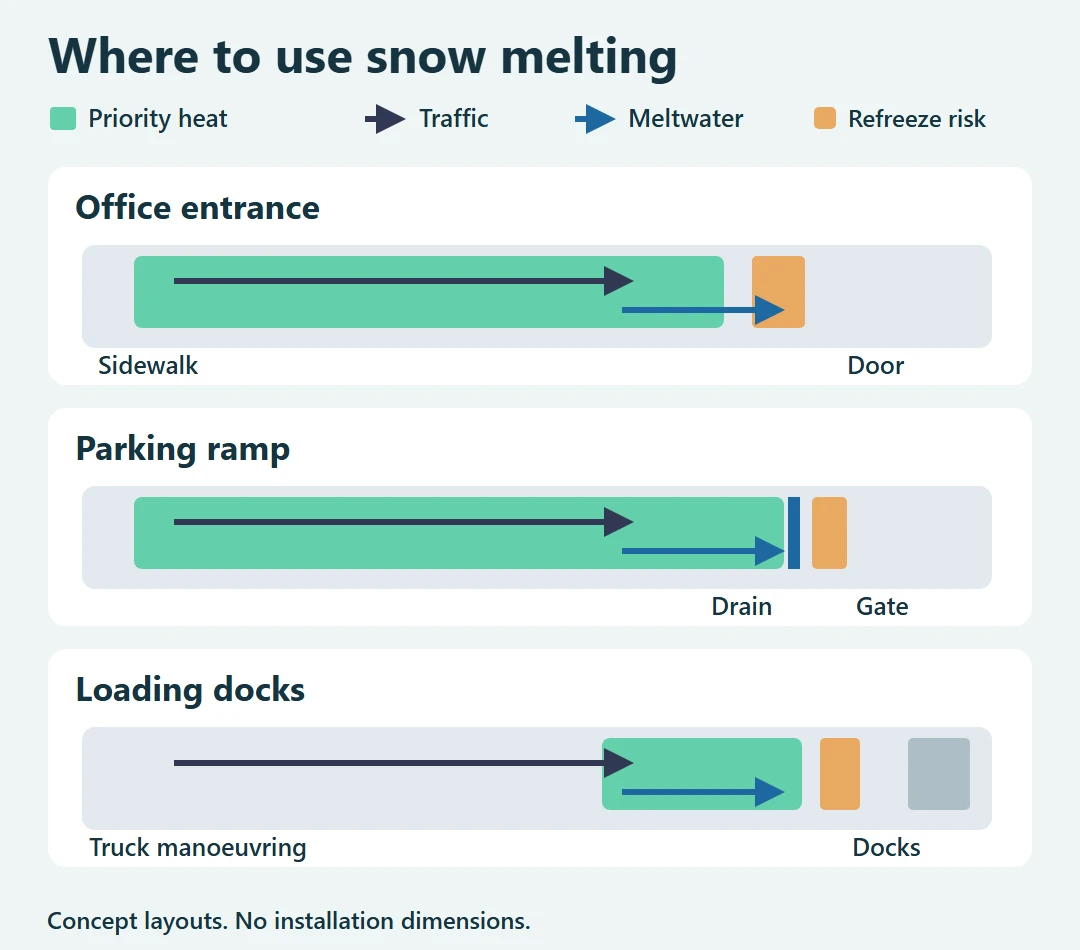
Illustration of a commercial entrance, parking ramp and loading area in winter.
For commercial snow melting, define the smallest continuous route that keeps the property open. At an office it may be the accessible entrance, at a parking garage the curved ramp and its drain, and at a warehouse the approach to a priority loading bay. Work out where meltwater goes and how you will keep people and vehicles moving when the system is unavailable.
What to heat at entries, parking ramps and loading docks
Office, clinic or retail entrance. Start at the sidewalk or drop-off point and trace the route through the door. Include the ramp, treads and landings where applicable. Locate roof and canopy runoff and check where snow will be stored so winter operations leave the route usable. Heated stairs can still discharge onto a cold landing at the bottom.
Parking garage. Map the start of the gradient, curves, braking and queuing positions, the door or barrier, and the trench drain. Compare the heating layout with actual tire paths for both directions. Two straight tracks may leave an icy gap at a bend or a place where drivers step out. Trace water down to the outlet, especially where the heated slab meets cold pavement.
Warehouse and logistics yard. Separate the pedestrian route from reversing trucks and handling equipment. Consider heating the approach to a priority bay or a specific braking area while clearing the wider yard mechanically. Coordinate slab loads, joints and embedments with dock leveller, bollard and guardrail anchors. Cold-store slab frost protection is a separate design task from melting snow outside.
When to clear snow and when to add heat
Walk the site with the operator, security team and shift supervisor. Record recurrent ice, vehicle queues, delivery windows and the longest acceptable closure. Set an operating target such as restoring one usable loading bay before the morning deliveries. Track downtime, call-outs and event energy against that target. These records are more useful for comparing bids than an isolated price per square metre.
Electric vs hydronic snow melting
Outdoor cables or mats can work well for discrete retrofit zones if the electrical service has spare capacity. Coordinate the paving assembly, cable protection, controls, measurements and access to sensors before specifying the system. Check suitability for the actual concrete, asphalt or paving assembly in the supplier documentation.
Hydronic tubing can be worth comparing over a larger area or where the heat source has verified winter capacity. Allow for heat exchange, pumps, controls, fluid expansion, freeze protection and service. A fuel-fired source may have a smaller electrical demand than direct resistance heating for the same heat output. It still uses fuel, and the heat source, pumps and controls must operate if the system is intended to run during an outage. See DEVI’s electric design guidance and Uponor’s hydronic design manual.
How much power and energy does snow melting use?
Multiply the active surface area by the installed power per unit area. For an early comparison, these examples use 300 W/m², about 28 W/sq ft, and three hours at full output.

Running all three zones together demands 34.8 kW for the heaters, or 104.4 kWh over three hours. For an electric system, multiply event energy by the applicable rate. Where the site pays a demand charge, check how coincident heating affects the billed peak. For a hydronic proposal, ask for heat and fuel estimates plus the electrical load of the auxiliary equipment.
The power density in the table is an illustrative input. A designer uses local weather, surface construction and the required melt rate to size a real system. Compare bids against the same service target. Include paving and drainage, breaker or plant upgrades, controls, commissioning, scheduled maintenance, clearing and downtime. Use comparable weather events and metered operation to refine the estimate after the first winter.
Drainage, gates and power outages
Trace the meltwater from the warm surface to its outlet. Check grate access, frost risks in the drain and downstream cold pavement. At gate lines look for recurring ice at a guide, bottom seal, threshold or sensor. Coordinate clearing, drainage and the manual procedure in the gate operator documentation. Surface drainage for paths and fences.
Write down the order in which zones can run when supply is constrained. In the example, the office route alone would need 4.8 kW for the heaters before other loads are counted. Size any backup and transfer arrangements with the electrical designer. Verify the source of heat and the auxiliary loads for a hydronic system.
Decide who sees a controller alarm, who closes the zone and where users go while it is closed. Test sensor failure, a single-zone trip and restart after a power cut. Reopening should follow a surface and drain inspection. Even with power restored, slabs can take time to warm and ice can survive at transitions.
Three published installation examples
- Municipal waste facility, Warsaw. DEVI reports about 750 m² of truck circulation area, 300 kW and four ground sensors. It illustrates the scale of a large service yard and why traffic zones and controls need to be specified. Warsaw case study.
- Bunker IV, Hamburg. The DEVI case describes approximately 1,100 m² and 350 kW. Prefabricated stairs received embedded cables, while flat sections used mats. It shows why stair fabrication and paving details need to be coordinated early. Hamburg case study.
- Mariinsky Palace, Kyiv. DEVI describes temperature and moisture sensing for an outdoor pedestrian surface and reports 250 kW of installed power. Commercial teams can use the example to discuss how an entrance responds to wet freezing conditions. Kyiv case study.
These case reports supply project examples and some design inputs. They do not include comparable seasonal meter readings or incident and downtime results. Ask bidders for an installed reference with a similar surface, climate and operating window.
Codes and questions for suppliers
Have the local design team identify applicable requirements for accessible routes, egress, parking ramps, workplace traffic, electrical protection and surface-water discharge. For examples of jurisdiction-specific guidance, the U.S. OSHA walking-working surfaces rule addresses hazardous conditions including snow and ice, and the UK HSE guidance on loading areas addresses the layout and operation of those areas. Availability of heating does not remove operating and inspection duties.
For procurement, DEVI’s tender material and Uponor’s hydronic manual illustrate how to discuss equipment and functional requirements. Ask local installers for the zoning plan, comparable commercial references, coverage for paving or drainage failures, inspection test records and a winter service arrangement. Confirm where responsibility passes between the paving, electrical and mechanical contractors.
What to test before handover
- Review as-built circuits or loops, sensor positions, joints, no-drill areas and the route to the outlet.
- Collect staged electrical measurements or hydronic test records specified in the project.
- Test sensor demand, fault reporting, manual override and recovery after loss of power.
- Walk the fallback route with operations staff and assign a reopening decision-maker.
- Schedule a first-storm inspection and document cold transitions, drain condition, recovery time and energy use.
Download the winter site survey worksheet, CSV. Use one row per zone and include photos of the heating boundary, discharge point and fallback route. When heating affects a gate line, coordinate footings, posts and underground services early. Mehbud fences and gates.
Frequently asked questions
Does an entire parking area need heating?
Start with the route you need to keep operational, typically the ramp, transitions, crossings and drainage. Extend the coverage if clearing or diversion cannot meet the agreed service target.
Can the system run on backup power?
Only if the backup can carry the selected heating zone and controls along with other priority loads. Hydronic heating also needs a working heat source. Keep an operating plan for manual clearing and closure.
Why can ice remain after snow melting?
Water can reach a cold surface or pool near a blocked or frozen drain. Inspect the full route of the meltwater and check the boundary of the heated zone.
For a detached property, see heated driveways, paths and steps for country homes.
Related articles
What Can Derail Winter Construction? Crews, Deliveries and Cost Contingency
Ukraine’s late-2026 construction data and a winter planning guide. Manage crews, delivery delays, cost contingencies and access to occupied buildings.
Heated Driveways, Paths and Steps for Country Homes
Plan snow melting for a detached home: heated wheel tracks, icy gates, meltwater drainage, electric versus hydronic systems, and backup power costs.
Where Ukraine Commissioned the Most Non-Residential Space: Regional Map
Explore commissioned non-residential floor area by Ukrainian region. Official statistics, regional trends and context for warehouses and retail.