
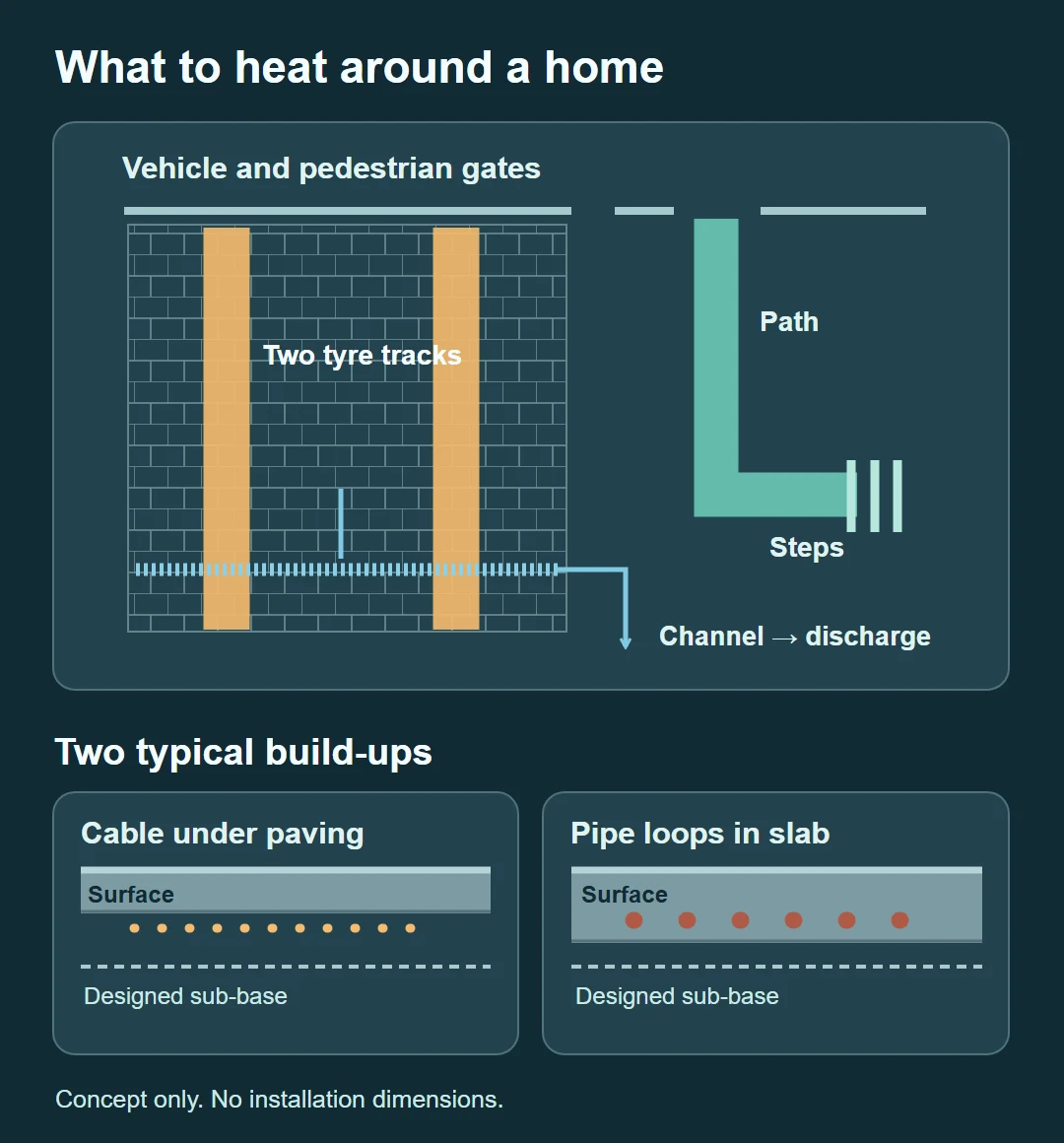
For a country house or detached home, start with the outdoor surfaces that need to stay usable: the steps, the route from the gate to the door, and the part of the driveway where a vehicle stops or struggles for traction. Two tyre tracks can work on a predictable straight run. Curves, steep ramps and places where people get out of a car need a wider assessment. Decide where meltwater will go before specifying the heated area.
What to heat around a detached home
The driveway. Mark where the wheels actually travel, including where different vehicles turn or reverse. Two heated strips can reduce the active area on a straight driveway, but the unheated centre is still a potential icy surface. Ensure pedestrians have a continuous route. Consider wider treatment at curves, braking points and passenger drop-off areas. On a steep driveway, ask how the system will behave if one zone fails or snowfall exceeds the design conditions.
The path from the gate. Choose the route you are most likely to use in winter. Consider the delivery point, lighting, places to put cleared snow, and whether water crosses the path from a roof or a higher area. A smaller independent zone can preserve the most useful route with a much lower load than the entire drive.
External steps. Think about the top and bottom landings as part of the same journey. A clear tread and an icy landing still create a hazard. Specify slip-resistant surfaces, handrails and drainage as required for the building. Coordinate the heating layout with railing fixings, movement joints and the finish before the stairs are covered.
Do you need to heat the gate?
Start by finding where the ice is forming. Heating the paving can help if the problem is ice at ground level. A frozen lock, jammed drive, obstructed safety sensor or garage-door seal each needs its own check.
- Track-mounted sliding gates. Check whether water or compacted snow collects in the ground track. Correct drainage and keep the track clear. If it still ices repeatedly, ask the gate installer and snow-melt designer about limited treatment of the stationary surface. Coordinate anchors and service locations before approving the layout.
- Cantilever gates. There is no ground track across the opening, but drifting snow can obstruct the leaf and ice can build up near the receiver. Keep the entire travel path clear. Consider local ground heating only where ice on the ground is the recurring issue.
- Swing gates and pedestrian gates. Check the full opening arc, clearance, snow storage and protection for the lock. Clearing a heated threshold does little for a frozen latch. Follow the maintenance instructions for the specific hardware.
- Sectional garage doors. If the bottom seal sticks, trace the incoming water first. Check the threshold, slope and drain. Consider a heated strip only in conjunction with the garage entry and water management.
Ask the installer to demonstrate the manual release on your own model and confirm whether approved battery backup is available. Use the release according to the manufacturer’s instructions with the gate stopped and the area safe. Do not try to drive a frozen gate repeatedly or bypass the safety devices. Keep an independent pedestrian route that you can use when grid power is down.
Electric versus hydronic snow melting
Electric heating cable or mats
Electric systems suit small areas or independently controlled zones where the available supply can carry the load. Choose a product approved for exterior snow melting and for the actual surface assembly. Asphalt, concrete and block paving can require different products and installation methods. Have the installer specify the circuit protection, sensor position, clearances and testing for the chosen system and local electrical rules. Coordinate joints, future fixing points and the route to the electrical panel. DEVI outdoor ground snow melting
Hydronic loops with a boiler or heat pump
A hydronic system transfers heat from the plant to the surface through buried pipes. Outdoors, the design must cover freezing conditions, compatible heat-transfer fluid, circulation, expansion, servicing and the behaviour of the loop during a power outage. An isolating heat exchanger can allow the exterior fluid to be kept separate from the building’s main heating circuit. Specify fluid and temperature limits for the actual components and climate. Use a suitable heat-transfer product specified by the designer.
A pump can use relatively little electricity compared with an electric cable, but it does not generate the heat needed to melt snow. A fuel-fired boiler still needs fuel and may require backup electricity for the burner, controls, pumps and valves. An electric boiler adds element load. A heat pump’s electrical draw depends on its performance at the required outdoor and supply conditions. Make sure the source has spare capacity while the house is being heated, or set a priority that preserves indoor heat. Uponor hydronic snow and ice melting design guide
Energy, running costs and backup power
Two 0.5 m × 12 m tracks cover 12 m², roughly 129 sq ft. At an illustrative 300 W/m² (about 28 W/sq ft), they draw 3.6 kW. Three hours at full output would use 10.8 kWh. A 3 m × 12 m driveway under the same assumptions would use 32.4 kWh. These are like-for-like examples. The design depends on snowfall, air temperature and wind exposure, build-up and desired clearance. The actual time may include warm-up and drying. A suitable temperature and moisture controller can reduce unnecessary operation.
For comparison, 3.6 kW of heat delivered for three hours is 10.8 kWh of heat. With an assumed 90% boiler efficiency, the fuel input corresponds to about 12 kWh before distribution losses, plus electricity for the electrically powered equipment. As a separate example, 250 W of measured combined electrical auxiliaries operating for three hours would use 0.75 kWh at the load. This is a calculation example; actual power, motor starting demand and backup losses must be measured or confirmed from equipment data. Compare both fuel and electricity, plus the upfront and servicing costs of each system.
During an outage, prioritize essential loads such as indoor heating, essential pumps, communications, lighting and access. An electric driveway may use substantial battery energy in a single cycle. A smaller step or path zone may be practical where the backup supply supports it. A hydronic loop can operate only while heat, controls and circulation are available. Have the designer address freeze protection and safe shutdown, especially with solid-fuel heating. Agree how zones restart so they do not all draw maximum power at once. Keep a route that can be cleared by hand. Use portable generators outdoors and follow local guidance and professional installation instructions. CDC guidance on portable generators and power outages
Meltwater, controls and handover
Trace the flow from the heated paving to an approved discharge point. A channel drain can intercept runoff before a garage threshold. Verify the grate load rating, clearing access, downstream capacity and how the outlet behaves when it freezes. Water leaving warm paving can refreeze on a cold path or outside the property. Check local requirements and do not redirect runoff onto a neighbouring plot or public route without approval. Surface drainage for paths and fences
Place a temperature and moisture sensor where it will detect representative conditions, according to the product instructions. A warm spot beneath a roof can be a poor proxy for an exposed stair. Agree the conditions that start the system, the run-on time after precipitation and what happens after a power interruption. Include a manual clearing plan for conditions beyond design capacity.
- Approve plans showing heated areas, slopes, drainage, structural joints and gate or rail fixings.
- Before covering the installation, photograph the layout with fixed reference points. Obtain the electrical test record or the hydronic pressure-test record required for the system. Keep the drawing for future repairs or drilling.
- Check operation of each zone, sensor response and the restart sequence. Obtain the controller settings and, for hydronic loops, fluid specification, service intervals and commissioning results.
- During the first winter, check the drainage during a thaw and identify spots where water refreezes. Revisit the settings or drainage if the site behaves differently from the design.
What to ask a local specialist
Ask for a local installer with comparable outdoor work on the same paving assembly. Check whether they provide a layout, electrical or hydronic design, control settings and commissioning records. Have the designer verify local requirements for wiring in wet outdoor locations, protection, surface drainage, public access and any shared connection. If your household includes somebody with limited mobility, give them a usable route even when heating is unavailable.
Tell the installer which zones need to work during a storm, what your normal and backup capacities are, and where the water can discharge. A useful proposal names the design conditions, explains exclusions and identifies who checks the system before the surface is covered.
Video. How snow melting is installed
DEVI winter solutions. Driveways, steps and paths
Manufacturer demonstration in English. The driveway and drainage sequence starts around 1:06. Installation details belong to the demonstrated system.
Coordinating the heated driveway with gates and fencing
Show the gate installer the opening width, foundations, full gate travel, conduit routes and drainage before the paving is laid. Agree where heating cable or pipes are allowed and where there must be room for fixings or future service work. If you are choosing a metal gate or fence for a project, share the site dimensions and an annotated plan with Mehbud. Mehbud fences and gates
Frequently asked questions
Can I heat just the tyre tracks?
Yes, if vehicles reliably follow the same straight route and people have a separate safe path. Check bends, steep sections and where passengers step out.
Does hydronic snow melting work without grid power?
It can run if the heat source is available and backup power supports the pumps, controls and other required equipment. An electrically heated boiler or heat pump changes the backup load substantially.
Can snow melt paving protect a gate motor?
Ground heating can reduce ice where a stationary surface obstructs the gate. Protect and service the motor, lock and safety devices as specified by their manufacturer.
What if the driveway is too large to heat?
Compare heating the most important segment and clearing the rest manually. Consider how cars will turn and how people will cross the site in snow. Leave a working route for outages.
Next in the series. Offices, car parks and loading yards
Commercial sites have longer operating hours, different access obligations and busier routes. The next guide will compare an office entrance, a car park ramp and a warehouse loading area, with criteria for choosing heated zones, specifying backup operation and accepting the finished system. Earlier in the series: how to choose indoor underfloor heating
Commercial Snow Melting for Entrances, Parking Ramps and Loading Docks
Related articles

What Can Derail Winter Construction? Crews, Deliveries and Cost Contingency
Ukraine’s late-2026 construction data and a winter planning guide. Manage crews, delivery delays, cost contingencies and access to occupied buildings.
Commercial Snow Melting for Entrances, Parking Ramps and Loading Docks
Plan snow melting for commercial entrances, parking ramps, and loading docks. Compare electric and hydronic systems, power, drainage and outages.
Where Ukraine Commissioned the Most Non-Residential Space: Regional Map
Explore commissioned non-residential floor area by Ukrainian region. Official statistics, regional trends and context for warehouses and retail.