
Data checked 15 November 2026. Illustration of a winter planning discussion at an occupied commercial property.
What can derail winter construction? Check crew availability, cash flow, complete deliveries and the conditions under which work can be accepted. Schedule backwards from the date the building needs the result. Give each critical package a decision deadline, an owner and a fallback.
What Ukraine’s construction data showed in late 2026
Ukraine’s construction confidence indicator was −23.4% in Q4 2026. Businesses identified shortages of labour and financial constraints among the main restrictions on activity. Respondents reported an average of six months of work covered by orders. For a project manager, that is a reason to confirm the actual crew slot, production commitment and payment dates with the companies doing the work. Months of orders describe the surveyed businesses’ workload coverage. State Statistics Service of Ukraine, Q4 2026 release
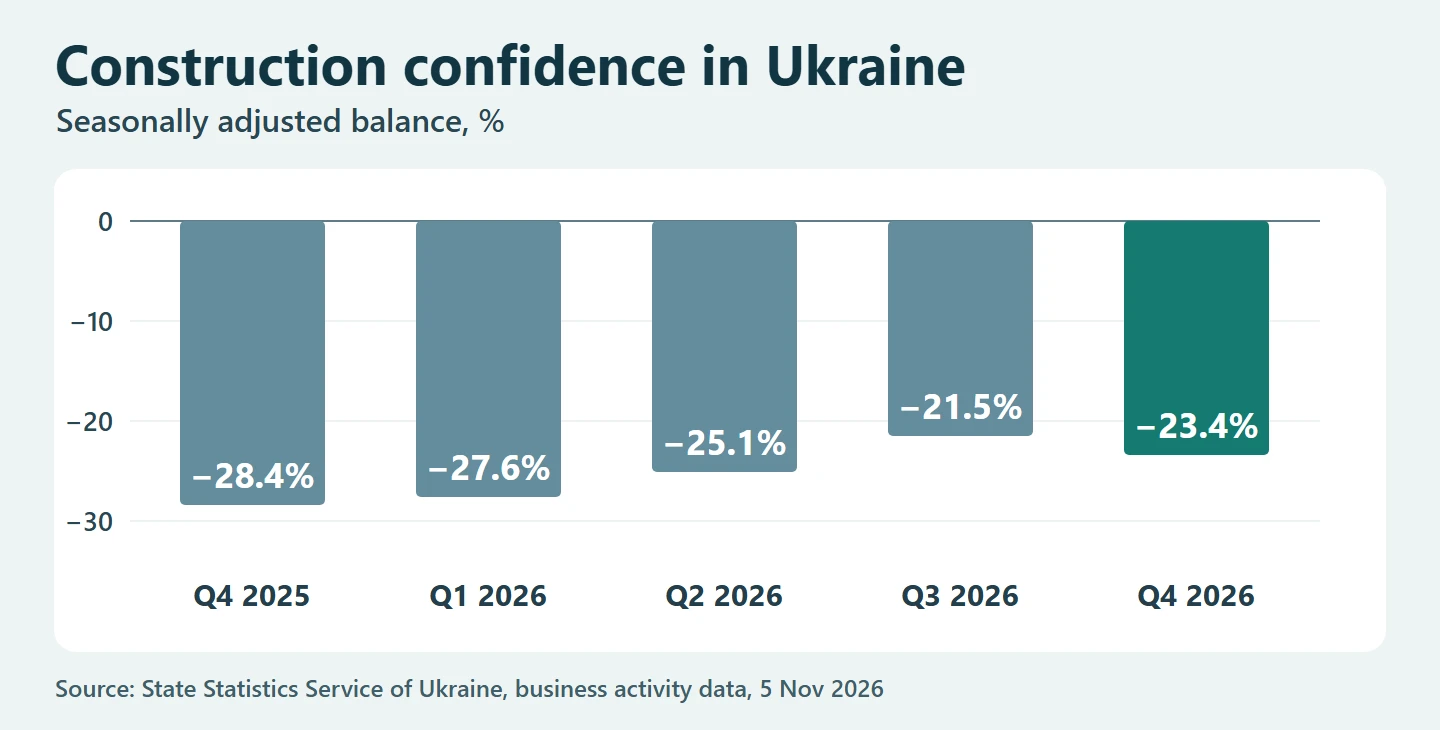
The survey reports each constraint separately, so the shares do not form a 100% breakdown. The underlying order-book series gives 5.5 months, reported as about six months in the release. The chart uses the data update of 5 November, including revised past quarters. The survey excludes territories under temporary occupation and some territories with current or past hostilities, as specified by the statistical office.
The confidence indicator uses seasonally adjusted balances on firms’ order books and employment expectations. Construction production measures activity in volume terms. The construction price index measures price change. Using the series for their intended purpose explains how a reduction in output over the first nine months of 2026 can coexist with higher prices in September. The next step for an individual project is to obtain current quotes for the actual specification and delivery slot. Business activity dataset and methodology · 9 November update on prices and output
Reconstruction and repairs accounted for 58.4% of construction work by value in January–September 2026, up from 57.4% a year earlier. This compares shares of expenditure in hryvnias. It gives context for planning work around occupied buildings, where the owner may need to keep operating through the refurbishment. Building counts and completed floor area use other measures. Ukraine’s mix of new construction, reconstruction and repairs · Official short-term construction dataset
Which work and deliveries matter most in winter?
Identify the result the operator needs. If a warehouse is replacing cladding near its main entrance, that result might be a weather-protected facade and a usable entrance by an agreed date. Trace the dependencies: survey, approved drawings, production release, shipment, inspection, access for installation and handover. A task is on the critical path when a delay to it pushes the required finish date. Different parts of the same shipment may affect that date differently.
Set working limits using the design, product instructions and equipment requirements. Relevant conditions can include air and substrate temperature, moisture, wind and curing time. Assign someone to measure conditions, record the result and halt work when necessary. Adjacent activities may have different limits. Construction seasonality and scheduling · Metal facade pricing and installation
What to do when installation slips
- Set the latest decision time. Work backwards from the required handover, allowing for installation, inspection and delivery. By that time the team must confirm the planned supply or choose an agreed fallback.
- Identify independent work. Move the crew to a prepared area if access, materials and approvals are in place. Keep concealed work available for inspection before closing it.
- Approve substitutions together. Compare dimensions, interfaces, performance, warranty and the evidence required by the designer. For cladding, check finish consistency and compatibility with the support system. Record who approves cost, schedule and acceptance changes.
- Protect the open work. Specify the temporary protection and drainage, name a responsible party and confirm the inspection required before restarting. Coordinate any effect on the operator in advance.
- Update the near-term plan. At the next meeting, show the next two weeks of work, decisions and deliveries against the revised milestones. Tell each party which commitment has changed and when they need to respond.
Illustrative warehouse retrofit. Cladding is late for the area next to an occupied warehouse entrance. The manufacturer checks whether one complete zone can ship first. The operator checks an accessible diversion with the contractor. If the supplier cannot release a complete set for that zone, the crew moves to approved internal preparation while the contractor secures the exposed facade. The daily log names the temporary route owner, the next inspection and what must happen before the entrance reopens. Surface drainage near pedestrian routes · Keeping commercial entrances and loading areas usable in winter
How to build a winter cost contingency
List the costs triggered by plausible changes. For each item, record the assumption, estimate, approval process and payment date. Confirm what the baseline contract covers, when the quote expires and which risks can occur together. This reduces the chance that the same cost appears twice or that money is allocated too late.
Against a baseline package of UAH 2 million, this scenario adds 4.5%. Compare actual quotes on a consistent VAT basis, account for contractual responsibility and set an approval threshold. The example uses Ukrainian currency to show the calculation. The individual amounts come from a hypothetical scenario. Put the approved costs in the payment schedule as well as in the budget so they are funded when needed.
Keeping an occupied building accessible
Walk the site with the operator and draw the plan for a normal day, active work and a temporary stop. Mark visitor and staff entrances, the accessible route, emergency exits, vehicle movements and storage. Check the diversion when it will actually be used, including darkness and wet conditions. Inform staff and visitors before changing a route. Before restarting, inspect temporary protection, drainage, barriers and access.
List critical electrical loads if the site may lose power. Agree priorities with the facility team for work equipment, route lighting and building systems. Follow the site’s instructions during air alerts and unsafe conditions. Give the person who must reopen a work area the criteria they need to make that decision.
How manufacturers, contractors and installers can work together
Ukraine’s construction sector needs reliable cooperation to keep work moving, sustain skilled teams and finish projects through a difficult period. Manufacturers know when a complete package can be released. Contractors manage sequence, access and decisions. Installers see the actual interfaces and constraints on site. The client needs all three perspectives when delays or substitutions change the plan.
Agree how each party will communicate with the client and approve changes. Direct technical discussion is valuable when participants can see the same requirements and decisions. Raise commercial changes openly, respect existing commitments and preserve the client’s freedom to choose. If a team spots a risk, share it early and present practical alternatives together.
For a facade or fence package, this can be as simple as three conversations. Before production, confirm the drawings, tolerances and exact package. Before shipment, confirm access, equipment and installation readiness. Before handover, agree which details will be checked and who delivers the documentation. That is how a manufacturer, contractor and installer can contribute to the same result. How workforce shortages affect construction schedules in Ukraine
Winter construction checklist for owners
- Define the required finish date and the work that determines it.
- Check site dimensions, drawing revision and the production release date.
- Confirm the crew, equipment, work permits or access arrangements and a fallback work area.
- Agree stop conditions, temporary protection and the inspection required to restart.
- Set a contingency by risk and assign authority to release it.
- Walk the accessible route, delivery route and emergency access with the operator.
- Confirm who speaks with the client, approves changes and updates the near-term schedule.
Download the winter construction worksheet, CSV. Record one row per decision or work package, with the owner, deadline, fallback trigger and estimate.
Frequently asked questions
Does −23.4% mean construction output will fall by that amount?
It is a confidence reading based on firms’ responses. Construction production is reported separately. Ukraine’s statistical office reported a 5.1% fall in construction production in January–September 2026 compared with the same period in 2025.
Is there a standard winter contingency percentage?
Calculate the combined cost of risks that can occur in the scenario you are budgeting. Use current quotes and agree who can approve expenditure. The illustrative 4.5% is the result of dividing UAH 90,000 by UAH 2 million.
What should be checked before a delayed installation is moved?
Confirm that the exposed work can be protected and people can use the building safely. Then agree a fallback work area, a revised delivery window and the conditions for restarting the original work.
Related articles

Commercial Snow Melting for Entrances, Parking Ramps and Loading Docks
Plan snow melting for commercial entrances, parking ramps, and loading docks. Compare electric and hydronic systems, power, drainage and outages.
Heated Driveways, Paths and Steps for Country Homes
Plan snow melting for a detached home: heated wheel tracks, icy gates, meltwater drainage, electric versus hydronic systems, and backup power costs.
Where Ukraine Commissioned the Most Non-Residential Space: Regional Map
Explore commissioned non-residential floor area by Ukrainian region. Official statistics, regional trends and context for warehouses and retail.