
1. Macroeconomic Landscape and the Systemic Crisis of the Labor Market
The Ukrainian labor market in 2025–2026 entered a phase of deep and unprecedented structural transformation, where a chronic talent shortage became not just a temporary phenomenon, but a key factor constraining economic recovery and business scaling. Market research indicates that the shortage of workers has reached its highest level on record. In 2026, between 67% and 78% of Ukrainian enterprises openly declared an acute shortage of personnel, which is a significant jump compared to 60% a year earlier. At the same time, the situation with recruiting even without special training has worsened, reaching 38.4% of companies experiencing difficulties in this segment.
This shortage coexists with a paradoxical situation: the average unemployment rate in 2025 was 11.3% (a significant improvement compared to 18.2% in 2023), yet thousands of specialists cannot find work, while businesses cannot fill vacancies. This indicates a colossal gap between the available qualifications of job seekers and the actual needs of high-tech manufacturing. Demographic pressure on the labor market is unprecedented: according to the UN Refugee Agency, about 5.8-5.9 million Ukrainians are abroad, of which 5.2 million are in European countries. The base scenario of the National Bank of Ukraine does not foresee a mass return of the population in the near future, predicting a further outflow of 200,000 people in 2025–2026. In addition, mobilization and new travel rules for youth have created an additional vacuum in the market.
For the industrial sector, this crisis is taking on an existential character. According to forecasts by the State Employment Service and the Ministry of Economy, by 2036 the need for new workers will increase by 1.24 million people, of which almost 400,000 will be needed specifically in the manufacturing industry. Already in 2026, there is a severe lack of machine operators, turners, millers, electric and gas welders, and fitters. Classic recruiting tools have completely lost their effectiveness. According to the NBU, in December 2025, there was an average of only 1.8 candidates per vacancy, and in critical technical areas, supply was practically zero. The ideal candidate for the position of a Computer Numerical Control (CNC) machine operator today is either unavailable, or their salary expectations make hiring them economically unviable for many civilian enterprises.
The situation is complicated by the unprecedented growth of Ukraine’s military-industrial complex (MIC), whose production volumes soared from $1 billion in 2022 to an estimated $12 billion in 2025. State and private defense enterprises are aggressively vacuuming the market, offering vacancies for CNC machine operators of the 4th-5th grades, boring turners, and design engineers, backing these offers with reliable reservation from mobilization. At the end of 2025 alone, almost 700 offers from more than 70 enterprises were posted in the MIC category. In this new reality, where 54% of companies plan to expand their staff despite all difficulties, retaining existing highly qualified CNC operators through corporate culture transformation becomes the only reliable mechanism for ensuring uninterrupted workshop operation.
2. Technological Evolution of the Profession and the Anatomy of Staff Turnover
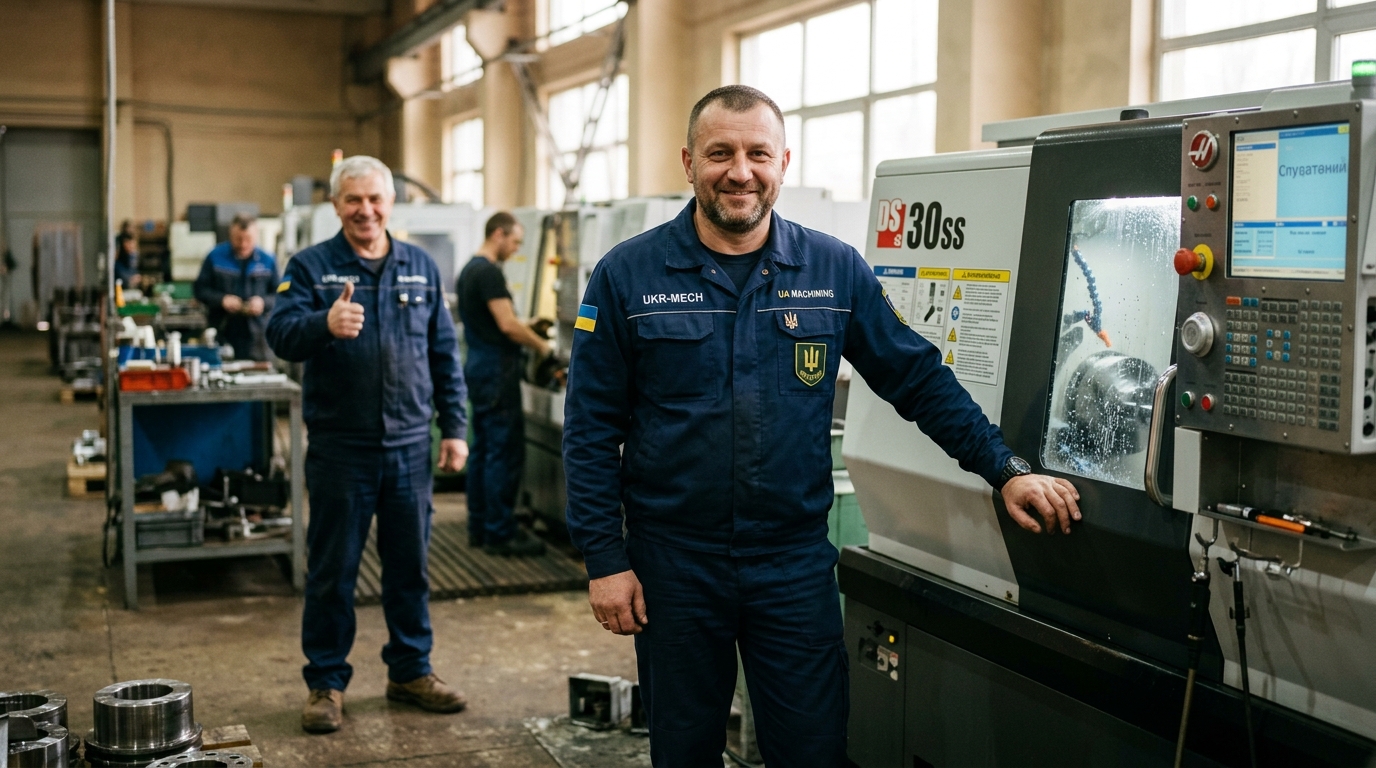
To build an effective retention strategy, management must deeply understand the nature of modern CNC operator work. This position has fundamentally evolved from the traditional perception of physically exhausting work at a universal machine. A modern CNC machinist is a highly qualified technical specialist whose work lies at the intersection of metalworking, engineering, and information technology.
Before launching a part into production, the operator must prepare the machine, select and install the appropriate cutting tools, set zero points, and secure the workpiece. During the operation itself, they continuously monitor equipment performance, adapt cutting parameters to prevent vibrations or tool breakage, and carry out strict quality and accuracy control of the final product. The ability to read complex technical drawings, understand spatial tolerances and fits, as well as possess quick problem-solving skills in the event of software glitches are absolute prerequisites for this role.
Such a level of responsibility forms a specific risk profile for burnout. First, the cognitive load is extremely high, as a simple miscalculation or loss of concentration for a few seconds can lead to a spindle collision, causing tens of thousands of euros in damage and stopping the production line. Second, this psychological tension is accompanied by physical discomfort: spending many hours on their feet at the machine, exposure to industrial noise, vibrations, and fumes from cooling lubricants.
Understanding these factors makes it possible to identify the true causes of staff turnover, which go far beyond simple dissatisfaction with the level of remuneration. The outflow of personnel is stimulated by a combination of psychological exhaustion, a lack of feeling the social significance of their work, and fear for their own safety (both physical in wartime conditions and legal in the context of mobilization). The loss of such a specialist is a critical blow to the company. Businesses face a reality where a vacant position costs significantly more than upskilling and creating comfortable conditions for an existing employee, because the downtime of a high-tech machine means the disruption of contractual obligations and irreversible financial losses.
3. The Illusion of External Hiring and Unexpected Sources of Talent Pool
In response to the staff shortage, many enterprises initially tried to take the path of least resistance — either attract labor from abroad, or poach specialists with higher rates. Both strategies suffered a crushing defeat in 2025-2026.
Despite the fact that 78% of employers acknowledge a deficit, the willingness to hire foreigners remains at a critically low level. Only 8% of Ukrainian companies are considering this possibility, which is even lower than last year’s figure of 13%. The reasons for this categorical reluctance lie in the practical plane, where corporate culture and communication play a decisive role.
| Barriers to hiring foreign workers for manufacturing | Share of companies indicating this factor | Dynamics compared to 2025 |
| Language barrier (critical for safety and reading blueprints) | 51% | Growth (was 27%) |
| Lack of need specifically for foreign specialists | 42% | Stable |
| Complex bureaucratic procedures (visas, permits, quotas) | 32% | Growth (was 18%) |
| Lack of integration experience and cultural differences | 28% | Stable |
| Internal team unpreparedness for changes | 19% | Stable |
These data indicate that language and cultural integration in complex manufacturing, where communication between a technologist, operator, and foreman must be instant and error-free, makes it impossible to quickly solve the problem at the expense of expats. To change this position, businesses need tax incentives (36%), guarantees of candidate certification (29%), and simplification of bureaucracy (25%). Until this happens, enterprises can rely exclusively on Ukraine’s internal potential.
3.1. Technological Migration: Talent Overflow from the IT Sector
An in-depth analysis of adjacent industries reveals unexpected but powerful trends that the manufacturing sector can use to form its own talent pool. We are talking about a systemic crisis in the domestic IT sector. Over 2025-2026, the number of IT specialists registered as Private Entrepreneurs (PEs) decreased by a record 21%, which means a loss of more than 56,000 people in this category. This is the biggest drop since observations began in 2016.
The greatest reduction occurred in the key segments for programming: the “Computer Programming” direction lost 35,000 PEs, “Data Processing” fell by 26.5% (over 9,000 people), and “Web Portals” by 26%. The number of newly created PEs in IT also sharply decreased: from 26.7 thousand a year earlier to 14.5 thousand. Although this is partially explained by the industry’s transition to gig contracts and the Diia City system (the share of which grew to 20%), the general trend indicates a significant release of people with analytical and algorithmic thinking. In addition, for the first time since 2018, the share of women in IT decreased, dropping to 29%.
This macroeconomic shift forms a unique window of opportunity for high-tech manufacturing. Modern CNC machines are programmed using G-code and complex CAD/CAM systems (for example, SolidWorks, Mastercam, Siemens NX). Professionals, who have lost positions as Junior developers or data processing specialists, possess the ideal cognitive foundation for rapid retraining as CNC programmer engineers or operators of 5-axis machining centers. Manufacturing companies, that adapt their corporate culture to the standards, familiar to IT professionals (flexibility, flat structure, investments in innovations), gain the chance to attract this highly intellectual resource, offering stability, reservation (if defense contracts are available), and work on real, physical products in return.

4. Theoretical and Practical Foundations of Motivation in Modern Manufacturing
For successful staff retention, management must move away from intuitive administration and rely on scientifically based models of work motivation, which have undergone radical changes in wartime conditions. Research on motivational strategies at Ukrainian enterprises in 2024-2026 demonstrates that the content of motivation has irrevocably expanded. Needs for physical safety, a sense of employer social responsibility, and deep psychological support have been added to traditional factors.
Traditional “instrumentally” motivated behavior — when an employee prioritizes exclusively receiving instant cash, remaining indifferent to the fate of the employer — is destructive in crisis conditions. Retaining an operator solely through constant rate increases turns into a financial race, which a civilian enterprise will inevitably lose to either the defense sector or foreign companies. Certainly, financial stimulation (official salary, bonuses) is a hygiene factor without which retention is impossible, which is confirmed by the fact that in 2025, 96% of employers raised salaries for their employees (most by 11-20%). However, money alone no longer guarantees loyalty. Businesses are facing a situation where even a significantly higher salary does not help to find or retain a specialist.
The scientific approach requires a transition to solidarity-based (identification) motivation. This method consists in developing a value system in employees that aligns with the organization’s mission. This is achieved through transparent communication, training, and creating a favorable psychological climate. As a result, motivation is perceived by the employee as an internal need, and the well-being of the company as their own.
The main problem and shortcoming of many domestic enterprises remains the prevalence of a unilateral, authoritarian management style, where a system of fines and deprizeation is used as the main tool of operational control. This remnant of the Soviet industrial paradigm acts as a catalyst for staff turnover. When a CNC operator is constantly under the threat of a fine for a technical error, they lose initiative, hide problems from management, which leads to cumulative equipment breakdowns, and is in a state of chronic stress. Modern HR policy should be aimed at preparing and preserving highly qualified personnel by stimulating the achievement motive, where the employee receives support from management to realize their professional ambitions.
5. Corporate Culture Architecture: From Slogans to Operating Processes
Corporate culture is the face of the company, which encompasses teamwork, reward policy, workshop atmosphere, learning opportunities, and attitudes toward mistakes. It cannot exist merely in the form of declarative documents; its viability is tested by daily management practices.
5.1. Values as a Coordinate System
Leading Ukrainian companies build their culture on fundamental values, which serve as a filter for making any operational decisions:
- Openness and honesty: An information vacuum is filled with rumors and sabotage. Therefore, it is critically important that everyone on the team, from the director to the machine operator, understands what is happening with the business, what contracts are being executed, and how the bonus fund is formed. A frank discussion of problematic issues without fear of punishment develops trust.
- Impact on the product: Modern workers want to see the results of their labor. Transitioning to a vertical team structure, where a CNC operator feels involved in creating the final high-tech product (and not just turning an impersonal part), increases their engagement.
- The right to make mistakes and empathy: Flexibility in solving production problems and an empathetic attitude toward one another create psychological safety. Employees become braver, propose innovative approaches to material processing, and are not afraid to take responsibility.
- Ambition and learning: A culture that encourages striving to become better professionals. Companies allocate significant budgets for purchasing specialized literature, programming courses, and professional development. Increasing training budgets was planned by 25% of companies.
5.2. Comprehensive Care for Workers’ Well-being
An increase in engagement level directly impacts job satisfaction, reduces turnover, and encourages self-organization. People are the company’s main value, and caring for them should manifest itself not only in paying salaries.
Corporate culture is expressed in creating a home-like, warm, and friendly atmosphere even in a strict industrial environment. In 2025, business actively invested in team well-being: 59% organized educational courses, and more than 52% provided psychological support. The most progressive companies provided financial assistance to compensate for housing rent (26%) and paid medical insurance for employees and their family members (20%). Providing access to top medical institutions, flexible vacations, material support in the event of family tragedies, and generous pension payouts build a level of loyalty that cannot be broken by a simple offer of a slightly higher rate at a neighboring factory.
Furthermore, 63% of employers in Ukraine stated they do not plan a mandatory return of all employees to the office. Although working at a machine requires physical presence in the workshop, this trend suggests a path to flexibility: CNC programmer engineers can write control programs remotely, and flexible shift schedules can be introduced for operators, allowing for a better work-life balance.
6. Demographic Transformation: Women at CNC Consoles
The personnel crisis forced Ukrainian employers to abandon outdated stereotypes and radically revise their hiring approaches. One of the most important trends of 2025-2026 was the active involvement of women in professions that were previously considered purely “male”. Women are massively mastering the professions of driving trucks, excavators, forklifts, and also becoming top-class CNC machine operators.
Working at a modern machining center requires analytical thinking, scrupulousness, attentiveness, and neatness, making it ideal for women. However, integrating women into the workshop requires the business not only to change its mindset but also to make infrastructure investments. To avoid violating legislation on lifting heavy loads and to make the work physically accessible, enterprises are forced to automate blank loading processes, install modern overhead cranes, pneumatic manipulators, and robotic arms. This forced modernization improves ergonomics for absolutely all employees and elevates the overall culture of production.
6.1. Mass Reskilling and Educational Initiatives
State and international programs play a key role in this transformation. The «Reskilling Ukraine» project, initiated by the Swedish non-profit organization Beredskapslyftet with the support of the Swedish government, launched a specialized free course «CNC Machine Operator» in Kyiv, aimed specifically at women and veterans.
The course is designed taking into account the needs of modern employers in the metalworking sector and combines fundamental theoretical knowledge with intensive practice. Training takes place in extremely tight deadlines: the program is designed for 72 academic hours (8 working days, 6 hours a day), while classes are held in small groups of 5-6 people, providing a deep individual approach.
The program covers the following modules:
- Fundamentals of metalworking;
- Reading technical documentation and complex blueprints;
- Programming, setup, and direct operation of CNC machines;
- Practical skills in servicing high-precision equipment.
After 1.5 months of full-time training, female graduates receive a state-recognized certificate and direct employment assistance from program partners. This case demonstrates that intensive, focused reskilling is capable of overcoming entry barriers into the profession and providing the market with new, motivated personnel.
7. Veteran Adaptation: From Policies to Real Actions in Manufacturing
The return of veterans to civilian life forms a completely new architecture for the Ukrainian labor market. According to the Prime Minister of Ukraine, there are already over 1.5 million veterans in the country, and after the war this figure could reach 3 million. The government approved the State Targeted Program «Veteran. Work» for 2026-2027 and set an ambitious goal to create an additional 100,000 jobs for veterans, engaging both the public sector and private business in this process. At the same time, the state is shifting the paradigm: it’s not the veteran who has to adapt to the company, but the team that must adapt to the veteran.
7.1. Physical and Spatial Inclusivity
Adapting a veteran in the workshop requires a systemic approach. Physical comfort is paramount. The employer must ensure that the lighting in the work area is sufficient, but not too bright, and that the lamps do not flicker. Sudden extraneous sounds must be minimized. Veterans should be given the opportunity to independently choose their workplace or machine, as some may find it uncomfortable to work with their backs to an open aisle or door.
Special attention must be paid to veterans who have suffered injuries or amputations. Adapting working conditions to their needs (for example, installing orthopedic chairs near CNC control panels, ramps, lowering the height of working surfaces) is a necessity, which is confirmed by the practice of leading Ukrainian companies.
7.2. Psychological Integration and Corporate Mentorship
The adaptation process in the workplace, especially a new one, can last from 3-6 to 18 months. During this period, the company should maintain an atmosphere of deep but unobtrusive respect, without crossing the employee’s personal boundaries. The team must discard stereotypes about post-traumatic stress disorder (PTSD) as a factor that obligatorily reduces productivity. On the contrary, the experience, iron discipline, and responsibility of veterans are seen as powerful human capital, capable of becoming a driver of the company’s development. Corporate culture must be equal for everyone: non-constructive leniency or pity demeans human dignity and creates discomfort for the whole team.
The most effective tool for retaining veterans is implementing mentorship and internship programs. Experienced workers “attached” to newly arrived veterans during the first months of work help them overcome obstacles, lower stress levels, restore technical skills in operating machines, and help integrate into the social fabric of the workshop.
An important aspect is providing a sense of mission. Veterans, accustomed to serving a higher purpose, may lose motivation during the mechanical performance of tasks. The company should broadcast its values and social responsibility, involve employees in fundraising for the needs of units, and support national rituals, such as the minute of silence. Additionally, the Cabinet of Ministers, by resolution No. 706 of June 4, 2026, expanded professional adaptation opportunities, allowing veterans to learn entrepreneurship at state expense, however, for those who choose employment, internal courses on leadership and digital skills remain the best method of career development.
8. Practical Retention Cases: Benchmarks of Ukrainian Business
The best strategies are tested in practice by leading Ukrainian companies, who are shaping new standards in the labor market. The experience of these brands should be implemented across all production sites.
8.1. Industrial Giant “Interpipe”
The metallurgical and machine-building sector works under colossal pressure due to the destruction of energy infrastructure, logistical problems, and a sharp talent shortage. The «Interpipe» company faced a systemic staff turnover for the industry, which in 2021 stood at 14%, and in 2023 decreased to 12%. To overcome the deficit, the company takes a whole range of measures: maximal retention of internal experts and veterans, bringing back pensioners, engaging contracting organizations, and employing women in positions of quality control inspectors, flaw detectorists, and crane operators (since work in steelmaking areas is legislatively restricted for women due to physical exertion).
Retention in Nikopol and other cities of presence is based on a robust social package. Interpipe guarantees stable, uninterrupted work with an official salary and surcharges for overtime hours. Employees receive medical care at their own corporate polyclinic, free professional training, and the possibility of higher education payment. A special retention factor is caring for families: the company pays 80% of the cost of summer vacations for employees’ children, and also ensures comfortable conditions in the workshops — shelters at workplaces, free meals, and corporate transport.
8.2. Broadcasting Practices of National Brands (Silpo, Starlight Media, SoftServe)
Although these companies operate in the retail, media, and IT sectors, their approach to retaining mobilized personnel and veterans has become a benchmark and is gradually being transferred to the manufacturing sector.
- Financial and career stability: Preserving jobs and paying wages in full for employees who are fighting. The IT company SoftServe even implemented a practice of paid reserve for a veteran if their project closed during their service.
- Removing the bureaucratic burden: Companies (for example, Silpo and Starlight Media) allocate specialists to accompany veterans in drawing up necessary documents, medical examinations, and internal applications, which removes a huge level of stress upon return.
- Family support and rehabilitation: Companies finance sanatorium vacations for families in western Ukraine, provide expanded medical insurance, give gifts to children, and organize equipment collections for those going to the front. Psychological aid for military families has become a standard.
Implementing such policies at a factory, where CNC operators work, creates a kind of “golden chain”. The employee understands that, having quit for a slightly higher rate at another enterprise, they will lose a comprehensive ecosystem of care for their health, safety, and the future of their family.
9. Internal Mobility and Training as a Strategic Investment
Formally, the labor market exists, but it is no longer capable of providing businesses with the necessary operational efficiency. Instead of looking for an unattainable ideal externally, the most successful companies build their own talent ecosystems. Training, mobility, and hiring are viewed not as separate processes, but as a single, manageable, and scalable system.
In 2026, 72% of global respondents acknowledged that internal mobility has become significantly more important for business success. When plant management implements upskilling (qualification upgrade) programs, it gives a clear signal: “You do not need to quit to make a career.” Reallocating functions towards multifunctionality, introduced by 17% of surveyed enterprises, allows the operator to master related areas of work, increase their own value, and avoid routine.
The State Employment Service also supports this trend by developing a dual form of education (combining theory and practice) and shortening training periods to satisfy rapid business needs. The creation of an internal talent pool is no longer an accident; it is a strictly managed process, at the core of which lies a developed corporate culture that encourages the pursuit of knowledge and guarantees fair reward for acquiring it.
10. Conclusions
An analysis of the Ukrainian labor market in 2025-2026 irrefutably proves that the staff shortage in manufacturing has taken on an irreversible, systemic character. The disappearance of entire segments of candidates due to migration, mobilization, and talent overflow to the military-industrial complex makes classic recruiting ineffective. Under these harsh conditions, preserving the operational capability of workshops with CNC machines depends entirely on the company’s ability to retain existing personnel and grow new ones through reskilling from other industries (in particular, from the IT sector).
The transformation of corporate culture has ceased to be an optional HR department initiative — it has become a matter of business survival. Companies, that overcame hierarchical, punitive management styles, implemented empathy, transparency, and deep social care for employees and their families, were able to significantly reduce staff turnover. Furthermore, the crisis forced society to take a colossal step forward in inclusivity: the mass involvement of women in engineering and operator professions, as well as comprehensive psychological and physical adaptation of workplaces for war veterans have become new industry standards. Only those enterprises, that view a person as their most valuable asset and form an ecosystem of support, safety, and development around them, will be able to weather the demographic storm and ensure long-term growth.
Related articles
Top 7 Companies to Buy Gabions in Ukraine: Ranking of Trusted Manufacturers
Rating of reliable manufacturers. Price comparison, expert tips on wire thickness and stone selection for durability.
Warranty for metal structures in Ukraine: Legal regulation, engineering standards, and judicial practice
Metal structure warranties in Ukraine: Legal regulation (10 years), DBN standards, ISO corrosion protection, fireproofing, and how to file defect claims.
Top companies performing foundation works in Kyiv
Rating of TOP foundation work companies in Kyiv 2026. Current prices, contractor comparison, market analysis, and expert advice on choosing a reliable foundation.