
Rivets and self-drilling screws can be used for fastening thin sheet metal if they are selected for a specific joint. A rivet is convenient for a permanent connection, while a self-drilling screw is used when dismantling is important and there is a suitable base for threaded fastening. Strength is determined by the characteristics of the fastener, metal, and structure, not just the name of the connection method.
For facade panels, fence lamellas, and ceiling details, the system documentation is checked first. Below is a practical comparison of metal screws and blind rivets, selection criteria, and typical mistakes.
Brief comparison · Screws · Rivets · What to check · Installation mistakes · FAQ
Rivet or screw: a brief comparison
| Blind rivet | Metal self-drilling screw |
|---|---|
| Installed with a riveting tool into a prepared hole. | Installed with an appropriate tool; the need for a pre-drilled hole depends on the type. |
| Usually designed for a permanent connection; the rivet is removed during dismantling. | Can be unscrewed for disassembly. The condition of the thread and the possibility of re-fastening are checked. |
| The grip range of the stack and hole requirements must be observed. | Requirements for the base, drilling capacity, and clamping thickness must be observed. |
| Load-bearing capacity is evaluated for a specific rivet and joint materials. | Load-bearing capacity is evaluated for a specific screw, base, and fastened sheet. |
| Tightness requires appropriate execution and installation conditions. | A sealing washer, if provided, works only with correct selection and installation. |
The table compares application principles. It does not replace technical data sheets or the calculation of a loaded joint.
When fastening with screws is appropriate
Screws are used when there is a suitable product and the required installation method for a specific base. The ability to disassemble is useful for maintenance or part replacement, but it does not guarantee unlimited re-driving into the same hole.
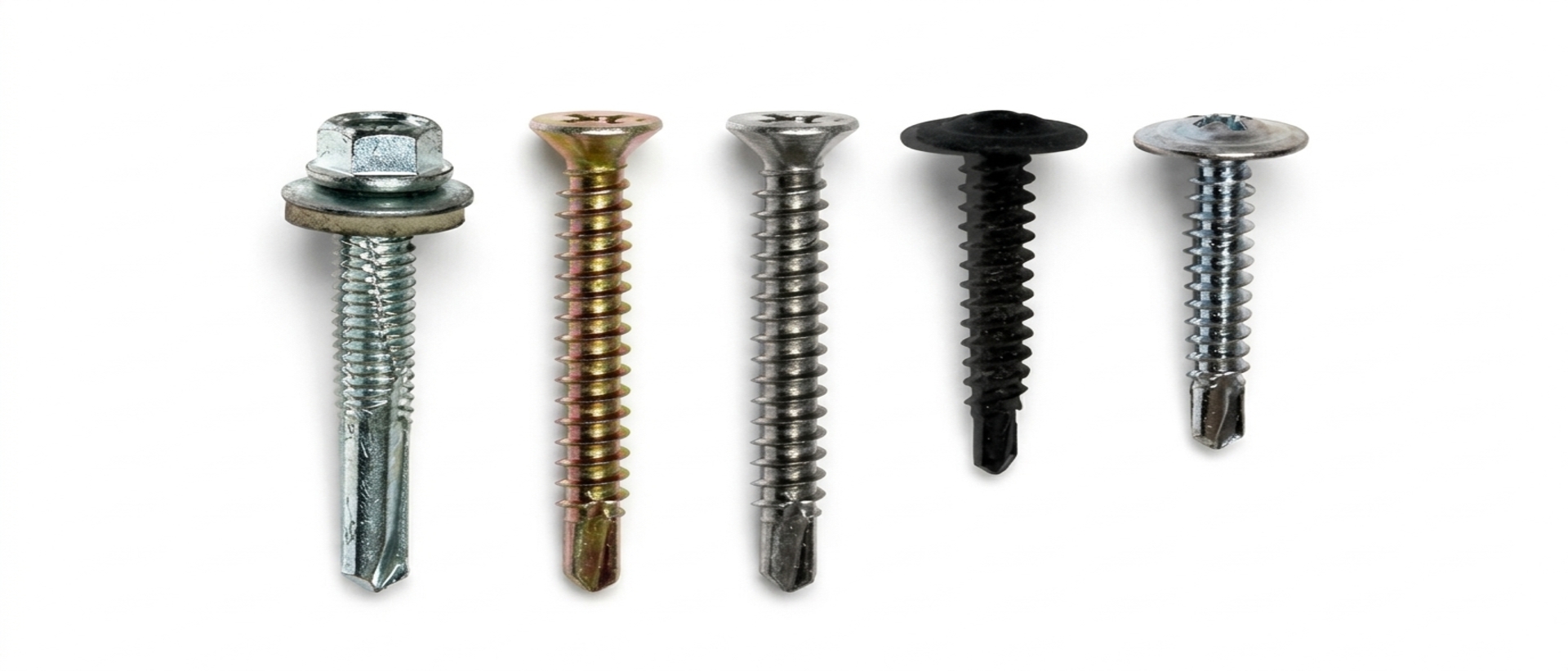
Self-tapping and self-drilling are not the same thing
A self-tapping fastener forms a thread in the corresponding base. A self-drilling screw has a drill point and, under conditions specified by the manufacturer, also prepares the hole. The type of drill point must match the material and thickness of the base.
EJOT explains drilling capacity: insufficient capacity prevents drilling completion, while excessive capacity for a thin component can impair retention. Therefore, a screw “with a more powerful drill” is not automatically better.
What determines reliability
The material and thickness of the base, thread type, length, clamping thickness, head, and, if necessary, sealing are checked. In the EJOT assembly instructions, these parameters are considered separately, along with the installation mode.
There is no universal rule that “a base of 1.5 mm means the fastening is reliable.” You need to check the data specifically for the chosen screw and connected materials. For a thin base, it is important to consider the possibility of thread stripping or destruction of the sheet itself.
When blind rivets are appropriate
A blind rivet consists of a body and a mandrel. During installation, the tool pulls the mandrel, the body deforms and holds the stack of parts; at the corresponding point, the mandrel breaks off. This principle and access to the joint from one side is described by GESIPA.
This explanation applies to blind rivets. Not all rivets have the same structure, and the body and mandrel can be made of different materials. The claim about “soft metal and necessarily a steel mandrel” does not apply to the entire range.
Grip range and hole
Grip range is the permissible range of stack thickness connected by a specific rivet. All layers of the joint must be considered and the execution selected according to the data sheet. The nominal length of the rivet itself does not confirm suitability.
In the GESIPA catalog, the minimum and maximum grip range, hole diameter, body, head, and materials are specified separately. A drill bit should not be chosen based solely on the nominal body diameter: the hole size and tolerance are taken from the fastener documentation.
Appropriate tools, a nosepiece, and space for forming the blind head are also required. After dismantling, an old rivet is not reused; the condition of the hole and the possibility of installing a new fastener are evaluated separately.

What to check before choosing a fastener
- Joint function and loads. Consider the direction of forces, pull-out and shear, wind action, and other conditions of the specific structure. Compare data sheets for comparable conditions.
- Materials and thicknesses. Determine the material of each part, the stack thickness, and the base. Information about the sheet itself can be clarified by the article on thin sheet steel.
- Fastener geometry. Coordinate the type, diameter, length, head, hole, location, and number of fastening points according to the joint documentation.
- Material and protection. Check the materials of the body, mandrel, or screw, their compatibility with parts, and suitability for the environment. The color of the head does not determine corrosion resistance.
- Dismantling. Determine if the panel will need to be removed and how the joint will be restored after disassembly.
- Tightness and movement. Check whether special sealing is required, and whether the joint must allow for thermal movement of the panel.
Facade fasteners: fixed and sliding points
SFS, using the example of ventilated facades, explains the combination of fixed and sliding points, which allow panels to react to temperature changes. For moving points, hole geometry, centering, and installation tools are important.
You cannot make all points rigid on your own or arbitrarily enlarge holes based on general advice. The scheme and parameters must comply with the documentation of the specific facade system; they are not automatically transferred to fences or ceiling details.
Typical installation mistakes
- Choosing a screw solely by the presence of a drill point, without checking the base and clamping thickness.
- Installing a rivet outside its grip range or in a hole of the wrong size.
- Assuming that any rivet automatically ensures tightness.
- Damaging the coating, stripping the thread, or deforming the sheet by over-tightening.
- Changing the type, quantity, or pitch of fasteners without checking the joint scheme.
- Concluding reliability solely based on the part holding immediately after installation.
After installation, check the seating of the head, the condition of the hole and surface, the absence of unwanted deformation, and compliance with the scheme. Signs of non-compliance are discussed in more detail in the article on defects in thin-sheet products.
How to make the final choice
A blind rivet may be appropriate for a permanent connection of a selected stack of parts. A self-drilling screw may be appropriate for a joint with a suitable base and a need for disassembly. Both options require checking the load-bearing capacity, materials, and installation requirements; there is no universal winner.
For Mehbud facades, ceilings, and fences, coordinate the fasteners in the specification of a specific system: the type and brand of the product, materials, location, and installation method. The general recommendation “rivet or screw” is not enough for this.
Frequently Asked Questions
Is a rivet always stronger than a screw?
No. Specific fasteners must be compared in the same materials and load conditions. An unfounded promise of an advantage “ten times over” does not replace such data.
Can two thin sheets be fastened with a screw?
It depends on the fastener type, materials, thicknesses, and joint requirements. Manufacturer data is required for such an application; small thickness alone does not allow making a final conclusion.
Is it enough to know the length of the rivet?
No. Check the grip range, hole diameter and tolerance, materials, head shape, and the required characteristics of the connection.
Can fasteners be replaced during installation?
Replacement is coordinated according to the requirements of the specific joint. A similar appearance or the same diameter does not prove the equivalence of the products.
Related articles
Where to buy a plot of land?
Buying a land plot is a significant decision that requires a thoughtful approach. You should not rush either at the stage of choosing the land or…
How to bend sheet metal at home
How to bend sheet metal at home and in the workshop? We review tools, bending methods, material thickness, and safe techniques.
Defects in sheet metal products: flaws and inspection
How to detect defects in sheet metal products: geometry, holes, bends, and coating. Causes of defects, quality control, and procedures during acceptance.