
Steel for sheet metal products is selected based on its grade, mechanical properties, thickness with tolerances, and corrosion protection system. Formability is essential for bending and stamping, while calculated characteristics matter for load-bearing profiles. Galvanization and polymer coating protect the surface but do not replace the requirements for the steel substrate.
Below is a guide on how to read the material specification for panels, cassettes, louver slats, and other components. There is no universal “best steel” or uniform thickness for all facades, ceilings, and fences: the material must match the design and manufacturing technology.
Grade and properties · Thickness and tolerances · Zinc protection · Batch inspection · Frequently asked questions
Steel Grade: Strength and Formability Are Different Criteria
A grade name describes the material within a specific designation system. It is not a general assessment of “quality”: steel suitable for one process may not be suitable for another. Grades should be compared using supplier documents, and any material substitution must be approved by the product designer.
Steels for Cold Forming
Stamping, drawing, and bending require steel that can withstand specified deformation. For example, SSAB highlights the DX51D–DX57D series of metal-coated steels for cold forming. The technical data sheet outlines specific requirements for strength, elongation, and other indicators, along with notes on thickness and supply condition.
These are examples of grades, not a list of actual raw materials used by Mehbud. The number in the DX designation should not be interpreted as a universal strength or durability rating.
Structural Steels
Components subjected to loads require appropriate calculated properties. The SSAB structural steel description includes S280GD and S350GD, among others. For S350GD, the manufacturer specifies a minimum yield strength of 350 MPa according to the conditions of that technical description. This is a material property, not the allowable load of a finished panel or fence.
Load-bearing capacity also depends on thickness, profile shape, supports, fasteners, and loading scheme. A grade with a higher yield strength is not automatically interchangeable with a more ductile steel intended for complex stamping.
What Metrics to Look for in Documents
| Parameter | What it helps evaluate |
|---|---|
| Grade and supplier document | The exact material ordered and the requirements applied to it. |
| Yield strength Re or Rp0.2 | The stress level associated with the onset or a specified level of plastic deformation. |
| Tensile strength Rm | Strength in a tensile test; this is a different metric than yield strength. |
| Elongation A | Ductility under specified testing conditions. Requires comparing identical methods, gauge lengths, and specimen orientations. |
| Thickness and geometric tolerances | Compliance of the blank with product requirements and processing technology. |
| Type and amount of coating | Surface protection parameters verified independently of the steel’s mechanical properties. |
High elongation does not guarantee preservation of all properties across any bend. The radius, bending direction, and coating behavior must be tested for the specific grade, thickness, and operation.
Thickness, Flatness, and Surface Condition
Steel thickness and its tolerances are defined by the specification and supply documents. The claim that thickness is “virtually unregulated” is incorrect. Similarly, one should not apply the thickness range of a single product to all sheet metal items.
The order must specify nominal thickness, allowable deviations, and whether the coating is included in the stated dimension. For example, the Tolerances section of the SSAB document distinguishes between normal tolerances and specially agreed requirements. For your order, you must check the applicable document, its revision, and measurement conditions.
Thickness variation refers to thickness changes within the material. It is not the same as flatness: a sheet may meet thickness requirements yet exhibit waviness or other shape deviations. For visible panels, surface condition, permissible defects, and post-forming requirements are also agreed upon.
Hot-Rolled, Cold-Rolled, and Skin-Passed Steel
Hot rolling and cold rolling describe the stages of rolling production. Skin-passing is an additional low-reduction treatment. As explained in a JFE Steel technical publication, it is used, among other things, to control surface and strip characteristics. Therefore, “skin-passed” is not a third independent alternative to hot-rolled and cold-rolled steel.
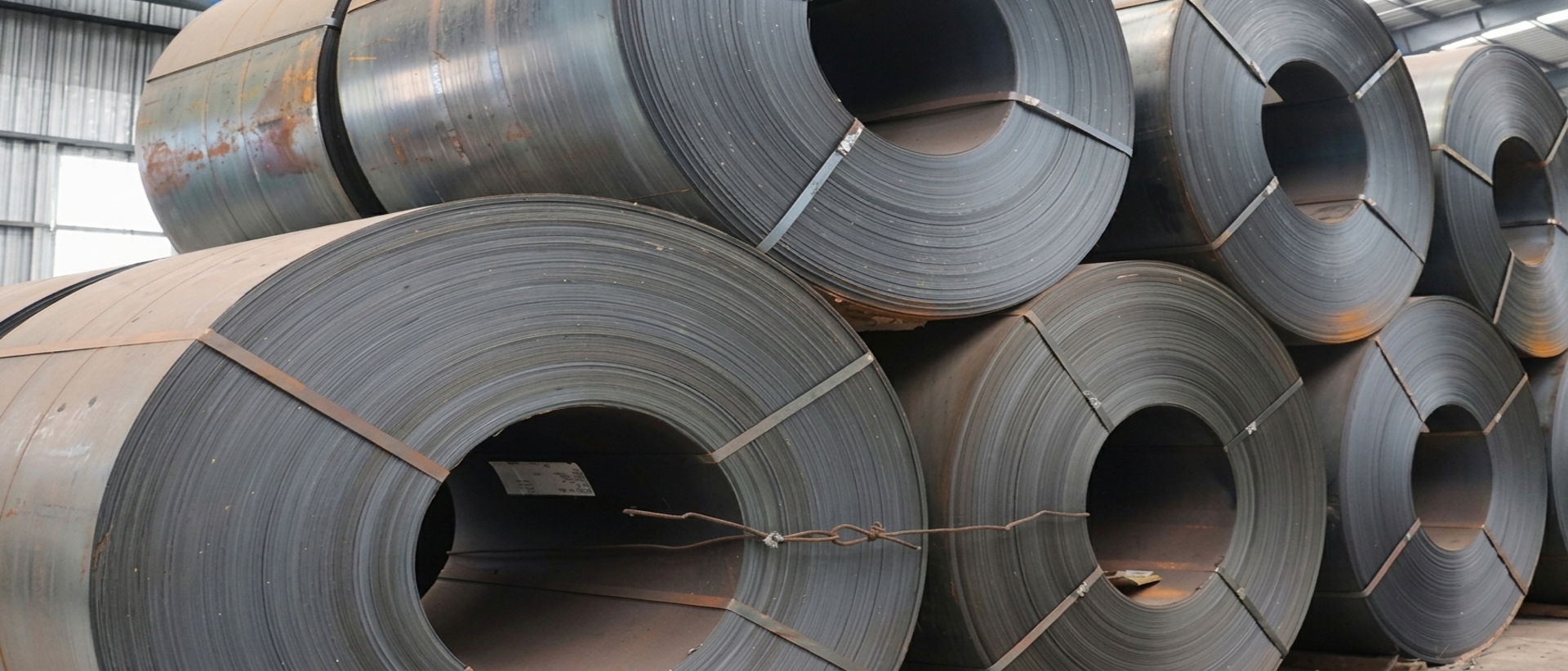
Steel is supplied in coils, sheets, or narrow strips (slits). The format is selected to match equipment and cutting layouts; it does not determine the grade or quality on its own. Read more in the comparison of sheet metal formats and types.
How Zinc Protects Steel and What Its Amount Means
Outdoor carbon steel products require an appropriate corrosion protection system. Zinc acts not only as a physical barrier: it also provides sacrificial, or cathodic, protection for the steel, and its corrosion products form a protective patina. These mechanisms are described by the American Galvanizers Association. This does not mean that damage of any size can be left without evaluation and repair.
Do Not Mix Application Methods
- Continuous strip hot-dip galvanizing: the rolled steel passes through a molten zinc bath on an industrial line.
- Electrogalvanizing: zinc is applied via an electrochemical process; characteristics are verified according to the specific product documentation.
- Zinc-rich paint: a separate paint-based protection system, sometimes referred to as “cold galvanizing.” It is not an automatic equivalent to factory metal coatings on rolled steel.
The AGA distinguishes between these processes and addresses hot-dip galvanizing of finished parts separately. Precise technology matters in the specification, not just the word “galvanized.”
Example of Designation Z275
In the SSAB zinc coating table, Z275 corresponds to a minimum total mass of 275 g/m² on both surfaces combined, based on a triple-spot test. This does not mean 275 g/m² on each side. Coating mass in g/m², layer thickness in µm, and steel substrate thickness in mm are different quantities.
A higher amount of zinc can increase the margin of corrosion protection, but the number alone does not determine the service life of the finished product. Factors such as environment, moisture, cut edges, forming, fasteners, and material compatibility must be taken into account. The spangle pattern on the surface is also not independent proof of coating mass or quality.
Polymer Layer — A Separate Specification Level
Color coatings serve both protective and decorative functions. They do not disclose the underlying steel grade or the amount of metallic protection. Coating systems, top and bottom sides, color, gloss, and allowable formability are agreed upon for the order. Technology differences are reviewed in the article on sheet metal painting.

How to Inspect Steel Before Ordering Products
- Determine the part’s function: cladding, decorative louver slat, or load-bearing element.
- Agree on the substrate: exact grade, supply document, mechanical properties, nominal thickness, and tolerances.
- Clarify processing: cutting, profiling, bending, or stamping; requirements for surface finish and edges after these operations.
- Note the protection system: type and amount of metallic coating, organic finish, operating conditions.
- Check traceability: manufacturer, batch or coil number, corresponding quality document. The type of inspection document is agreed upon in the order.
- Agree on acceptance: which parameters are measured, where and how, what defects are permissible, and how non-conformities are handled.
For Mehbud facades, ceilings, and fences, the material must be approved in the specific system specification. A general article does not replace its technical documentation or structural calculation.
Frequently Asked Questions
Is higher-strength steel always better?
Only if these characteristics match the task. Ductility is important for complex forming, while calculated properties of the entire structure matter for loaded parts. Improving one metric does not guarantee material suitability.
Can steel thickness be determined from a finished painted sheet?
Measuring total thickness may include protective layers. Evaluating the substrate alone requires a mutually agreed methodology and coating data; a single measurement without these conditions does not validate the entire specification.
Does a polymer coating replace galvanization?
These are different components of a protection system. The necessary composition is determined for a specific product and environment. The presence of a colored layer alone does not confirm the presence or quantity of zinc.
Can old designations be equated to DX51D or S350GD?
Not without document verification. Designations from different standards are not automatically interchangeable: composition, mechanical properties, supply conditions, tolerances, and coatings must be compared.
Related articles
Zinc: Everything You Need to Know About This Metal
Main properties of zinc, its history, compounds, and alloys. We explain the mechanisms of steel protection, differences between galvanizing methods, and material inspection criteria.
TOP Multi-Market Chains in Ukraine: Architectural Ranking and Space Innovations
Architectural ranking and innovations of Ukrainian multi-markets: space trends, energy efficiency, and market leaders like Aurora and Kopiyochka.
Thin-sheet metal: main varieties on the Ukrainian market
Use of thin-sheet metal. Forms of metal products. Materials and their features.