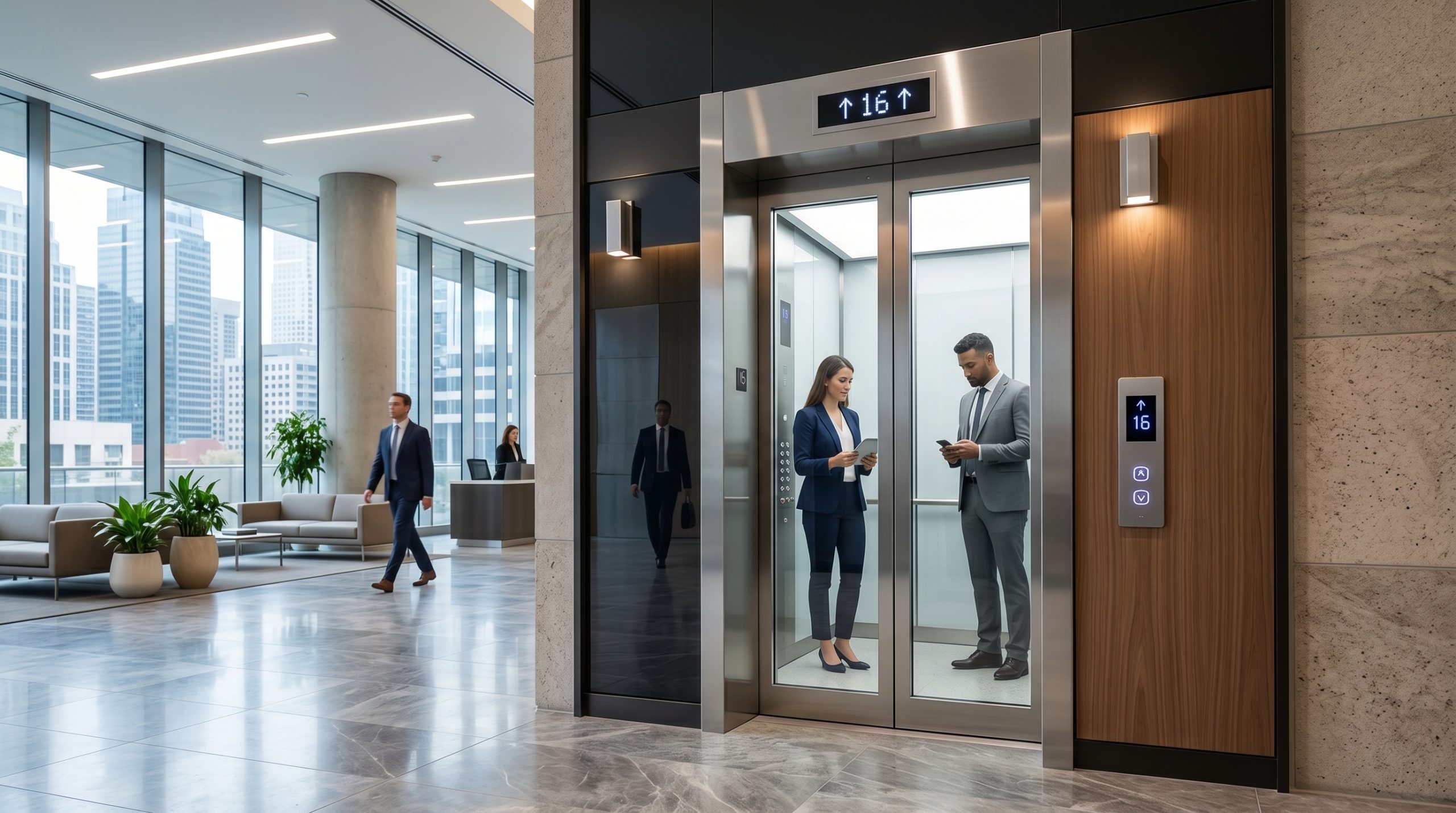
Modern high-speed elevators for skyscrapers in Ukraine define the level of safety and comfort in high-rise buildings. The growing scale of urban construction requires the integration of reliable vertical transportation systems. Our expert report analyzes the TOP-10 suppliers in detail, highlighting their key advantages and innovative solutions, helping developers and investors make an informed choice of partner for the successful implementation of architectural projects.
Macroeconomic and Architectural Context of High-Rise Construction
The development of urban infrastructure in Ukraine, particularly in key metropolises such as Kyiv, Dnipro, Odesa, and Lviv, objectively faces an acute shortage of vacant land plots in central business districts. This phenomenon stimulates leading developers to transition from extensive to intensive construction, which is reflected in the rapid growth of the number of stories in commercial and elite residential real estate. The construction of skyscrapers (buildings over 100 meters high) imposes unprecedented engineering requirements on vertical transportation systems, since the elevator infrastructure becomes the circulatory system of any high-rise facility.
High-speed elevators for skyscrapers have long ceased to be exclusively mechanical rope-driven lifts; they have transformed into complex cyber-physical ecosystems deeply integrated into the digital architecture of a “smart home.” Modern international requirements for such transport systems include the ability to develop speeds from 3.5 to 10 meters per second, dynamic compensation for building spatial sway caused by heavy wind loads, as well as the availability of multi-level intelligent passenger traffic routing algorithms. Analysis of global development trends indicates that innovations in the field of vertical transport are an absolutely critical factor that directly determines the ultimate financial success of a high-rise project. The so-called net usable area ratio of a building (space utilization efficiency factor) directly depends on the overall efficiency of the elevator group. Any space lost to the arrangement of an excessive number of elevator shafts is automatically deducted from the commercially attractive rentable area, thereby reducing the return on investment for the property owner.
Rationalization of the elevator core is a primary task for architects. That is why world leaders offer solutions that allow placing two independent cabins in one shaft or using double-deck cabins that simultaneously serve even and odd floors. Such spatial innovations require significant computing power to synchronize the movement of massive mechanisms in a limited space with millimeter accuracy.
Physico-Mathematical and Aerodynamic Aspects of High-Speed Lifting
The design and installation of high-speed elevators for high-rise buildings requires solving a complex of extremely demanding engineering, aerodynamic, and physical tasks. When a cabin moves at speeds exceeding 3.5 meters per second, pronounced aerodynamic effects occur that cannot be ignored. The elevator cabin acts on the principle of a massive piston in a narrow shaft cylinder, creating zones of extreme overpressure ahead of itself and zones of deep rarefaction (vacuum) behind. This phenomenon, known in engineering as the “piston effect,” not only generates vibrations but also creates acoustic discomfort and physiological pressure on the eardrums of passengers (ear-popping effect). To overcome this barrier, modern manufacturers develop sophisticated aerodynamic cowlings for the top and bottom of the cabins, resembling the nose sections of high-speed trains, and design complex networks of ventilation bypass channels in the shaft walls for instantaneous equalization of barometric pressure.
No less important is the kinematics of movement. The kinetic energy of a massive elevator cabin moving at high speed is directly proportional to its mass and the square of its velocity. In the event of emergency or even routine braking, this huge amount of accumulated energy must be safely dissipated or returned to the grid through recuperation. In addition, the main criterion for the physiological comfort of a passenger is not so much the speed of ascent, but the rate of acceleration and jerk, which defines the rate of change of acceleration over time. To maintain the normal well-being of passengers, acceleration is usually limited to 1.0–1.2 meters per second squared, and the rate of change of this acceleration (jerk) should not exceed 1.5 meters per second cubed.
Another critical issue in high-rise construction is structural vibration and transverse resonance of the hoisting ropes. Skyscrapers taller than 150 meters are inherently prone to low-frequency oscillations under the influence of wind loads (sail effect of facades) and microseismic activity. If the natural frequency of the building matches the oscillation frequency of long elevator cables, a dangerous resonance occurs. The amplitude of the sway of heavy steel ropes in the shaft can reach such values that they start hitting the shaft walls or twisting together, which inevitably leads to equipment damage. Modern suppliers solve this problem comprehensively: they develop active computerized roller guide shoe damping systems that dynamically compensate for cabin deviations, and switch to using ultra-light composite materials. In particular, replacing traditional steel ropes with polyurethane belts reinforced with steel cords or with carbon fiber ropes allows for a radical change in the natural frequency of the system and minimizes the building’s impact on lifting safety.
Intelligent Routing Systems
For skyscrapers with thousands of office workers, the traditional relay or basic microprocessor elevator control system (where a passenger presses a call button on a floor and then selects the destination floor inside the cabin) is inefficient. This leads to chaotic cabin stops on each floor, creating a “bus” effect, which increases waiting time in the lobby and travel time. Advanced suppliers operating in the Ukrainian market implement destination control systems, the most famous of which is the Swiss PORT system by Schindler.
In the paradigm of destination control systems, a passenger identifies themselves and enters the desired destination floor on a special touch terminal or via smartphone while still in the lobby, before boarding the elevator. The central system server, using complex machine learning and fuzzy logic algorithms, instantly analyzes a multidimensional data matrix: the current location of all cabins in the shafts, their capacity load (data from weight sensors), travel speed, and queue formation dynamics in the hall. After that, the system assigns the passenger a specific elevator letter (e.g., “Elevator B”), which will exclusively serve a group of people with the same or closely matched destinations.
This approach algorithmically minimizes the number of intermediate stops during a single trip. Operational data analysis confirms that the implementation of such systems increases the total throughput capacity of the elevator group by 25–35% and reduces passenger waiting times during critical peak hours (morning building loading, lunchtime two-way traffic, and evening unloading).
Global Market Consolidation: Analysis of the KONE and TK Elevator Mega-Merger
The Ukrainian high-speed elevator market does not exist in a vacuum; it is an organic part of the global macro-environment dominated by several multinational corporations: the American Otis, the Swiss Schindler, the Finnish KONE, and the German TK Elevator (formerly a division of ThyssenKrupp). The dynamics of their interaction, financial acquisitions, and patent wars directly affect technology availability, pricing, components logistics, and service standards in Ukraine.
The most resonant event of recent years, which has the potential to completely reshape the architecture of the global and Ukrainian vertical transport market, is the official proposal of the Finnish corporation KONE to acquire the German giant (https://kraft-aufzuege.com). The value of this unprecedented deal is estimated at 29.4 billion euros (or about 34.4 billion US dollars). If all regulatory procedures are successfully passed, the merged mega-corporation will dethrone the current leader Otis and become the world’s largest manufacturer of elevators and esclators with combined annual sales of around 20.5 billion euros.
This strategic move has a profound economic justification. Analysis by the Morningstar investment bank shows that doubling the maintenance service base to 3.2 million units of equipment radically transforms the economics of services. In the elevator industry, the profitability of maintenance significantly exceeds the margins from new equipment sales. A higher density of elevators per single mobile technical specialist means a significant reduction in logistics operational costs, lightning-fast response times to emergencies, and higher customer loyalty metrics. Furthermore, TK Elevator’s presence in North America (about 45% of its portfolio) would allow KONE to diversify its own geopolitical risks and reduce its current dependence on the stagnating real estate market in China.
| Financial Indicator / Metric | Current Status (Pre-Merger) | Estimated Combined Group (KONE + TK Elevator) |
| Enterprise Value Estimate | – | €29.4 bln ($34.4 bln) |
| Combined Annual Sales | Separate balances | €20.5 bln |
| Maintenance Base | 1.6 mln units (KONE) | ~3.2 mln units |
| Price-to-Earnings Multiple | 18x (pre-synergy estimate) | 13x (post-synergy) |
| Competitors’ Multiples | Otis (15x), Schindler (14x) | – |
| Expected Annual Synergy | – | €700 mln (operational) + €200 mln (financial) |
The synergistic effect of this merger is estimated by analysts at 700 million euros annually due to the optimization of research and development platforms, efficiency of global procurement, and a massive reduction in administrative and commercial costs. Additionally, management claims 200 million euros in financial synergy. According to the released plan, the combined company will be led by the current CEO of KONE, Philippe Delorme, while representatives of the private equity funds Advent and Cinven (which bought TKE from the parent concern in 2020 for €17.2 bln) will receive two seats on the board of directors.
However, such a large-scale market consolidation raises concerns from global antitrust regulators and competitors. The CEO of the Swiss company Schindler, Paolo Compagna, harshly criticized the potential deal in an interview with Reuters, calling it a “bloodbath” that is guaranteed to destroy the industry’s stability. He argues that the merger of the third and fourth largest global players will inevitably lead to a conflicting overlap of client bases, duplication of production sites, and layoffs of engineering teams. Schindler has openly stated its readiness to legally challenge this merger in antitrust authorities of every country where the companies conduct business. Even under the most optimistic financial forecasts, the process of integration and obtaining approvals from European and American regulators will take at least 12–18 months, with final closure of the deal expected no earlier than the second quarter of 2027.
For the Ukrainian high-speed elevator market, these global processes mean a deep change in the alignment of forces. In the long term, this could lead to better pricing discipline within a rational market of several large players, but at the same time, it creates risks of maintenance service monopolization. An additional significant factor is the geopolitical stance of these companies: following the start of the full-scale invasion, TK Elevator corporation officially condemned the war in Ukraine, supported international sanctions, and immediately suspended the development of new business in the Russian Federation. Such corporate social responsibility and ethical stance open up significant reputational benefits and extra opportunities for dominance in rebuilding projects for its Ukrainian representative office (the company “Kraft Aufzüge Ukraine”).

Digitalization, Internet of Things, and Predictive Maintenance
The reliability of a high-speed elevator in a skyscraper directly depends on the quality of its preventive maintenance service. Any downtime of the lift due to an breakdown generates significant financial losses for the business center. To minimize these risks, leading companies integrate Internet of Things modules into their products.
Hundreds of micro-sensors installed on key components (winch, door drives, guide rails) collect large volumes of telemetry data in real time. These data sets (bearing vibration, voltage micro-fluctuations, relay response times, acoustic changes in engine operation) are continuously transmitted via encrypted communication channels to cloud computing centers. There, artificial intelligence algorithms detect anomalies. This concept of predictive maintenance allows the system to automatically generate a work order to replace a part several weeks before its actual physical failure. Consequently, repair work is performed at night or on weekends, bringing the elevator availability metric up to 99.9%.
Regulatory-Technical Controls and Safety Standards in Ukraine
The vertical transport market is one of the most rigidly regulated sectors of engineering infrastructure, since passenger safety has an absolute legal priority. In Ukraine, the process of design, manufacture, installation, and operation of elevators is strictly regulated by harmonized European standards, which significantly raised the barrier to entry into the market and weeded out unscrupulous contractors.
DSTU EN 81-20 and EN 81-50 Standards
Over recent years, Ukraine has completed a full transition to advanced European safety standards EN 81-20 (design requirements) and EN 81-50 (rules for testing components), which were implemented as national DSTU standards. For instance, KONE openly guarantees the full compliance of its equipment with these strict regulations.
The main technological changes dictated by these standards for high-rise facilities include:
- Increased material strength: Cabin walls and door leaves are required to withstand significantly greater kinetic impacts to prevent the risk of a passenger falling into a deep shaft. In skyscrapers, this requirement is critical due to the aerodynamic air pressure effect.
- Strict lighting requirements: Minimum illumination thresholds for both routine and autonomous emergency lighting inside the cabin have been raised to prevent panic in the event of a building power outage.
- Safety of service personnel: Standards dictate an increase in the volume of safety zones in the pit and on the cabin roof, and establish new requirements for the brightness of illumination of the shaft itself during maintenance work performed by electromechanics.
In addition to production codes, technical support for already installed equipment is subject to the requirements of the European standard EN 13015. The official distributor of TK Elevator in Ukraine, the company “Kraft Aufzüge Ukraine”, explicitly declares maintenance service with full compliance with this regulation. The EN 13015 standard formalizes the schedule of predictive and routine services, inspection intervals, and staff certification. Additionally, national legislation requires full inclusivity, which is successfully implemented by domestic manufacturers, such as the Tixit plant, through their accessibility programs (Braille font, voice announcements, widened door openings).
| Regulatory Document | Scope of Technical Application | Critical Aspects for Skyscrapers |
| DSTU EN 81-20 | General engineering safety requirements for structures | Wall strength, lighting, door locks, clearance minimization |
| DSTU EN 81-50 | Methodology for testing safety components | Laboratory testing of safety gears, buffers, and overspeed governors |
| EN 13015 | Rules and regulations for maintenance | Frequency of checks, repair logging, certification of electromechanics |
| DBN V.2.2-40 | Inclusivity and barrier-free architectural environment | Cabin width for wheelchairs, audio and tactile navigation |
Criteria and Methodology for Supplier Selection
The expert rating of suppliers was formed on the basis of a deep search and comprehensive audit of public data. The rating includes exclusively legal companies that demonstrated the highest results according to the following criteria:
- Portfolio of works and engineering experience: Analysis of the company’s ability to implement highly complex high-rise projects, availability of its own technical base.
- Equipment quality: Compliance of products with strict international directives (EN 81-20) and the ability to ensure travel speeds above 3.5 m/s.
- Service network and availability of contacts: Availability of round-the-clock emergency dispatch services and regional representative offices, public transparency of telephone numbers and email addresses.
- Online presence and relevance: Evaluation of the professionalism of official websites, regularity of updates in news sections, and presence on key platforms.
- Customer reviews and corporate reputation: Assessment of business transparency, absence of legal disputes regarding installation quality, as well as geopolitical ethics (cessation of cooperation with the aggressor country).
Ranking: TOP-10 High-Speed Elevator Suppliers
Below is a detailed description of the selected leading companies that shape the architectural face of Ukrainian skyscrapers.
1. PrAT “OTIS” (Otis Ukraine)
Main services and specialization: Design, sales, installation, and comprehensive modernization of premium-segment high-speed elevators (SkyRise, Gen3 Peak lines), escalators, and moving walkways.
Key advantages and unique value: World pioneer of the industry with leadership in the high-rise segment. Systems are designed for buildings over 150 meters high (speeds from 3.5 m/s). They provide energy recuperation, personalized cabin design, and flawless safety architecture.
Contact information: Phone: 0-800-501-901, Website: otis.com/uk/ua, Email: [email protected], Social media: active (Facebook/LinkedIn).
Why you should contact them: Brand reliability, the availability of the 24/7 OTISLINE support line, and a full range of tools for architects make them a trustworthy partner for the largest construction projects.
2. TOV “KONE LIFTS” (KONE)
Main services and specialization: Manufacture, installation, and maintenance of high-speed passenger lifts (specifically machine-room-less models), escalators, travelators, and innovative access control turnstiles.
Key advantages and unique value: Global ambassador of the People Flow philosophy (passenger traffic optimization). Equipment strictly complies with DSTU EN81-20. The corporation actively invests in research and development and is executing a large-scale market expansion.
Contact information: Phones: (044) 377-77-40, 0-800-21-77-40, Website: kone.ua/ua/, Email: [email protected], Social media: present.
Why you should contact them: Expertise in digital solutions. The presence of a powerful central office in Kyiv guarantees uninterrupted service and access to revolutionary ultra-light materials for ultra-high-rise speeds.
3. TOV “Schindler” (Schindler)
Main services and specialization: Sale, installation, warranty service of high-speed passenger, panoramic, and service elevators, as well as escalators.
Key advantages and unique value: Swiss quality of metal and electronics. Availability of the exclusive PORT intelligent routing system. The company maintains an active policy of protecting antitrust laws.
Contact information: Phone: +38 (044) 499-98-95, Emergency service: 0-800-306-626, Website: ua.schindler.com/uk, Address: Kyiv, BC “Symvol”.
Why you should contact them: Working directly through the representative office of a European brand prevents the use of non-original parts and ensures an instant round-the-clock response to emergencies.
4. TOV “Kraft Aufzüge Ukraine” (TK Elevator)
Main services and specialization: Distribution, installation, and modernization of high-speed elevator systems of the TK Elevator brand, escalators, and moving walkways.
Key advantages and unique value: Exclusive access to revolutionary TWIN systems (two independent cabins in one shaft) and MULTI. Maintenance according to the EN 13015 standard. Ethical stance and cessation of activity in the aggressor country highlights their reliability.
Contact information: Phone: +38 (044) 227-05-32, Website: kraft-aufzuege.com, Email: [email protected], Social media: Facebook/YouTube/LinkedIn.
Why you should contact them: Using TWIN technology allows developers to optimize the space of a skyscraper core, freeing up to 30% of net usable area for leasing.
5. EUROFORMAT (Euroformat)
Main services and specialization: Domestic production, engineering, installation, and maintenance service of passenger elevators for multi-story commercial and residential buildings.
Key advantages and unique value: Status of the largest national manufacturer with European certification and a representative office in Poland. The use of reliable European components is combined with flexibility in customizing cabins under a design project.
Contact information: Phone: +380 (044) 494-35-38, Website: euroformat.com, Address: Kyiv, 21 G Kurenivska St, Social media: present.
Why you should contact them: Localization of production capacities in Kyiv ensures independence from logistics crises, fast spare parts delivery, and optimal budget formation for procurement.
6. “Masterlift” Company (Masterlift)
Main services and specialization: Selection, installation, modernization, replacement, and 24/7 maintenance service of elevator equipment of any complexity.
Key advantages and unique value: Deep engineering expertise and a multi-brand approach. Availability of its own commercial department and a modern dispatching service. Main focus is extending the life cycle of high-rise mechanisms.
Contact information: Phones: +38 (044) 498-43-32, +38 (044) 229-88-32, Website: masterlift.com.ua, Address: Kyiv, 04073.
Why you should contact them: A reliable general contractor for operating organizations (OSBB / co-owners associations, property management companies), guaranteeing safe and uninterrupted operation of a multi-brand park of high-speed elevators at a favorable price.
7. Citylift (Citylift)
Main services and specialization: Sale of elevators, escalators, and travelators. Deep modernization services for outdated systems and development of transparent pricing for large-scale construction projects.
Key advantages and unique value: A wide range of lifting mechanisms to meet the needs of multi-functional complexes. Ownership of its own 24/7 emergency repair service.
Contact information: Phone: +38 (096) 709-07-07, Emergency service: +38 (096) 2000-977, Website: citylift.com.ua, Social media: present.
Why you should contact them: A flexible approach to budgeting and the ability to cover all infrastructure needs (from parking to roof) on a turnkey basis make them a reliable integrator for commercial skyscrapers in the capital.
8. TOV “Viplift” (Viplift)
Main services and specialization: Supply and installation of premium passenger and glass panoramic elevators, automated parking complexes, and lifts for persons with disabilities.
Key advantages and unique value: Exclusive focus on non-standard premium architectural solutions. Integration of high-quality equipment based on Finnish KONE technologies for the most sophisticated designer lobbies and facades.
Contact information: Website: viplift.com.ua/uk/, Social media: active online presence (Facebook/Instagram).
Why you should contact them: Their experience in designing panoramic shafts and integrating elevators for luxury underground parking lots allows developers to significantly increase the prestige and market capitalization of a building.
9. TIXIT Plant (Tixit)
Main services and specialization: Design and manufacture of passenger (electric/hydraulic), dumbwaiters (service) lifts, car parking systems, and equipment for a barrier-free environment.
Key advantages and unique value: Powerful in-house manufacturing facilities in Ukraine, allowing the creation of unique custom products. High financial accessibility of base models and support at all stages of project implementation.
Contact information: Website: tixit.ua, Address: Kropyvnytskyi (executing objects all over Ukraine, including Kyiv and Odesa).
Why you should contact them: An optimal choice for equipping the auxiliary infrastructure of skyscrapers (service areas, restaurants, inclusive lifts). Cooperation with the plant stimulates the national economy and minimizes the developer’s currency risks.
10. TOV “Karat-Liftkomplekt”
Main services and specialization: Manufacturing, full configuration, and supply of elevator equipment, electronic control stations, and mechanical units for installation companies.
Key advantages and unique value: Large-scale production and warehouse base near the capital. Many years of experience and guaranteed availability of critical spare parts for vertical transport systems.
Contact information: Phone: +380 (44) 585-25-90, Website: karatlift.com.ua, Address: Kyiv Region, Vyshhorod (Didovytsia), 19 Sholudenko St.
Why you should contact them: Due to geographical proximity to Kyiv, the company ensures instant logistics of original components, reducing down-time risks at construction sites to zero.
Life Cycle Economics and Energy Recuperation
When choosing a high-speed elevator, capital expenditures for the purchase and installation of equipment represent only a small fraction of the total cost of ownership. About 70% of the financial burden over 25–30 years of operation comes from operational expenses, including electricity consumption and regular maintenance. Elevator groups in skyscrapers are among the most powerful energy consumers, accounting for 5% to 15% of the total energy balance of a high-rise building.
That is why all leading suppliers (such as Otis, KONE, Schindler, TK Elevator) mass-integrate regenerative frequency drives. When a fully loaded cabin (the mass of which exceeds the mass of the counterweight) descends under the action of gravity, or when an empty cabin ascends, the electric motor transitions into generator mode. Instead of dissipating this excess mechanical energy as useless heat on brake resistors, the regenerative drive converts it into clean electrical energy returned to the internal power grid of the building. This process saves up to 40% of electricity compared to conventional systems, which is an important condition for a building to obtain LEED or BREEAM environmental certificates.
Future of the Industry: Magnetic Levitation and Rope-free Systems
Technological development does not stand still. The presence of global leaders’ representative offices in the Ukrainian market guarantees access to tomorrow’s technologies. The traditional architecture of an elevator relying on steel cables and a motor at the top of the shaft has reached its physical limit (approximately 1,000 meters). The weight of the ropes themselves becomes so heavy that the motor spends most of its power lifting the cable rather than the passengers.
The response to this engineering challenge is the development of rope-free systems that utilize the principles of linear synchronous motors and magnetic levitation. The most famous prototype of such a system is the MULTI project by TK Elevator (represented in Ukraine by “Kraft Aufzüge Ukraine”). In such a system, cabins are equipped with built-in magnetic drives and move along shafts independently of each other. The revolutionary advantage of this technology is the ability of cabins to move not only vertically but also horizontally at special intersections. This completely obliterates traditional architectural limitations: developers are no longer obliged to design skyscrapers strictly as vertical columns; they will be able to create futuristic buildings in the form of rings, arches, or pyramids, where elevators will travel like independent metro cars inside the facade.
Choosing a supplier of high-speed elevators is a strategic decision for the success of a high-rise project. Contact the industry leaders from our ranking to provide your facility with innovative and reliable lifts. Analyze estimates, request a technical consultation on official websites, and integrate the best vertical transport solutions today!
Related articles
Top 7 Companies to Buy Gabions in Ukraine: Ranking of Trusted Manufacturers
Rating of reliable manufacturers. Price comparison, expert tips on wire thickness and stone selection for durability.
Warranty for metal structures in Ukraine: Legal regulation, engineering standards, and judicial practice
Metal structure warranties in Ukraine: Legal regulation (10 years), DBN standards, ISO corrosion protection, fireproofing, and how to file defect claims.
Top companies performing foundation works in Kyiv
Rating of TOP foundation work companies in Kyiv 2026. Current prices, contractor comparison, market analysis, and expert advice on choosing a reliable foundation.