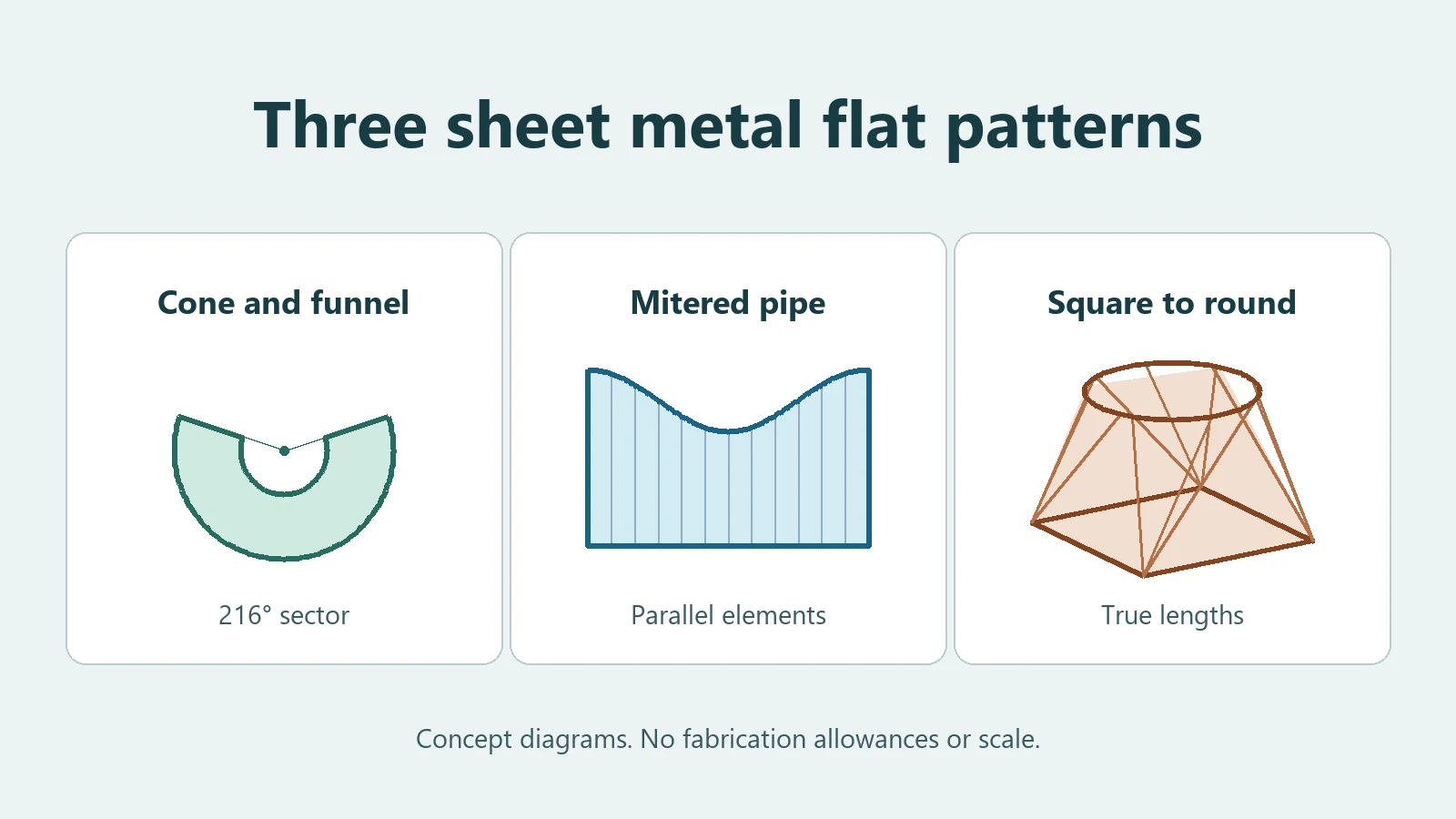
A straight-sided cone unfolds into a circular sector. The cone’s slant height becomes the sector radius, and the sector’s outer arc must match the circumference of the base. A funnel with the tip removed develops into an annular sector. Two other familiar metal-shop parts look different when laid flat: a mitered pipe has a wave-shaped edge, and a square-to-round duct transition takes a sequence of triangles.
Jump to a demonstration: 01:08 — mitered pipe, 02:07 — the 216° cone, 04:16 — square-to-round triangulation.
Which flat pattern matches the part?
| Part | Flat shape | Dimension to verify |
|---|---|---|
| Cone or frustum | Circular or annular sector | Slant height and the arc length for each opening |
| Round pipe with a miter | A strip with a wavy edge | Circumference and the cut height at each division |
| Square-to-round duct transition | Sections laid out from triangles | True lengths, seam placement and alignment of the openings |
1. Cone layout: why the sector measures 216°
Try a paper cone using a 3 in. base radius and a 4 in. vertical height. Those are the two legs of a right triangle, so the slant height is 5 in. The video uses the same 3:4:5 geometry at 60, 80 and 100 mm. The full circumference of the cone base is 2π × 3 ≈ 18.85 in. The developed arc needs to measure 18.85 in. along a circle whose radius is 5 in. That makes the sector angle 360° × 3 / 5 = 216°.
Cut the paper sector and meet the straight edges. Tape across the outside to test the form. A full circle can be rolled with overlap, but the 216° sector already matches the desired circumference edge to edge. If a real metal joint needs overlap, the seam allowance is part of the fabrication detail.
Cutting the tip parallel to the base creates a second arc with the same center and the same angle. A small opening with a 1.2 in. radius gives an inner slant radius of 5 × 1.2 / 3 = 2 in. The spout is a separate part of this model. Brian Coey’s frustum layout.
2. Mitered pipe: a planar cut makes a wavy pattern
On an ideal 4 in. diameter tube, the unrolled circumference is about 12.57 in. Mark equal divisions along that stretch-out. Look at the side elevation to find the cut height at each matching point around the tube. Transfer those heights to the strip. As the marks go around the tube, they pass from the high side to the low side and back to the seam. The cut is planar in three dimensions, while the developed edge is wavy.
If the seam begins at the highest point, the lowest point lands halfway along the strip. Compare the seam endpoints when you make the paper test. A straight chord between two points on the circle is shorter than the corresponding arc. Parallel-line layout for a mitered pipe.
3. Square-to-round duct transition: use true lengths
Mark the square corners and the corresponding points around the round opening. A sloping edge appears shorter in plan than its true three-dimensional length. A 3 in. plan projection and a 4 in. rise give a true length of 5 in. Lay out each triangle from its side lengths, then use a shared edge to start the next one. More divisions can improve the approximation of a curved edge. If the round opening is offset, check which sides still share a template. Triangulation in the BCcampus sheet metal textbook.
What does the paper test prove?
It shows whether the edges meet, the openings fit the intended geometry and the seam lands where expected. Specify the stock, seam, joining method, bending and forming details before ordering a cut. Paper can follow the shape, while a production trial accounts for the behavior of metal and tooling. A compound-curved panel may require stretching, shrinking or separate pieces. A single flat template works only for the geometry it was drawn to represent.
For straight bends, see the practical sheet metal bending guide for bend radius and springback.
Related articles

Metal Galvanizing: Technologies, Differences, and Coating Selection
How hot-dip galvanizing, electrogalvanizing, coil sheet coatings, and zinc-rich paints differ. Comparison, technology selection, and quality inspection.
Sheet Metal Processing Equipment: Types and Selection
Guillotine shears, corner notching machines, folding machines, press brakes, and roll forming lines: what they do, how to choose a production routing, and how to check…
How to Choose Gates for a House: 6 Practical Tips
How to choose gates for a private house: materials, sliding vs. swing designs, infill, automation, and backup power. Six practical tips, measurement guide, and FAQ.