
You can bend sheet metal at home if the material is suitable for forming, and the tool is designed for its thickness and bend length. For a short, simple bend, sheet metal seaming pliers or a vise with a suitable mandrel are used; for a straight, long bend — a manual sheet metal brake. First, check the material data and do a test on an offcut. There is no universal “home” thickness limit.
This material will help you prepare a simple, unloaded part. For load-bearing elements, safety guards, tight joints, and parts with specified tolerances, you need drawings, proven technology, and appropriate equipment.
What to check before bending a sheet
Not only the thickness is important for the work, but also the metal grade, supply condition, strength, coating, and part geometry. Aluminum alloys of different grades and tempers, just like different steels, cannot be considered equally ductile. If the material is unknown, a test only shows the behavior of the sample and does not confirm the suitability of a critical part.
- Thickness and bend length. As the thickness, strength, and width of the bending section increase, the required force also increases.
- Inside radius. It is selected based on the recommendations for the specific sheet and tool. Clamping on a sharp edge does not guarantee a permissible radius.
- Rolling direction. It can affect the tendency to crack; check the manufacturer’s requirements, not just the layout convenience.
- Springback. After the load is removed, the angle and radius may change. The necessary correction is determined by a test, not by a single number for all metals.
The influence of strength, geometry, and rolling direction is explained by the OCAS research center in their article on bending and springback of steel. Its data on high-strength steels are not ready-made parameters for any home tool. You can also read about choosing a base in the article “Steel for sheet metal”.
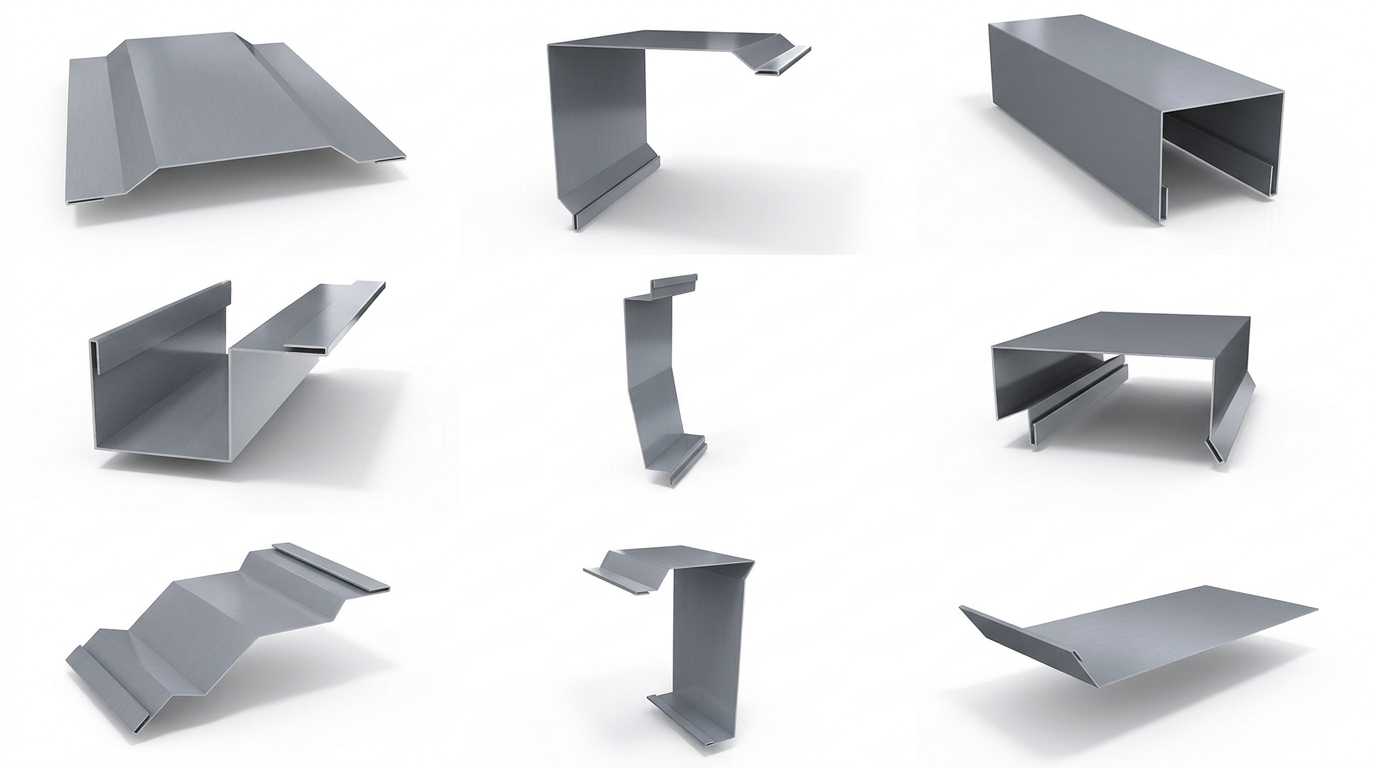
What to use to bend sheet metal in a home workshop
| Tool | Where to use and what to check |
|---|---|
| Hand seamers (Sheet metal pliers) | Short bend or local fitting. Wide, clean jaws reduce local dents; check the permissible material and thickness. |
| Vise and mandrel | A small workpiece with a simple bend. Requires rigid mounting, sufficient clamping area, and a specified support radius. |
| Manual sheet metal brake | Straight-line bending and repetitive parts. Verify the material, working length, thickness, minimum flange, and permissible angle according to the manual. |
| Slip roll machine | Arc or cylinder. Requires appropriate rolls, protection against drawing-in, and checking the method for removing the workpiece. |
A manual drive by itself does not mean low precision. For example, the manufacturer of the Baileigh HB-4816E manual brake specifies capacity by material and working length, and provides for clamping adjustment. The parameters of one machine cannot be transferred to a homemade device.
How to make a right-angle bend: sequence for a simple part
1. Prepare the workpiece, support, and protection
Mark the flange dimensions, bending direction, and inside radius. Remove burrs with a suitable tool, clean the contact surfaces. Secure the vise or machine on a stable base according to the instructions. Support a long workpiece so that it does not tip over during bending.
Protect your eyes and use suitable gloves when handling a sharp sheet. Near moving and rotating parts, follow the equipment instructions: gloves should not pose an entanglement risk. Keep your hands out of the clamping area; do not work with loose clothing or jewelry. Basic rules for operator and equipment preparation are given in the CCOHS guidelines for metalworking machines.
2. Account for the flat pattern, not a fixed allowance
The length of the flat blank depends on the thickness, radius, angle, and forming method. Do not automatically add 0.5 mm “per bend.” CAD uses bend tables or the K-factor, which describes the position of the neutral axis; this is explained in the Autodesk help on sheet metal rules. For a single simple part, make a test with the same material and tooling, measure the result, and adjust the flat pattern.
3. Clamp and form the bend
- Position the test offcut relative to the tooling according to its instructions. The marking line and the clamping edge do not always align: account for the tool’s radius and geometry.
- Ensure the workpiece is securely clamped, the supports are stationary, and the bending path is clear.
- Smoothly form the bend with the standard tool. Do not extend the handle with a pipe or exceed the rated capacity. If the clamp shifts or the part resists, stop.
- Remove the load and check the angle with a square or protractor, and the dimensions with an appropriate measuring tool. If necessary, adjust the settings based on the test result.
- After a successful test, process the main workpiece and repeat the inspection. For a U-shaped profile, check access for the second bend and the ability to remove the part in advance.
Standard narrow pliers and hammer strikes on an unsecured edge often leave a wave and marks. A mallet can be an auxiliary tool for the material and operation where permissible; it does not replace a properly selected support and clamp. Do not try to repeatedly bend a section back and forth to fix a mistake.

Can you bend galvanized and painted sheet metal?
Yes, if the specific steel and coating allow such forming. Clean, smooth contact surfaces, the correct radius, and the material temperature are more important than the assumption that a “thin sheet will bend without damage.” The permissibility of protective pads or film is checked against the technology: they can change the clamping conditions.
The claim that a polymer coating cannot be bent is incorrect. For example, SSAB GreenCoat PLX Pural BT is designed for forming and has a manufacturer-specified minimum inside radius and lower forming temperature. These conditions apply specifically to this product, not to any painted sheet.
After bending, inspect the outer surface: cracks, peeling, exposed base metal, and deep scratches require evaluation. Do not heat a galvanized or painted sheet with a torch to “ease” the bend. Repair the protective layer only according to its manufacturer’s recommendations; touch-up paint does not fix a crack in the metal itself.
Radius bending and cylinder forming
For a smooth arc or cylindrical shell, a slip roll machine rated for the required material is appropriate. Forming on a stationary mandrel is possible only for a suitable workpiece and fixture, with reliable clamping and controlled force. Do not stand on the sheet or use people as a hold-down.
A cylinder flat pattern requires a specified diameter, thickness, neutral layer position, and joint design. The product of πD does not give a universal ready-made blank width: it matters which surface D refers to. The allowance for a seam, lap, or weld is determined by the specific joint; you should not automatically add 30 mm. Do not consider a homemade shell as a ready-to-use pressure pipe or a certified gutter element.
Homemade sheet metal brake: what to check
A photo of the device or a list of angles and hinges is not a sufficient drawing. You need to check beam stiffness, pivot axis geometry, clamping, welded and bolted connections, base mounting, and pinch points. Door hinges and randomly selected profiles do not have automatically confirmed suitability for the required load.
For repetitive parts, a machine with known specifications or a workshop service is more practical. Quality is evaluated by dimensions, radius, material condition, and repeatability, not just by the presence of automation.
How to check the result and when to contact a workshop
- The angle and flange dimensions match the drawing after load removal.
- The bend line is straight, without unwanted twisting or waviness.
- There are no visible cracks on the bend, and no unassessed damage on the coating.
- The part assembles with adjacent elements without forced pulling.
Contact a workshop if you need long, straight bends, a series of identical products, a complex sequence of flanges, or controlled tolerances. To order, prepare a sketch with dimensions, material, thickness, coating, quantity, and surface requirements.
Frequently Asked Questions
What is the maximum thickness that can be bent by hand?
There is no single limit. Compare the sheet grade, temper, thickness, bend length, and radius with the tool’s manual. Being able to bend a short offcut does not prove the same tool is suitable for a long sheet.
Why does the angle open up after bending?
This is springback. The correction is selected for the specific material and tooling on a test sample; there is no universal overbend angle.
Is it necessary to heat the metal?
No. A sheet suitable for cold forming is processed under the conditions specified by the manufacturer. Heating is not a universal way to bypass material or tool limitations.
Can a crack be fixed by rebending?
No. Stop processing and find the cause: material, radius, blank edge, or operating procedure. Do not accept a part with a crack as sound just because you managed to get the required angle.
Related articles
Defects in sheet metal products: flaws and inspection
How to detect defects in sheet metal products: geometry, holes, bends, and coating. Causes of defects, quality control, and procedures during acceptance.
Using mobile apps to calculate the area of facades, fences, and ceilings
Digitalize architectural measurements: use LiDAR, ARKit, and mobile apps like Polycam to accurately calculate facade, fence, and ceiling areas.
Zinc: Everything You Need to Know About This Metal
Main properties of zinc, its history, compounds, and alloys. We explain the mechanisms of steel protection, differences between galvanizing methods, and material inspection criteria.