How to Choose a Company: Expert Advice Before Ordering
Ordering gabions is a responsible process that requires a deep understanding of engineering and aesthetic aspects. Despite the visual simplicity of the structure, a metal cage filled with massive stone is subjected to colossal loads. Poor-quality material or design errors can lead to the destruction of the structure within just a few years. Expert market analysis allows highlighting key criteria to pay attention to when choosing a contractor.
What to look for when evaluating materials
The basis of gabion longevity is the quality of the metal and its coating. Always check the wire’s technical specifications with the company. For fences or retaining walls, the wire thickness should be at least 4–5 mm. If a manufacturer offers a 3 mm thick mesh for a structure over a meter high, this will inevitably lead to deformation (“bulging” into a barrel shape) under the pressure of the stone.
Even more critical is the anti-corrosion coating. Cheap alternatives are often coated with a thin layer of zinc (about 100 g/m²). Such a coating in aggressive environmental conditions may last only 5–10 years, after which the structure will quickly begin to rust. Reliable companies use hot-dip galvanizing with a density of at least 275 g/m², and ideally — Galfan coating (a zinc and aluminum alloy). Thanks to this diffusion coating bonding with the metal at the molecular level, the service life of gabions is extended up to 50–70 years even without additional polymer painting.
What questions to ask before ordering
During the initial consultation with a company representative, pay attention to the depth of their engineering knowledge. Ask:
- Which type of mesh is best for my task? A professional will explain that for retaining walls on slopes where soil subsidence is possible, it is better to use double-twisted woven gabions, as they are capable of adapting to deformations without breaking. On the other hand, perfectly flat decorative fences require welded panels with rigid geometry.
- Does your cost estimate include internal ties (hooks)? Their absence is one of the most common mistakes leading to structure failure.
- How to properly calculate stone volume? A reliable company should advise that the bulk density of granite or basalt for gabions is approximately 1.5–1.6 tons per cubic meter. This means filling a standard 1x1x2 meter gabion will require about 3 tons of stone, significantly impacting the logistics budget.
How to check reputation and evaluate the portfolio
When analyzing a company’s portfolio, pay attention to installation details. Images should show flat edges of the structures with no signs of sagging or bulging. An important marker of competence is the use of geotextiles when arranging the foundation. Placing a gabion directly on open soil without a separation layer is a gross engineering mistake that leads to base erosion, subsidence of the entire structure, and weeds sprouting through the stones. Furthermore, experienced companies always display objects with organized drainage, as the hydrostatic pressure of water can topple even a massive stone wall.
How to compare prices and alternative solutions (combined fences)
The cost of building a solid gabion fence is quite high. Considering the price of welded galvanized panels, the required volume of natural stone (granite or quartzite), and the complexity of manual laying, the final turnkey cost per square meter can easily exceed 5,000 UAH. Plus, massive stone structures require a solid foundation.
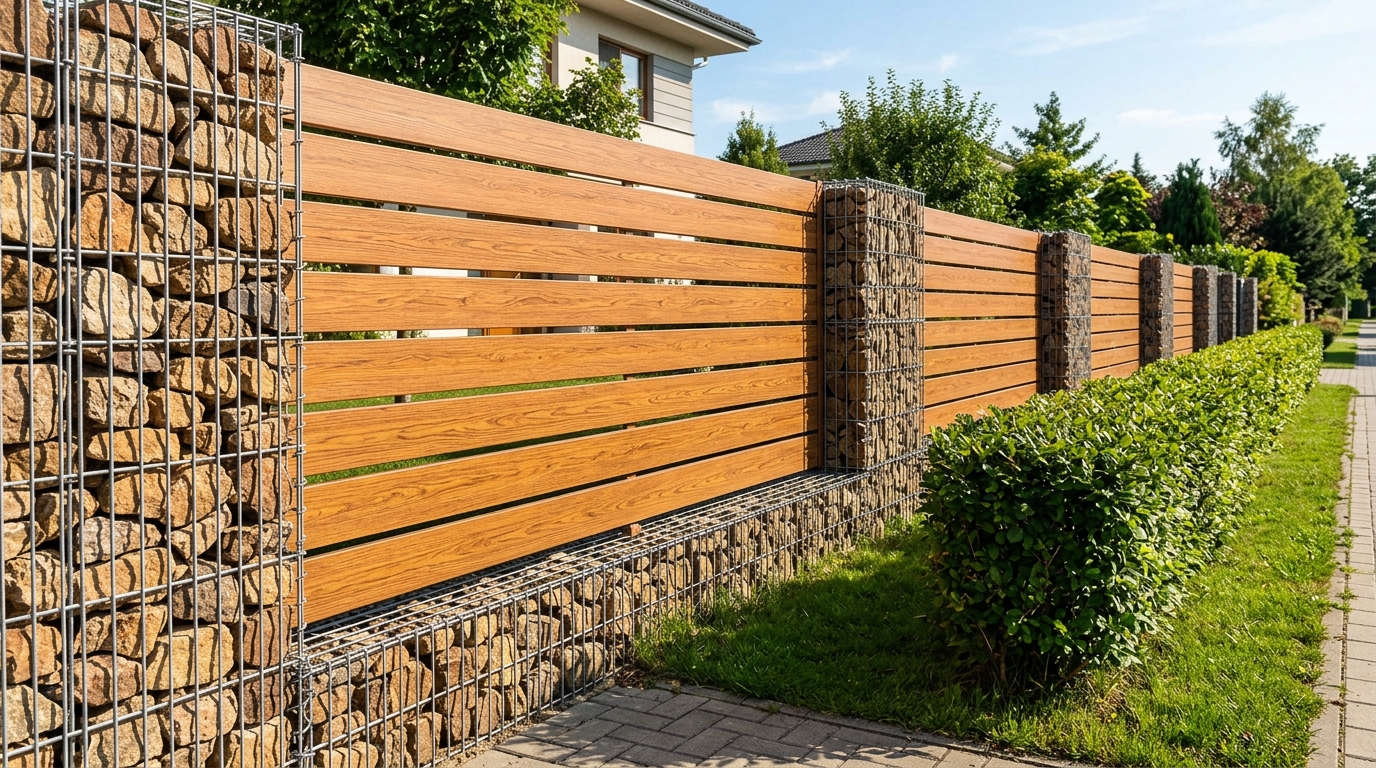
If the budget is limited, or you want to ensure better site ventilation, landscape design experts recommend looking into combined fencing. One of the most current trends in private construction architecture is the use of gabions exclusively as supporting pillars or a base, between which modern metal sections are mounted.
In particular, the ideal complement to the brutal texture of gabion stone is panel metal fencing from domestic manufacturers, such as the “Mehbud” plant. Metal fences of the “Jalousie”, “Rancho”, or “Horizon” type are made from galvanized steel with a polymer coating (Pural, PVDF, or polyester), ensuring a service life comparable to gabions (up to 20–30 years) and full protection against corrosion.
Combining massive gabion supports with light, ventilated “Rancho” or “Jalousie” sections solves several problems at once:
- The overall weight load on the foundation is reduced.
- Proper insolation (sunlight penetration) and air circulation are ensured, which is critically important for plants on the site.
- The project budget is significantly optimized, as metal lamellas are much cheaper than bulky cubic meters of imported or processed stone.
- A modern contrasting design is created, where cold metal, painted in trendy colors or stylized as natural wood (PRINTECH coating), harmoniously blends with the natural texture of wild stone.
When making the final choice of a company, compare not only the price per square meter of mesh, but also the cost of the full range of work (delivery, stone, installation, consumables). Trust contractors who can provide warranty obligations for the structure for a period of at least 10–15 years.