
AI-generated illustration of a building retrofit.
Repairs and the “reconstruction and other work” category accounted for 58.4% of the value of construction work in Ukraine in January–September 2026, up from 57.4% in the same months of 2025. New construction accounted for the remaining 41.6% in 2026. The figures measure completed work at current prices and cover buildings and civil engineering. State Statistics Service dataset.
For clients, contractors and manufacturers, the mix matters because the scope is different on an existing property. On a new site, the design provides a starting point for dimensions and specifications. On an existing building, teams often start by checking what can be retained, how crews will gain access and what may be discovered once the structure is opened up.
How Ukraine’s construction mix changed from 2025 to 2026
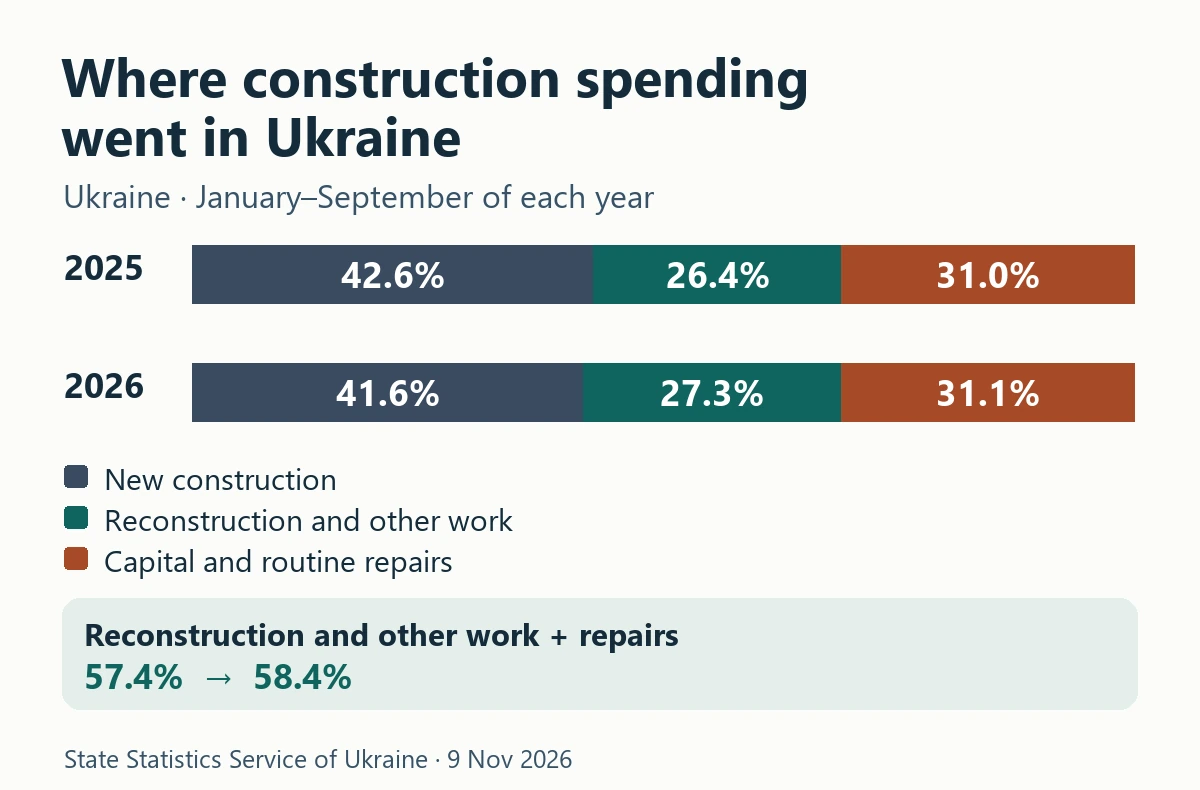
The combined share increased by 1.0 percentage point. Most of that shift came from reconstruction and other work, up 0.9 points. The share of capital and routine repairs rose by just 0.1 points. New construction remained the largest individual category. Its share declined even though its estimated value in hryvnias increased.
What do the shares amount to in hryvnias?
Multiplying the total value of work by the published shares puts repairs plus reconstruction and other work at about UAH 113.6 billion in January–September 2026, compared with UAH 97.1 billion for the same months in 2025. The corresponding figures for new construction are about UAH 80.9 billion and UAH 72.1 billion. These are estimates from rounded shares. A project budget or a procurement analysis requires its own source.
Why the value of construction work rose as output fell
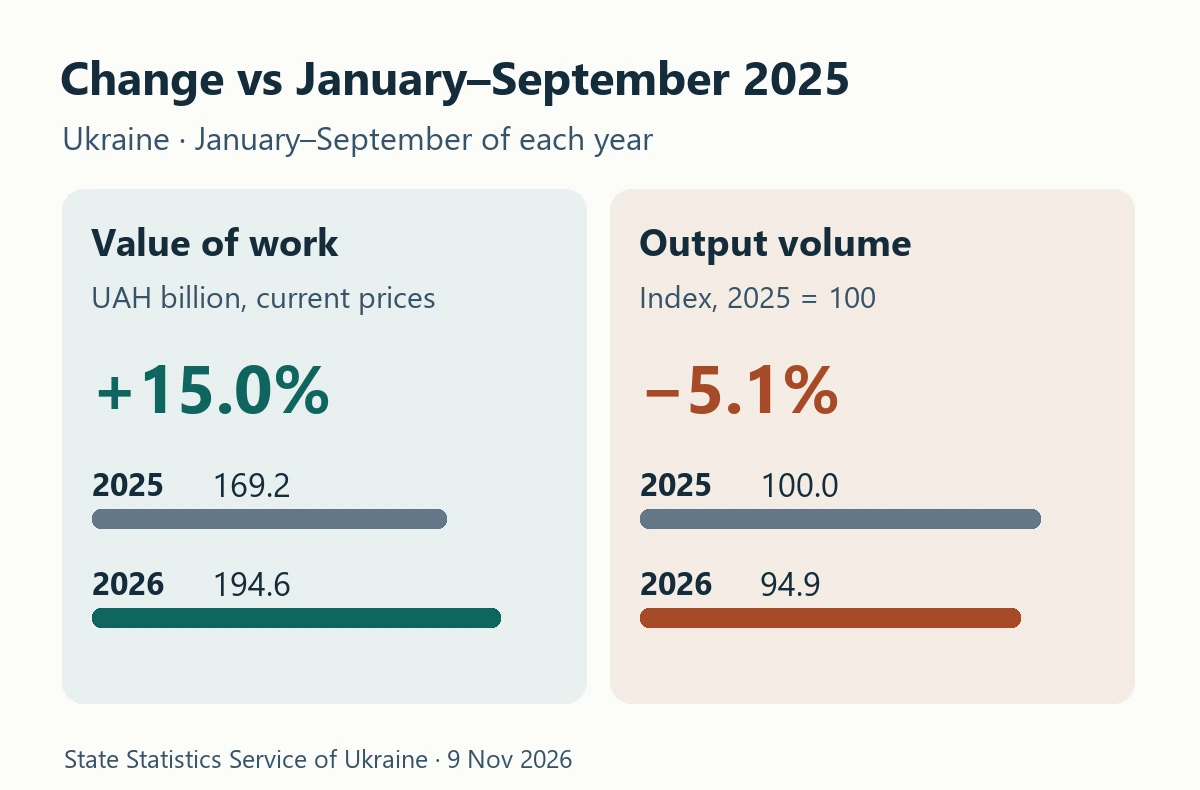
The value of work at current prices rose from UAH 169.2 billion to UAH 194.6 billion over the comparable nine-month periods, up about 15.0%. The construction output index stood at 94.9% of the 2025 period, a 5.1% decline in volume. The hryvnia figure records work at the prices in use at the time. The index measures the change in volume at constant prices. Official statistics release, 9 November 2026.
The volume index covers the whole sector. A repair-only or facade-specific comparison needs its own measure. When revising an old quote, check its date, the components included and the quantities first, then update rates for materials, installation and site access. Overview of Ukraine’s construction market in 2025–2026.
How the statistics define the construction mix
The chart shows the type of work. Ukraine’s statistics agency also publishes output by type of structure, including residential and non-residential buildings and civil engineering. Reconstruction can cover buildings or networks. The national figure of 58.4% describes the value of all reported work in the comparison. Project counts, floor area and the facade share require different evidence.
- New construction. This is work reported as new construction. On a new building, the team needs agreed dimensions, a schedule for other trades and delivery dates.
- Reconstruction and other work. This is the full name of the data category. On an existing building, establish which parts will remain and where new elements will meet them.
- Capital and routine repairs. The service reports them together in this series. Replacing a few elements and planning more extensive work involve different scopes and preparation.
For any individual property, the actual scope and applicable rules determine how the project is classified and documented. The official methodology defines the value measure as work carried out with a contractor’s own resources under construction contracts, excluding VAT. The 2026 figures are preliminary. Official methodology.
Three scenarios for clients and contractors
New building: agree the interfaces before the production run
For a new warehouse, identify when the substrate will be ready and when window and roof junctions can be checked on site. Before production, agree a panel layout, sample, batch labels and storage locations. If parts must be ordered from drawings before a final survey, flag the elements that depend on as-built dimensions. A late change to one opening can move the joints across an entire elevation.
Existing building: plan the work in zones
Suppose an office ground floor must stay open during a retrofit. Begin with a survey, identify the areas to be altered and assess the substrate. Mark entrances, lifting equipment, pedestrian routes and temporary storage on the plan. Price removal, protection, preparation, the new components and inspection of concealed work separately. Agree who signs off each area before the cladding covers it. Rainscreen details at windows, wall bases and parapets.
Local repair: find the cause before ordering replacement parts
For several damaged cassettes at the base of a wall, mark their locations and record the damage with a scale, along with geometry, coating and fixing type. Establish whether the components can be removed individually and whether there is damage underneath. If it extends past the cladding, assess the affected structure before defining the work. In the request for a replacement, include access, removal and reinstatement of neighbouring elements. Guide to replacing facade cassettes.
How to compare repair and reconstruction quotes
Illustrative example. Quote A is UAH 500,000 for materials and installation. Quote B is UAH 580,000 for the same work including a lift and entrance protection. If these cost UAH 65,000 and UAH 30,000 separately under A, its comparable total is UAH 595,000. Quote B is UAH 15,000 cheaper at the same scope. These are hypothetical figures on a consistent VAT basis.
Use four columns to make the comparison repeatable: item, quantity, responsible party and whether the cost is included. Flag removal, disposal, substrate preparation, protection of people and equipment, lifting, junction details and reinstatement of adjacent areas. Where quantities will only become clear during opening-up, agree unit rates and a way to record and approve extra scope before the team mobilises. Metal facade prices and installation.
For a building that remains in use, also record when areas will be closed, when noisy works can take place and how access and temporary drainage will be maintained. These conditions affect crew output and the number of site visits. Ask for the associated costs separately if bidders plan to deliver the work in different phases.
What to agree before the first site visit
- Inspection and survey. Supply plans, numbered work areas, photographs and a list of locations that still need opening up. Mark which dimensions have been checked and which are provisional.
- Supply scope. List panels, fixings and flashings separately. Identify who approves samples, accepts deliveries and manages storage for each item.
- Programme. Tie deliveries to substrate readiness, lifting access and approval of the junction details. On an occupied building, identify the routes that remain open during each phase.
- Handover and maintenance. Define what the team will inspect before it is concealed and what it will test after installation. Give the facilities team the panel layout and spare components.
When the scope changes, issue one agreed set of drawings, inspection requirements and dates. For example, a damaged rail discovered behind the cladding can extend the area that needs opening up, increase the number of panels to remove temporarily and require additional access. After inspection, confirm the revised boundaries of the work and use them to update the quote.
What these figures mean for Mehbud and its partners
A large share of work on repairs, reconstruction and other projects makes accurate measurement, phased manufacture and component compatibility relevant to designers, contractors and facilities teams. When asking Mehbud to supply cassettes or flashings for an existing facade, include substrate photographs, detail drawings, dimensions, finish requirements and access constraints. If panels must be replaceable in service, agree the removal method and spare quantities before manufacture. Mehbud facade systems · Rainscreen handover checklist.

Mehbud’s portfolio includes a cassette-clad building in Kyiv. The photograph shows the scale of the modules, joints and colour transitions. On your own project, evaluate those details alongside access for inspection, maintenance and replacement. Mehbud project portfolio (Ukrainian).
Data and calculation method
The comparison uses cumulative national figures for January–September 2025 and 2026, updated on 9 November 2026. The official shares by type of work give 58.4% as 27.3% + 31.1%, and 57.4% as 26.4% + 31.0%. The source notes that since March 2022, the data exclude territories temporarily occupied by Russia and some areas where military operations are or were taking place. Official short-term construction statistics · Data explorer.
Map of commissioned non-residential floor area by region
Frequently asked questions
Which category accounted for the largest share of construction work in 2026?
New construction was the largest individual category at 41.6% of current-price value in January–September. Repairs and reconstruction and other work accounted for 58.4% together.
What does the change from 57.4% to 58.4% mean?
It is an increase of 1.0 percentage point in the share of current-price construction output over comparable nine-month periods.
Did the volume of repair work increase?
The chart describes the distribution of value. Measuring repair output volume requires a comparable repair-specific index or physical measure.
How can I use these figures on my project?
Use them as market context. Build your estimate from a survey, quantities, agreed scope, access constraints and current quotations.
Related articles
Where Ukraine Commissioned the Most Non-Residential Space: Regional Map
Explore commissioned non-residential floor area by Ukrainian region. Official statistics, regional trends and context for warehouses and retail.
Galvanic Corrosion: Causes and Protection Methods
How galvanic corrosion occurs, which metal pairs to check in facade assemblies, and how to protect fasteners from degradation.
Top Manufacturers of Fireplaces, Inserts, and Chimneys in Ukraine: Expert Rating and Buyer’s Guide
Top fireplace, firebox, and chimney manufacturers in Ukraine (SAVEN, Versia-Lux). Expert ratings, brand overviews, and selection guide.