
1. Introduction: Architecture on the Verge of an Algorithmic Revolution
Modern architectural practice is undergoing a fundamental, unprecedented transformation, catalyzed by the rapid development of computational technologies. Artificial intelligence in facade design is no longer viewed purely as a futuristic concept or an experimental academic toy; it has evolved into a powerful, pragmatic tool that radically changes engineering and aesthetic approaches to shaping the outer shells of buildings. It is important to understand that algorithms and neural networks are not meant to independently create perfect facades instead of humans. Their greatest value, as emphasized by modern research, lies in their ability to see broader, test an exponentially larger number of options, and question established design hypotheses at the earliest stages of development. In this new context, the role of the architect is significantly transformed: from an artisan generating a single alternative-free solution, to a strategic curator of a limitless field of possibilities, guiding the work of algorithms toward conceptual and engineering clarity. Provided it is used thoughtfully, the algorithmic approach does not dilute the architect’s authorship; on the contrary, it significantly enhances it.
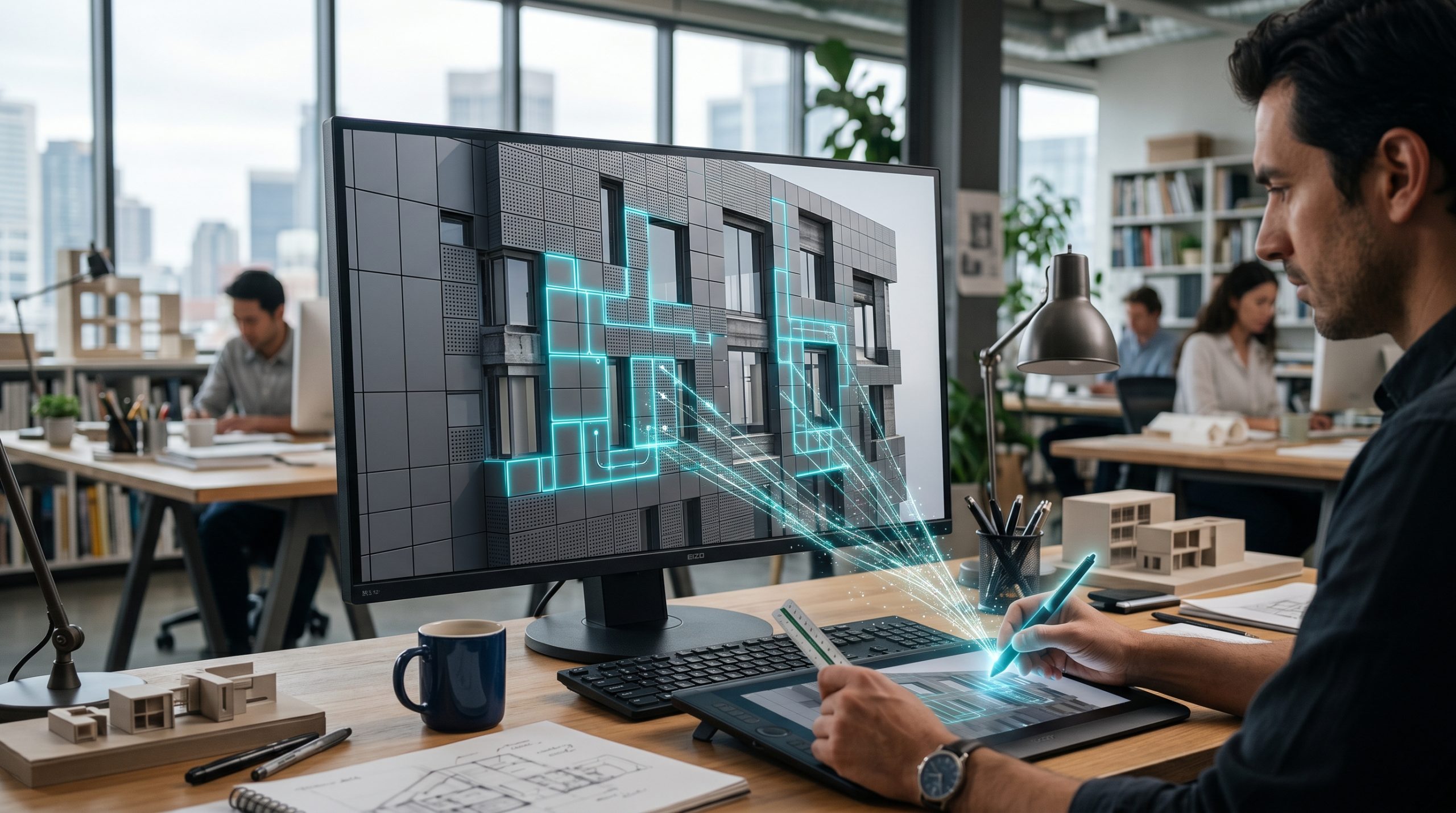
As of 2025-2026, the outer shells of buildings are not just seen as passive barriers or static boundaries between interior and exterior. The facades of the future are highly intelligent, adaptive screens that continuously respond to changing climatic conditions, solar radiation levels, noise pollution, and microclimate specifics. The development of such multidimensional structures requires extraordinary precision in calculations, especially when it comes to such a complex process as facade cassette layout, the optimization of sheet material nesting, and the lifecycle management of manufacturing waste. The implementation of Building Information Modeling technologies in deep combination with artificial intelligence allows for unprecedented modeling accuracy, ensuring real-time collaboration among multidisciplinary teams and the highly efficient execution of the most complex projects. AI technologies allow for the complete automation of the most complex technical stages of design: calculating load-bearing subsystems, fastening nodes, placing insulation layers, and integrating fire safety requirements, thereby turning ephemeral conceptual sketches into mathematically precise, production-ready documentation in a matter of hours.
In addition to technical excellence, the cultural and semantic component comes to the forefront. Architecture by its nature is deeply rooted in culture. Today, there is a departure from the universal, homogeneous aesthetic of “modern glass boxes” in favor of buildings that express regional identity. Facades are turning into narrative canvases that tell stories about place, identity, and context. Architects are increasingly using traditional motifs in modern execution, and it is artificial intelligence that can analyze colossal arrays of visual data from local heritage to integrate these patterns into the complex geometry of modern facade cassettes. This synthesis of environmental urgency, technological innovation, human-centered design, and cultural relevance forms an entirely new philosophy of how we think about buildings: as smart, responsive, and expressive participants in the urban fabric.
2. From Traditional Drafting to the Generative Paradigm
Historically, the design of facade systems was a process that almost entirely relied on the manual labor of engineers, the sequential development of 2D drawings, and the intuition of the lead architect. Traditional methods of facade design, although time-tested, show serious limitations today. They require colossal time expenditures for iterative changes, manual coordination of material specifications, and exhausting resolution of spatial clashes between adjacent engineering disciplines. When it comes to objects with complex nonlinear geometry and parametric double-curvature forms, traditional design inevitably becomes a critical bottleneck. Changing even a single architectural element within the classic approach requires a complete, often manual, recalculation of dimensions, angles, and fastening points for every adjacent facade cassette.
In contrast to this destructive approach, generative design offers a fundamentally new epistemology of creating space. It is an iterative engineering process that uses complex artificial intelligence algorithms and scalable cloud computing to autonomously create tens, hundreds, or even thousands of design alternatives based on clearly defined mathematical and logical parameters. The architect is no longer required to draw every line; instead, they formulate a set of constraints and requirements (e.g., budget limits, maximum insolation, wind resistance, dimensions of standard material sheets), and specialized software independently generates optimized 3D models.
The facade development process in the generative design paradigm is usually structured as a cycle of six key stages that form an integrated workflow between human and machine :
- Generate: This is the initial stage where the algorithmic system creates a large number of design options for cassettes or the overall form, using the logic and parameters specified by the architect.
- Analyze: All structures generated in the previous step are subjected to rigorous measurement to determine how accurately and efficiently they achieve the defined goals.
- Rank: Based on the simulation results, the design options are ordered from most to least efficient.
- Evolve: The system uses the ranking results to determine the direction in which the structures should further develop. At this stage, evolutionary and genetic algorithms are most often applied, “crossbreeding” the best features of the leading models.
- Explore: The curator-architect compares the results, carefully inspecting the generated layouts for aesthetic compliance and initial intentions.
- Integrate: After selecting a favorite, the designer integrates this option into the overall project information model for further detailing.
This technology autonomously develops variations and allows engineers to make informed decisions at much earlier stages. To better understand the scale and depth of structural changes in the industry, it is appropriate to consider a comprehensive comparison of design methods, presented in Table 1.
| Key Characteristic | Traditional Facade Design | AI-Based Facade Design |
| Development Duration | Requires 6 to 36 months for complex projects. The process is burdened by manual revisions. | Compression of workflows to under 2 weeks, aiming to achieve a full calculation cycle in 24 hours. |
| Material Nesting Optimization | Layout is done manually, which often leads to a significant amount of unproductive scrap. | 2D nesting algorithms and metaheuristics are applied to maximize sheet utilization, reducing waste by up to 11%. |
| Flexibility and Adaptability | Changes are extremely expensive. Local adjustments require manual redrawing of nodes. | Instant adaptation of the entire topology and updating of specifications upon changing a single parameter is ensured. |
| Clash Detection | Clashes are discovered at late stages or directly on the construction site. | High-precision models are generated with a built-in validation system that algorithmically prevents spatial errors. |
| Cost Efficiency | High financial costs to pay for the working hours of a team of drafters and constant reworks. | Radical cost reduction due to the automation of routine tasks and the absence of the human factor in volume calculations. |
| Concept Visualization | Difficulty in promptly preparing realistic images for the client. | Instant generation of photorealistic renders using neural networks in seconds. |
Traditional workflows often rely on flat tools that are not adapted to integrate geometric evaluation and material minimization strategies. Today, artificial intelligence completely eliminates this obstacle.

3. The Mathematics of Aesthetics: The Neural Network Stack in Facade Design
The ability of modern computer systems to fully “draw” optimized cassette layouts lies in the application of a complex stack of machine learning algorithms, deep learning, and advanced mathematical optimization methods.
Convolutional Neural Networks and Deep Semantic Segmentation
For an algorithm to create new forms, it must learn to flawlessly understand and classify existing architectural context. This is exactly what Convolutional Neural Networks (CNN) are used for. With the spread of computer vision technologies, architectures like U-Net and Mask R-CNN have become absolutely fundamental tools for the semantic segmentation of architectural images.
The U-Net network has a specific symmetrical encoder-decoder structure. It uses skip connections that allow it to preserve and restore the finest spatial details on facade images. The Mask R-CNN algorithm goes even further—it generates pixel-wise masks for each individually detected object. This allows the machine to flawlessly identify window openings, doors, load-bearing panels, balconies, and decorative elements on existing building arrays.
In addition to segmentation, these algorithms work effectively in design recommendation systems. Feature vectors are fed into a neural network trained on hundreds of thousands of photographs of buildings from different eras. The network analyzes visual patterns and matches them with style labels (e.g., modernism or art deco), providing preliminary estimates of the stylistic authenticity of the generated object.
Generative Adversarial Networks and Variational Autoencoders
As soon as AI understands “what a facade is made of,” it moves to the phase of autonomous creativity. Generative Adversarial Networks (GAN) have caused a real revolution in the synthesis of architectural forms. In the context of envelope design, these models are used to create innovative cassette layout patterns, complex sun shading screens, and the volumetric geometry of buildings. The mechanism relies on a competitive game between two networks: a generator continuously creates new layout samples, while a discriminator studies a database of real facades and tries to distinguish the generator’s “drawing” from a real engineering blueprint. Thanks to millions of iterations of this competition, the generator learns to create cassette layouts that look entirely realistic.
However, generative networks have a drawback: they can create structures that are impossible from the perspective of physics or building codes. To solve this problem, researchers combine them with Variational Autoencoders (VAE). This algorithm expands the design search space: the model trains on a dataset of realistic data to learn a continuous latent space $z$ that captures all the variability of facade architecture. When the algorithm samples from this space ($z \sim p(z)$) to generate a new facade, rigid viability bounds are applied. For example, the algorithm clamps the glazing ratio or material dimensions within allowable limits. This means the machine will never propose a cassette whose area exceeds the size of a standard factory metal sheet.
Generation Stack: Architecture from Plan to Facade
An important concept in the application of neural networks is the use of a “generation stack,” where several deployments of models work sequentially. Building development is divided into three interconnected steps: generation of the building footprint volume; distribution of internal functionality; and generation of facade and spatial solutions. A separate model is applied at each step. Nesting these models within one another allows the algorithm to independently solve complex design tasks, while leaving room for the architect’s manual intervention between generation stages.
4. Facade Cassette Layout Optimization and Nesting
While image generation is responsible for the conceptual form, the mathematical optimization of nesting and panelization is the most crucial tool for translating a sketch into reality. Today, Aluminum Composite Materials (ACM) and thin sheet metal are the most popular cladding systems. They are lightweight, corrosion-resistant, and durable. However, the production of such cassettes requires an extremely careful approach to waste minimization.
Traditional approaches to facade layouts often relied on rigid rules or simply transferring a regular grid onto a plane. However, in modern architecture, where buildings abound in angled walls, slanted planes, and nonlinear openings, such a straightforward method leads to the inefficient use of material.
The Optimal Cutting Stock Problem
The nesting of facade cassette cutouts from a flat sheet of material is a classic and at the same time highly complex problem of combinatorial optimization, known in mathematics as the 2D bin packing problem. The main goal of algorithms in this process is to find the best spatial arrangement of the contours of the cut panels on raw material sheets of a given size, taking into account the shape, area, and total number of required parts. The task is to maximize the usable area and minimize scrap.
To find a solution, facade engineers use several computational approaches:
- Enumerative Algorithms: Programs systematically calculate and evaluate absolutely every possible combination of unfolding and placing a cassette. However, for modern skyscrapers, where the number of unique panels can reach tens of thousands, the computational time for a full search becomes unacceptably large.
- Metaheuristic Algorithms: For large-scale and geometrically complex projects, metaheuristic methods have become the standard. They use intelligent directed search strategies (such as genetic algorithms or swarm intelligence) to rapidly find solutions that are extremely close to perfect.
Algorithmic Panel Layout Complex
One of the most powerful developments in this area is an evolutionary algorithm specifically designed to achieve a perfect balance between strict adherence to manufacturing constraints and the ambitious goal of total waste minimization. The algorithm initiates work by simultaneously generating many potential solutions within a defined space. The peculiarity of the approach is that it perceives structural building rules not as rigid laws, but as flexible constraints. The algorithm allows itself to experiment with the panel’s shape, making micro-corrections to the joint geometry at the post-processing stage. Tests show that such an approach outperforms all existing manual and basic software developments by industry experts.
Synergy of Nesting and Design for Assembly: 11% Waste Reduction
Combined with the general concept of Design for Manufacture and Assembly (DfMA), advanced nesting algorithms work real miracles for sustainable development. Systems consider the holistic implementation of intelligent models for industrialized production. Proper application of these mathematical models in facade engineering allows efficiently unfolding each panel, optimally nesting its contour within the raw material dimensions, and reducing manufacturing waste by a fantastic 11%.
To ensure that optimized panelization strategies do not restrict the architect’s conceptual exploration, systems use Hamming Distance algorithms. They evaluate the similarity between different segments of the generated facade. This makes it possible to identify recurring patterns and standardize production as much as possible, reducing thousands of unique forms to a few dozen typical cassettes that are simply mounted at different angles.
5. Reinforcement Learning in Adaptive Facade Design
If we consider the cutting edge of artificial intelligence development, deep reinforcement learning models open up entirely new horizons for creating next-generation facades—kinetic ones. At the core of this paradigm lies the idea of an AI “agent” that constantly interacts with a simulated environment. Depending on its actions, the agent receives a reward or a penalty, through which it autonomously develops the most optimal behavioral strategy by trial and error.
Spatial and Facade Layout
The application of reinforcement learning algorithms to form plans and facade contours is a complex combinatorial optimization problem. The architect defines a design scenario, specifying geometric properties (number of windows or panels, their area, desired aspect ratio) and topological goals.
The agent is trained using Proximal Policy Optimization algorithms. In a dynamic planning format, the process begins with a chaotic, randomly generated set of walls and facade elements. The agent iteratively moves virtual partitions, adjusting the areas of cassettes and windows until all strict constraints are fully satisfied. Deeper research uses this approach for facade parsing, formulating the problem as a Markov Decision Process. The algorithm lightning-fast classifies and divides the facade mass into logical objects (balconies, blank cassettes, doors), strictly adhering to the rules of architectural symmetry.
In the realm of direct manufacturing, hybrid reinforcement learning approaches are used to solve the problem of placing elements on a sheet of material, achieving packing efficiency results on par with top-tier experts.
Kinetic Facade Optimization
Kinetic facades are dynamic building systems equipped with moving elements (louvers, diaphragm panels) that actively change their position to adapt to the external environment.
Previously, the development of such facades faced significant limitations due to an enormous number of variables (wind speed, sun angle at different times of the year, temperature). Modern research proposes a new design methodology based on integrating reinforcement learning directly into visual scripting environments. The agent is tested under various scenario conditions. The algorithms of movement and layout of kinetic cassettes generated by such AI demonstrate unprecedented efficiency in blocking direct radiation heating and solar glare. Using these tools, engineers can simulate millions of days of facade operation even before laying the foundation, finding the perfect rhythm for cassette movement.
6. Software Ecosystem: Tools for Architects
The successful realization of the theoretical potential of algorithms would be impossible without their integration into software products for the Architecture, Engineering, and Construction (AEC) industry. A powerful technological landscape of tools has formed that completely covers the facade’s life cycle. About 46% of architectural firms are already actively using these technologies.
Let’s look at the most influential platforms:
- Rhino 3D + Grasshopper: Considered the absolute industry standard in parametric architecture. The tool provides limitless flexibility for visual scripting. Engineers use it to model highly complex double-curvature facade surfaces. The ecosystem of add-ons (Ladybug Tools, Karamba3D) allows for real-time environmental and structural analysis.
- Autodesk Forma: A powerful cloud platform focused on conceptual design. It uses predictive analytics to analyze sun hours, wind corridors, and microclimate.
- Autodesk Revit: As a flagship solution for building information modeling, it now contains an integrated generative design module. It provides automated testing of developed alternatives. A similar approach is demonstrated by the Allplan 2025 system.
- Dextall Studio: An outstanding example of a specialized approach to facade design and cassette manufacturing. The platform’s algorithms take over the automation of the most cumbersome technical nodes: calculating multi-layer panel structures, fasteners, and insulation layers. The creation of facade system models for skyscrapers is now completed in 2 weeks with an ambition to compress it to 24 hours.
- Civils.ai and Estimators: A separate revolution is the automation of quantity takeoffs. Platforms apply computer vision to instantly recognize flat drawings. They recognize and calculate the areas of various types of cladding, separate glazing areas into vision and spandrel zones, providing accurate estimates in a matter of minutes.
- AI for Visualization: Platforms like Visoid or Rendair AI allow completing the calculation of a photorealistic image in seconds without the need to purchase ultra-powerful hardware.
7. Seamless Integration with Manufacturing
Conceptual development of cassette layouts makes no sense if it cannot be physically realized within given financial limits. Artificial intelligence eliminates the gap between architecture and manufacturing. High-precision information models and algorithms integrate manufacturing tolerances and milling machine parameters into the model body from the very beginning. Through direct digital-file-to-machine transfer systems, optimized nesting layouts go directly to the control system at the factory.
Laser scanning and computer vision technologies are applied for quality control. These systems scan the manufactured metal facade cassette on the production line and compare its physical dimensions with the reference model. This guarantees that every part meets strict tolerances, which is absolutely critical for the trouble-free assembly of facade puzzles on the construction site.
8. Energy Efficiency, Sustainability, and Biomimicry
The architectural landscape of tomorrow is driven by the desire to achieve Sustainable Development Goals. Buildings must adapt to climate change and radically reduce energy consumption. In this context, AI acts as a tool for multi-objective optimization.
Using continuous sorting genetic algorithms, architects find the optimal balance between conflicting criteria. For example, the algorithm simultaneously tries to achieve maximum natural lighting, reduce metal scrap during nesting, and optimize the thermal insulation properties of the envelope. The optimization of window masks and screen layouts on the facade can increase a building’s daylighting efficiency by 30%.
Overlaying bionic concepts opens up unprecedented ways to optimize facade mass. Neural networks analyze hierarchical structures created by nature and apply their mathematical logic to cassette topology, creating adaptive facades with minimum weight.
9. The Future of Facade Design: Agentic AI and Multimodal Models
The biggest shift in the coming years is considered to be the emergence of agentic artificial intelligence. If early systems were tools for responding to a single user prompt, agentic programs are capable of autonomously executing and moderating multi-step workflows. An architect will set a top-level task (e.g., “design a western facade structure with a budget limit of $5 million”), after which the system will independently launch a chain of neural networks: generate topology, analyze loads, optimize nesting, and issue a finished project with financial indicators.
Another vector is the integration of natural language processing technologies. Text-to-image tools are already capable of generating facade sketches based on textual descriptions. In parallel, dynamic video generation technologies will permanently change the design presentation format. Instead of static drawings, architects will be able to make real-time adjustments to facade parameters, instantly observing how changing the size of a cassette affects the overall look of the building.
10. Conclusion
An analysis of a wide range of technologies demonstrates that the implementation of artificial intelligence in facade design and cassette layout processes is a fundamental change in the architectural paradigm, erasing the boundaries between aesthetic vision and strict engineering efficiency.
The application of deep learning algorithms allows solving unprecedentedly complex computational tasks. Metaheuristic algorithms in synergy with 2D nesting tools demonstrate the ability to radically reduce material costs. Reducing the production scrap of expensive aluminum composite materials by 11% is the industry’s direct response to the challenges of climate change. The integration of cloud platforms compresses the timeframes from concept development to document release from several months to a matter of weeks.
By taking on the burden of solving multi-criteria dilemmas and generating thousands of options, algorithms free up the creative resources of specialists. Artificial intelligence allows focusing on the key aspect: creating deep, narrative facades that reflect regional identity and enrich the human urban experience. Those engineers and architectural studios who master the management of this intelligent computational stack today will undoubtedly shape the look of the cities of the future.
Related articles
Facade Finishing Passport in Kyiv and Major Cities: A Step-by-Step Guide to Obtaining Permits in 2026
A Step-by-Step Guide to Obtaining a Facade Finish Passport in Kyiv (2026): Approvals, Design Code, Signage, DBN Standards, and Materials.
Analysis of the cost and technological features of the installation of modern metal facades in the regions of Ukraine: Kyiv, Lviv, Dnipro
Cost analysis and installation of modern metal facades (cassettes, rack, blinds) in Ukraine (Kyiv, Lviv, Dnipro). Tech features & prices.
Planned preventive maintenance of metal ventilated facades of commercial facilities: methodology, regulations, and technologies
How to extend a metal facade's lifespan to 50 years? Effective strategies for preventive maintenance, diagnostics, and modern cleaning technologies.