
The interaction of the human eye with spatial forms is an exceptionally complex cognitive and physiological process, in which the baseline plays the role of a fundamental tool for guiding perception. The outer shell of any structure never performs an exclusively utilitarian function of a physical barrier separating a controlled internal climate from an aggressive environment. On the contrary, the facade forms a continuous visual and aesthetic dialogue with the landscape, setting the tone for the entire architectural ensemble. The choice of orientation for the exterior cladding — specifically, facade panels — is a strategic engineering and design decision that goes far beyond purely decorative or personal stylistic preferences. This critical choice directly dictates how wide, high, proportionally balanced, or conversely — monumental and heavy a structure will appear from the perspective of an average observer from the street.
Centuries of architectural practice and modern research convincingly demonstrate that structures absolutely identical in their physical dimensions, area, and volume can be perceived by the human brain in radically different ways depending on how exactly the elements of their exterior covering are arranged. A certain cladding layout that perfectly suits one building and reveals its potential can make another structure look visually stretched, excessively low-slung, or visually disconnected into disproportionate fragments. At the same time, the engineering and technical dimension of this issue encompasses a vast spectrum of challenges: from climatic adaptation to local weather conditions, calculating resistance to wind loads and managing moisture, to optimizing frame erection processes and subsequent maintenance. A comprehensive and deep analysis of all these factors allows us to understand that the direction of cladding lines is not just a styling option, but a powerful, scientifically grounded tool for modifying how the geometry of the building is perceived. This tool requires designers to have a profound understanding of both the laws of geometrical optics and the fundamental principles of building physics, thermodynamics, and materials science.
This study examines the full spectrum of the influence of line direction on the properties of an architectural object, ranging from the neurobiological characteristics of vision to the microbiological processes occurring inside wall structures.
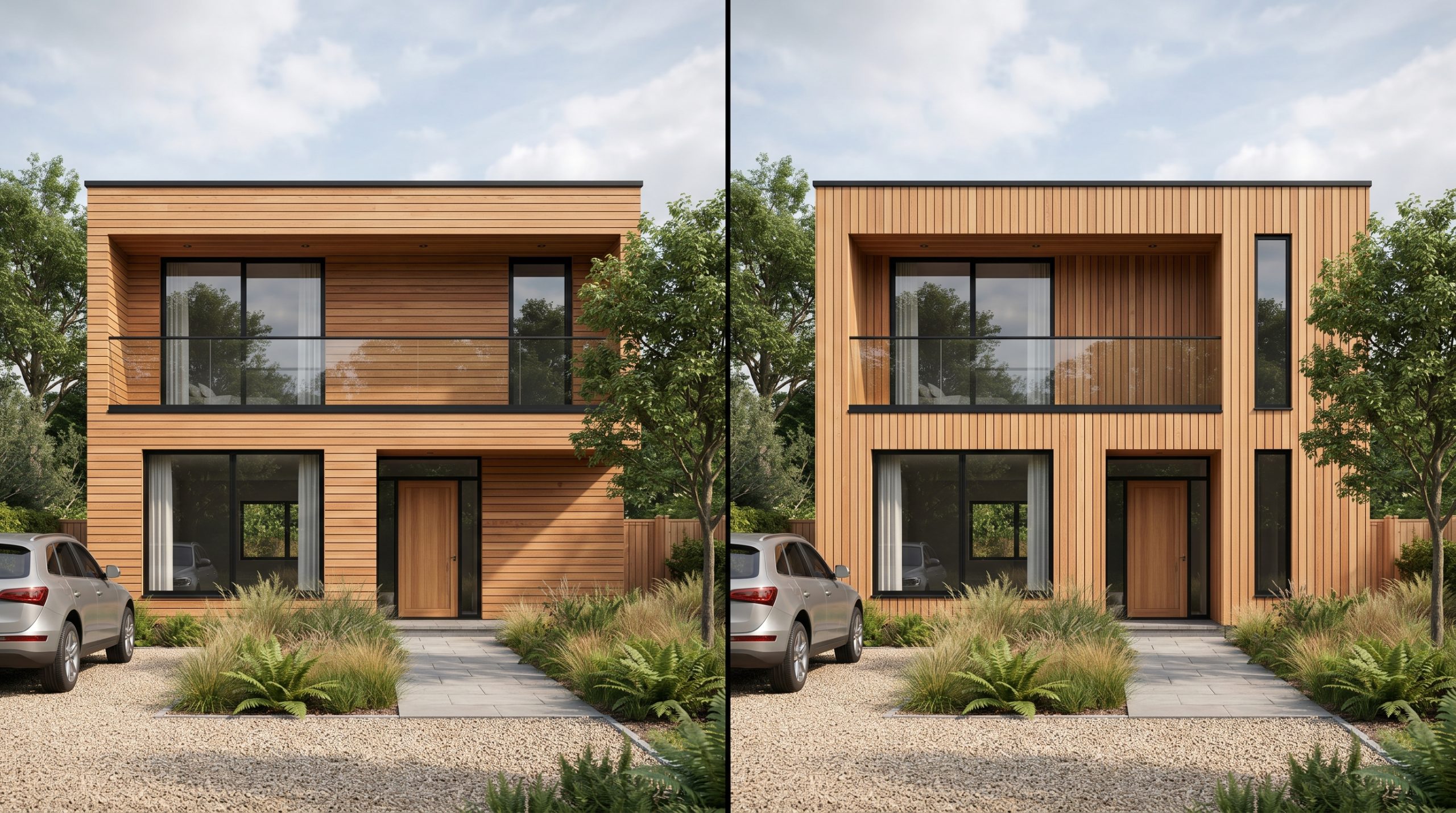
The Evolution of Visual Perception: From Antiquity to Modern Neurophysiology
Human perception of space and volume is never an absolutely objective or mathematically precise mirror reflection of reality. The human brain interprets visual signals through a complex prism of evolutionary mechanisms that constantly strive to find patterns, identify boundaries, estimate scale, and determine aspect ratios. The application of deliberate optical adjustments and illusions in monumental architecture has a millennial history, which proves humanity’s long-standing awareness of the discrepancy between physical form and its perceptual image.
The most classic and textbook example of such an approach is the Parthenon in Athens. Research shows that the prominent ancient architects Iktinos and Kallikrates applied a sophisticated method of so-called “counter-perspective.” This concept, which was later described in detail and systematized by the outstanding Roman engineer and architect Vitruvius as early as the first century BC, consisted of the intentional curvature of straight lines. The purpose of such mathematically calculated deformations was to negate and eliminate unpleasant optical phenomena and distortions naturally inherent in the post-and-beam architectural system with its long horizontal and vertical guides.
Due to a slight thickening of the columns in their middle part (entasis), a gentle inward tilt, and the curvature of the stylobate, ancient builders were able to achieve a look that makes the building appear perfectly straight and harmonious to the naked eye. Modern observers and specialists in architectural history also suggest that the goal of Iktinos and Kallikrates was not only to correct optical errors of the eye, but also a desire to “animate” the building, to breathe a more natural, organic life into the cold stone, making the massive structure breathe. This stands as fundamental proof that the stability of the physical form itself does not mean the stability of its perception by the observer.
This ancient principle is directly relevant to the modern choice of cladding direction. Any contemporary facade covered with rhythmic lines is an heir to this tradition of manipulating the human eye. The way light and shadow fall on the joints between panels creates its own micro-perspective, which is capable of visually deconstructing or enhancing the volume of the building.

Optical Illusions as a Design Tool: The Helmholtz Paradox
The deepest analytical and scientific interest in the context of the influence of stripes and lines on the perception of proportions is represented by the famous Helmholtz square illusion. In 1867, the prominent German physicist and physiologist Hermann von Helmholtz, while investigating the optics of the human eye, discovered an absolutely counterintuitive phenomenon that shattered many contemporary stereotypes regarding the perception of form.
The essence of Helmholtz’s classic experiment lies in comparing two geometrically identical squares, the space of which is filled with parallel lines (usually seven evenly distributed lines). In one square, the lines are arranged strictly horizontally, and in the other — strictly vertically. Logic based on everyday experience and established architectural and design rules suggests that horizontal lines should widen an object, making it visually lower and broader. However, Helmholtz convincingly proved the opposite: a square filled with horizontal lines appears taller and narrower to the observer than it actually is. Conversely, a square whose space is filled with vertical straight lines visually appears wider and lower compared to the square with horizontal guides. Studies have shown that so-called “illusory stripes” are capable of producing this effect reliably and consistently across the absolute majority of respondents.
From Theory to Three-Dimensional Forms and Modern Experiments
This scientific fact enters into a direct and irreconcilable contradiction with generally accepted rules of design, fashion, and architecture. Reporting on this illusion, Hermann von Helmholtz noted that such phenomena, where a filled space appears larger than an unfilled one, are extremely common in everyday life. He added an interesting observation from contemporary fashion: women’s dresses with horizontal stripes make the figure look visually taller, not wider, as is commonly believed. Since this statement runs counter to modern popular beliefs that horizontal stripes “make you look fat,” scientists have conducted numerous tests of this phenomenon over decades.
To test the effect of the Helmholtz illusion on three-dimensional objects, which more accurately replicate building columns or facades, researchers measured the perception of width of real 3D cylinders covered with horizontal or vertical lines, as well as a uniform grey color. In the experiment, participants had to compare the visible width of a series of cylinders (with real diameters ranging from 2 to 12 centimeters) with the distance between two vertical lines on a computer screen. The results were astonishing: the Helmholtz illusion persisted in three-dimensional space as well. Cylinders with horizontal stripes appeared 6% narrower than cylinders with vertical stripes, a value comparable to the effect observed on flat two-dimensional images.
This empirical result contradicts the expectations of other researchers (for example, Taya & Miura in 2007), who assumed that vertical lines on a 3D cylinder would provide more clues about the object’s depth, and therefore should have a narrowing effect. Instead, other scientists (Li & Zaidi, 2000) proved that patterns containing contours lying along the lines of maximum surface curvature are critically important for conveying correct form. This means that depth in a vertically oriented cylindrical or 3D body is best revealed and emphasized precisely by horizontal, rather than vertical lines.
Furthermore, the application of this concept was explored within the context of self-discrepancy theory, proposed by Higgins in 1987. In a mixed-methodological study involving nearly a hundred women, who were shown computer avatars in dresses with different stripe orientations, it was studied how the application of the Helmholtz optical illusion helps bridge the visual perception of the actual “self” and the ideal “self,” camouflaging the size and shape of the object. Experiments confirmed that the slimming and elongating effect of horizontal stripes cannot be explained by a difference in brightness or illumination (luminance), since all stimuli had identical brightness regardless of the orientation of the stripes.
The Architectural Paradox: Why Do Facades Work Differently?
How then can we explain the deeply rooted architectural dogma asserting that in real construction, it is vertical cladding that makes a building taller and slimmer, while horizontal cladding makes it wider and lower-slung? At first glance, this seems to be a complete negation of the scientifically proven Helmholtz illusion.
The answer to this paradox lies in scale, context, and the presence of the horizon line. The Helmholtz illusion works flawlessly for isolated, relatively small objects (squares on paper, silhouettes of figures, cylinders) that the human eye can take in with a single glance. However, an architectural facade operates under radically different laws of perception due to its colossal area and rigid connection to the ground and the surrounding landscape.
When we look at a building with horizontal facade panels, these lines create long, continuous vectors. The observer’s eye reflexively follows these guides, scanning from left to right along the entire length of the structure. This continuous lateral movement of the eyeball physically and psychologically “stretches” the perception of the object. In addition, horizontal lines visually merge with the natural horizon line, the street, and the foundation, making the building appear to be an integral part of the landscape on which it is spread.
On the other hand, when an architect applies vertical panels, they act as kind of arresting markers for the horizontal glide of the gaze. The eye is forced to interrupt its movement along the horizon and begin moving from the bottom up, from the base of the foundation (or plinth) to the cornice or roofline. It is this change in gaze kinetics — the forced upward movement — that creates the persistent impression that the building is reaching for the sky, visually adding height and monumentality to it. Thus, architectural space synthesizes the physiological illusions of vision with the macro-scale kinetics of human gaze movement, giving rise to the “architectural stripe” rule, which differs from Helmholtz’s laboratory conditions.
Kinetic Architecture and Manipulation of Space Through Line
Understanding how lines can distort the perception of a plane is not limited merely to changing the proportions of height and width. Cladding direction can be used to create the illusion of movement, curvature of space, or the visual dematerialization of weight.
The Café Wall Illusion and Contrast Polarity
One of the most interesting phenomena is the geometrical-optical “café wall illusion.” In this illusion, parallel straight dividing lines running between shifted rows composed of contrasting dark and light rectangles (or squares) appear tilted, diagonal, or wavy to the observer, even though they are actually perfectly parallel to each other.
This optical phenomenon has an interesting history of discovery and rediscovery. A similar version of the illusion was first described by Hugo Münsterberg as early as 1894, and subsequently detailed by A. H. Pierce in 1898 under the name “kindergarten illusion.” The effect received its modern name only in 1973 thanks to researcher Richard Gregory. As Gregory noted, this effect was accidentally noticed by a member of his laboratory, Steve Simpson, while looking at ceramic tiles on the wall of an ordinary café at the foot of St. Michael’s Hill in the city of Bristol.
To construct this illusion on a facade, a technique is often used where each contrasting “brick” or panel is surrounded by a layer of “mortar” or a joint whose color is intermediate between the dark and light shades of the main elements. Researchers attempted to deconstruct this effect, explaining it through the irradiation illusion (an optical phenomenon where a light zone appears larger than a black zone of the same physical size). Indeed, if the black and white elements are replaced with different colors but with the same level of brightness, the illusion disappears. However, even after excluding all retinal and optical components of the eye, the core component of the illusion remains. Scientists concluded that contrasting polarities are the determining factor dictating the direction of the perceived tilt of the lines. Architecture inspired by this illusion is actively used worldwide, particularly in projects in the Melbourne Docklands, where buildings appear curved simply due to the correct alternating of lines.
The Energy of “Kinetic Swaying” and Curved Facades
When the principles of line-based optical illusions or similar principles of kinetic art are applied on the scale of an entire building, an amazing effect occurs: the static reinforced concrete facade appears to be in a state of rhythmic, continuous movement. Researchers note that when the eye moves along these composite geometric forms, the discrepancy between the dark and light areas creates the impression that the horizontal rows are swaying or tilting.
Architects often enhance this effect by adding curved lines or circles to the strict vertical and horizontal guides, intersecting with the straight extensions. Thanks to this, a visual clue arises, as if the distance between the parallel lines expands as they move away from the center of the composition. This technique creates a colossal kinetic energy — so-called “kinetic swaying.” It is capable of turning a massive, absolutely immobile administrative or office building into an object pulsating in a state of constant rhythmic movement. A striking example of this approach is the facade of the Customs House building at Melbourne Airport.
World architectural practice knows many other examples of line manipulation for the deconstruction of space:
- The Kiral building in the Colonia Juárez district of Mexico City, designed by the Mexican studio Agence Arquitectura in collaboration with Movimiento Workshop. The facade of this small building is inspired by the trends of kinetic art and op-art. It consists entirely of vertical and horizontal lines forming three-dimensional waves. These waves aggressively disrupt the habitual, linear progression of perceiving a vertical plane, making the building look like a mirage.
- The mirror installation “Bâtiment” (Building) by artist Leandro Erlich in Paris. A huge facade with strict lines is constructed on the floor, while a giant mirror is installed nearby at an angle, giving observers an uncanny illusion of weightlessness during “walks” along the walls.
- The use of forced perspective and ambivalent vanishing points. By wrapping horizontal lines around the sharp corners of a building or changing the cut angle on the ground floor, architects force the eye to become confused in perceiving edges, creating the impression that the building is falling over or has an impossible shape.
All these examples prove that the line is a highly powerful tool in a designer’s arsenal for subordinating geometric perception.
Horizontal Cladding: Tradition, Stability, and Space Expansion
Moving from abstract illusions to practical construction, it is important to analyze the horizontal direction of lines, which is an absolute and unconditional dominant standard in the global, and particularly American and European, residential sector. This orientation is deeply rooted in traditional vernacular architecture, as it naturally replicates the structure of primitive timber log work made of massive logs.
Visual Effect: Psychological “Grounding”
Horizontal cladding extends parallel to the ground from one edge of the building to the other. Psychologically, such lines visually “ground” the structure, helping the exterior feel exceptionally reliable, stable, and steadfast. This effect is often called the “stripe principle”: just as the direction of stripes on clothing can visually alter a person’s figure, the orientation of cladding is capable of radically modifying the geometry of a building.
Horizontal cladding is endowed with the unique ability to counteract excessive, disproportionate height, making the facade appear visually wider, flatter, and more spacious. This is precisely why such a line direction is especially useful and strategically advantageous for smaller structures or houses with a small footprint. The application of horizontal lines optically “stretches” the building along the horizon, forcing the observer to perceive it as much larger, more solid, and voluminous than its actual metric metrics indicate.
From the perspective of architectural style and design, this approach is inextricably associated with a sense of classic comfort, domestic warmth, and timeless elegance. This style is considered to have stood the test of time and is a “safe” design choice that never goes out of fashion. It is ideal for colonial-era architectural styles, Cape Cod houses, traditional two-story cottages, sprawling ranch-style structures, classic farmhouses, and any buildings characterized by a symmetrical and balanced arrangement of window openings and doors. Horizontal lines blend very naturally and organically into rural, pastoral landscapes and historic preservation areas, emphasizing continuity and respect for tradition. They create a clean, easily recognizable, and familiar exterior that satisfies the needs of clients who want their home to look settled, calm, and stable, rather than dramatically tall or avant-garde. The availability of a huge number of options on the market, such as tongue-and-groove boards or classic lap siding, makes this direction highly versatile.
Engineering of Horizontal Systems: Frame, Installation, and Vulnerabilities
The technical and economic attractiveness of the horizontal direction is largely due to the engineering simplicity of its integration with the base structure of most modern buildings. The physical foundation of a frame or even masonry house prepared for a ventilated facade usually consists of vertical load-bearing elements.
Installation Mechanics and Cost-Efficiency
The classic load-bearing wall frame is formed by vertical studs. Since facade panels are mounted horizontally, they run perpendicular to these vertical studs (or perpendicular to solid structural OSB sheathing). This creates ideal conditions for installation: builders do not need to create complex transitional systems. Horizontal cladding is fastened directly to these vertical supports.
The fastening process is as direct and logical as possible: installers nail or screw each panel directly into these structural studs at regular, well-defined intervals. Depending on building codes and the frame spacing of a specific house, this interval is every 40 or 60 centimeters. This approach offers colossal advantages from a project management perspective:
- Execution Speed: Installing a horizontal facade is generally simpler and much faster, since it follows the natural line of the house and does not require the installation of additional furring strips (battens) to ensure a flat fastening plane.
- Cost Optimization: The lack of need for additional sub-structures translates to a significant reduction in execution time, a radical decrease in manual labor, and substantial minimization of material waste. This makes horizontal installation the most financially effective option for mass residential construction.
- Personnel Qualification: The absolute majority of contractors and construction crews have rich experience working specifically with this method, which minimizes the risk of technological errors during execution.
- Maintainability: Further routine maintenance of the facade is often simpler due to the ability to relatively quickly replace individual damaged boards in a row.
Climatic Risks: Interaction with Moisture and Microbiology
Despite all its advantages, the horizontal direction conceals serious engineering challenges in the area of moisture management. Building physics dictates that when atmospheric precipitation collides with a structure’s surface, horizontal joints become obstacles to the gravitational runoff of droplets. Although traditional installation systems provide for the upper panel overlapping the lower one (lap cladding) to effectively divert water away from the internal layers of the facade, this protection is not absolute.
In the absence of perfect installation, or as a result of thermal contraction of materials over time, water can get trapped and accumulate in horizontal joints. This risk increases exponentially in regions with frequent gale-force winds that create a wind-driven rain effect. Wind pressure is capable of driving water upward, directly beneath the overlap of horizontal boards.
Water penetration or even regular moisture accumulation due to capillary suction in the joints triggers a chain reaction of degradation. Moisture creates an ideal environment for the development of various microorganisms, particularly bacteria and fungi. If water is retained near the inner surface of the wall or the back surface of the plywood, provided there is insufficient ventilation, favorable conditions are formed for the life activity of aerobic bacteria, and in cases of complete absence of oxygen in the crevices — anaerobic bacteria as well. Saprogenous bacteria (decay bacteria) pose a particular danger to natural wood facades, as they begin to actively break down cellulose, leading to the structural collapse of the wood. This is precisely why a horizontal cladding system is potentially more susceptible to water retention, rot, and fungal attack.
To preventatively avoid these problems, horizontal facades require the use of high-quality insulation membranes, perfectly precise installation technologies for protective metal flashings, and regular maintenance of joints. Moreover, microscopic horizontal protrusions between panels act as natural shelves for collecting street dust, dirt, and pollen, which requires more frequent and thorough washing of facades compared to other systems.
The Vertical Dominant: Elongation, Modernity, and Architectural Accent
In contrast to the sober, predictable stability of the horizontal, the vertical orientation of facade panels is a powerful tool for architectural expression and creating strong visual accents. In this case, the panels extend from the base of the wall (foundation) swiftly upward to the cornice or roofline. This vector radically changes how the human eye reads the overall shape of the house.
Form Dynamics and Visual Elongation
The application of vertical lines is a purposeful and conscious architectural step toward creating an illusion of height and slimness. Vertical guides act as natural channels for the observer’s gaze, forcing the eye to glide continuously upward. In accordance with the “stripe principle” in facade design, this optical effect makes certain parts of a building, or the structure as a whole, look significantly taller, more proportionally defined, and slender.
This design solution is extremely effective and valuable in two polar scenarios:
- For small single-story buildings: Adding extra upward-striving lines substantially enhances the visual perception of facade height, compensating for its physical low-slung nature and adding prestige and weight to the building in the urban landscape.
- For colossal, massive structures: When working with large commercial complexes or expansive residences with a vast footprint, the application of vertical cladding becomes the only way to overcome visual overload. It helps balance and subdue the massiveness of volumes, break planes into elegant segments, and reduce the overall effect of visual bulkiness, making the structure easier to perceive.
From an aesthetic and stylistic standpoint, a vertical direction creates an exceptionally clean, bold, uncompromising, and deeply modern look. This technique is increasingly a hallmark of minimalist projects, contemporary architecture, as well as designs that reinterpret tradition (such as rustic modern or Scandinavian barnhouse aesthetics). The use of vertical systems (for example, classic board-and-batten siding with wood or composite battens) forms deep, contrasting vertical shadows on the facade. These shadows change dynamically throughout the day depending on the angle of sunlight, creating a rich texture and crisp articulation for each wall.
Vertical finishing often acts as a bold, even radical alternative to traditional horizontal layouts. Due to its capacity for making striking design statements, it was historically more common in commercial non-residential architecture, but is now experiencing a true renaissance in the private sector, especially for highlighting and emphasizing the unique architectural features of luxury homes. Vertical lines create a unique charm that harmoniously echoes tree trunks, allowing buildings with such cladding to blend incredibly naturally into forested landscapes.
Physics of the Vertical Facade: Hydrodynamics and Multi-Level Subsystems
Despite its undeniable aesthetic appeal and dynamism, a vertical cladding direction poses significantly more complex structural and installation challenges for designers and structural engineers compared to its horizontal counterpart.
Anatomy of Installation: The Need for an Additional Frame
The main technical obstacle lies in the basic geometry of frame construction. Since the main load-bearing studs of a wall frame are arranged strictly vertically, fastening vertical facade panels directly to them is physically impossible from a reliability standpoint: the facade boards and frame studs would run parallel to each other. Consequently, the panels would not have a sufficient number of points for rigid fixation, rendering the construction unstable and vulnerable to deformation.
To solve this geometric problem, installing a vertical system unconditionally requires creating an integrated auxiliary structure. This means the mandatory installation of horizontal blocking between load-bearing studs, or mounting an additional layer of horizontal furring strips (battens) over the rough wall. Only in the presence of such perpendicular support surfaces do installers gain the ability to securely nail each vertical board along the entire plane of the facade.
Often, technology requires creating an even more complex, multi-level system — a so-called counter-batten system. Creating such a complex foundation has several serious implications for the project:
- Colossal Labor Intensity: The process becomes objectively much more complicated, slower, and requires jewelry-precise engineering calculations. Installing vertical boards, especially when dealing with long panels spanning multiple floors, is a technically difficult undertaking.
- Increased Material Volume and Waste: Unlike a horizontal layout, vertical geometry often requires executing a significantly larger number of precise material cuts, particularly when fitting panels to roof angles, gables, and non-standard shaped window and door openings. Adding hundreds of linear meters of lumber for the battens substantially increases the total mass of raw materials used.
- High Cost: Due to increased time expenditure, the involvement of highly qualified craftsmen, the need to purchase additional support materials, and a higher percentage of technical offcuts, installing a vertical facade costs the client significantly more compared to the horizontal standard.
Hydrodynamic Advantage and Envelope Thermodynamics
However, the additional expenses for installing a vertical system are fully offset by its fantastic performance in the area of building physics, particularly in moisture management and wall thermodynamics.
The orientation of vertical cladding perfectly aligns with the natural vector of gravity and the trajectory of falling raindrops. Thanks to this alignment, water hitting the facade utilizes the joints between panels themselves as natural hydrodynamic channels, draining down to the plinth unimpeded and rapidly.
- Minimization of Infiltration: Unlike horizontal cladding, there are no transverse protrusions here that could trap droplets. Vertical joints are practically insusceptible to water accumulation or capillary suction into the wall assembly. This makes the vertical configuration an unassailable favorite for erecting objects in difficult climatic zones, regions with frequent and intense downpours, stormy winds, or critically high air humidity levels.
- Enhanced Ventilation: The technological necessity of using a multi-level batten structure conceals a huge thermodynamic bonus. This design automatically forms a deep gap near the back surface of the cladding. This air corridor provides an exceptionally powerful, constant circulation of air currents between the load-bearing wall and the exterior panels. The effective movement of air instantly dries up any condensate that might form due to temperature differentials between the interior and exterior. Accordingly, the risk of developing anaerobic bacteria, mold, or damage to the load-bearing wood frame by saprogenous microorganisms is reduced to an absolute statistical minimum.
- Ease of Care: Vertical surfaces without transverse shelves do not accumulate dirt and dust. Nature itself performs the cleaning work: ordinary rain easily washes away dirt from top to bottom along the smooth channels of the boards. In addition, having fewer transverse joints often means that such a facade will require less frequent painting, application of protective stains, or sealing.
Materials Science and Adaptation to Building Geometry
The durability and flawless look of any architectural design depend not only on the chosen vector of guide lines, but also on a deep understanding of the synergy between this geometry and the chemical-physical properties of the raw material.
Traditional natural wood is a classic but highly demanding choice for facades. Since wood is a hygroscopic material, it constantly breathes — altering its linear dimensions (swelling or shrinking) depending on fluctuations in atmospheric humidity and temperature. When using a horizontal layout, this natural movement of material requires leaving expansion gaps and constant, meticulous control over the integrity of the paint or lacquer coating to prevent water from entering the transverse joints. When choosing a vertical arrangement, the bottom cut of the boards becomes a critical zone. The end grain of wood acts like a sponge, making it the most vulnerable to capillary suction of moisture from splashes bouncing off the apron or snow cover.
To minimize these structural limitations, the modern building materials industry offers innovative alternatives. For instance, modified wood (such as Accoya brand products) undergoes complex chemical processes (acetylation) that radically alter the cell structure of the wood at a molecular level. As a result, the material loses its ability to absorb water and deform. Such materials ensure equally flawless performance in both horizontal and vertical installations. Thanks to their exceptional durability and absolute resistance to moisture, designers can confidently choose the direction of cladding guided solely by design and spatial goals, without being hostages to the physical limitations of traditional wood or the fear of swelling horizontal joints. Similar creative freedom is provided by modern composite solutions (such as ACRE material), which combine organic and synthetic components to create a product completely inert to moisture.
Comparative Analysis: Structured Geometry of the Facade
To systematize the multifactorial influence of line orientation on the visual, engineering, and operational characteristics of an object, a detailed comparative table summarizing the key differences is presented below:
| Evaluation Criterion | Horizontal Cladding Lines | Vertical Cladding Lines |
| Visual and Optical Effect | Visually “grounds” the building, makes it wider, more spacious, and lower. Enhances volume perception for compact structures. | Visually elongates the plane upward, making the structure look taller, slimmer, and lighter. Helps break up heavy volumes of massive objects. |
| Psychology of Space Perception | Associated with steadfast stability, classic balance, domestic tranquility, and blending with the horizon line. | Evokes a sense of dynamics, upward aspiration, boldness, rigor, and innovative modernity. |
| Architectural Resonance | Traditional development, Colonial style, cottages, rural architecture, Ranch style, and Cape Cod. | Modern minimalism, commercial architecture, industrial motifs, Scandinavian barnhouse. |
| Complexity and Installation Mechanics | Low level of complexity. Cladding is fastened directly to existing vertical load-bearing frame studs. | High level of complexity. Requires mandatory creation of an additional cross-frame or batten system. |
| Economic Feasibility | Significantly faster and cheaper to execute. Optimizes lumber use and reduces working hours. | Costs more due to increased labor intensity, number of trims, and material expenses for the sub-system. |
| Moisture Management and Climate | Moderate protection. There is a constant risk of water retention at horizontal joints, especially during wind-driven rains. | Ideal protection. Water flows freely down gravitational channels without obstacles. Excellent resilience in rainy regions. |
| Ventilation and Microbiology | Standard. If membrane integrity is compromised, there is a risk of moisture accumulation and saprogenous bacteria development. | Excellent. Thanks to the counter-batten system, powerful air circulation is ensured, which eliminates the appearance of anaerobic bacteria. |
| Operational Maintenance | More demanding. Horizontal protrusions collect street dust and dirt, requiring more regular washing. | Minimal. Smooth vertical lines are naturally washed by rainwater from the cornice to the plinth. |
Synthesis of Lines: Combined Approaches in Contemporary Space Design
Analyzing the dogmatic division into exclusively horizontal or exclusively vertical vectors, it is important to note that in modern cutting-edge architectural practice, these rigid boundaries are gradually blurring. The most outstanding results are achieved not from blind adherence to a single standard, but thanks to a reasonable, balanced synthesis of both directions within a single object. A deep understanding of exactly how line direction alters geometry allows masters of their craft to use hybrid approaches to solve complex spatial and compositional tasks.
Combining different cladding orientations on the same facade creates unprecedented depth, adds intrigue, and forms powerful architectural interest. This technique allows for elegant visual and functional zoning of a large structure without the need to physically alter its dimensions or complicate the foundation configuration. For example, the main mass of the first floor of a residential building or long blank walls can be clad using the classic horizontal method. This will emphasize their weight, stability, and solid connection to the ground. At the same time, projecting architectural elements that require accenting attention — such as main entrance groups, high staircases with panoramic windows, bay windows, towers, attic extensions, or separate wings of the house — can be finished with vertical panels.
Such a play of contrasts instantly rivets the observer’s gaze to the most important compositional nodes of the building. Vertical inserts on a horizontal background act as a powerful means of breaking up the monotony of blank wall planes. Furthermore, a hybrid layout opens the way to total optimization of the building’s climatic protection. Those floors or zones of the facade that lie deep under the protection of large roof overhangs and barely suffer from the direct impact of wind-driven rain can be covered with horizontal panels without any risk. In turn, the highest gables, attics, or those walls that directly bear the main brunt of bad weather and prevailing winds are smartly designed using a vertical system to guarantee maximum hydrodynamic water shed.
Through awareness of the conclusions from Helmholtz’s warmth experiments and an understanding of kinetic art phenomena (like the illusions of Melbourne or Paris), modern designers can deliberately manipulate facade parameters. By changing the width of panels, varying the distance between decorative slats, and combining directions, they create complex “illusory stripes” that dematerialize the visual weight of heavy concrete or brick, turning a static object into a dynamic piece of art that changes depending on the passerby’s angle of view.
Final Conclusion
A detailed analysis of the mechanisms of line direction influence on the shape and perception of buildings convincingly proves that the exterior envelope is an exceptionally complex, multidimensional system. In the plane of the facade, the fundamental laws of neurobiological psychology of vision, the rigorous requirements of engineering statics, and the imperatives of building climatology inextricably intersect. The choice between horizontal and vertical panel arrangement can no longer and should no longer be viewed exclusively as a superficial matter of personal taste or fleeting fashion trends. In reality, it is a deeply strategic engineering decision that pre-programs the entire subsequent life cycle of the structure, its ability to resist natural destructive forces, and its harmonious optical integration into a complex urban or natural context.
Horizontal guides remain the gold standard for psychological stability and building cost-efficiency. Due to their absolute compatibility with the natural geometry of classic vertical studs of a wall frame, they allow for radical savings of precious time and material resources when erecting an object. Simultaneously, they generate a powerful and eye-comfortable optical illusion of expanding space, forcing the building to visually spread out along the horizon line, making it look larger and more solid in width. However, the price for this traditionality and simplicity is an increased vulnerability to the forces of nature: the accumulation of moisture on transverse joints under the influence of wind-driven rains requires flawless insulation installation, the choice of innovative moisture-resistant materials, and constant preventative care to protect walls from aggressive microflora.
On the other hand, vertical panels act as an ultimate tool for architectural boldness, dynamics, and elitism. They ruthlessly break the traditional perception of mass, direct the gaze vector swiftly upward to the sky, and endow any structure with a sense of refined monumentality and lightness. From an engineering standpoint, this path is more complicated: creating a mandatory multi-level cross-frame significantly increases the project’s budget and timeline. However, these investments pay off completely, since the vertical configuration ensures unsurpassed, perfect resistance to any atmospheric precipitation. Water naturally drains unimpeded along parallel gravitational channels, while powerful ventilation of the backside of the facade completely minimizes any risks of biological destruction of the envelope.
Finally, operating a line in space opens limitless horizons for manipulating the observer’s optics. From classic perspective distortions from the times of ancient temples erection to laboratory-proven Helmholtz paradoxes about the mismatch of stripe perception, and all the way to modern kinetic installations — all this knowledge proves one rule. A line on a facade is not just a physical boundary of material. It is a powerful vector of force that, in capable hands, is able to visually deform rigid space, radically alter metric proportions, and directly dictate the emotional state and kinetics of the gaze of anyone beholding the architectural design. An exceptionally balanced, scientifically grounded approach to choosing the direction of this line allows for creating objects that are simultaneously technologically advanced, invulnerable to time, and visually captivating.
Related articles
Facade Finishing Passport in Kyiv and Major Cities: A Step-by-Step Guide to Obtaining Permits in 2026
A Step-by-Step Guide to Obtaining a Facade Finish Passport in Kyiv (2026): Approvals, Design Code, Signage, DBN Standards, and Materials.
Analysis of the cost and technological features of the installation of modern metal facades in the regions of Ukraine: Kyiv, Lviv, Dnipro
Cost analysis and installation of modern metal facades (cassettes, rack, blinds) in Ukraine (Kyiv, Lviv, Dnipro). Tech features & prices.
Planned preventive maintenance of metal ventilated facades of commercial facilities: methodology, regulations, and technologies
How to extend a metal facade's lifespan to 50 years? Effective strategies for preventive maintenance, diagnostics, and modern cleaning technologies.