
Modern architecture imposes extremely strict requirements not only on the aesthetic expressiveness of buildings but also on their operational reliability under aggressive climatic influence. Metal suspended ventilated facades have become a recognized industry standard due to their exceptional durability, fire safety, and high energy efficiency. The products of advanced factories, in particular the Mehbud factory, which includes cassette, rack systems, and blinds facades, demonstrate the ability to withstand significant loads. However, it is the winter period that makes the most significant adjustments to the operation process of such structures. Cyclic temperature fluctuations, heavy snowfalls, freezing rain, as well as the formation of dangerous icicles create a complex mechanical and physicochemical load on the load-bearing profiles, polymer coating, and fastening system.
This report is a deep expert analysis of the problems of caring for metal facades in severe winter conditions. The study examines in detail the thermodynamic processes occurring in facade systems during frosts, methods for safe surface cleaning from ice, the impact of anti-icing chemical agents on metal corrosion resistance, as well as advanced technologies for preventing icing. Special emphasis is placed on preserving the integrity of protective polymer layers, preventing structural deformations, and ensuring maximum personnel safety during high-altitude work.
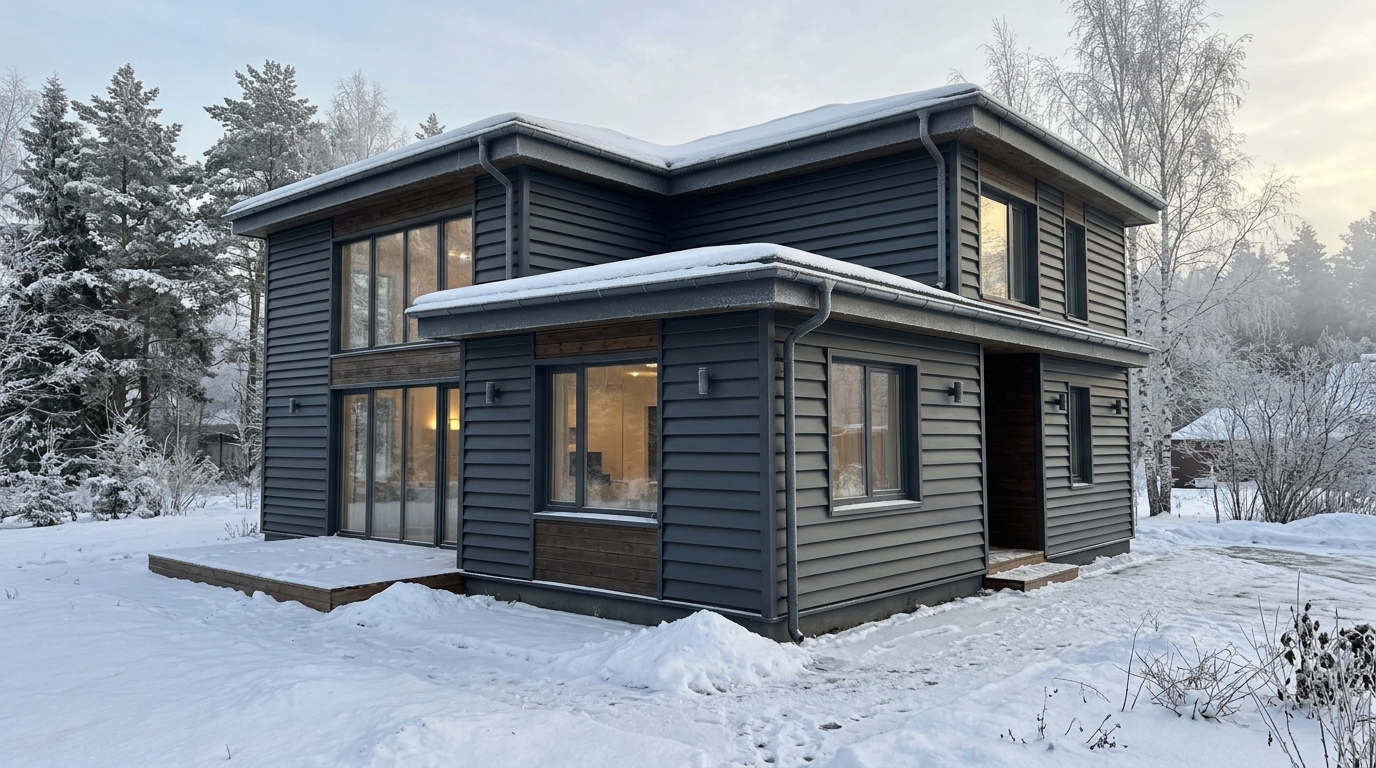
Architectural paradigm and structural features of ventilated facades
A suspended ventilated facade is a complex engineering system consisting of a load-bearing frame (subsystem), a thermal insulation layer, a windproof membrane, and an external decorative screen. The main idea of such a structure is the presence of an air gap between the insulation and the outer cladding. Due to the difference in pressure and temperature, a natural draft arises, which removes condensation and excess moisture from the thickness of the wall and insulation to the outside.
In the winter period, this mechanism becomes critically important. If the ventilation gap functions correctly, the mineral wool remains dry, ensuring maximum thermal resistance. However, if as a result of the formation of massive ice or improper drainage of meltwater, the ventilation openings are blocked by an ice shell, air circulation stops. This leads to the accumulation of moisture in the insulation. Freezing of wet mineral wool not only completely destroys its thermal insulation properties but also significantly increases the weight of the structure, creating an excessive load on the anchor fasteners and the load-bearing wall.
The use of high-quality metal cladding materials, such as the products of the Mehbud factory, allows minimizing wind load on the insulation due to the high tightness of the main plane. However, the outer surface of these materials remains the first line of defense taking the blows of winter weather.

Climatic factors and thermodynamics of facade systems
Winter climate in temperate latitudes is characterized by a constant transition of temperature across the zero mark. This cycle of freezing and thawing is the most destructive factor for building materials. Metal facade elements, regardless of whether they are made of galvanized steel or aluminum, have specific linear thermal expansion coefficients. With a sharp drop in temperature, the metal rapidly contracts.
The main danger arises when during a thaw, meltwater gets into the narrow gaps between facade cassettes, into the lock joints of rack systems, or into the attachment points of lamellas. With the next drop in temperature, the water crystallizes into ice, the volume of which significantly exceeds the initial liquid volume. A hydraulic wedge effect occurs. Locked in the tight space of a metal lock, ice creates colossal internal pressure that can tear thin-sheet metal or pull out rivets.
In addition, temperature changes cause significant linear deformations of the panels themselves. Projects must take into account the pitch of expansion joints, which depends on the coefficient of linear expansion of the material and the maximum amplitude of temperature fluctuations, which in some regions can reach eighty degrees. If ice tightly binds the movable joints of the subsystem designed to compensate for these deformations, the metal will begin to bend, forming waves, or will lead to the shearing of fasteners.
Specific behavior of various types of metal facades in winter
Depending on the architectural shape and design features, various types of metal facades react differently to snow accumulation and ice formation. An analysis of the product line of modern manufacturers, such as Mehbud, allows distinguishing three main categories: cassette facades, rack (in particular cubic shaped) and blinds facades.
Cassette facades form a relatively flat plane consisting of voluminous metal boxes with bent edges. They are prone to the formation of a continuous ice crust when condensation or rain freezes. Horizontal seams between cassettes, where moisture can accumulate, are especially vulnerable.
Rack facades, in particular those using a cubic shaped rack, create an expressive voluminous pattern. Due to the significant distance between the racks and their geometric shape, snow can partially linger on the upper edges. However, the vertical arrangement of the racks contributes to the rapid drainage of meltwater, which reduces the risk of large-scale icing.
Blinds facades demonstrate the highest efficiency under winter precipitation conditions. The inclined surfaces of the metal lamellas provide a natural ability for self-cleaning. Snow and water do not linger on the facade but slide down under the influence of gravity. Thanks to this property, blinds facades remain the most ventilated even during heavy snowfalls, preventing the blocking of air flows.
| Type of metal facade | Resistance to snow accumulation | Risk of ice blockage in locks | Self-cleaning ability |
| Cassette facade | Medium (lingers in seams) | High (in closed joints) | Low |
| Rack facade (vertical) | High (snow has no support plane) | Low | Medium |
| Blinds Facade | Highest (snow slides off lamellas) | Minimal | Highest |
Physicochemical properties of polymer coatings and ice adhesion
Understanding the mechanism of ice adhesion to metal facades is the foundation for effective icing prevention. The adhesion (sticking) of ice to the surface of a metal sheet coated with polymer paint is determined by a combination of intermolecular forces, electrostatic interaction, and mechanical interlocking at the microscopic level.
Factory protective coatings, such as polyester, polyurethane, matte polyester, and polyvinylidene fluoride, act as the first barrier separating metal and water. Surface wettability studies show that smooth glossy coatings (e.g., classic polyester) have a smaller actual contact area with a water droplet, which theoretically should reduce adhesion. However, in practice, coatings with microroughness, such as matte polyester or specialized polyurethane compounds, are able to retain microscopic air bubbles in their micropores. This creates a composite contact in which water rests only on the protrusions of the microrelief without penetrating deep inside. This state significantly reduces the contact area, and consequently, the adhesion force of ice to the surface.
However, this balance is fragile. During heavy freezing rain with wind, or during cyclic freezing and thawing, water under pressure can overcome the air barrier, completely filling the microrelief of the polymer coating. When such water freezes, the ice forms a perfect imprint of the surface, providing extremely strong mechanical interlocking. That is why tearing off such ice by force inevitably leads to microdamage of the polymer layer, its separation from the primer, or even peeling off of the zinc layer.
Influence of coating type on winter operation: Polyvinylidene fluoride contains a significant proportion of fluorine, which gives it exceptional chemical resistance and reduces surface energy, bringing its properties closer to Teflon. Ice sticks to such a coating worst of all and easily flakes off. Polyurethane coatings are highly elastic even in severe frosts, allowing them to withstand thermal deformations of metal without forming microcracks. Conversely, the cheapest glossy polyester at extremely low temperatures can become brittle, and any mechanical impact on an icy facade can lead to peeling of the paint.
Hydrophobization as a preventive measure against icing
In order to prevent the accumulation of moisture on metal facades and thereby prevent the formation of an ice shell, modern science offers the method of hydrophobization. Although historically water-repellent liquids were mainly used for mineral surfaces (concrete, brick), the latest superhydrophobic nanocoatings demonstrate impressive efficiency on metal polymer bases as well.
The essence of hydrophobization lies in changing the surface wetting angle. Special impregnations based on silanes and siloxanes form an ultra-thin film of molecular thickness on the facade. This film changes neither the color nor the texture of the metal, but radically reduces its surface energy. When a drop of rain or meltwater hits a treated facade cassette, it does not spread into a flat spot but gathers into an almost perfect sphere and instantly rolls down, taking dust and dirt particles with it.
In the winter period, this means that water simply does not have time to crystallize on the facade surface. This is especially critical for the plinth areas of the building and zones under the eaves, where moisture constantly gets during thaws. Even if a drop freezes, its adhesion force to the hydrophobized metal is so small that the slightest gust of wind blows it off.
However, the process of applying water-repellent compounds to the polymer coating of metal facades requires extreme caution. Before total application, a test on a local, inconspicuous area is necessary. Some hydrophobizators contain solvents that can soften or cause clouding of certain types of polyester. A correctly selected agent forms a strong chemical bond with the surface and retains its anti-icing properties for several years.
Engineering prevention systems: Cable heating
Despite all the advantages of hydrophobic coatings and architectural solutions, the most effective, engineering-sound way to combat the formation of icicles is electric cable heating. The primary cause of giant icicles on facades is a temperature imbalance: heat from the building melts snow on the roof, the water flows to a cold cornice or drain, where it instantly freezes. When the gutter overflows with ice, meltwater spills over the edge, forming ice growths directly on metal cassettes or racks.
To solve this problem, anti-icing systems are used. Their core is heating cables, which are laid in gutters, downspouts, valleys, and along the roof edge. Today, the industry uses two fundamentally different types of cables: resistive and self-regulating.
A resistive cable is a simpler technological solution that emits a constant amount of heat along its entire length. Its key advantage is lower cost. However, for metal ventilated facades, its use hides a danger. If a resistive cable crosses itself, or part of it is covered with dry leaves, there is a risk of local overheating. This can lead not only to burnout of the cable itself but also to thermal degradation of the metal facade’s polymer coating at the point of contact.
A self-regulating cable is the technological benchmark. In its structure, between copper conductors, there is a semiconductor matrix with a carbon filler. Its operating principle is based on changing resistance depending on the local temperature. If the cable lies in ice water, the matrix contracts, forming a multitude of conductive bridges, resistance drops, and the cable emits maximum heat. As soon as the ice melts and an air environment is formed around the cable (which has lower thermal conductivity), the cable in this area heats up, the matrix expands, the bridges break, and heat emission automatically decreases. Such technology completely eliminates the risk of overheating. A self-regulating cable can be mounted right up against decorative metal facades without any fears for the preservation of the polymer layer.
The effectiveness of the heating system directly depends on automation. The control complex includes a weather station with air temperature and moisture sensors. The system turns on power only when the ambient temperature is in the range of ice formation (usually from minus five to plus three degrees) and water or snow is present on the sensors. In severe frost (below minus ten), heating is blocked, since at such temperatures natural snow melting stops, and there is no sense in wasting electricity.
| Parameter | Resistive heating cable | Self-regulating heating cable |
| Heat emission | The same along the entire cable length | Changes locally depending on temperature |
| Overheating risk | Exists, especially when turns cross | Completely absent, physically impossible |
| Safety for polymer coating | Requires careful installation and monitoring | Absolutely safe for any facades |
| Energy consumption optimization | Only via an external thermostat | Automatic, at the cable structure level |
Safe protocols for removing ice and icicles
If for some reason preventive measures have not worked, and massive ice growths have formed on the facade, there is a need for their immediate removal. Cleaning metal polymer facades from ice is a highly complex procedure that does not tolerate brute force.
Mechanical cleaning method. The use of traditional equipment for chipping ice — metal shovels, crowbars, axes, or rigid metal scrapers — is strictly prohibited. Any, even the slightest touch of a sharp metal object to the facade will cut through the layer of polyester or polyurethane and damage the anti-corrosion zinc coating. Steel, stripped of protection, will begin to actively corrode immediately after an increase in temperature and humidity levels.
For the safe knocking down of small icicles, special telescopic poles are used, at the end of which nozzles made of soft plastic, thick rubber, or silicone are fixed. The knockdown process should not resemble blows. The worker creates slight vibration around the icicle, striving to destroy the adhesion seam between the ice and the metal. If the ice does not yield, applying excessive force is unacceptable, as this can lead to the deformation of thin-sheet metal (crumpling of the cassette) or damage to hidden cleats and rivets.
Thermal cleaning method. To remove ice that has tightly fused with the facade and does not succumb to vibration, the most effective and delicate method is the use of industrial steam generators. This equipment supplies a stream of dry steam under pressure. The steam temperature instantly melts the ice, destroying its structure at the level of contact with the metal. Steam absolutely does not harm the polymer coating and allows cleaning even complex lock joints of rack facades. In some cases, specialists use industrial heat guns, but this method requires significant qualifications: the hot air flow must be constantly moved, avoiding prolonged heating of one point so as not to cause melting of the polymer layer.
Chemical impact of reagents and metal corrosion mechanisms
Modern public utilities massively use chemical reagents, such as calcium chloride, technical salt, and other mixtures, to melt ice on sidewalks and roads. These substances enter into an exothermic chemical reaction with water, releasing a significant amount of heat and lowering the freezing point of the resulting solution, which turns ice into liquid slush.
However, the ingress of such salt solutions onto the surface of metal ventilated facades carries a catastrophic threat. Aqueous solutions of chlorides are extremely powerful electrolytes. The disturbed polymer coating (for example, at the cut points of facade panels, in areas fastened with self-tapping screws, or in micro-scratches resulting from mechanical cleaning) becomes the epicenter of rapid electrochemical corrosion.
The galvanic process develops as follows. The steel sheet under the polymer layer is coated with a layer of zinc. Zinc, being a more active metal compared to iron, acts as a sacrificial anode. When a salt solution enters a scratch, the zinc begins to sacrifice itself, oxidizing instead of the steel. Visually, this process manifests itself in the formation of so-called “white rust” — a loose grayish-white bloom. White rust indicates that the protective zinc layer is being depleted. The rate of this depletion in the presence of chlorides increases tens of times compared to a normal humid environment.
As soon as the zinc layer fully oxidizes, the electrolyte solution will reach the steel core. The formation of “red rust” — iron oxide — will begin. Iron oxide has a much larger volume than pure steel, so rust begins to burst the polymer coating from the inside, causing it to swell (blisters) and massively peel off from the metal.
That is why the use of chemical anti-icing reagents to clean facades, plinths, or drips directly is strictly prohibited. If a reagent is used to clean paths, a safe distance to the metal facade must be maintained to avoid splashes. In the event of accidental ingress of a salt solution onto the panels, they must be washed as soon as possible with a large amount of clean water.
Occupational safety and organization of high-altitude work
The removal of massive icicles, ice accretions, and snow caps from the roofs and facades of multi-story buildings, office centers, and industrial facilities is classified as high-risk work. Performing such tasks without strict adherence to occupational safety standards is unacceptable, as it poses a direct threat to the lives of workers and passersby.
Industrial alpinism specialists are most often involved in servicing modern ventilated facades. Unlike heavy aerial platforms, climbers do not destroy the landscaping around the building and are able to reach the most complex architectural nodes. Industrial climbers work according to international standards of steeplejacks training, which regulate every step.
The organization of work begins with issuing a work permit. Only persons over eighteen years of age who have undergone specialized training and regular medical examinations (in particular, checking the vestibular apparatus) are allowed to work. Weather conditions are the strictest admission criterion. It is forbidden to perform high-altitude work if the wind speed exceeds ten meters per second, as gusts of wind can swing the climber, leading to a hit against the facade. Also, work is stopped during a thunderstorm, heavy fog, blizzard, or if the air temperature drops below minus twenty degrees Celsius.
The most important stage is preparing a safe zone on the ground. According to safety rules, the territory of possible falling of ice and tools must be fenced with bright signal tape installed on inventory posts.
Calculation of the safe fencing zone:
| Height of the building from which work is performed | Minimum distance of the fence from the wall |
| Up to 20 meters | No less than 6 meters |
| From 20 to 40 meters | No less than 10 meters |
A worker in a signal vest must be on duty at the border of the fenced area without fail. Their task is to physically prevent pedestrians and cars from entering the risk zone, because a piece of ice falling even from the fifth floor gains kinetic energy sufficient for fatal consequences.
The climber’s equipment includes a certified helmet, warm clothing, safety glasses, and two independent rope systems (working and safety). All tools used for chipping ice must be tied to the equipment with special safety lanyards to prevent accidental dropping. It is strictly forbidden to use elements of a ventilated facade (cassettes, brackets) as attachment points for ropes; anchor points must be mounted exclusively in the capital load-bearing structures of the roof or walls.
Winter cleaning and washing of facade systems
Regular cleaning of metal facades from dust, city smog, and organic contaminants has a direct impact on icing processes. The contaminated surface of the polymer coating forms a microporous layer that accumulates moisture and serves as a catalyst for rapid ice crystallization. The cleaner the metal, the harder it is for ice to catch on its surface. Although main cleaning works are carried out in the warm season, sometimes there is an urgent need to wash the facade in winter (for example, after completing construction work or to wash off aggressive salt dust from the roads).
Winter facade washing is a complex technological process. The main danger is that the water may freeze faster than it washes away the dirt, forming a solid ice crust. Furthermore, water under pressure can penetrate through ventilation slots deep into the facade system. If the mineral wool gets wet and freezes, it will completely lose its thermal insulation properties.
For washing in winter, systems for supplying heated demineralized water through lightweight telescopic poles with soft brushes at the end are used. Demineralized water, due to the absence of salts and impurities, is a powerful natural solvent that excellently copes with dirt without adding chemical agents (which in frost can become thick or aggressive to paint). Heating the water prevents it from freezing upon contact with cold metal.
Washing is strictly performed from top to bottom. The jet pressure must be strictly regulated: it must be sufficient to wash off dissolved dirt, but not strong enough to penetrate under the blinds lamellas or into the cassette locks. An important condition for winter washing is choosing a sunny day with a temperature close to zero degrees, so the surface can dry quickly naturally.
Technologies for diagnostics and local repair after winter
When the winter season comes to an end and the snow and ice completely melt, metal facades require detailed diagnostics. Extreme climatic factors — ice weight, thermal expansion of metal, icicle impacts, and possible errors during mechanical cleaning — inevitably leave their mark on the condition of the structures.
The first stage is an audit of the facade geometry. If under the pressure of ice, metal cassettes or racks are bent, and the gaps between them have become asymmetrical, this indicates deformation of the load-bearing brackets or tearing out of rivets. Such elements of the subsystem must be adjusted or replaced to restore a uniform load distribution.
The second, most critical stage is finding and restoring damaged polymer coating. Scratches that have cut through the polymer and reached the zinc or steel layer are hotbeds of future corrosion. Leaving them unattended until the next season means deliberately allowing rust to spread under the paint.
For local repair of scratches, cold galvanizing and tinting technology is used:
- Cleaning. The damaged area is carefully cleaned of dust and white or red rust using a very fine abrasive, acting as carefully as possible so as not to remove the intact polymer around the scratch.
- Degreasing. The surface is wiped with a mild solvent that does not react with the polyester or polyurethane of the facade.
- Priming. A special aerosol or liquid zinc primer containing a high concentration of metallic zinc (over ninety percent) is applied to the dry metal. This layer provides sacrificial protection, taking on oxidative processes instead of steel.
- Painting. After the primer has completely dried, a finishing touch-up paint is applied. The paint color must perfectly match the original color of the facade cassettes according to the universal color palette, so the repaired areas do not look like patches.
Timely spot repair costs hundreds of times less than replacing an entire cassette that has begun to rust.
Economics of operation and technical maintenance
An economic analysis of the maintenance of ventilated metal facades in the winter period indisputably proves that preventive investments are much more cost-effective than the costs of eliminating the consequences of accidents or corrosion.
The cost of dismantling ice-damaged cassettes, replacing damp insulation, restoring a deformed subsystem, and installing new panels starts at several hundred hryvnias per square meter, and this is only for the work of climbers or installers, not counting the price of new materials from the manufacturing plant. If the facade was damaged due to improper knocking down of icicles with crowbars, the affected area can amount to tens of square meters.
In contrast, the costs of integrating a self-regulating cable heating system for valleys and gutters are one-time. Such a system functions reliably for years, and electricity costs are optimized thanks to the smart operation of weather stations. Surface hydrophobization also requires some investment, but it reduces ice adhesion and extends the service life of the polymer coating.
Regular spring inspection, local touch-up of micro-scratches, and cleaning downspout systems from autumn leaves can extend the flawless service life of suspended facades by several decades, ensuring the preservation of real estate owners’ capital.
Conclusions
The winter season is the ultimate strength test for modern suspended metal facades. Aggressive environmental factors, such as cyclic temperature changes, ice formation in lock joints, thermomechanical deformations, and sticking of heavy snow masses, demand a transition from a reactive strategy (eliminating consequences) to a deeply proactive one (preventing causes).
Integration of high-tech solutions, such as anti-icing systems based on self-regulating heating cables, the application of specialized hydrophobic compounds, as well as the correct selection of the type of facade systems (for example, the use of blinds facades, which have a self-cleaning effect), allow minimizing the risks of ice mass formation. In cases where there is a need to directly clean metal facades from ice, it is critically important to involve professional industrial climbers working under strict safety protocols and to use exclusively gentle methods — delicate vibration removal with non-metallic tools or thermal melting with steam generators. The use of metal equipment and aggressive anti-icing salts on metal structures must be completely excluded to preserve the polymer and zinc coating layers.
Carrying out regular spring diagnostics, timely local repair of scratches with zinc-containing primers, and regular washing of surfaces can extend the flawless service life of facade structures for many years, preserving the architectural expressiveness of the building and its energy-efficient characteristics.
Related articles
Facade Finishing Passport in Kyiv and Major Cities: A Step-by-Step Guide to Obtaining Permits in 2026
A Step-by-Step Guide to Obtaining a Facade Finish Passport in Kyiv (2026): Approvals, Design Code, Signage, DBN Standards, and Materials.
Analysis of the cost and technological features of the installation of modern metal facades in the regions of Ukraine: Kyiv, Lviv, Dnipro
Cost analysis and installation of modern metal facades (cassettes, rack, blinds) in Ukraine (Kyiv, Lviv, Dnipro). Tech features & prices.
Planned preventive maintenance of metal ventilated facades of commercial facilities: methodology, regulations, and technologies
How to extend a metal facade's lifespan to 50 years? Effective strategies for preventive maintenance, diagnostics, and modern cleaning technologies.