
- Tip 1. Assess the initial condition of the building
- Tip 2. Properly dismantle the old facade
- Tip 3. Do not neglect substrate preparation
- Tip 4. Effective thermal insulation is the key to a comfortable microclimate
- Tip 5. Do not confuse vapor barrier and waterproofing
- Tip 6. Choose facade cladding taking into account the load-bearing capacity of the walls
- Tip 7. Consider the design and color scheme of the facility
- Tip 8. Material selection – considering loads and external factors
- Tip 9. Entrust the installation to professionals
- Tip 10. High-quality cladding means savings on maintenance
10 things you need to know when replacing a facade

If you are replacing an old facade cladding or want to radically update the appearance of your house, you should start with detailed work on an engineering project. With the right architectural approach, accurate load calculation, and careful handling of materials, a modern facade can serve you flawlessly for decades—so it makes immense sense to think through the entire replacement procedure down to the smallest nuances long before the start of installation.
If we are talking about the facades of large industrial, warehouse, or commercial facilities, integrated planning and the development of a detailed project is a mandatory stage by definition. The large surface area of external walls and significant operational loads inevitably lead to a substantial increase in estimated costs. That is why it is crucial to thoroughly calculate absolutely all technical specifications so that significant investments in the modernization of the building fully justify themselves and prove effective.
Ideally, professional certified designers, architects, and engineers are involved in facade design and installation. But even if you plan to make key decisions on your own at the current stage, you should closely listen to the expert advice given below.
Tip 1. Assess the initial condition of the building
The first and key question a qualified designer must ask themselves before starting work is, “is it really necessary to completely replace the cladding?”. Quite often in practice, a situation arises where, despite an obvious external loss of gloss, the facade completely retains both its mechanical strength and excellent performance qualities.
This is very typical for ventilated metal cassette facades that were actively installed on commercial facilities in the mid-90s—the technologies of that time could not always ensure flawless resistance of the decorative layer to fading, but the steel or aluminum base itself, with minimal local repair, cleaning, and replacement of individual damaged cassettes, will allow the entire structure to reliably stand for more than one decade. This saves colossal funds that can be redirected to the modernization of internal utility networks.
If, according to the results of an expert inspection, the physical wear of materials has indeed reached a critical point, the substructure is deformed, and the old cladding has become unusable, then a complete facade replacement will still have to be carried out. Moreover, in the process of choosing a specific option for the new cladding, it is essential to deeply consider which negative factors (excessive humidity, squally wind loads, temperature drops, aggressive urban environment) damaged the previously installed cladding the most, in order to avoid repeating old mistakes in the future.

Tip 2. Properly dismantle the old facade
The old facade cladding must be completely and carefully dismantled before the installation of the new system begins. Even if you or the contracting organization are highly tempted to save time and install a curtain ventilated facade directly over the old painted or plastered wall, this is strictly prohibited. The following technological steps must be carried out beforehand:
- Thoroughly tap the entire working surface of the wall with a special construction hammer to detect hidden cavities, internal delaminations, and voids.
- Completely remove all loosely attached, crumbling fragments of old plaster, brick, and putty.
- Clean off cracked and peeling paint, remove traces of fungus and moss, and eliminate efflorescence.
- Completely dismantle all attached elements (downpipes, air conditioner brackets, old flashings, advertising signs, and lighting fixtures).
If this is not done, the destructive processes inside the facade wall under the influence of trapped moisture and condensation freezing cycles will intensively continue right behind the installed new cladding. In the medium term, this will inevitably lead to a critical weakening of the sub-system’s anchor fixings and cause emergency and very expensive repairs.
In addition, during dismantling work, it is necessary to strictly ensure that the main foundation of the building and active utility communications are not accidentally damaged. Sometimes ill-advised, rushed actions by workers lead to local destruction of load-bearing structures and a significant reduction in their overall strength.
Tip 3. Do not neglect substrate preparation
The wall substrate, which will later be completely hidden from view behind the new facade cladding, largely determines its durability, safety, and overall operational reliability. To completely minimize any construction risks, prior to the direct installation of the load-bearing frame brackets, it is necessary to:

- Timely identify and reliably eliminate all construction defects (at least, properly rout, dust, and seal all structural cracks with durable non-shrink repair compounds).
- Treat the cleaned surface of the load-bearing walls with a strengthening deep-penetration primer to stabilize and de-dust the substrate.
- Obligatorily treat the substrate with effective antiseptics, biocides, and fungicides (broad-spectrum anti-fungal and anti-mold preparations).
Thanks to the thorough implementation of these steps, even in the event of accidental atmospheric moisture getting behind the cladding or condensation forming, dangerous colonies of pathogenic microorganisms or black mold will guaranteed not settle on the load-bearing walls, and the risk of gradual structural destruction of the building’s load-bearing design will drop to zero.
Tip 4. Effective thermal insulation is the key to a comfortable microclimate
From the point of view of modern building thermal engineering and the laws of physics, external insulation of facade envelope structures is many times more effective, safer, and more economically feasible compared to the installation of any thermal insulation materials inside the premises. That is why **a comprehensive replacement of facade cladding is an excellent and most opportune reason to perform high-quality thermal insulation of the entire building.**

Proper installation of a closed and continuous thermal insulation loop on external walls will solve the most important tasks:
- Significantly reduce the overall heat loss of the facility during the cold season, ensuring a stable, healthy, and comfortable microclimate inside all interior spaces.
- Radically cut monthly financial expenses for heating in winter and air conditioning in summer heat (for many large industrial, warehouse, and office buildings, energy savings can be colossal, fully paying off the facade in a few seasons).
- Completely shift the “dew point” into the outer insulation layer, entirely eliminating the risk of freezing in the outer part of the wall envelope and significantly slowing down its natural degradation.
For facade thermal insulation (especially when installing curtain ventilated facade structures with high airflow velocity in the gap), it is highly recommended to choose dense, hydrophobic basalt mineral wool slabs with a density of at least 80–125 kg/м³. The use of combustible polymer insulation (regular polystyrene foam, extruded polystyrene foam, and analogues) in ventilated facade systems is highly undesirable and unsafe from the standpoint of fire safety, and their low vapor permeability leads to trapping moisture in the walls and increasing dampness inside the premises.
Tip 5. Do not confuse vapor barrier and waterproofing
When installing reliable facade cladding under modern metal linear panels, siding, or cassettes, specialized protective membranes must be laid over the insulation layer. Their main purpose is to protect the walls and thermal insulation from wind and atmospheric precipitation. Here it is important to consider key technological rules:
- The use of regular polyethylene, roofing felt, and other dense film materials with minimal permeability for water vapor leads to an immediate disruption of the natural moisture exchange of the walls, trapping moisture inside the insulation, and forming a destructive “greenhouse effect”, because of which mineral wool quickly loses its properties.
- In order to ensure a normal microclimate in the building and guarantee the dryness of the insulation, only vapor-permeable (superdiffusion) membranes must be installed — they reliably protect against wind and external droplet moisture, but at the same time freely release water vapor from the inside out into the air gap, preventing the system from getting wet.

Tip 6. Choose facade cladding taking into account the load-bearing capacity of the walls
One of the most important and fundamental engineering limitations when choosing a new facade cladding is the actual load-bearing capacity of the walls and foundation of the building. With a sufficiently large facade area, the cladding materials used in the design can weigh many tons in total. If an accurate preliminary calculation of the sub-system is not made, heavy panels will eventually simply begin to deform and fall off under the influence of their own weight, or (what is much worse and more dangerous) will cause serious deformation, cracks, and gradual destruction of the load-bearing part of the building.
To completely avoid such catastrophic consequences, thoroughly evaluate the load-bearing capacity of the walls, as well as their strength and density — the specific type of anchor fasteners to choose during sub-system installation directly depends on this. It is also desirable to give preference to light but maximally durable facade materials. An excellent solution would be linear facades based on thin-sheet galvanized steel from the leading “MechBud” plant, or three-dimensional facade cassettes from the same reliable manufacturer. They provide a minimum specific load per square meter of wall while ensuring the highest rigidity of the structure.
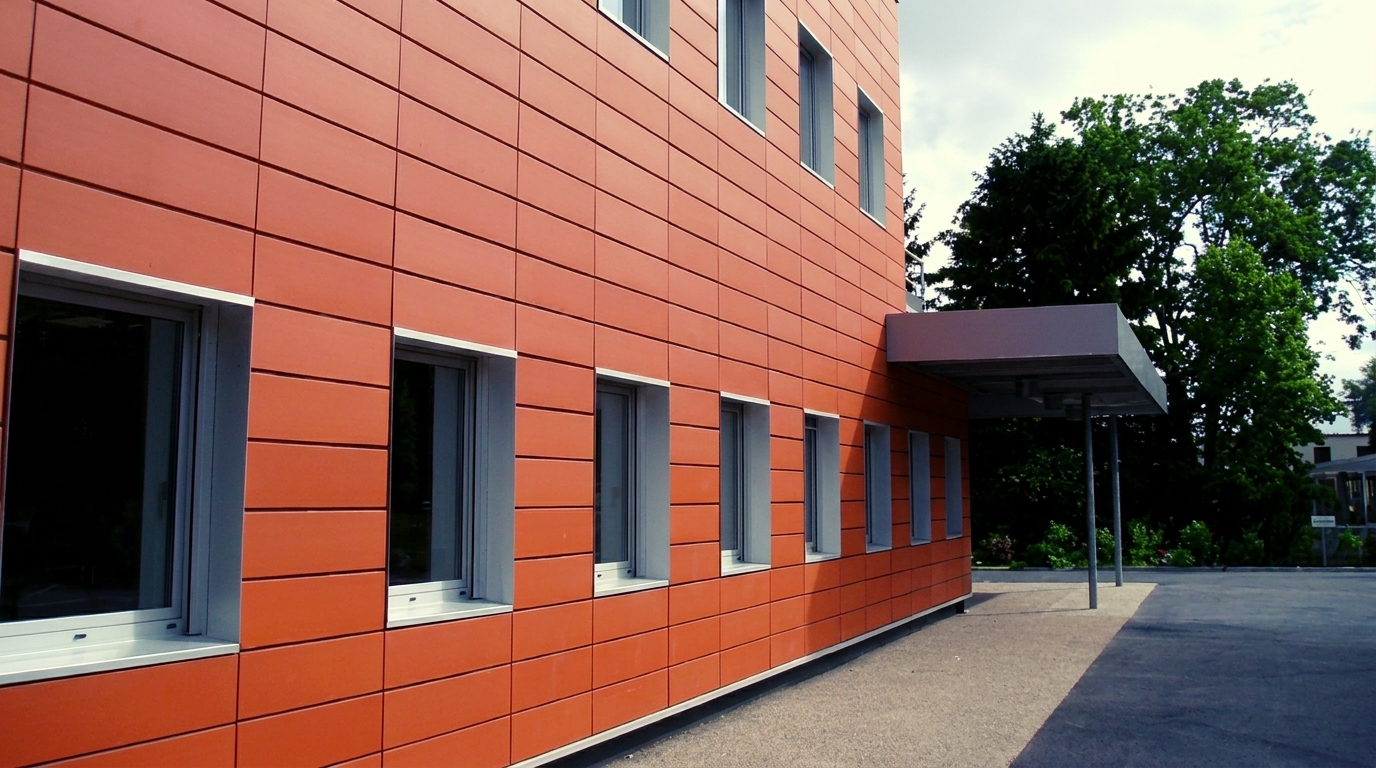
Tip 7. Consider the design and color scheme of the facility
While for a small private house the color of the new facade is mainly a matter of the owners’ personal aesthetics, for commercial, office, and retail properties, the visual appearance plays a key strategic role. It is extremely important that the facades of modern buildings:
- Ideal harmony with the surrounding landscape, landscaping, and architectural style of the area.
- Strictly correspond to the approved corporate color scheme of the brand (company Brand Book), increasing business recognition.
- Allow to easily implement any original, complex design and architectural ideas.
- Retain their original brightness, saturation, and richness of shades under the scorching sun for many decades.
The ideal and most durable option for modern reconstructed facades would be the use of curtain metal structures painted with high-quality powder pigments under factory conditions. This solution is much more practical and reliable compared to classic painting of a plastered surface: the palette of powder paints on the RAL scale is significantly richer, and their resistance to harsh UV radiation, which causes panel fading, is many times higher.

Tip 8. Material selection – considering loads and external factors
The key and most crucial moment of the project is the choice of the base material for the final facade cladding. As for traditional plaster facades (“wet method”), today they are used either in budget private construction or in the most economical insulation of old apartment buildings. Finishing using wet technology has many inherent disadvantages (seasonality of installation, susceptibility to cracking and peeling from shrinkage, the need for regular repainting every 3–5 years), so today technological curtain ventilated structures are increasingly given unconditional preference.
The following can be used as modern materials for cladding the power frame:
- Vinyl siding. It is inexpensive, weighs little, but absolutely lacks high mechanical strength. It becomes brittle in the cold, easily deforms and cracks from accidental impacts, so it is mainly used in finishing small private cottages and summer houses.
- Porcelain stoneware is a very expensive and very heavy cladding material, used in the cladding of large public, administrative, and commercial buildings. Due to its significant weight, it requires a powerful reinforced sub-system and is almost always used as a reliable anti-vandal cladding for the plinth or lower floors.
- Linear, cassette, and panel facades are a universal, balanced solution for both residential complexes and any commercial buildings. The choice of metal products for cladding is huge (at least in the catalog of the famous “MechBud” plant), so you can easily find the perfect option that fits in terms of price, rigidity, and design.
For clarity and to ease the selection process, let’s consider a detailed comparison table of the main facade materials:
| Comparison criterion | Vinyl siding | Porcelain stoneware | Metal facades (MechBud) |
|---|---|---|---|
| Mechanical strength | Low (brittle in the cold, easily deforms from impacts) | High (but prone to chipping under strong point impacts) | Maximum (impact-resistant galvanized steel or aluminum) |
| Weight and load on walls | Minimal (very light, does not require frame reinforcement) | Very high (requires a powerful foundation, walls, and sub-system) | Optimal (does not overload load-bearing building structures) |
| Fire safety | Combustible material (actively melts, emits acrid toxic smoke) | Absolutely non-combustible (Class NG) | Absolutely non-combustible (Class NG, completely safe) |
| Service life and fading | 5–10 years (quickly dulls, yellows, and fades in the sun) | More than 30 years (resistant to ultraviolet radiation) | More than 50 years (thanks to polymer-powder coating) |
| Scope of application | Private low-rise construction, summer houses, cabins | Plinth floors, entrance groups of large facilities | Universal (Residential complexes, shopping malls, office and industrial buildings) |

The last mentioned variety — metal curtain ventilated facades — will certainly be preferred both from the point of view of long-term practicality and from the point of view of uncompromising resistance to any harsh external climatic influences.
Tip 9. Entrust the installation to professionals
The correct choice of engineering design, high-quality material, and harmonious color scheme of the facade is only half of the overall success. It is very important that all facade cladding is technologically correctly and professionally installed in strict accordance with building codes. At the same time, the key nuances in the assembly process will be:
- Competent calculation and installation of the substructure — the load-bearing metal frame, which is rigidly fixed to the base with anchors and serves as a reliable support for cladding materials, leveling the curvature of the walls.
- Perfect alignment of all cladding elements — strictly along the vertical and horizontal planes using professional laser equipment.
- The highest quality of fixing the frame to the base and the cladding to the frame (which is critically important during strong hurricane winds, weight deformations, and constant operational loads).
- Flawless combination of individual cladding elements with each other — for example, neat conjugation of transparent glass panels, window openings, doors, and metal cassettes.
- Timely consideration of unforeseen structural or geometric features of the building, which can significantly complicate installation at the site.

Only experienced, qualified specialists can fully consider and implement all these highly complex factors. They, as a rule, use specialized construction equipment, reliable scaffolding, lifts, and modern precise equipment during the installation of facade cladding — this significantly reduces the time spent on replacing the facade without the slightest loss of quality.
Tip 10. High-quality cladding – savings on maintenance
Finally, even at the design stage, it is important to think in detail about how exactly the facade of the building will look a week, a month, and many years after the installation is completed:
- If your task is to minimize operational costs for cleaning, choose practical, non-marking materials for cladding, on which road dust and natural precipitation are practically invisible.
- Too light glossy or deep dark solid facades very quickly start to look untidy under the influence of smog, so you will have to wash them quite often. This applies in full measure to panoramic glass facades.
- To maximize the ease of ongoing maintenance of the structure, immediately choose materials that are easily washed off with ordinary rainwater. The outstanding anti-vandal, hydrophobic, and dirt-repellent properties of powder polymer paints used by the “MechBud” plant in the production of their facade slats and panels will come in very handy here, protecting the building from any pollution for a long time!

Of course, strict compliance with these practical recommendations will not replace full-fledged assistance from a professional design engineer. But if you take all these tips into account, and when choosing models and materials for the new facade cladding you listen to the advice of authoritative experts — then the renovated building is guaranteed to maintain its flawless structural reliability and stunning beauty for many decades!

Subscribe
Login
0 Comments
Oldest