
- Garage structures: from classics to modernity
- Classic closed garage: a capital approach
- Carport, pergola, and other open structures: lightness and aesthetics
- Garage finishing options: next-generation materials
- Closed garages: what to use for exterior and interior finishing?
- Garage-pergola: how to make it reliable and durable?
- Instead of a conclusion: the garage of the future
Fortunately, the “shell” garages and structures made of welded metal sheets that abundantly “decorated” our yards a couple of decades ago are gradually becoming a thing of the past. Even the old brick garages, although still actively used, are now undergoing major renovations by many owners. A modern car requires a completely different approach to storage. Furthermore, the emergence of new high-tech materials on the construction market allows for the construction of fundamentally new structures that are not only suitable for safe vehicle storage but also harmoniously blend into the landscape design of the plot.
Today, a garage has ceased to be just a “box for a car.” It is a multifunctional space that often combines the functions of an auto workshop, a storage area for seasonal items, a hobby room, and in recent years, even a charging station for electric vehicles. This is precisely why higher demands are placed on its design, construction, and finishing.
In our expanded review, we will provide detailed characteristics of the most common types of garages, analyze their structural features, and examine which advanced materials are best to use for their exterior and interior finishing.
Garage structures: from classics to modernity
A garage is a specialized premise or engineering structure intended for the reliable protection of a car (or other equipment: motorcycles, ATVs, boats) from adverse external factors and intruders. Garages can be built in various places — from garage cooperatives and courtyards of apartment buildings to private household plots. Regardless of the location, such a structure must meet strict standards of reliability, fire safety, and ergonomics.
Speaking of the private sector, two main concepts are actively used today:
- Closed capital garage — a full-fledged space, completely isolated from the external environment, often heated and equipped with engineering utilities.
- Open garage — a carport, architectural pergola, or similar light structure that provides high-quality protection mainly from atmospheric precipitation (rain, snow, hail) and the destructive impact of direct sunlight.
Both varieties have their own unique operational features, pros, and cons, which we will analyze in detail below.
Classic closed garage: a capital approach
The most common and historically familiar design is the classic closed garage. As a rule, it is a solid structure erected on a reliable foundation (strip, monolithic slab, or pile), sometimes featuring a full-fledged basement or an inspection pit.
Key structural features:
- Garage walls are built from durable construction blocks (ceramic or silicate brick, cinder block, aerated concrete, foam concrete) or mounted from metal (frame technology using sandwich panels or cladding with an effective heat insulator, such as mineral wool, placed inside).
- As for the roof, a shed, gable, or flat roof is most often used. The covering can be made of metal tiles, corrugated sheets, flexible bituminous tiles, or, in the case of flat roofs, concrete slabs with heat-weldable waterproofing (Euro-ruberoid, PVC membranes).
- The entrance group is designed with wide and reliable gates. Today, heavy swing metal gates have been replaced by modern sectional, up-and-over, or roller systems equipped with automatic drives and remote control.
This fundamental design has a number of undeniable advantages:
- First, the microclimate in a closed building can be made as favorable as possible. Through insulation, heating, and a proper supply-and-exhaust ventilation system, an optimal balance of humidity and temperature is maintained, preventing body corrosion.
- Second, storing a car in a closed room ensures maximum preservation of the paintwork, plastic, and rubber parts. The car is fully protected from hurricane-force winds, sudden temperature changes, icing, and destructive ultraviolet radiation.
- Third, a capital garage offers an unparalleled level of security. It ensures reliable protection for equipment, expensive sets of tires, and tools from both professional theft and acts of street vandalism.
- Fourth, a closed space allows for organizing a full-fledged workshop, installing storage rack systems, and comfortably maintaining the car at any time of the year.
In general, closed garages are absolutely universal structures. However, it is worth understanding that their construction requires significant financial investments, preparation of design documentation, and time for the foundation to settle. While a classic garage on a private closed territory can certainly be replaced (or supplemented) by an open structure, there is simply no alternative in an unguarded cooperative or in the courtyard of an apartment building.
Carport, pergola, and other open structures: lightness and aesthetics
The main disadvantage of a closed capital garage is the high complexity of its construction, the need for building permits, and, consequently, high total cost. That is why where rigid protection against theft is not the main priority (on closed suburban plots, on the territories of cottage settlements with 24/7 security), elegant open structures are increasingly being built.
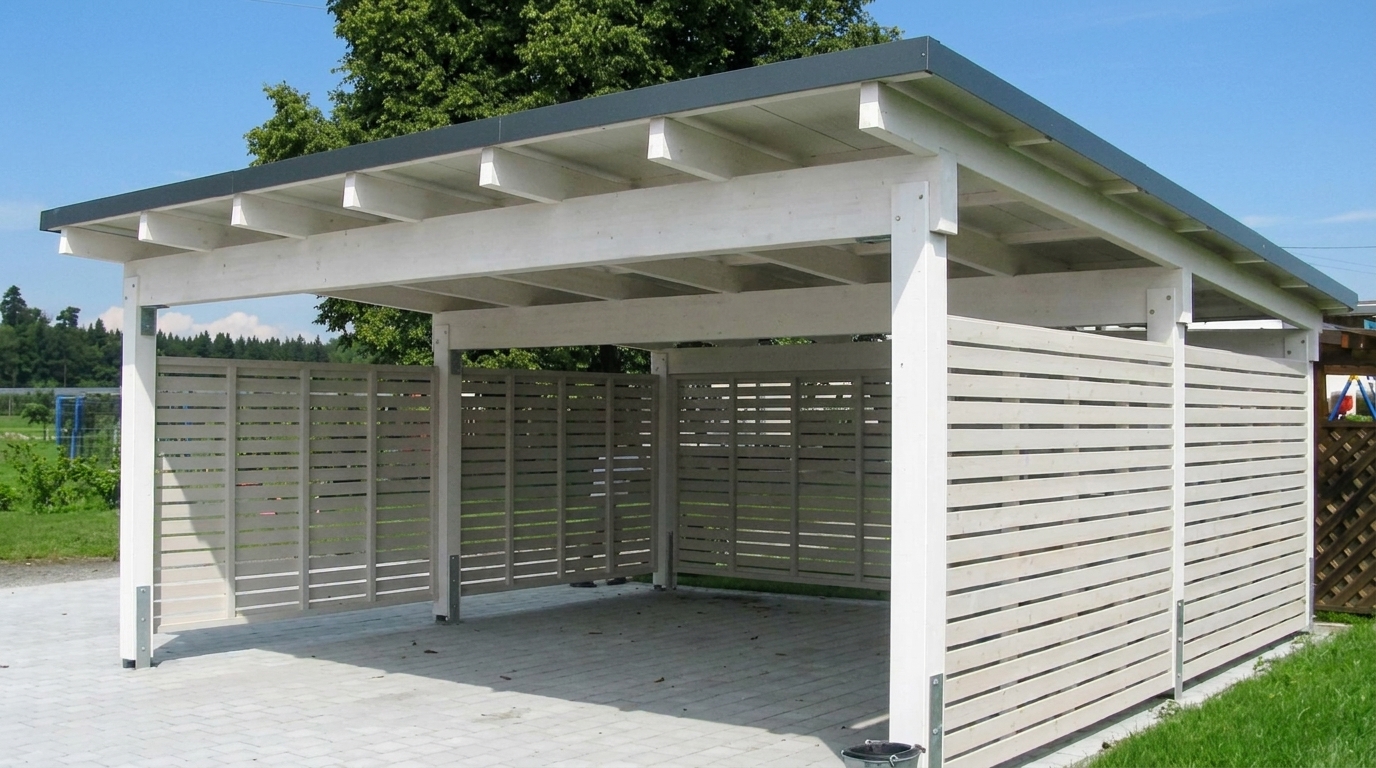
A striking example of such an architectural form is a cantilevered carport mounted flush against one of the load-bearing walls of a capital building, or a freestanding pergola — a stylish and visually light structure on support posts consisting of interconnected beams, arches, and a roof covering laid on top.
Such structures have a number of objective advantages:
- Saving time and budget: building a carport or pergola for parking a car takes only a few days, does not require deep foundation pouring (point concreting of supports is sufficient), and costs significantly less than capital construction.
- Ease of operation: an open design is low-maintenance, does not need heating or the organization of a complex ventilation system (the car is ventilated naturally, which instantly dries out moisture and prevents rust).
- Multifunctionality: such structures have a much wider range of applications. In the absence of a car, the space under a stylish carport can easily be used as a spacious covered terrace, a barbecue area, or a gazebo for recreation in the fresh air.
- Visual lightness: pergolas do not clutter the site, preserve the view, and fit perfectly into the concept of modern minimalist landscape design.
At the same time, in regions with a moderate climate, a carport or pergola is more than suitable for permanent car storage. If the design is improved by installing additional protective screens — for example, stylish metal blinds, decorative slats, or descending roller shutters that cover the carport from the windward sides — then even in a heavy snowstorm or driving rain, the car will remain dry and clean.

Garage finishing options: next-generation materials
Closed garages: what to use for exterior and interior finishing?
To ensure the building does not look like a foreign gray spot against the background of a beautiful house, and that it is practical and bright inside, the garage must be finished correctly. Relatively recently, owners faced great difficulties (used short-lived plaster, paneling, or simply painted brick), but today the arsenal of finishing solutions is vast.
For exterior cladding, it is optimal to use modern ventilated facades. They allow hiding the insulation layer and transforming the appearance:
- Metal siding. An absolutely universal material that is perfectly suitable for cladding walls made of any raw blocks. One could get by with cheap vinyl siding, but for a technical room, metal siding wins hands down. It does not crack in the cold, does not melt in the sun, is fireproof, and has the highest strength.
- Slat facade systems. Like metal siding, they are ideal for exterior cladding. Slat design is currently at the peak of architectural fashion. Also, slats are traditionally used for cladding roof overhangs (soffits) and designing canopies over the entrance.
- Facade metal cassettes and panels. Using these premium materials allows giving the garage a strict, ultra-modern high-tech look. Cladding walls with metal cassettes using a ventilated facade system makes it possible to insulate the garage effectively and without condensation, drastically reducing heat loss.
Comparative table of materials for exterior finishing
| Material type | Key characteristics | Main advantages for a garage |
|---|---|---|
| Metal siding | Profiled panels made of galvanized steel with a polymer coating. Imitation of timber or log is possible. | Non-combustible, requires no repainting, resistant to mechanical impact, easily washed with a water jet. |
| Facade cassettes | Volumetric metal elements (square or rectangular) for creating strict geometric facades. | Premium appearance, ideal for hidden wall insulation (ventilated facade), excellent soundproofing. |
| Slat systems | Narrow and long metal slats. Can be mounted either with a gap or flush. | Excellent facade ventilation, possibility of creating an original architectural rhythm, low weight. |
For interior garage finishing, where maximum practicality is important, it is recommended to use:
- Metal slat systems — for impact-resistant wall cladding and stylish ceilings.
- Steel or aluminum cassettes and panels — for forming an even and reliable ceiling space.
The advantages of such solutions for the interior are similar to those described above, but there are also specific operational nuances:
- First, finishing walls with durable steel slats or panels incredibly facilitates the installation of heavy storage systems. Brackets, perforated panels for keys, wall cabinets, and shelves for heavy power tools are easily and reliably attached to the metal frame. Metal, unlike drywall or plastic, withstands serious loads and accidental impacts.
- Second, using suspended metal structures on the ceiling is an ideal solution for routing utilities. Wiring, ventilation pipes, and power supply units can be hidden beneath them. In addition, it is extremely easy to integrate recessed LED fixtures into metal panels, which allows for even, shadow-free lighting — a prerequisite for comfortable work in a workshop.
- Third, the highest level of fire safety. Flammable and combustible materials, fuels, and solvents are often stored in a garage. Metal finishing does not support combustion at all.
It is worth mentioning the phenomenal ease of maintenance. Any work (be it oil changes, grinding, or painting) is accompanied by dust, oil splashes, and soot. It is almost impossible to wash stubborn dirt off porous plaster or brick. But cleaning smooth steel panels with a polymer coating with a regular sponge and car shampoo will take literally minutes.
Garage-pergola: how to make it reliable and durable?
From an engineering point of view, approaching the construction and finishing of open garages — carports and pergolas — should be completely different. This is because there are no blank walls here to hide the frame. Therefore, all modern materials must be incorporated into the project at the drawing stage: the load-bearing frame itself should be planned in such a way that the spacing of supports and beams allows for the final cladding to be fastened aesthetically and without the accumulation of additional profiles.
When designing, you need to take into account the following specifics:
- Carports very often rely on the load-bearing structures of the main building. That is, at least two attachment points of such a carport are located on the capital wall of the house, and the remaining mass of the roof and snow load are distributed between the extended support posts. It is important to calculate the tilt angle correctly so that snow from the house roof does not collapse onto the carport’s light roof.
- A freestanding garage-pergola relies entirely on its own posts for its entire mass. There can be from 4 to 8 of them (or significantly more if a large-scale covered parking for several family cars or a commercial parking lot is being designed). The structure must have high spatial rigidity to withstand strong winds.
Modern solutions based on high-quality thin-sheet metal products also perform excellently in finishing such airy structures:
- To protect the car’s paintwork from driving rain, snowdrifts, and crosswinds, it is advisable to partially cover the side walls. The optimal cladding height is from the ground to a level of 1.5–2 meters. At the same time, it is critically important to maintain cross-ventilation so that damp air does not stagnate under the carport. For this purpose, metal elements of modular fences such as “Ranch” or “Blinds” sections are ideal. They hide the car from prying eyes, break gusts of wind, but perfectly let in fresh air.
- The carport roof can be made from a wide range of materials. This can be impact-resistant monolithic polycarbonate, corrugated sheet, standing seam roofing, or bituminous tiles (if maximum silence is needed during rain). The color palette of the roof is always selected so that it resonates with the shade of the side slats or the roof of the main house.
- When installing a solid (non-transparent) roof, the pergola’s rafter system is neatly cladded from below. For creating an aesthetic ceiling (soffit), slat aluminum/steel systems or cassettes are used. This instantly turns a technical carport into a stylish architectural object, masking beams, fasteners, and weld marks.
- As with a capital structure, cladding the carport ceiling provides a great opportunity to install hidden wiring and mount recessed spotlights or LED strips. Spectacular night lighting of the pergola is not only convenient for parking but also fantastically decorates the plot at night.
- A trendy solution for summer carports is a ventilated blinds roof. If you have chosen a classic pergola, then instead of solid polycarbonate, wide metal slats (blinds roof system) are mounted on the roof, either swivel or rigidly fixed at an angle. This design provides an ideal balance: the scorching summer sun does not heat up the car interior, hot air escapes freely upwards through the gaps, and light precipitation rolls off the slats into hidden gutters. This is an ideal “summer residence” for a car.
Instead of a conclusion: the garage of the future
The era of gloomy, damp, and cramped “boxes” for car storage has finally passed. Modern garages are becoming an integral, aesthetically attractive part of the architectural ensemble of a suburban plot. Depending on the budget, area, and climate, they can be both fundamental closed blocks with smart heating and light, floating pergolas with designer lighting.
The latest finishing materials have played a huge role in this evolution. The use of facade systems based on profiled metal products with high-tech polymer coatings allows making any garage — open or closed — not only vandal-resistant, fireproof, and durable but also incredibly stylish. By investing in quality finishing today, you get a comfortable space for your car that will not require repairs for decades.
Related articles
Fence Installation on Challenging Soils: Foundation Mistakes and Solutions
Installing fences on difficult soils: foundation mistakes, frost heave, pile selection, and drainage. Expert tips for a durable enclosure.
Comprehensive design of metal fencing systems for pet safety: engineering, architectural, and veterinary aspects
How to choose a safe fence for dogs and cats? Analysis of modern metal fencing: reliable protection against climbing, digging, and injuries.
Types of fence posts
An analysis of the most important requirements for fence support posts, and an evaluation of the pros and cons of the most popular options.