
Architecture that shapes consciousness
The boundaries of the space in which we live are not just physical engineering barriers protecting the territory from prying eyes, wind, or unauthorized access. They are extremely complex psycho-emotional tools that continuously and on a deep subconscious level interact with our nervous system. Neuroarchitecture is a modern scientific discipline that studies the impact of architectural forms, spatial solutions, and volumes on the brain and emotions of living beings. It convincingly proves that the surrounding artificial environment can both provoke chronic stress and perform a powerful therapeutic, healing function. In the context of modern cottage towns, where people purposefully seek refuge from city noise, information overload, and fuss, the shape, height, and internal structure of the fence become key factors in forming a basic sense of security or, conversely, a source of subconscious anxiety.
For a long time in society and private construction, the prevailing opinion was that ideal protection and peace could only be provided by a solid, maximum height, and blank wall. However, long-term studies in the field of spatial psychology, as well as observations of residents of strictly closed territories, testify to the exact opposite. Excessive spatial isolation inevitably generates mild forms of claustrophobia, increases suspiciousness, and forms a persistent fear of the outside world. A person who walls themselves off from society with a monolithic wall subconsciously begins to perceive everything behind it as a potential and invisible threat.
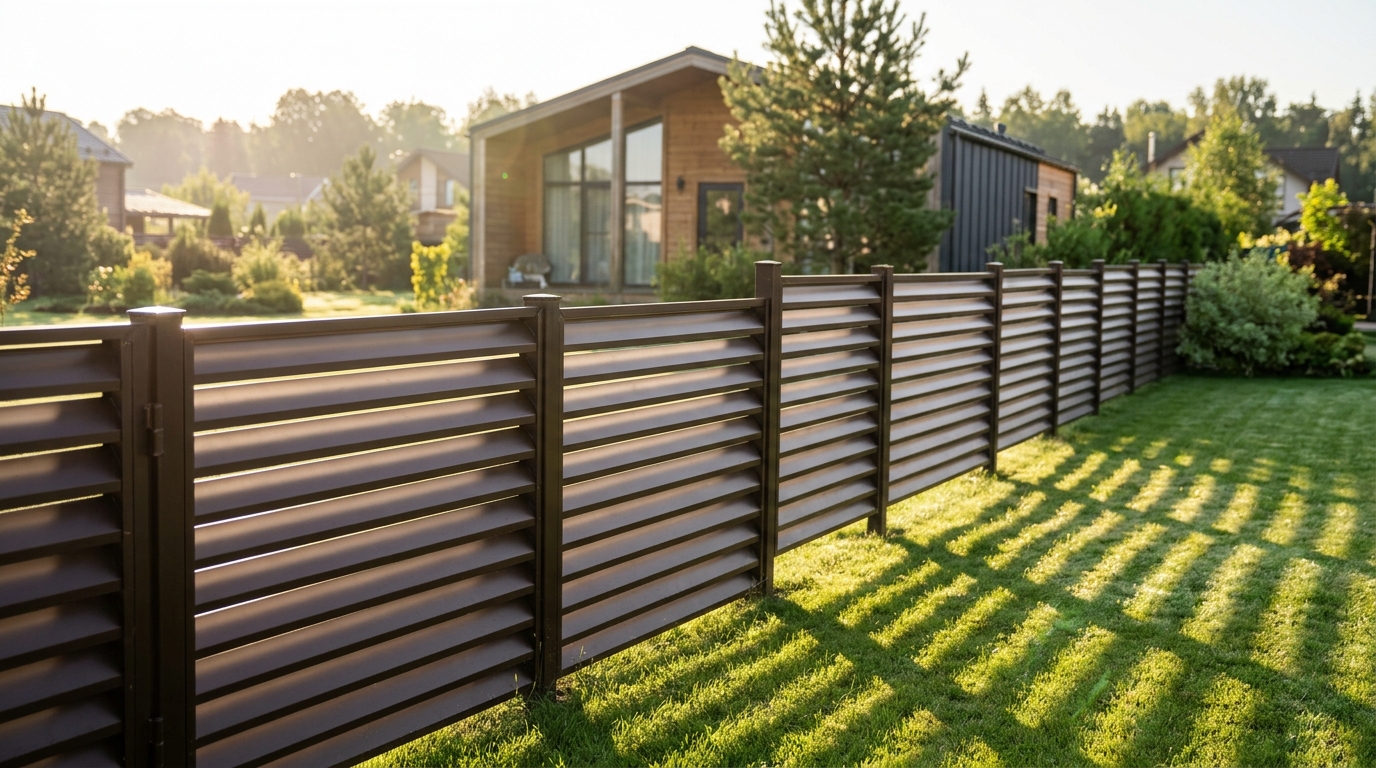
The answer to this fundamental psychological and architectural challenge was modern metal blinds fences. These are innovative structures assembled from inclined lamellas that ingeniously combine absolute visual privacy with spatial permeability, natural lighting, and proper ventilation. This detailed analytical report examines exactly how the physical parameters of such fences — from the overall height to the millimeter pitch of the lamellas — directly affect the stress level, sense of territoriality, social interaction, and overall psychophysiological comfort of country house residents.
Neurophysiology of space: How the brain perceives physical boundaries
The process of perceiving any space always begins with a complex of visual stimuli. Light waves reflecting off surrounding objects hit the retina of the eye. The information collected there is instantly converted into electrical impulses, which are transmitted through the optic nerve to various parts of the cerebral cortex. During this process, the neural system analyzes spatial perspective, object orientation, contrast, movement, and the presence of physical limitations. Most importantly, this visual information parallelly enters the amygdala — the oldest part of the brain’s limbic system, which is directly responsible for the formation of basic emotions, including fear, aggression, and stress reactions.
When a person is on their private property, their brain continuously scans the boundaries of the territory in the background for potential threats or avenues for possible retreat. This is a deeply rooted biological survival mechanism. If the property boundary is completely blank (e.g., a solid concrete wall or a solid metal profile fence), the brain faces an acute shortage of information about what is happening in the immediate vicinity outside.
This information deprivation is an extremely powerful trigger of subconscious anxiety. Evolutionarily, a person is accustomed to fully controlling their habitat. The inability to visually control the adjacent street forces the nervous system to constantly be in a state of readiness for surprises. The brain tries to resolve this information uncertainty by generating scenarios of potential danger. Furthermore, spaces with a disturbed balance of proportions, where physical boundaries significantly exceed human height and have no visual breaks, can cause a persistent feeling of loss of control, psychological pressure, and complete isolation.
On the other side of the spectrum are completely transparent fences, such as regular metal mesh or low picket fences. They deprive a person of the most important sense of security, leaving them “in plain sight” before the whole world. This roughly violates the fundamental human need for intimacy and privacy of one’s own life, which ultimately leads to emotional exhaustion of the nervous system due to continuous social pressure and the inability to relax.
That is why modern neuroarchitecture persistently suggests looking for a balance in structures capable of scattering a direct gaze, finely controlling lighting, and providing optical semi-permeability. Metal blinds structures solve this complex neurological conflict perfectly: they allow the resident to see the outlines of the street but completely hide their yard from passers-by. This instantly calms the amygdala, reducing the basal level of cortisol and relieving background stress.

Evolutionary psychology: The balance of prospect and refuge
To understand as deeply as possible exactly why blinds fences act so soothingly on people’s psyches, it is necessary to turn to classic theories of evolutionary aesthetics and environmental psychology. In the second half of the twentieth century, an outstanding researcher formulated the so-called prospect and refuge theory. According to this fundamental concept, modern people subconsciously give absolute preference to those environments that simultaneously satisfy two basic needs. These needs were formed hundreds of thousands of years ago when our ancestors survived in the conditions of wild savannas:
- Prospect: The ability to see far and wide around oneself, to control the horizon in order to be able to notice any potential danger (predator or attacker) in time or to find the necessary resources for life.
- Refuge: The presence of an absolutely safe place, reliably closed from behind and above, where a person can hide so that nobody can notice them.
From the point of view of evolution, the most comfortable environment for a human is a forest edge or a cave on a mountainside, where one can safely stay in dense shade (having a refuge), while simultaneously freely observing an open, sunlit plain (having a prospect).
In the context of modern architecture of cottage towns, high blank walls provide exclusively the function of refuge, but at the same time completely and brutally destroy any prospect. This causes strong subconscious discomfort, as ancient parts of the brain perceive such an environment as a blind “trap” from which it is absolutely impossible to observe an approaching threat from the outside.
The modern metal blinds fence ingeniously imitates the optical structure of dense natural bushes or that very saving forest edge. Thanks to the calculated inclination of the lamellas and the presence of clearly calibrated gaps, the homeowner, being on their territory, gets an excellent opportunity to safely observe the adjacent street. Thus, the vital need for a prospect is ideally realized. At the same time, any person just walking down the street past the house sees only a continuous architectural plane of inclined metal strips and cannot look inside the private yard in any way. This completely satisfies the need for a refuge.
This architectural technique is proven to reduce the production of stress hormones and, conversely, stimulates the release of hormones of calm and pleasure, as the brain receives a continuous signal: “I am in absolute safety, I completely control the situation, nobody sees me”.
In addition to purely individual comfort, preserving an open view through the fence lamellas forms the so-called concept of natural surveillance. This is one of the main pillars of the modern urban theory of crime prevention through environmental design. When residents can at least partially see the street from their yards or windows, the overall level of street crime, vandalism, and public order violations plummets. Potential intruders intuitively feel that the territory is not “dead”, and unseen witnesses can observe them at any moment. Thus, the individual reduction of anxiety is multiplied, forming a general, collective psychological comfort for the entire cottage town.
Psychology of gated communities: A sense of security or fortress syndrome?
The desire to wall oneself off from the rest of the world has very deep historical and socio-cultural roots. Researchers of the gated community phenomenon note that the erection of walls goes back to the times of the first permanent human settlements. From ancient cities where walls protected against military attacks to medieval European settlements where gates closed for the night gave townspeople a sense of unity and physical security — a wall has always been a symbol of order opposing external chaos.
Over time, with the development of society, walls transformed into an instrument of social segregation. In suburban construction, wealthy segments of the population began to create closed enclaves, trying to wall themselves off from social problems, noise, and potential crime. However, anthropological studies of life in such ultra-protected cottage towns revealed a striking psychological paradox.
Instead of the expected absolute relaxation, life behind high blank walls often generates the so-called “fortress syndrome”. Residents who surround themselves with three-meter blank fences, cameras, and security begin to feel a disproportionately high fear of the outside world. Their psyche falls into the trap of its own defense: the subconscious dictates that if such powerful, massive, and visually impenetrable fortifications are needed for safety, then the world beyond them is extremely hostile and deadly.
Researchers describe the condition of such people as a mild form of social claustrophobia. Being in a spacious yard, but squeezed on all sides by high concrete or solid metal walls, people complain of feeling as if they are “in a trap”, and that “something dangerous is lurking right outside the door”. Moreover, children who grow up in such a visually isolated environment more often develop distrust towards other people, since anyone outside their wall is a priori perceived as a stranger and a threat.
This is exactly where the architecture of blinds fences acts as a powerful socio-psychological corrector. Metal blinds fences blur the rigid visual boundary between “us” and “them”. They clearly mark private property and physically prevent intrusion (since it is extremely difficult to climb over inclined metal strips, the foot simply slips off), but at the same time, they do not look like the wall of a prison isolation ward. This allows residents to feel like part of a wider community, maintaining a healthy psychological connection with the world, but without sacrificing their own privacy.
The impact of fence height on spatial cognition and anxiety levels
In neuroarchitecture, the height of any physical boundary is one of the most critical parameters that directly affects the cognitive perception of space scale. How high a fence rises relative to a person’s eye line determines the level of their psychological dominance over the environment or, conversely, the level of depression. In modern cottage development, three main height categories are most often encountered, each of which triggers completely different physiological and behavioral reactions.
| Fence height | Visual and physical effect | Psychological impact and anxiety |
| Low (up to one and a half meters) | Provides an unobstructed view for an adult. Demarcates the territory only nominally without blocking the line of sight. | Stimulates active socialization but deprives the sense of refuge. In areas near roads, it causes chronic stress due to the inability to relax under the gazes of passers-by. |
| Medium (from one and a half to two meters) | Located at or slightly above average human height. Completely blocks direct eye contact with passers-by but leaves the sky and tree crowns open. | The “gold standard” of neuroarchitecture. Guarantees deep privacy, calms the psyche without causing a feeling of spatial compression. Preserves the natural scale of the environment. |
| High (over two and a half meters) | Creates a monumental obstacle. Forms a sense of absolute physical and visual fencing off from the outside world. | Can provoke claustrophobia and “fortress syndrome”. Perceived by the brain as a disproportionately large element pressing on the subconscious. A feeling of isolation instead of comfort. |
For people with a high level of personal anxiety, as well as for introverts, low fences are a factor of constant irritation. The need to constantly be in sight of neighbors exhausts the reserves of the nervous system. Instead, a height of about two meters, especially if implemented using a blinds fence (whose lamellas can reach three meters in length, forming wide, continuous sections), creates an ideally clear territorial boundary.
However, there are situations when the landscape of the site, proximity to a busy highway, or the specifics of neighboring development objectively require the installation of a fence over two and a half meters high. If such a fence is built of brick, concrete, or solid corrugated board, the yard will inevitably turn into a stone bag. Here, the geometry of the lamellas becomes the salvation. Even at significant height, a metal blinds fence retains its architectural and visual lightness.
The horizontal lines of the inclined metal strips create a powerful optical effect of expanding space. Our eye slides along these lines, and the yard seems wider. In addition, the presence of thin gaps through which light breaks through does not allow the structure to turn into a depressive monolith. Accordingly, the brain perceives this high fence not as a strict prison wall, but as a modern, reliable, and light breathable structure.
Geometry of lamellas: Pitch, tilt angle, and privacy gradients
The distance between the lamellas (their pitch), the overall width of each individual metal strip, and its tilt angle are those crucial microparameters that form the “character” of the fence and dictate its impact on the human subconscious. The neurophysiology of the visual apparatus is arranged so that the brain constantly tries to complete a holistic picture from disparate fragments. Cognitive reading of blinds structures is based exactly on this.
When a person walks or drives past a blinds fence quite quickly, a so-called cinematic sweep effect occurs: the gaps between the slats visually merge into a single whole, allowing a mobile observer to very briefly assess the overall situation and perspective beyond the boundary. But as soon as a person stops or tries to focus their gaze on a specific point in the yard, the tilt angle of the lamellas creates an insurmountable optical curtain.
Increasing the lamella pitch leads to a significantly higher visual permeability. This architectural tool is ideally suited for those functional areas where maximum psychological contact with the environment is needed. For example, on the border between two friendly neighboring families or on the facade part of the yard facing a quiet forest or park area. More light and visual information radically reduce stress from spatial isolation and form deep trust in the environment. Models with a wider pitch and straight placement of lamellas resemble the classic “Rancho” style, which in people’s minds is firmly associated with space, rural openness, and freedom of spirit.
In contrast, decreasing the pitch or changing the tilt angle in such a way that wide lamellas begin to partially overlap each other vertically, forms the highest level of privacy. Structures that use a complex multi-level profile of metal strips with numerous stiffening ribs not only guarantee phenomenal resistance to physical deflection but also completely and guaranteed cut off any direct visibility. From the outside, such a massive fence looks practically solid, which effectively deters any unwanted guests. The homeowner at the same time receives an absolute, inviolable psychological refuge, knowing that even the most attentive gaze from the street cannot penetrate their private life.
An interesting architectural and extremely powerful psychological solution is the double-sided symmetrical placement of lamellas. In such specialized models, the metal fence has an absolutely identical, flawless aesthetic appearance both from the busy street and from inside the cozy yard. Symmetry of form has a very soothing effect on the psyche, since the human brain in the process of evolution formed an attraction to symmetry, order, and predictability. The absence of a reverse (unattractive, technical) side completely eliminates the subconscious feeling that a person is living “in the backyard” of their own life, which very often happens when using an ordinary, cheap profile sheet, when the entire rough frame sticks out toward the house.
Biophilic design: Microclimate, aerodynamics, and lighting
Modern neuroarchitecture is never limited solely to the visual perception of space; it comprehensively studies and takes into account the full spectrum of physical impacts of the environment on human biology and health. One of the most important fundamental principles here is the concept of biophilic design. This approach involves deep optimization of natural lighting, improving air quality, and creating ideal temperature comfort on the site. Any physical discomfort is very quickly converted by the nervous system into emotional irritability, chronic fatigue, and unprovoked anxiety.
Natural ventilation and fighting air turbulence: The construction of solid stone walls or solid metal fences around a site creates the effect of a kind of hermetic “bag” in which air inevitably stagnates. In summer, this leads to extreme overheating of the yard, the accumulation of heavy exhaust gases (especially if a road passes nearby), and significantly increased humidity. Such conditions create an ideal environment for the multiplication of dangerous mold and insects.
Moreover, during strong gusts of wind, a solid fence acts like a giant sail. The air stream hits the plane with force and flips over it, forming powerful, turbulent, and very loud vortex flows in the yard. These flows lift dust into the air, break decorative plants, and create unbearable noise. The sound of strong wind howling around a solid obstacle is a classic trigger for ancient parts of the brain that instinctively signal a storm and mortal danger, automatically raising the anxiety level.
Blinds metal structures work as perfect aerodynamic diffusers calculated by engineers. When a strong air stream collides with the inclined lamellas, it breaks into a multitude of small, weak, and manageable jets. The wind is effectively decelerated as it passes through a complex trajectory of gaps. As a result of this physical process, a constant, very soft circulation of fresh air is maintained in the yard without dangerous drafts. The physical sensation of a light, pleasant fresh breeze instead of summer stuffiness or a storm wind reduces the heart rate and contributes to deep physiological relaxation, qualitatively relieving stress after a busy workday.
Dynamic lighting and circadian rhythms: Natural light is the most important stimulus that regulates circadian rhythms — the internal biological clock of a person responsible for sleep, mood, and hormonal balance. High solid fences cast an extremely deep, thick shadow on the yard. It makes a significant part of the yard uncomfortable, damp, and psychologically cold. Constant stay in such dark, gloomy areas depresses the mood and, according to medical observations, can contribute to the development of depressive states.
The lamellas of blinds fences create a unique, healing effect of diffused light. They form a pleasant shadow that reliably protects from the scorching midday sun but at the same time freely lets in a sufficient amount of rays, especially in the critically important morning and evening hours. This dynamic play of light and shadow is very reminiscent of sun glare softly breaking through the leaves of forest trees. Such natural, slightly changeable illumination positively and gently stimulates the visual cortex of the brain, maintaining its activity at a healthy level without overexcitation.
An additional bonus is that the sun’s rays freely reach decorative plants planted along the metal fence. This ensures their normal, healthy growth, which in turn significantly enhances the overall therapeutic effect of the site’s biophilic landscape. Greenery against the background of beautiful metal creates an ideal picture of a safe home.
Typology of blinds fences in the context of neuroarchitecture
The choice of a specific fence configuration should never be random. It must be based on a detailed understanding of the homeowner’s individual psychotype, their socialization needs, and the specifics of the site’s geographical location. Depending on the width of the metal strips, the thickness of the galvanized steel, and the features of the frame structure, different fence models form fundamentally different behavioral reactions. Modern premium segment manufacturers offer a wide palette of engineering solutions, each of which has its own clear neuroarchitectural goal.
A detailed comparison of the characteristics of the most popular models through the prism of psychological perception demonstrates how engineering solutions transform into emotional comfort:
| Fence model (Concept) | Engineering and technical features | Psychological impact and spatial purpose |
| Classic line | Maximally light but spatially rigid lamellas. Standard pitch and proven tilt, minimalist and understandable design. | An ideal solution for quiet, peaceful neighborhoods and demarcating inner territories of a town. The fence does not overload the visual space, creates a pleasant feeling of openness and lightness. Reduces stress due to the maximum preservation of light and free breathing of the site. |
| Exclusive series | Significantly increased lamella width, a special, calculated tilt angle, fastening on massive brick or concrete pillars for monolithicity. | Emphasizes deep aesthetic pleasure and the expression of the owner’s high status. Massive but not solid elements form an unshakable confidence in one’s own safety. Excellent for facade lines facing active streets. Gives guaranteed privacy. |
| Premium standard | Use of metal with a thickness of one millimeter or more. Application of special spacer inserts for perfect geometry and maximum rigidity. | Designed specifically for people with an increased need for safety and situational control. Absolute resistance to deformation broadcasts a clear signal to the subconscious about the “invincibility” of the home boundary. Blocks drafts but preserves visual connection with the world. |
| Double-sided (Double) | A unique design where lamellas form an absolutely identical appearance on both sides of the fence. Completely blocks direct visibility, “invisible” mode. | Brilliantly solves the problem of a compromise between “front” beauty and “reverse” technical appearance. Provides the highest level of psychological and visual refuge. Recommended for sites near noisy areas or for residents seeking peace. |
| Ventilated panels (Rancho, Horizont) | Lamellas are arranged straight (vertically or horizontally) without tilt, leaving clear, even gaps. Maximum visual permeability. | Forms the most friendly, transparent, and democratic environment. Radically reduces the anxiety level regarding relations with neighbors, promotes active formation of close, trusting social ties in the community. Absolutely does not cause a feeling of wall pressure. |
An integral but extremely important advantage of metal lamella structures (unlike cheap corrugated board) is their acoustic passivity. Reliably fixed elements with sufficient metal thickness do not vibrate, rattle, or create annoying noise even during very strong, stormy gusts of wind. The absence of unexpected and sharp metal sounds preserves the silence on the site, which is a critically important condition for the recovery of the exhausted nervous system and the deep, quality sleep of all residents of a country cottage.
In addition to functional form, color has a huge impact on the brain. Modern polymer coating technologies allow you to choose any shade or even a complex imitation of a texture (for example, sawn natural wood). This allows the fence to be integrated into the overall landscape color therapy. Warm, natural shades (light wood, soft green, warm terracotta) promote deep relaxation, reduce aggression, and help psychological “grounding”. While dark, saturated shades (deep black, matte graphite) emphasize strict architectural geometry and form a feeling of an insurmountable, inviolable boundary in the subconscious, reliably protecting the family from any external chaos.
Thanks to the tilt, most of these lamellas have the property of self-cleaning from dirt during rain. The lack of need to constantly wash and paint large areas of the fence removes unnecessary household burden from the owners, freeing up time for rest, which also indirectly contributes to improving mental health and reducing life stress.
Conclusions
Creating a full-fledged, psychologically comfortable, and safe space in a modern cottage town requires a radical departure from exclusively technical or utilitarian approaches to construction. Neuroarchitecture and environmental psychology convincingly prove that a fence is not just a demarcation line on a cadastral plan. It is an extremely powerful spatial and psychological tool that, on a daily, background basis, models mood, regulates the level of stress hormones, and forms a basic sense of security for every person present on the territory.
An excessive, uncontrolled desire for physical isolation by erecting solid, impregnable, and visually heavy walls leads to paradoxical and highly negative consequences for the psyche. Physical inviolability in this case is achieved at the cost of developing chronic background anxiety, a feeling of hostility of the environment, isolation from the world, and the gradual development of spatial claustrophobia. On the other hand, excessive openness deprives a person of a vital evolutionary “refuge”, leaving them vulnerable to constant and exhausting social observation by neighbors and passers-by.
Modern metal blinds fences are the architectural embodiment of the highest psychological compromise. Their complex geometry, built on a mathematically precise pitch and tilt angle of the lamellas, directly and very positively interacts with our deepest neurobiological needs. This structure provides the owner with the ability of invisible visual control over the environment (satisfying the need for a prospect) while simultaneously guaranteeing reliable, absolute protection from prying eyes (satisfying the need for a refuge). Additionally, such fences provide a healthy, natural microclimate on the site due to the correct circulation of air masses and dynamic, lively lighting.
A correctly and thoughtfully selected height, color, and typology of a metal blinds fence allow not only reliably protecting private property but also transforming an ordinary yard into a truly therapeutic, restorative space. In such an environment, the nervous system of the residents gets an opportunity to fully rest, reboot, and restore resources, daily enjoying absolute harmony, silence, safety, and an unbreakable connection with nature.
Related articles
When you don’t need to put up a fence and what restrictions to check
When you can do without a solid fence, how to check boundaries and restrictions, and when to postpone installation. Checklist and answers to frequently asked questions.
TOP Medical Laboratory Networks in Ukraine: Architecture, Infrastructural Innovations, and Market Leaders Rating
Overview of top medical lab networks in Ukraine 2026: Synevo, Dila, CSD LAB. Architecture, ISO 14644 cleanrooms, accessibility, and energy independence.
Winter maintenance for metal gates and wickets: Comprehensive protection of mechanisms, automation, and coatings
Practical guide to winter care for Mehbud metal gates and wickets. Learn how to lubricate locks, protect automation, and maintain coating.