
A profiled sheet (corrugated board) is a profiled metal sheet used for fences, roofs, wall cladding, and load-bearing decking. When choosing, it is important to consider not only the profile name and color, but also the base steel thickness, geometry, protective coating, and the operating conditions of the structure. A sheet intended for fencing should not be automatically considered suitable for a roof or floor decking.
Below, we will look at the structure of a profiled sheet, its marking, coating, production, and purchasing criteria. For fences, we will separately explain how to account for the working width and why framework parameters cannot be determined solely by the profile height.
Table of Contents: structure · marking · coating · choosing for a fence · sheet calculation · quality check.
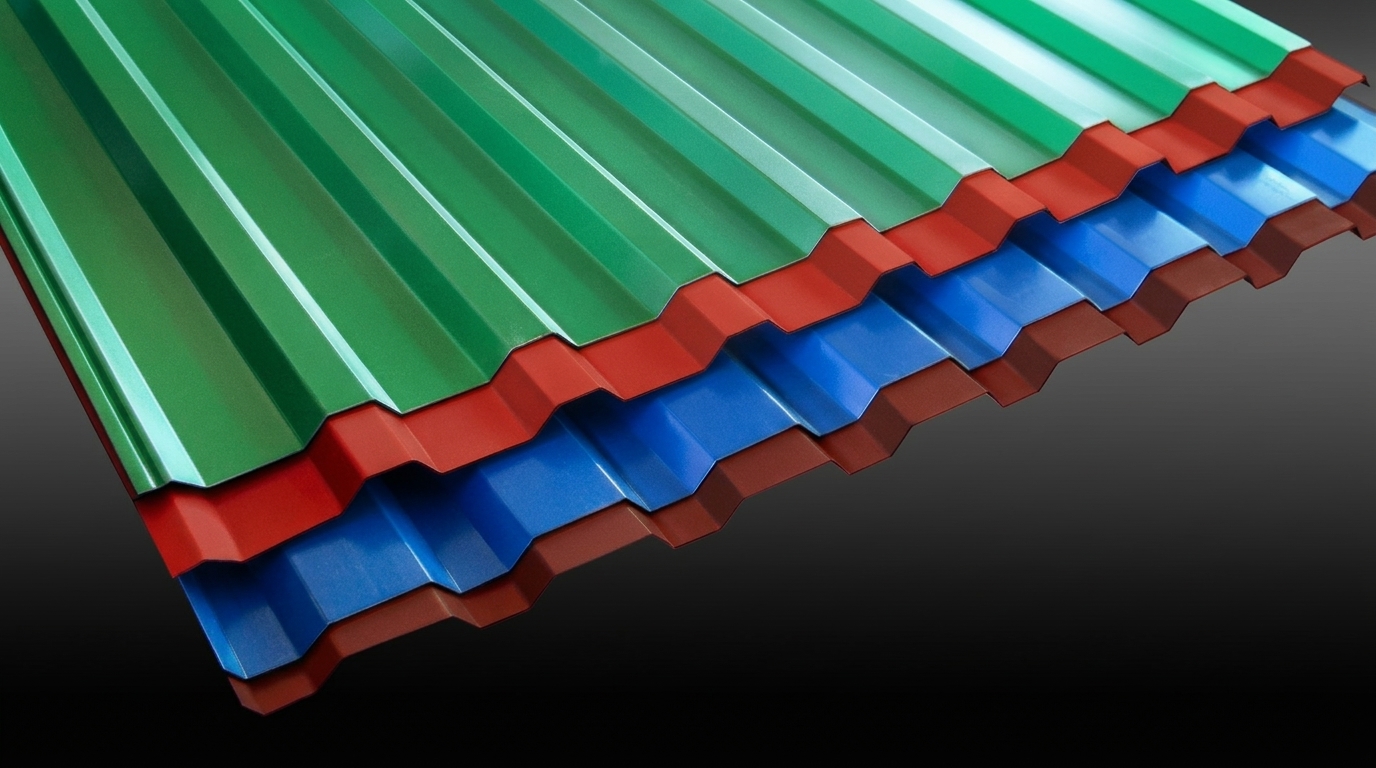
What is a profiled sheet and how does its profile work
During profiling, a flat sheet is given a repeating relief: trapezoidal, corrugated, or another shape specified by the product design. The geometry affects the sheet’s stiffness. However, a high profile alone does not guarantee the required load-bearing capacity: thickness, steel grade, load direction, spans, and support schemes are also evaluated.
Practical conclusion: compare profiles using technical specifications and manufacturer calculation tables. Photos, designations, or the phrase “reinforced” do not replace this data. In the Ruukki instructions for load-bearing profiled sheets, p. 2, the choice is linked to the required stiffness and loads; the provided installation solutions have their own application limits.
Steel base: what data is needed
The specification must indicate the base material, its nominal thickness, and applicable tolerances. Clarify exactly which thickness is meant: the steel base or the finished sheet with coatings. Offers with the same number in the name may turn out to be incomparable.
Do not set a single “correct” thickness for all profiled sheets. First, determine the purpose and loads, and then select the product. For load-bearing decking, roofing, and high fences, coordination with design solutions is required.
How to read profiled sheet markings
Designations like C, HC, H, PK, T, and other indices can be found on the market. They are deciphered using a specific manufacturer’s catalog. You should not assume all marking systems are the same or determine the base material solely by the letters.
For example, Pruszynski describes its own load-bearing trapezoidal profiles using the letter T and a number related to the profile height in millimeters. This is an example of a specific nomenclature, not a universal rule for every seller.
A conditional example of reading the C8-1150-0.5 code: if this exact scheme is defined in the product passport, 8 may mean a profile height of 8 mm, 1150 — a working width of 1150 mm, and 0.5 — a nominal base thickness of 0.5 mm. Before ordering, verify the meaning of each number and unit of measurement in the supplier’s documentation.
How popular grades differ
Names like C8, C10, C18, C21, C44, HC35, HC44, H57, H60, H75, or H114 help find the corresponding item in the catalog. But you cannot assign the support spacing, allowable load, or steel thickness based on the name alone: an exact drawing and characteristics of a specific product are required.
- For walls and fences, look for a product intended by the manufacturer for the corresponding application, and verify it together with the framework.
- For roofing, additional data on the slope, joints, fasteners, and drainage are needed.
- For load-bearing decking, calculated characteristics and an approved structural operation scheme are required.
Profiles with similar names should not be substituted for one another without verification. The number in the marking is not an allowable span and does not mean the sheet “will not bend.”
Profiled sheet coating: what to compare
For a protected steel profiled sheet, it is important to distinguish between the metallic coating and the organic decorative-protective layer. The documentation specifies the type of coatings and their parameters, not just the color. The ArcelorMittal user manual for organic coated steel, sections 2.1–2.3 explains the material structure and differences in protection systems.
- Metallic protective layer: clarify its composition and declared coating mass. For comparison, the same units and the same measurement basis are needed.
- Organic coating: check the exact system name, layer thickness, intended use for outdoor or indoor conditions, and declared characteristics.
- Reverse side: ask what coating is applied on the inside. For a fence, this side remains visible from the yard.
- Warranty: clarify exactly what it covers and what operating and maintenance conditions the manufacturer sets.
Polyester, polyurethane systems, PVDF, and plastisol coatings should not be compared solely by their general names. The characteristics are determined by a specific product. Similarly, a matte surface is not automatically more durable than a glossy one, and the color name does not guarantee corrosion resistance.
Do not confuse units: the thickness of the steel base is usually recorded in millimeters, while the thickness of the paint layer is in micrometers. 1 µm = 0.001 mm: for example, 25 µm is 0.025 mm, not 25 mm. This is an explanation of units, not a recommended thickness for any product. The mass of the metallic coating in g/m² is a different indicator.
How profiled sheets are produced
Sheet or roll material is used for profiling. The workpiece is fed through successive pairs of rollers that form the required cross-section; the finished profile is cut, checked, and packaged. The line settings must correspond to the material and geometry of the product.
When color and protective layers are applied
Not all colored profiled sheets are powder-coated after forming. For pre-painted steel, continuous application of liquid organic coatings onto a metal strip — coil coating — is particularly used. This process and subsequent profiling are described in the ArcelorMittal manual, sections 2.2 and 4.3. The technology for a specific order must be clarified with the manufacturer.

Where profiled sheets are used
The scope of application depends on the specific profile and the structure in which it operates.
- Fences, gates, and wickets: the profiled sheet forms a solid infill, while posts, crossbars, and fixing nodes are selected based on site conditions.
- Roofing: allowable application, slope, and details of the roofing system are verified.
- Wall cladding: the sheet is part of a system with a substructure and necessary layers of the enclosing structure.
- Load-bearing decking and permanent formwork: only appropriate products according to the project are used. The suitability of a sheet cannot be justified by the assumption that the concrete will have time to gain strength before the metal corrodes.
How to choose a profiled sheet for a fence
Start with the task: do you need a solid site boundary, privacy, entrance decoration, or fencing for a utility area. Then determine the height, lengths of individual sections, gate placement, and terrain features. Pass this data to the supplier and the specialist selecting the framework.
A solid sheet takes on wind loads, so the profiled sheet, posts, crossbars, foundation, and fasteners must be considered together. Do not rely on a single piece of advice about the distance between posts for all heights and sites. There is no universal sheet thickness that will independently ensure the reliability of any fence.
When comparing options, check:
- the exact profile and purpose of the product;
- the steel base and both coatings;
- the appearance of the front and reverse sides;
- the framework scheme, fastenings, and edge finishing;
- transportation conditions for long sheets and their unloading;
- the full estimate, not just the price per square meter of the sheet.
If you need a different balance between solidity, appearance, and openness of the fence, also compare other materials for fences and Mehbud blinds fence structures. These are alternatives for comparison, not an automatic replacement for the selected profiled sheet.
Total and working width: how to calculate the number of sheets
Total width is the overall dimension of the sheet from edge to edge. Working width is the width the sheet covers after the designated overlapping. For layout planning, the working width from the manufacturer’s documentation is exactly what is needed.
For a simple straight section with a vertical arrangement of identical sheets, the preliminary quantity can be estimated as follows: section length ÷ sheet working width, rounded up.
Educational example: infill length — 20 m, working width of the selected sheet according to the passport — 1.10 m. 20 ÷ 1.10 = 18.18; you will preliminarily need 19 sheets. These are conditional initial data, not the parameters of specific Mehbud products and not a ready-made estimate.
Calculate each individual section, gate, and wicket according to its own layout. Trimming, installation direction, terrain elevation changes, and the usability of offcuts can alter the quantity. The estimate also includes the framework, fasteners, flashing elements, delivery, and labor. Do not add a universal waste percentage without a layout plan.
How to check quality before buying
Ask for the specification of the exact product offered. The profile, thickness, coating, width, and length must correspond in it. Upon receiving, check the completeness, geometry, and visible damage, and record any discrepancies prior to installation.
| Parameter | Question before ordering |
|---|---|
| Purpose | For which structure is this profile allowed? |
| Base thickness | What is being measured and what tolerances are specified? |
| Coating | What protection systems are applied on both sides? |
| Width | What are the total and working widths and the joint scheme? |
| Framework and fasteners | On the basis of what data were the supports and nodes chosen? |
| Warranty | What does the document cover and what are the exclusions? |
| Delivery | What are the lengths, complete set, timelines, and acceptance conditions? |
Do not evaluate the coating merely by its gloss, and do not determine the base thickness “by touch.” Check the evenness of the edges, the repeatability of the profile, dents, and scratches. The presence and shape of an anti-capillary groove depend on the product; do not demand the identical groove on all wall and roofing profiles.
Cutting, installation, and care: how not to damage the sheet
Determine the tools, fasteners, joints, and cut edge treatment according to the manufacturer’s instructions. For instance, Ruukki, for its load-bearing profiled sheets, p. 3, stipulates cold cutting, prohibits angle grinders with abrasive discs, and requires the removal of metal shavings. Do not transfer a specific fastening scheme from this instruction to another profile without verification.
When carrying, protect your hands from sharp edges, do not drag sheets over one another, and do not leave damage unassessed. To repair the coating, use compatible materials and the procedure specified by the manufacturer. Periodically inspect the joints, fasteners, edges, and places where dirt accumulates.
Advantages and limitations of profiled sheets
A profiled sheet allows you to cover a plane with repeating elements and choose the desired geometry, length, and finish. The solid infill of a fence provides visual separation of the site. However, the final properties belong to the entire structure, not just a single sheet.
What to consider in the project
- Damage to protection: scratches, cuts, and improper fastening require attention; the coating does not make the steel invulnerable.
- Loads: the sheet can bend, and a solid fence requires properly selected supports.
- Thermal and acoustics: a thin sheet is not a ready-made thermal or sound insulation system. The composition of an insulated roof differs from an uninsulated canopy.
- Appearance: the reverse side, joints, flashings, and fasteners affect the result no less than the color.
- Fire characteristics: evaluate the specific product and system according to the documents; do not draw conclusions about any coating just by the word “metal.”
How to compare suppliers
Send the same technical specification to several suppliers. Compare identical profiles, bases, coatings, completeness, and delivery conditions. Clarify the manufacturer, the origin of the characteristics, the possibility of getting a sample, and the claims procedure.
A low price by itself does not prove poor quality, and the size of an enterprise does not guarantee the absence of defects. What matters is the specific product, documents, conformity of the delivery to the order, and the ability to get a technical explanation.
Frequently asked questions about profiled sheets
Which profiled sheet to choose for a fence?
A product approved by the manufacturer for fencing and verified together with the framework for the height and site conditions. The name C8 or C21 in itself does not determine a sufficient thickness, distance between posts, or fasteners.
Can a wall profiled sheet be laid on a roof?
Only if the documentation for the specific product and the project allow such an application. You need to check not only the profile but also loads, supports, slope, joints, and roofing nodes.
What is the difference between galvanized and colored profiled sheets?
Compare the complete protection system. A colored sheet may have an organic layer over the metallic coating, but the mere presence of color does not guarantee specific quality or service life.
Does a high profile make the sheet non-deformable?
No. Load-bearing capacity and deflections are evaluated for a specific geometry, thickness, steel, load, and support scheme.
Video examples of profiled sheet fences
In the selection below, you can see options for the appearance of fences. This is a video from the original version of the article, not an instruction for framework calculation or confirmation of the characteristics of Mehbud products.
What to prepare before ordering
Record the purpose of the structure, its dimensions, site conditions, appearance requirements, and budget. Obtain the sheet specification and coordinate the framework and nodes. Then comparing profiled sheets by price will make sense: you will be comparing solutions for a single task, rather than just similar material names.
Related articles
Arrangement of surface drainage systems along metal fences and paths
Surface drainage for walkways and fences: protect paving and pavers from settling and water damage. Expert guide on effective channel selection.
Fence Installation on Challenging Soils: Foundation Mistakes and Solutions
Installing fences on difficult soils: foundation mistakes, frost heave, pile selection, and drainage. Expert tips for a durable enclosure.
Comprehensive design of metal fencing systems for pet safety: engineering, architectural, and veterinary aspects
How to choose a safe fence for dogs and cats? Analysis of modern metal fencing: reliable protection against climbing, digging, and injuries.