
At the end of a shift, a ceiling installer’s watch celebrates an active day. The installer takes off their work boots and asks a fair question. “If I’ve been on my feet all day, what would an hour at the gym add?” To answer, it helps to ask what the work involved, alongside how much the person moved.
Construction work counts as physical activity. A shift can still differ from a planned workout in intensity, repetition, duration and recovery. Step counts, energy expenditure and end-of-day fatigue each tell part of the story. Leisure-time activity can also be as ordinary as walking or cycling. WHO definition of physical activity
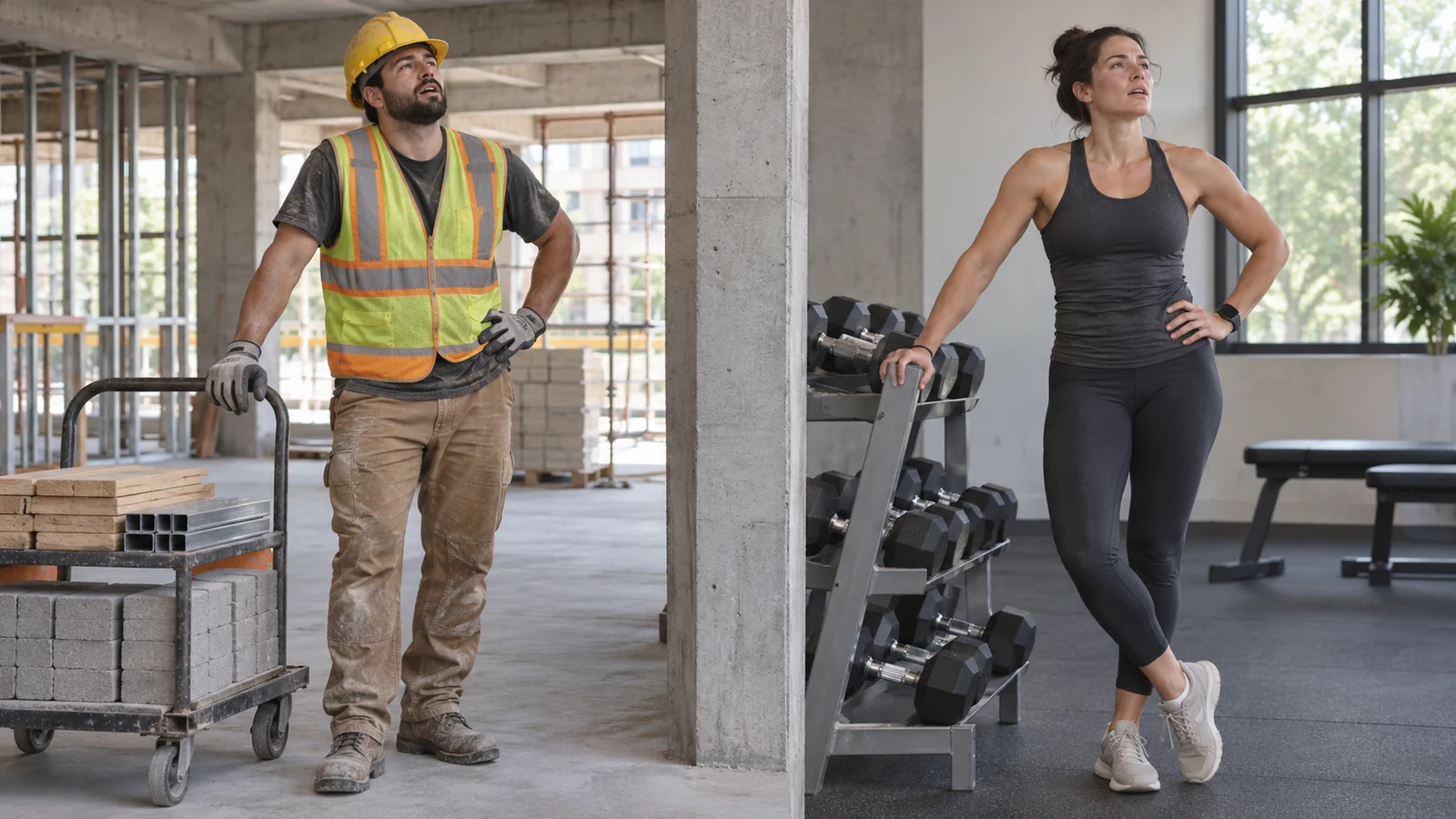
The same step count can hide two very different days
Imagine a ceiling installer making several trips from the staging area before spending a long stretch working with their arms overhead. On another day, the same person takes a brisk walk and chooses when to slow down. Both days could end with the same step count. The watch reading leaves out time spent holding a position, how long each effort lasted and whether the person could pause.
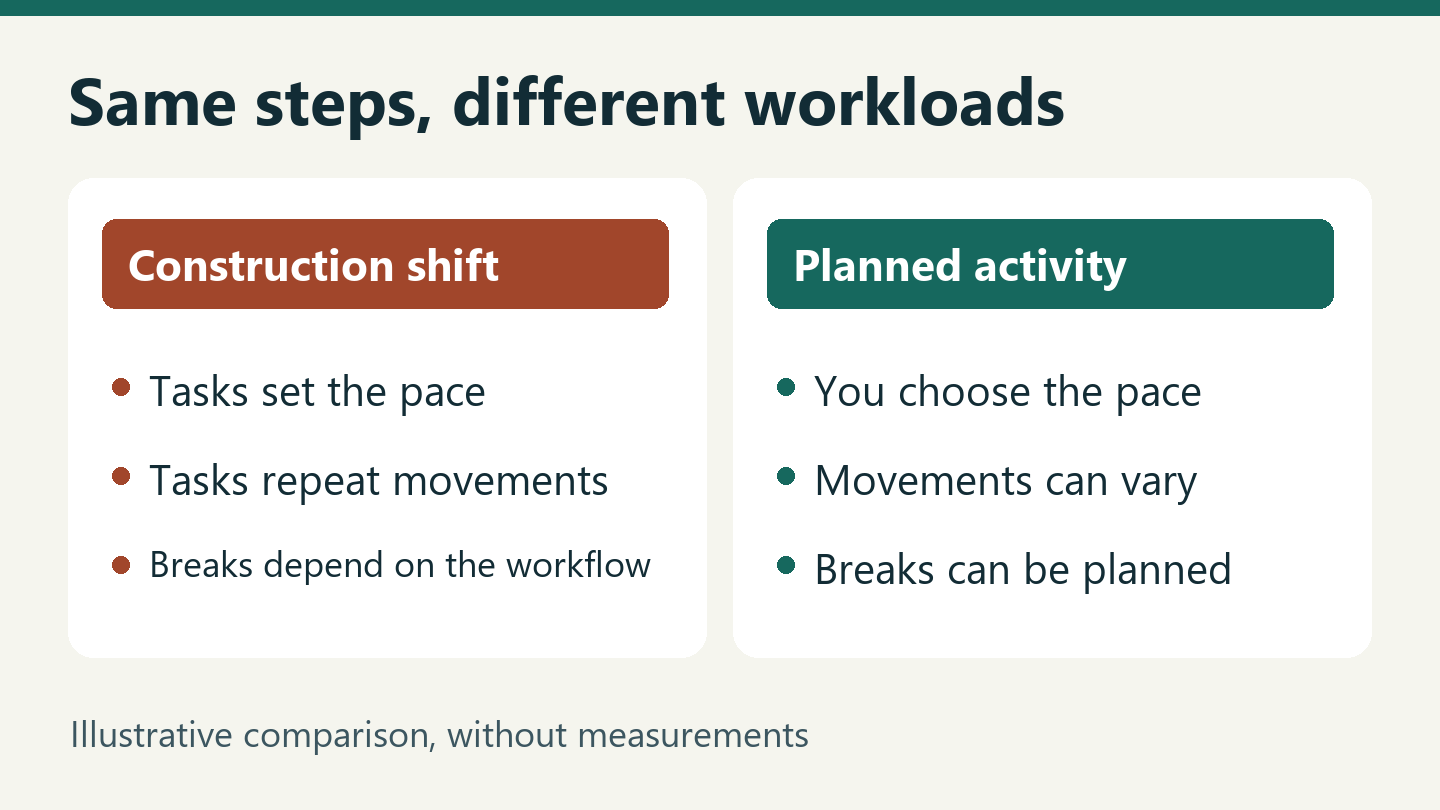
| What changes? | A shift on site | Planned activity |
|---|---|---|
| What sets the pace? | Deliveries, work sequence and the crew’s needs. | The person can shorten a session, slow down or pause. |
| What gets repeated? | Whatever the task requires, such as reaching overhead during installation. | Movements and duration can be chosen for a specific goal. |
| What does a watch capture? | Steps and an estimate of heart rate. Holding a part in position may add almost no steps. | The same readings. The activity log gives them context. |
What researchers measured in construction workers
In a 2016 study by Gram and colleagues, 67 construction workers completed the baseline assessment. Researchers combined questionnaires, instrument-based estimates of energy expenditure from activity and observation of postures and tasks. Mean expenditure per minute was 56.6 J/kg at work and 35.7 J/kg during leisure time. These were group averages over observed periods. The study did not compare a whole shift with a specific gym workout or measure future disease from those workloads. Construction-worker study

Why the Copenhagen and UK results differ
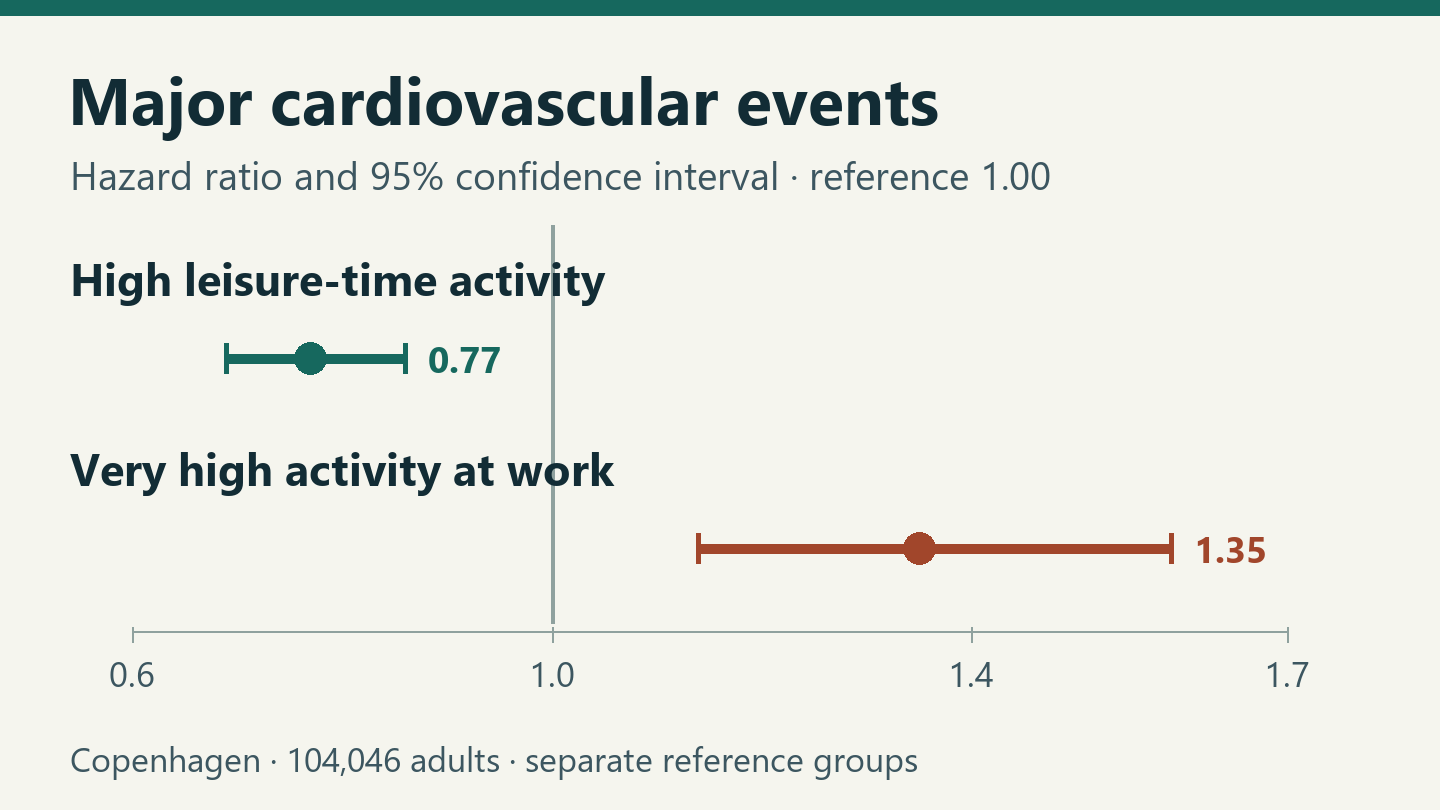
The Copenhagen General Population Study followed 104,046 adults from a range of occupations for a median of about 10 years. High leisure-time activity was associated with a lower rate of major cardiovascular events relative to low leisure-time activity. Very high activity at work was associated with a higher rate of those events relative to low activity at work. Participants reported their own activity levels. The study looked for patterns across groups and cannot establish what caused the differences. Copenhagen cohort
In UK Biobank, among 267,765 people in paid work, researchers found no convincing evidence that all-cause, cardiovascular or cancer mortality differed across levels of activity at work. In Norway’s Tromsø Study, men whose jobs involved walking and lifting had lower observed all-cause and cardiovascular mortality than men in sedentary jobs. The heaviest manual work showed no such association. UK Biobank, Tromsø Study
Studies can assign the same label to jobs that involve a lot of walking, prolonged standing or repeated lifting. Their outcomes can differ, too. The Copenhagen analysis included major cardiovascular events, while the UK analysis followed deaths from specified causes. A 2025 meta-analysis also found that the comparison group mattered. The association between high occupational activity and cardiovascular disease differed depending on whether the researchers used low or moderate occupational activity as the reference. 2025 meta-analysis
What end-of-shift tiredness can tell you
An hour spent reaching overhead can tire your shoulders with very few steps. A long walk may feel demanding in a different way. Try asking, what got tired, during which task and for how long? Those answers help explain a day’s work. Fitness and health take more than an end-of-shift impression to assess.
What site managers can change
Site managers can use the same questions to examine how work is organised. Where crews repeatedly carry supplies across a site, review the staging area, the delivery route and access to carts or suitable equipment. The UK Health and Safety Executive recommends avoiding unnecessary manual handling and using mechanical aids where practical. For an actual site, assess the task and equipment with the people responsible for site safety. HSE construction guidance
An agreed fallback task gives the crew a planned alternative when deliveries are late or site conditions change. How to plan winter construction around crews and deliveries
Try a one-week workload diary
Record the job tasks, how long repetitive work lasted, when there was time to pause and how you felt at the end of the shift and the next morning. In another column, record activity outside work that you could pace yourself. Keep the descriptions simple enough to compare across days. You may notice that the most tiring shift was the one with very few breaks or long periods in one position, even though the watch logged fewer steps. The diary gives you a way to discuss workload with your crew or manager.
Frequently asked questions
Does walking on a construction site count as physical activity?
Yes. The World Health Organization includes movement at work. Step counts can help describe a shift, while intensity, time spent bearing a load and sustained postures provide additional context. WHO
Do I need a gym if I do manual work all day?
The gym is one option for activity you can pace and plan. Walking, cycling and other forms of activity also count. When choosing additional exercise, take your workload, recovery and health into account. WHO
Does a physically demanding job harm the heart?
The studies have mixed results. The Copenhagen study found an adverse association in its highest category of activity at work, while UK Biobank found no clear difference in mortality by occupational activity. Neither provides a personal risk estimate for a given job or worker. Copenhagen cohort, UK Biobank
Related articles
10 Room Measuring Apps for iPhone and Android
Compare 10 room measuring apps in the U.S. stores. Find an AR tape measure, a LiDAR floor plan app or a tool for Bluetooth laser readings.
Tape Measure vs LiDAR: How Far Off Is a Phone Room Scan?
How far off is a phone LiDAR room scan? Compare published dimensions, repeat a three-scan accuracy check and run a separate mirror test.
A Sofa, Bed and Desk in 6 m²? Eight Traps in AI Architectural Renders
A room that looks bigger and a window floating inside a pane. Explore eight AI rendering mistakes, real designers’ examples and checks before you build.