
Fixing a dent in metal is not always possible: you first need to assess the shape of the damage, the condition of the coating, and the purpose of the component. A small, smooth depression can sometimes undergo professional repair without painting. A sharp crease, tear, damaged fastener, or significant deformation requires a separate decision regarding repair or replacement.
For fence slats, facade cassettes, and ceiling panels, a flat surface is not the only priority. After intervention, the geometry, mounting reliability, and metal protection must be preserved. An automotive trick or a video featuring a household hair dryer is not a ready-made instruction for every building panel.
What to Check Before Fixing a Dent
Dents can result from impact, pressure during storage, improper support of a long component, or installation loads. At the same thickness, different profiles, alloys, and coatings behave differently. You cannot always determine from visual appearance alone how stretched the metal is or if hidden damage exists.
- Record the condition. Take general photos and angled-light shots showing the scale and location of the damage relative to edges and fasteners.
- Identify the component. Find the product name, material, thickness, coating type, color, and delivery documents. Do not identify polyester or PVDF by gloss alone.
- Inspect the surface. Distinguish a smooth depression from a sharp crease; look for cracks, peeling, scratches down to the base material, and signs of corrosion.
- Check the assembly unit. Pay attention to edges, locks, joints, and fasteners. For sandwich panels, assess potential damage to the core and its bond to the facing.
- Relieve the load source. Do not begin straightening while the part is pinched by a foreign object, continues to deform, or is insecurely held.
Prior to inspection, you may carefully clean the surface using a method approved for its coating. Do not strip paint, drill access holes, or remove load-bearing elements without an agreed-upon work plan. High-altitude, ceiling, or dangerously secured components require a specialist.

When Repair is Possible vs When Replacement is Considered
| Component Condition | Next Step |
|---|---|
| Smooth local dent, coating appears intact | Assess feasibility of controlled leveling, access to the reverse side, and pulling permissibility for this product. |
| Scratch or localized chip without major deformation | Select an approved touch-up coating system; do not apply random paint based solely on color similarity. |
| Sharp crease, crack, tear, or damaged edge | Do not disguise the defect cosmetically. Submit the component for evaluation; replacement may be more practical than repair. |
| Deformed fasteners, lock, rib, or large panel area | Check the functionality of the entire assembly and safe operation. Manufacturer or designer guidelines are required. |
In the Ruukki manual for SPA sandwich panels, section “Repairing small dents”, p. 5, repairability depends on dent size and location; damage affecting load-bearing capacity requires additional verification. Criteria from this system cannot automatically transfer to a fence slat or another cassette type.
Will a Dent Inevitably Lead to Corrosion?
A shape change alone does not confirm that the protective layer is already compromised. However, the coating must be checked within the deformation zone, especially along sharp bends. Chips, cracks, flaking, and exposed metal require attention; the risk level depends on material, protection state, and operating conditions.
Neither ignore coating damage nor label every small dent an inevitable cause of rust. Inspection and an agreed repair method provide a more solid basis for decisions than universal lifespan predictions.
How Dents Are Straightened While Preserving Paint
Possible approaches include controlled pressure from the backside, suction cups, or specialized glue-pulling tools. The choice depends on profile, access, coating, and deformation type. This does not mean any panel can be pulled out with a household suction cup.
Metl-Span’s Owner’s Maintenance Manual, Section 5 allows assessing paintless dent repair methods based on damage shape and size, recommending a qualified contractor. Major damage may require complete panel replacement. This illustrates a manufacturer’s approach to its own system, not a blanket permission for DIY repairs.
Why You Shouldn’t Start with a Hair Dryer, Ice, or Tape
Heating followed by rapid cooling is not a proven universal repair method for polymer-coated building components. If the material and coating are unknown, do not experiment with a hair dryer or torch. A thickness of 0.4–0.5 mm alone does not guarantee trace-free restoration.
Ordinary adhesive tape is not a substitute for a pulling system. When working with glue or suction cups, consider coating bond strength, prior repairs, and the risk of peeling. Application conditions are determined based on the specific product and tools.
Hammering and Rear-Side Straightening
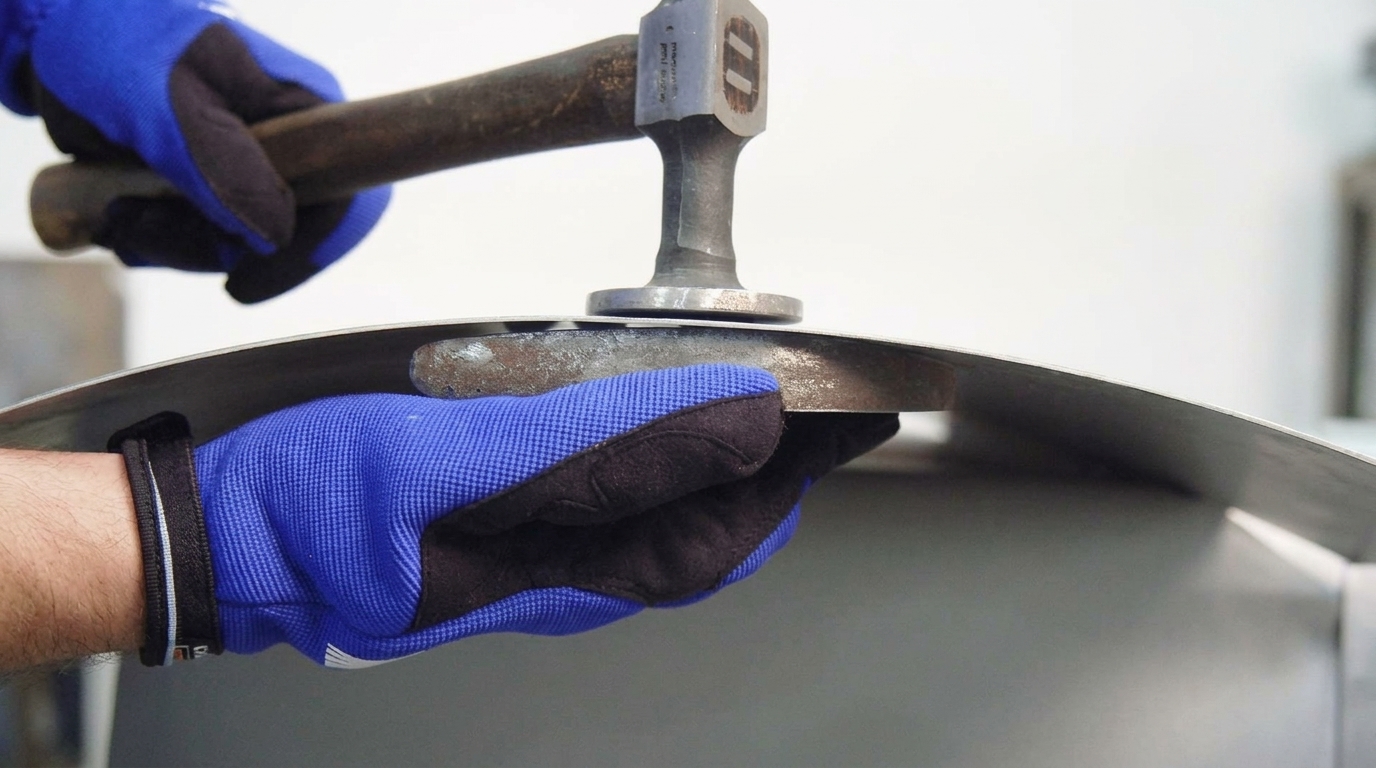
Metal straightening requires appropriate support and controlled force. An impact may cause a bulge, wave, or new mark instead of removing the dent. Even a soft mallet attachment does not guarantee texture and paint preservation.
Do not apply the “hit hard around the edges” rule universally. The sequence of actions is chosen by a technician after assessing deformation. Do not heat a finished panel for supposed universal “metal stress relief”: heat treatment cycles are not determined by a household hair dryer or by eye.
Restoring the Coating After Repair
Touch-up painting, shape restoration, and structural repair are distinct tasks. Paint does not fix a metal crack, and putty does not confirm fastener or panel core integrity.
When local repair is deemed feasible, first identify the coating type and compatible materials. Next, prepare the surface within approved technical limits, remove unstable areas and corrosion if present, and apply the touch-up system according to its technical instructions. Cleaning scope, primer requirements, layer count, and drying times vary between products.
In GreenCoat — Maintenance instructions, pp. 5–6, spot painting differs from full repainting; professional evaluation is recommended for complex coatings. Repair paint may age and shift shade differently than the original factory layer.
Do not strip intact zinc protection with aggressive sanding or select “any anti-corrosion primer.” PVDF, polyester, and powder coatings may require different repair systems. Matching color codes does not guarantee identical gloss, texture, or appearance between old and new surfaces. Read more in our article on sheet metal painting nuances.
How to Inspect Repair Results
- Geometry: no new bulges, waves, or unwanted twisting; the component meets agreed specifications.
- Surface: no visible cracks, peeling, exposed metal, or unassessed damage remaining.
- Assembly Unit: fasteners, joints, locks, and drainage function properly; cosmetic fixes did not replace functional inspection.
- Appearance: shade, gloss, and texture are acceptable under agreed lighting and viewing conditions.
Keep before-and-after photos, repair material specs, execution date, and follow-up inspection recommendations. For general acceptance procedures, consult the article on sheet metal product defects.
Do not relocate a repaired element “out of sight” without checking its condition and compatibility with the new location. Resolve warranty questions prior to work according to specific product documentation. Repair does not automatically guarantee original service life.
What Information to Provide to a Specialist or Manufacturer
Prepare the system and component name, dimensions, known material and coating details, scaled photos, dent location relative to edges and fasteners, description of cause, and reverse-side accessibility. Clarify aesthetic requirements, demountability options, repair order, and acceptance procedures. Attach warranty documents if available.
Frequently Asked Questions
Can a dent be removed without painting?
Sometimes yes, if deformation character, coating condition, and design permit the chosen technique. This is determined by inspection; small size alone does not guarantee success.
Will a heat gun/hair dryer help?
Do not use it as a universal remedy for painted or galvanized panels. Without an approved method, heating and rapid cooling do not constitute a sound repair plan.
Does metal always lose strength after straightening?
Outcomes depend on material, deformation severity, and repair technique. A flat appearance does not prove structural integrity, nor can one conclude that all parts weaken equally.
When is it better to replace the panel?
When an approved repair fails to restore required function or appearance, or when significant creases, tears, or joint damage are present. For load-critical components, decisions should be made with the manufacturer or structural engineer.
Related articles
Laser Metal Cutting: Principles, Capabilities, and Quality
The principle of laser cutting, material and assist gas selection, equipment limitations, and edge inspection. We explain what needs to be confirmed before cutting and subsequent…
Top Façade Insulation Companies in Kyiv (2026): Expert Ranking and Review
Detailed overview of the best façade insulation companies in Kyiv. Comparison of prices, reviews, services, and materials. How to choose a reliable contractor without overpaying.
Where to buy a plot of land?
Buying a land plot is a significant decision that requires a thoughtful approach. You should not rush either at the stage of choosing the land or…