
Painting sheet metal combines protective and decorative functions. To choose the right coating, you need to know the substrate, application technology, operating conditions, and requirements for the final product’s appearance. The same RAL code alone does not guarantee identical gloss, texture, or visual perception of the parts.
The most important thing is to distinguish between pre-painted coil metal and painting already manufactured parts. These are different production routes with their own requirements for surface preparation, coating application, and quality control.
In this article: metal protection · painting technologies · reasons for shade differences · sample approval · quality check.
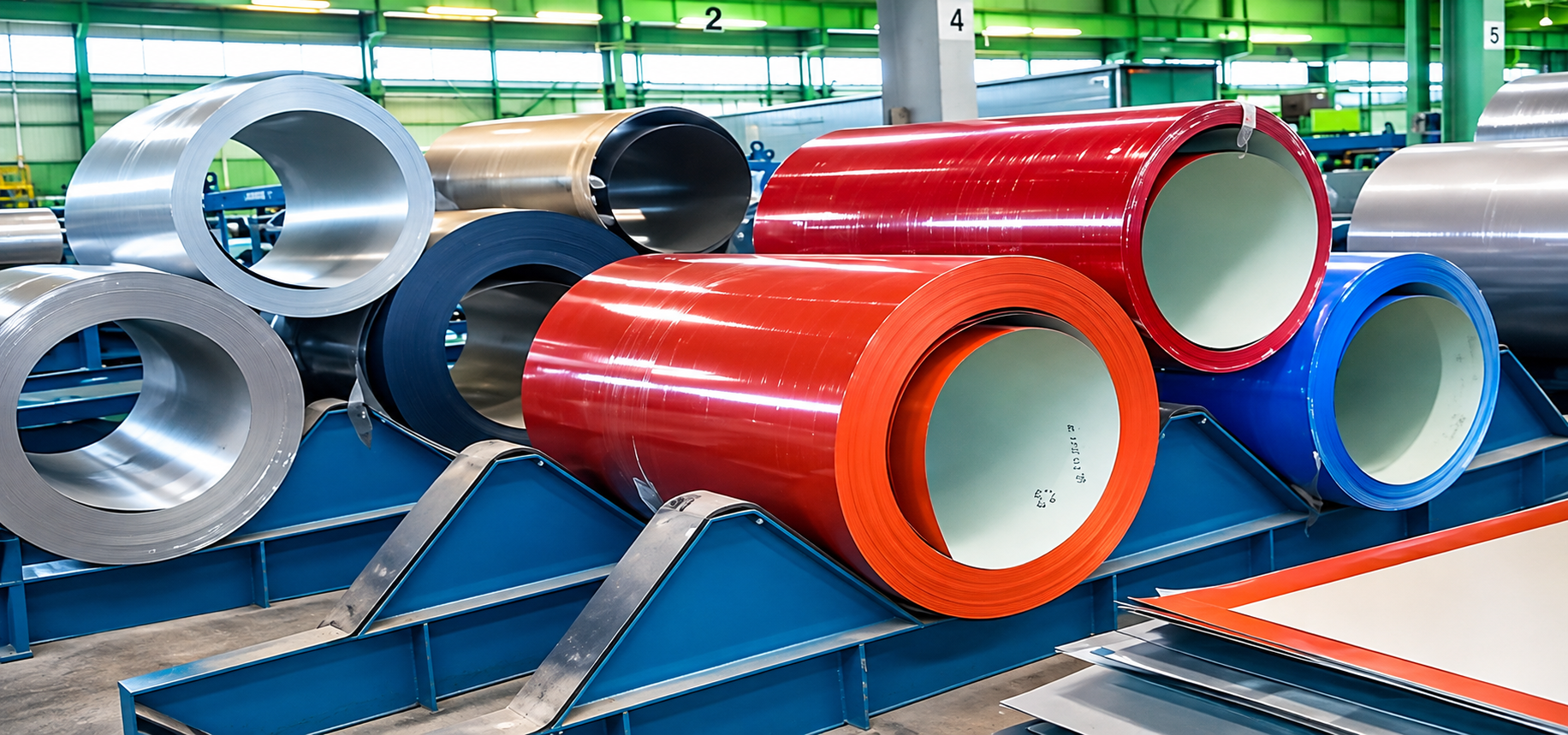
Why paint sheet metal
The coating helps protect the surface and gives it the desired color and finish. For a steel product, the entire system matters: the substrate, the metallic protective coating (if present), surface preparation, and paint layers. You should not evaluate it solely by color.
The claim that galvanized metal will inevitably rust quickly outdoors is incorrect. The result depends on the specific material, environment, coating condition, structure, and maintenance. Similarly, paint does not make damaged edges or poorly executed joints invulnerable to corrosion.
A facade, fence, suspended ceiling, or product in a humid room may require different characteristics. Specify the purpose of the coating system in the documentation, rather than applying the properties of one paint to all polymer materials.
Two technologies not to be confused
Coil coating
In this approach, the metal strip is processed on a continuous line before the final part is manufactured. The process includes surface preparation, coating application, and curing according to the selected technology. After this, the painted material is used for further processing.
The European Coil Coating Association (ECCA) describes coil coating as a method for pre-painting metal. On its overview page, roller application of paint and oven operation are shown among the main operations. Therefore, you cannot describe every colored coil as the result of mandatory powder spraying onto the strip.
If a part is made from a pre-painted sheet, check the material’s suitability for the required bending and profiling, as well as requirements for cutting and surface protection.

Powder coating of parts
Powder coating can be applied electrostatically to prepared metal parts. Further processing depends on the type of powder: a thermosetting system requires an appropriate curing regime. The substrate preparation method and operating parameters are taken from the specific product’s technical data sheet.
For example, the technical data sheet for Interpon 610 AF, pp. 1–2, details electrostatic application, surface preparation, and curing schedules. This is an example of a specific powder system, not a recipe for all sheet metal.
Why there is no single curing temperature
Oven settings and part temperature are not the same thing. The actual heating of the product, duration, and material requirements matter. In PPG’s technical FAQs on powder coating curing, the part’s temperature profile and manufacturing heating differences are discussed separately. The universal rule “bake any sheet at the same temperature” is not suitable for selecting a technology.
Why parts of the same color can look different
Differences in coating appearance do not come down to a single factor. When comparing samples, first check whether not only the color code matches, but also the material, paint system, gloss, and texture.
- Different material batches. A matching color name does not negate potential differences between batches.
- Substrate, primer, and coating thickness. Changing these parameters can affect the final surface appearance.
- Gloss and texture. Matte, glossy, and textured surfaces offer different visual perceptions.
- Application conditions. Process control, rather than just identical paint names, is critical for reproducible results.
- Lighting and inspection. Compare parts side-by-side under agreed conditions, not from photos taken at different times.
For its Interpon 610 AF system, the manufacturer explicitly notes the possibility of batch-to-batch variations and advises using a single batch for parts to be assembled together. It also describes the effect of the substrate, primer, and changes in film thickness. These are recommendations for a specific product, p. 2; they shouldn’t be turned into a promise of absolute identicality for all products.
Application stability is particularly important for effect powder coatings. TIGER’s recommendations on batch-to-batch consistency review the impact of equipment, film thickness, and line parameters. It is best to add parts to an already completed order only after comparing a new sample with the retained standard.
How to approve a RAL color before ordering
The color code is the start of a specification, not a complete finish description. Add the desired gloss, texture, substrate material, coating system, and evaluation conditions to it.
An image on a website helps pick a direction but doesn’t replace a physical sample. In the notes to its digital color library, RAL points out that a digital image is an approximation and advises making the final decision based on a physical color sample. For the finished product, a sample of the exact chosen coating on the corresponding metal is additionally useful.
- Define the finish. Note the color code, gloss, and texture; explain which adjacent elements the product must coordinate with.
- Get a sample. Compare it with the approved standard and materials that will be nearby.
- Record the decision. Identify the sample, agree on comparison and acceptance conditions, and keep a control copy.
- Discuss batches and follow-up orders. Ask for an explanation of how material will be planned for visible adjacent parts and what will be done if a batch changes.
Read more about choosing a color in the article “RAL Catalog: Choosing Colors for Metal Products”. For profiled sheets, it is also important to check the substrate and protection: see the overview of types and coatings of corrugated sheets.
What to check in coating quality
Before acceptance, compare the delivery with the agreed specification and sample. Visual inspection is important but doesn’t prove all coating properties. If necessary, request control or test results specified for the product.
| What to check | What to clarify |
|---|---|
| Substrate | What is the metal, the metallic coating, and surface preparation? |
| Paint system | What is the product name, and for what conditions is it intended? |
| Color and appearance | What code, gloss, texture, and control sample have been agreed upon? |
| Film thickness | What value and control method are set in the documents? |
| Batches | How will the consistency of adjacent parts and follow-up orders be ensured? |
| Surface condition | Are there any damages, peeling, or differences from the approved sample? |
| Maintenance | What cleaning, repair rules, and warranty terms apply to the product? |
Paint thickness is not determined by eye, and proper adhesion is not judged merely by an even color. The inspection method and evaluation criteria must comply with the material and documentation. Do not specify the same coating thickness for every steel, aluminum, or technology.
What to clarify for ordering Mehbud products
Prepare the purpose of the product, installation site, desired color and texture, and details about elements it should coordinate with. Before launching the order, approve the specification and sample with a Mehbud representative.
Conditions for reserving material, using a single batch, follow-up orders, payment, and acceptance must be recorded for a specific order. Prepayment alone is not technical proof that shades will match and does not replace an agreed specification.
Frequently Asked Questions
Is all colored sheet metal powder-coated?
No. Pre-painted coil metal and powder coating of parts are different production routes. The exact technology and coating system must be determined from the supplier’s documentation.
Why can the same RAL look different?
Check the batch, substrate, coating system, gloss, texture, and inspection conditions. A color code alone is not enough to describe all the parameters of the finished surface.
Can I approve a color using a photo on my phone?
A photo is suitable for preliminary selection. Finalize your decision with a physical color sample, and when the finished product’s look is crucial, use a sample of the corresponding coating on the metal.
How can I reduce the risk of shade differences in a follow-up order?
Keep the standard and specification from the initial order. Before manufacturing additional parts, agree on a new sample and comparison conditions. Don’t rely solely on repeating the old RAL code.
Related articles
Thin-sheet metal: main varieties on the Ukrainian market
Use of thin-sheet metal. Forms of metal products. Materials and their features.
Comprehensive Analysis of Occupational Safety in Press Brake Operation
How to ensure press brake safety: optoelectronic light curtains, hydraulic monitoring, and PPE footwear. Complete industrial safety guide.
Digital Transformation of Construction Measurements: An In-Depth Study of Ruler Apps, Spatial Scanners, and Their Impact on Construction Economics
How are AR apps and 3D scanners transforming construction? Explore mobile tools, error economics, and seamless data integration with CAD & BIM.