
The broken window is covered, but the ceiling is wet again after the next storm. Rain might have come through the roof, travelled along a floor slab and emerged across the room. It can also enter at a damaged façade joint above a sound window frame. A stain that keeps growing in dry weather calls for a different investigation, including a check of the building services.
What goes first? Once access is authorised and the building has been assessed, prioritise the opening that is causing the most ongoing damage. If a breach in the roof is soaking several rooms, temporary roof protection generally comes first. If the roof is sound and rain is entering through broken windows, protect those openings first. A qualified team may protect both in parallel when the condition of the building and the work plan allow it.
First steps after a building is damaged
Follow the emergency services’ directions on access. After conflict-related damage, keep clear of suspicious debris and report it from a safe location using the local emergency number. Permission to enter for a survey and clearance to live or work in the building are separate decisions. Leave damaged electrical and other building services to qualified personnel. Ukraine’s emergency service guidance after shelling
When it is safe to document conditions, record the room, floor, date and when the damp appeared. For an apartment block, collect observations on a single floor-by-floor plan. A vertical band of damp across several floors can help surveyors decide what to investigate first. Keep the records needed by the relevant authority or insurer. In Ukraine, emergency works and condition surveys follow separate procedures, and housing owners can also check the applicable reporting and compensation arrangements. Emergency works in Ukraine · Building surveys in Ukraine · Ukraine’s housing recovery programme
Where did the water come from?
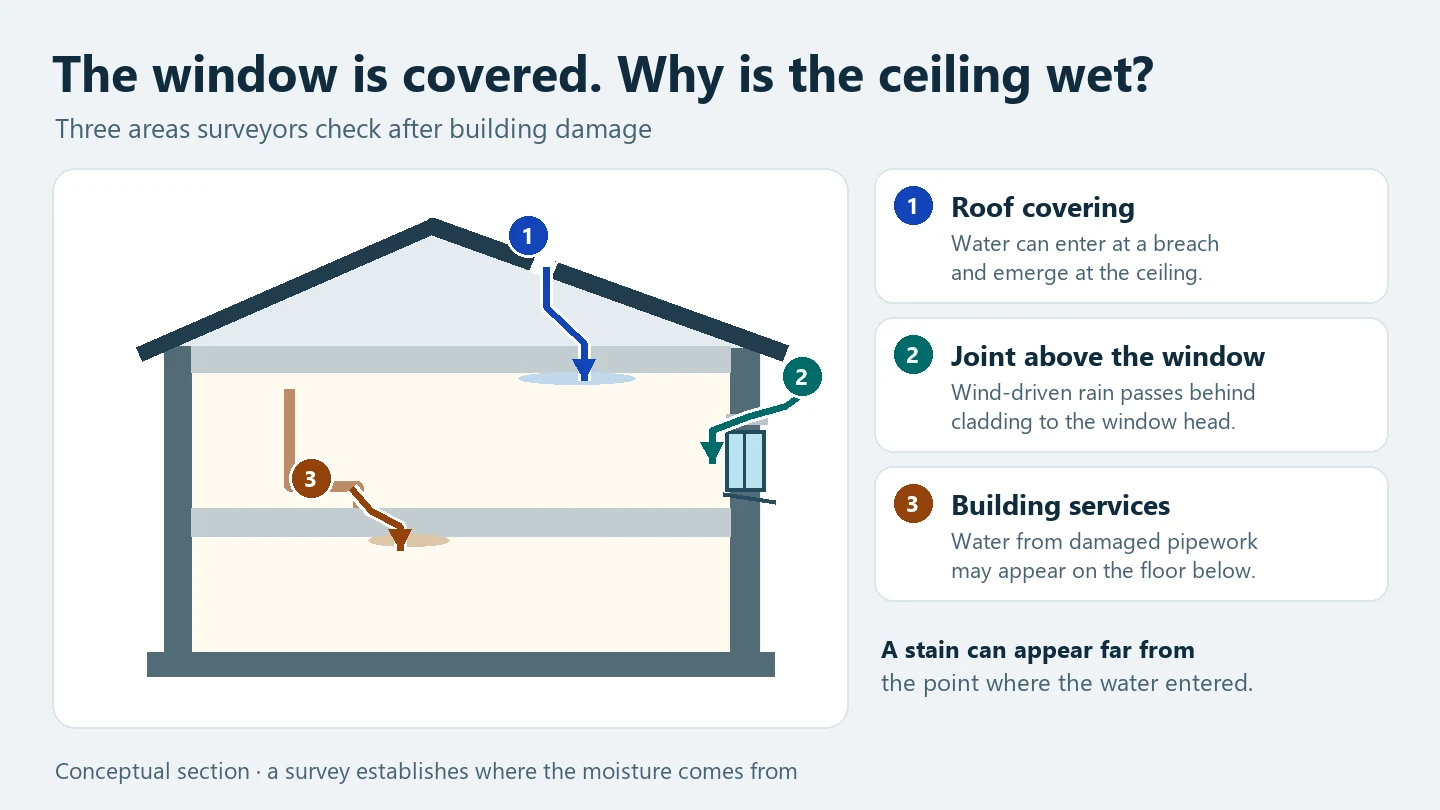
Roof coverings and roof-to-wall junctions
A roof breach, a damaged parapet junction or a service penetration can admit rain. Once beneath the outer layer, water may travel within the roof assembly or along a slab. Compare the timing and position of fresh stains with rainfall, wind direction and the roof plan. Building Science Corporation on rain penetration
The façade joint above the window
Wind-driven rain can get behind cladding and appear at the top of a window reveal even when the frame closes securely. A surveyor checks what happens above the opening and where the sill flashing discharges. If the adjoining façade is damaged, coordinate the repair of the entire junction. Window, base and parapet details for ventilated façades
Pipework and condensation
A new stain below a bathroom after water use points towards a plumbing check. Droplets on a cold surface during a period of high indoor humidity point towards a different diagnosis. Note what happened before the damp appeared and report it to the surveyor. Guidance on moisture and indoor damp
How repair teams set priorities
| What the initial survey finds | What the specialist checks | Possible first action |
|---|---|---|
| Roof damage and damp in several rooms | Structural condition, water paths and the affected area | Temporary weather protection and control of rainwater runoff. |
| Rain enters through broken windows below a sound roof | Condition of the opening, fixings and adjacent wall | Close the openings temporarily, accounting for ventilation and access. |
| Damage to the roof, façade and windows | Exposure and whether teams can work safely in parallel | Protect the affected areas in stages or in parallel; coordinate permanent junction repairs. |
| Visible distortion or suspected failure of building services | Access restrictions and any emergency measures | Emergency services or qualified specialists direct the response. |
Temporary protection buys time. Assign someone to check it after severe weather and to adjust the plan if materials are delayed. Permanent repair connects the parts. Set out who owns the roof-to-parapet junction, window perimeter, sill flashing and drainage. Before closing up, confirm the source has been addressed, check hidden areas and agree which materials can dry in place or need replacement. EPA guidance on managing water damage
Irpin, Ukraine: two apartment blocks restored
In December 2024, UNDP reported the restoration of two eight-storey apartment blocks that had been severely damaged by Russian shelling early in the full-scale invasion. Across the two buildings, 60 flats were damaged and 20 needed full restoration. Supported through UNITED24 with UNDP technical assistance, the work covered roofs, façades, utility systems, some insulation work, and new doors and windows. UNDP’s report on the Irpin restoration
The report lists the completed work without specifying the order in which the roofs and windows were repaired. For property managers, the useful lesson is to schedule work on shared components and inside flats together. If different contractors supply the windows, insulation and roofing, specify who must complete and sign off the junctions between their work packages.
What changes for homes, public buildings and businesses?
| Building | What to organise early | What to check before reopening |
|---|---|---|
| Single-family home | Survey the roof, attic and building services. Identify habitable areas that need temporary weather protection. | The condition of the structure and services, the results of drying and whether heating can be used safely. |
| Apartment block | Name a lead for the building, map damage floor by floor and establish one channel for residents. | Shared structures and services, safe routes, and readiness of common areas and affected flats. |
| Library or public service centre | Arrange temporary premises or an alternative way to deliver services and inform visitors. | A safe, accessible entrance, working building services and an agreed reopening plan. |
| Office, shop or warehouse | Define the restricted, repair and operating areas. Arrange stock and equipment protection. | Safe exits, functioning essential systems and any approvals needed to reopen in phases. |
Illustrative example. After a storm, a warehouse loading area is wet and two office windows are broken. The manager agrees the restricted area with the survey team and the logistics team arranges an alternative delivery point. Once the survey is complete, contractors protect the loading-area roof and close the office openings if the jobs can run together. The designer coordinates permanent junction details, specialists test affected equipment, and the manager arranges an inspection after rain.
Lessons from reconstruction in Bosnia and Kosovo
Bosnia and Herzegovina. The World Bank records that its emergency housing repair project repaired more than 650 public apartment buildings, benefiting roughly 17,500 flats. The building is a useful unit of recovery planning: decide which repairs to roofs, façades and common services belong in a shared contract, then coordinate the work needed inside individual homes. World Bank project summary
Kosovo. In 1999, UNHCR reported distributing basic shelter kits intended to weatherproof one room temporarily before winter. They addressed roof openings and broken windows. The transferable lesson is to plan an emergency weather-protection stage with an owner and a clear handover into permanent works, subject to site assessment and safe access. UNHCR’s Kosovo crisis update
A checklist for the owner or property manager
- Map the damage. Include dated photographs, room and floor references and information about recurring damp where available.
- Record the survey decisions. List access restrictions, temporary measures and any works that require a designed solution.
- Assign the junctions. Identify who will coordinate window heads and sills, roof edges, parapets, drainage and service penetrations. Agree when concealed work will be inspected.
- Plan procurement and drying together. Build in material deliveries, access arrangements and a follow-up check after rain.
- Agree the handover evidence. Specify the inspection records, photographs and service-check results the client should receive.
Where the assessment supports local façade repairs, a fabricator can help match replacement sill flashings, parapet caps, trims or metal cassettes to the agreed details. Provide drawings, dimensions and finish requirements. Mehbud architectural metal systems · Selective replacement of metal façade cassettes
Frequently asked questions
Can permanent windows go in before the roof is finished?
Sometimes. The team must confirm the condition and geometry of the opening, control the risk of further water entry and coordinate the detail with the future façade. Temporary closure may be appropriate while those decisions are pending.
Will replacing the sill flashing stop a leak at the window?
It can if the survey confirms the flashing was the source. If moisture first appears above the frame, check the window head, the adjacent wall and the roof above the opening.
When can the ceiling be refinished?
After the source is resolved, concealed areas are checked and the condition of the affected materials is confirmed. Damaged building services require a separate check by qualified personnel.
Recovery starts with concrete jobs: keep a room dry through the next storm, return a family to its home or reopen a facility a community relies on. Residents, designers, manufacturers and installers each bring something different to that work. In Ukraine, every safe return is part of a much larger effort. We stand, we fight, we rebuild. We will prevail.
Related articles

Winter Warehouse Heat Loss: Loading Docks, Insulation and Backup Power
Measure dock door use, review warehouse heating and insulation, detail the wall base and plan backup power for heated and refrigerated storage.
0.45 mm Metal Thickness: Where It Is Used and How to Check It
When 0.45 mm metal is suitable for fencing and cladding. Weight comparison with 0.4, 0.5, and 0.7 mm, thickness verification, coatings, and tips before ordering.
Facade Siding: Structure, Types, and Selection Criteria
How to choose siding for a house: wood, WPC, vinyl, metal, and fiber cement. Comparison, panel calculation, installation, maintenance, and FAQs.