
0.45 mm thick metal is used for profiled fence slats, individual facade elements, and flashing components. It is chosen when the profile geometry and fastening layout provide the required rigidity at an acceptable weight and cost. The suitability of this thickness is verified for each specific product based on its dimensions, loads, and operating conditions.
When comparing quotes, ask what exactly “0.45 mm” refers to in the specification, what coating is applied to the steel, and how the product is installed. Below, we examine the difference between sheet thickness and the rigidity of the finished structure, calculate the weight, and provide a pre-purchase checklist.
Where 0.45 mm metal is used
Examples can be found in the current Mehbud product range. For the Polisad fence, the manufacturer specifies a 0.45 mm option as well as the option to order 0.7 mm. For the Mehbud Double fence, 0.45 mm is also listed. These figures refer to the product models. Section height and width, post spacing, and fasteners are agreed upon in the order specification.
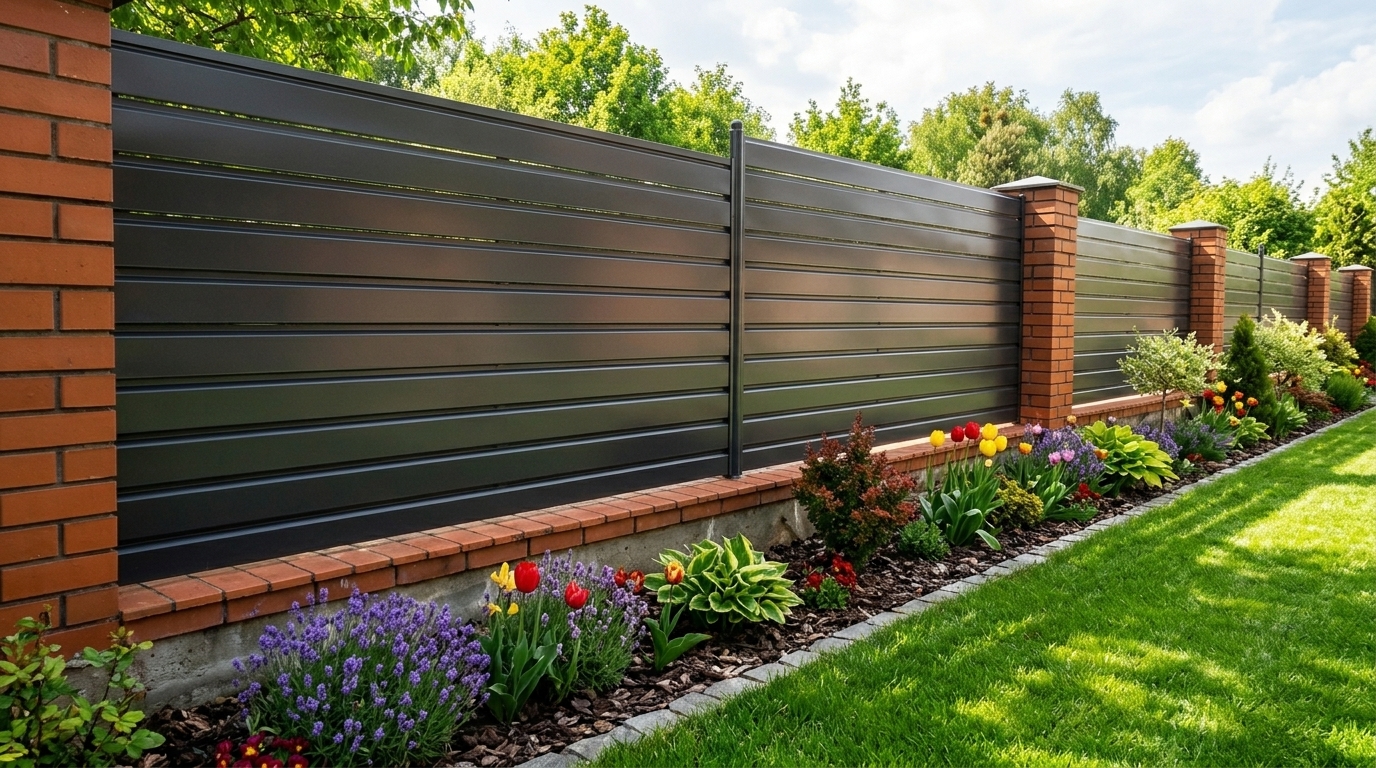
A 0.45 mm sheet is easy to roll-form into profiles with bends and stiffening ribs. This creates the desired slat pattern while reducing cladding weight. For long, wide components, exposed windy sites, or areas prone to impacts, you need to verify the allowable configuration and, if necessary, adjust the thickness, profile, or support layout.
What the stated 0.45 mm thickness means
A coated sheet consists of several layers. A typical structure includes a steel substrate, a metallic protective layer, pretreatment layers, and an organic coating. Therefore, clarify with your supplier whether the stated figure refers to the base metal thickness, the sheet with metallic coating, or a measurement including paint. In the SSAB GreenCoat Crown BT steel specifications, for example, paint coating thickness is listed separately from steel thickness and zinc coating weight.
The ArcelorMittal tolerance tables for flat products specify different tolerances depending on the product type, thickness, width, and other conditions. For galvanized steel sheet, verify the standard and tolerance class stated in the documentation. Agree on these parameters before ordering so that the nominal value, actual measurement, and allowable deviation share the same baseline for comparison.
How to check thickness upon delivery
- Request the material certificate and batch labeling. Verify the thickness, steel grade, and coating type against the specification.
- Use a calibrated micrometer with sufficient accuracy for the agreed inspection. Clean the surface of any debris and measure on a flat area.
- Agree on the number and locations of measurements in advance. Bends, burrs, or overlapping layers at lock seams will distort a single-sheet thickness reading.
- If the measurement is taken over the coatings, compare it against the corresponding total thickness value. Determining the base metal thickness requires an agreed method or laboratory testing.
0.4, 0.45, 0.5, or 0.7 mm: how weight changes
For a reference comparison, let’s take a steel density of 7850 kg/m³, which ArcelorMittal uses in weight calculations for steel profiles. The weight of a flat steel substrate per square meter equals its density multiplied by its thickness in meters. At 0.45 mm, the calculation yields 7850 × 0.00045 ≈ 3.53 kg/m².
| Base metal thickness | Calculated weight of 1 m² flat steel |
|---|---|
| 0.40 mm | 3.14 kg |
| 0.45 mm | 3.53 kg |
| 0.50 mm | 3.93 kg |
| 0.70 mm | 5.50 kg |
This example accounts only for the steel substrate of the specified thickness. Coatings and fasteners add to the weight of the finished product. After roll-forming, the surface area of the raw sheet also differs from the visible coverage area of the facade or fence. To calculate support loads and shipping, use the finished kit weight provided by the supplier.
For the same area and material, stepping up from 0.45 to 0.50 mm adds roughly 11% to the base metal weight, while moving to 0.70 mm adds about 56%. The price of a finished section also varies due to coatings, profile geometry, cutting waste, and accessories. For an accurate comparison, request quotes for identical dimensions and specifications.
What determines slat rigidity
Thickness works in combination with steel grade, cross-sectional shape, component length, and support spacing. For instance, a narrow profiled slat and a wide flat panel made from the same sheet perform differently under load. Request a cross-section drawing and the approved installation layout for your chosen dimensions.
For a fence on an open site, verify wind loads, post spacing, and section fastening methods. For a facade, also check corner zones and abutments. A panel can still dent from a localized impact even when properly fastened. If vehicles park nearby or garden equipment operates close to the structure, discuss lower-zone protection and individual slat replacement options.

Coatings, corrosion, and maintenance
Request separate specifications for the metallic protective layer and the polymer coating. The SSAB galvanized steel specifications explain how the corrosion protection of a metallic coating depends on its thickness. The 0.45 mm figure alone says nothing about surface corrosion resistance. Confirm warranty terms for your specific environment, especially near roads, swimming pools, or industrial facilities.
During installation, remove metal shavings from the panels and document any coating damage. Treat cut edges and perform touch-ups using compatible materials in accordance with the manufacturer’s instructions. The SSAB maintenance instructions for color-coated steel cover inspection, cleaning, and repairing damaged areas. For more on surface preparation, read the article on painting thin-gauge sheet metal.
Where separate structural verification is required
Load-bearing elements. For posts, trusses, purlins, and substructures, thickness and cross-section must be determined by structural calculation. Cladding slat specifications cannot simply be carried over to the framing. If the project includes slotted thermal steel studs (thermo-profiles), their impact on thermal bridging and load-bearing capacity must be verified for the specific wall assembly.
Welding. For 0.45 mm sheet metal, the joining method and restoration of the protective layer must be approved in advance. Thin sheet is prone to burn-through and warping, and hot work on galvanized steel generates hazardous fumes. HSE welding safety guidelines require proper fume extraction and worker protection. The joining technique should be selected together with the manufacturer or a welding engineer.
Aluminum composite panels. In composite panels, the aluminum skin thickness and total panel thickness are separate parameters. When comparing options, also ask about the core type, weight, and fire-rating documentation for the specific product. For a facade system, every component matters, including insulation and fasteners.
What to clarify before ordering 0.45 mm metal
- Product name, overall dimensions, cross-section drawing, and effective coverage width.
- What the stated thickness includes, as well as the applicable standard and tolerances.
- Steel grade and specifications for both metallic and polymer coatings.
- Allowable dimensions, support spacing, fastening layout, and design operating conditions.
- Finished kit weight, warranty terms, maintenance guidelines, and acceptance inspection procedure.
For a site with non-standard loads, send the supplier photos, dimensions, and a description of the operating conditions, then compare the proposed configurations against those inputs. Pay as much attention to documentation compliance as to thickness: the article on construction product documentation provides a checklist of details to verify.
Frequently asked questions
Is 0.45 mm metal suitable for a fence?
Yes, provided the specific model in this thickness is engineered for the required dimensions and site conditions. Confirm the post spacing, profile, fasteners, and wind load.
Is 0.5 mm always better than 0.45 mm?
Greater thickness increases the base metal weight, whereas required rigidity is evaluated alongside profile geometry, span length, and support spacing. Compare identical models using their technical documentation.
Is the paint layer included in the metal thickness?
This must be confirmed in the specification. Measuring a finished painted component includes coating layers, so the reading should be checked against the corresponding total thickness value and test method.
How much does a square meter of 0.45 mm steel weigh?
For a flat 0.45 mm steel substrate at a density of 7850 kg/m³, the weight is approximately 3.53 kg/m². A finished profile with coatings, fasteners, and lock seams has its own weight listed in the product datasheet.
Can a 0.45 mm slat deform?
Yes, particularly from impacts, excessive loads, or an improper fastening layout. Staying within allowable dimensions, using proper supports, and following maintenance guidelines are essential.
Related articles
Facade Siding: Structure, Types, and Selection Criteria
How to choose siding for a house: wood, WPC, vinyl, metal, and fiber cement. Comparison, panel calculation, installation, maintenance, and FAQs.
Marble in Construction: Applications, Selection, and Care
How to choose natural marble for facades, flooring, kitchens, and bathrooms. Comparison with granite and porcelain tile, architectural examples, installation rules, and maintenance guidelines.
TOP Perfume Stores in Ukraine: Analysis of Architecture, Design, and Engineering Solutions
Analysis of top perfume stores in Ukraine: architecture, design, lighting, and engineering solutions of flagship stores like BROCARD, EVA Beauty, and Aromateque.