Rooftop Enclosures for Ventilation Ducts
Generic selectors
Exact matches only
Search in title
Search in content
Post Type Selectors

Rooftop Enclosures for Ventilation Ducts

June 26, 2026
659  

Massive ventilation and climate control equipment is traditionally installed on the roofs of modern residential complexes, shopping and entertainment centers, industrial enterprises, and administrative buildings. This can include chillers, remote condensing units, multi-split VRF/VRV systems, air handling units, rooftop air conditioners (rooftops), and powerful exhaust fans. Such placement is driven by technological necessity: it saves useful internal building space, minimizes noise and vibration levels inside the premises, and provides direct access to outdoor atmospheric air for efficient heat exchange and ventilation.

For a long time, such expensive equipment was placed completely in an open manner, mounted directly onto the load-bearing frames or reinforced concrete foundations of the roof. However, harsh operational practice has shown that under the influence of aggressive external factors, climate control equipment fails prematurely, requires frequent costly repairs, and loses its original energy efficiency. Recently, owners of commercial and residential properties, seeking to protect their investments, prefer to place ventilation ducts, outdoor units, and climate control installations in special protective casings, screens, or other enclosing structures.

A single strict state standard for the design and construction of such structures on roofs has not yet been established in construction practice — each solution is often developed individually for a specific object. Nevertheless, the operational experience of hundreds of facilities clearly proves that using metal blinds panels allows designing and constructing a protective casing that will be as effective as possible. Such an engineering solution not only guarantees reliable protection of high-tech climate control equipment from any atmospheric and mechanical influences, but also maintains optimal conditions for its standard operation.
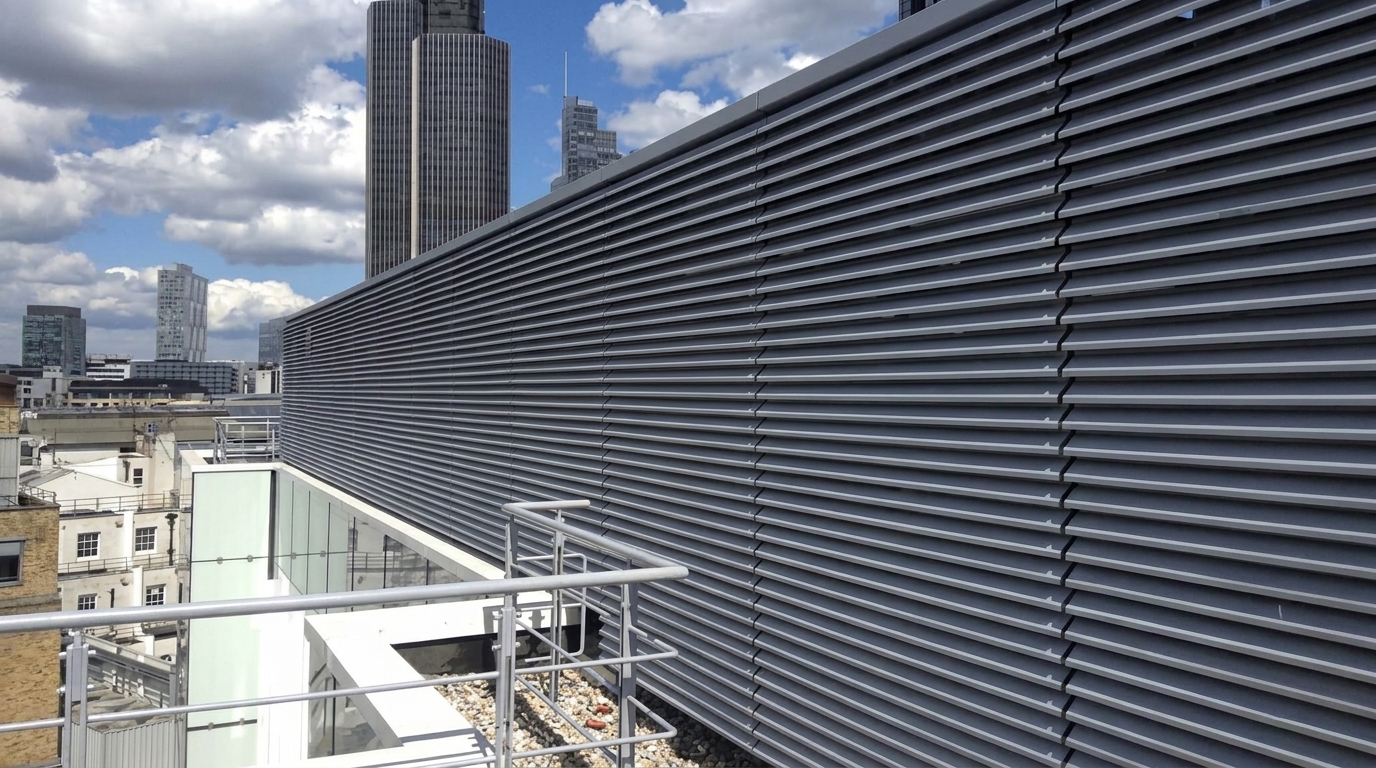
Современный фасад здания с горизонтальными металлическими жалюзи на фоне городских небоскрёбов и облачного неба

Requirements for a Protective Engineering Structure on the Roof

With open, unprotected placement on the roof, ventilation ducts, electromechanical nodes, and precision climate control equipment suffer primarily from excessive moisture (rain, downpours, melting snow, icing), which inevitably becomes the main cause of deep corrosion of metal elements, oxidation of automation contacts, and destruction of duct thermal insulation. In addition, gale-force winds, sharp temperature drops, and direct ultraviolet rays also cause colossal damage to the external contours of the equipment, causing deformation of elements and cracking of rubber seals.

Urban and industrial dust, along with accompanying debris (dry leaves, branches, poplar fluff, bird droppings), also becomes a crucial negative factor that significantly reduces the standard service life of the equipment and decreases the overall efficiency of ventilation. Small abrasive particles and fluff penetrate the moving elements of ventilation units (bearings, impellers), settle on the lamellas of heat exchanger radiators, and rapidly clog air filters. This leads to a critical growth in aerodynamic resistance, compressor overheating, a sharp drop in system efficiency, and an avalanche-like increase in power consumption.

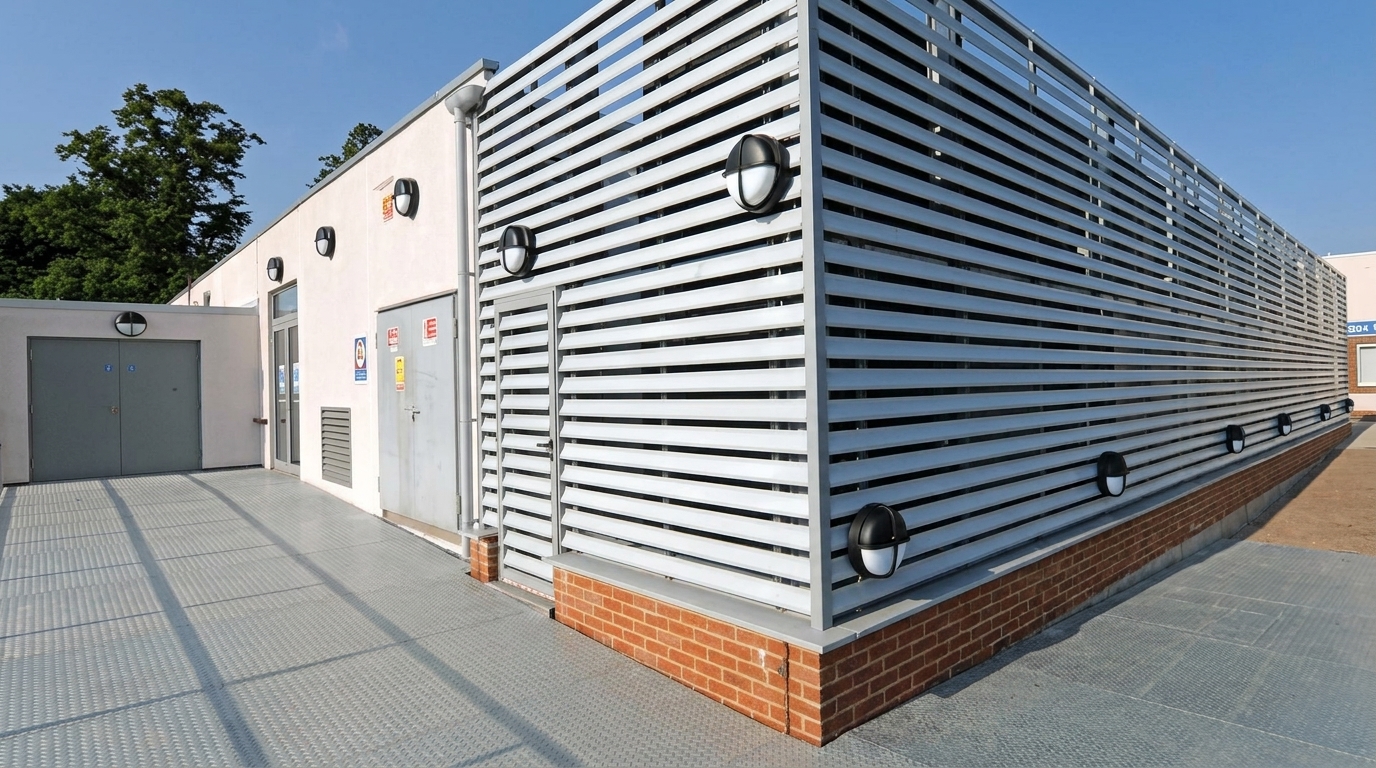
Техническое здание с металлическими жалюзийными панелями, наружными светильниками и площадкой из рифлёного металла

It is possible to mitigate or completely eliminate the destructive impact of these factors by designing and installing specialized protective and decorative enclosures. A whole complex of strict engineering and technical requirements is imposed on such structures:

  1. High mechanical and wind strength. The enclosure must be guaranteed to withstand extreme wind loads. The higher the number of stories of the building and the overall height of the roof above ground level, the more powerful the airflows and wind pressure acting on the structure.
  2. Minimum dead weight (lightness of construction). The protective screen must not create a critical additional static load on the roof slab, load-bearing beams, columns, and building foundation. The use of heavy building materials (brick, concrete, solid blocks) on roofs is most often unacceptable due to safety considerations.
  3. Simplicity and high speed of installation. The structure must be assembled quickly in the limited space of the roof, without using heavy construction equipment or large-scale welding works that could damage the roof’s waterproofing membrane.
  4. Aesthetic and harmonious appearance. Modern architectural requirements mandate hiding unsightly technological units. The enclosure should serve as an element of facade design, matching the color and texture of the overall building concept.
  5. Impeccable air permeability. This is the key and most complex technical point. It is strictly forbidden to block or restrict free access of fresh air to ventilation ducts and outdoor air conditioning units. Air intake must be constant, and the removal of exhaust hot masses must be unhindered.

Attempts to build solid blind walls around climate control blocks lead to equipment ‘suffocation,’ the formation of thermal stagnation zones, and system shutdowns due to emergency pressure. That is why engineers have to find compromise solutions: the protective casing must reliably cut off external moisture, dust, and wind, yet allow airflows to pass through with a minimal aerodynamic resistance coefficient.

One of the most balanced, economically justified, and technologically advanced solutions today is the use of specialized metal blinds panels.

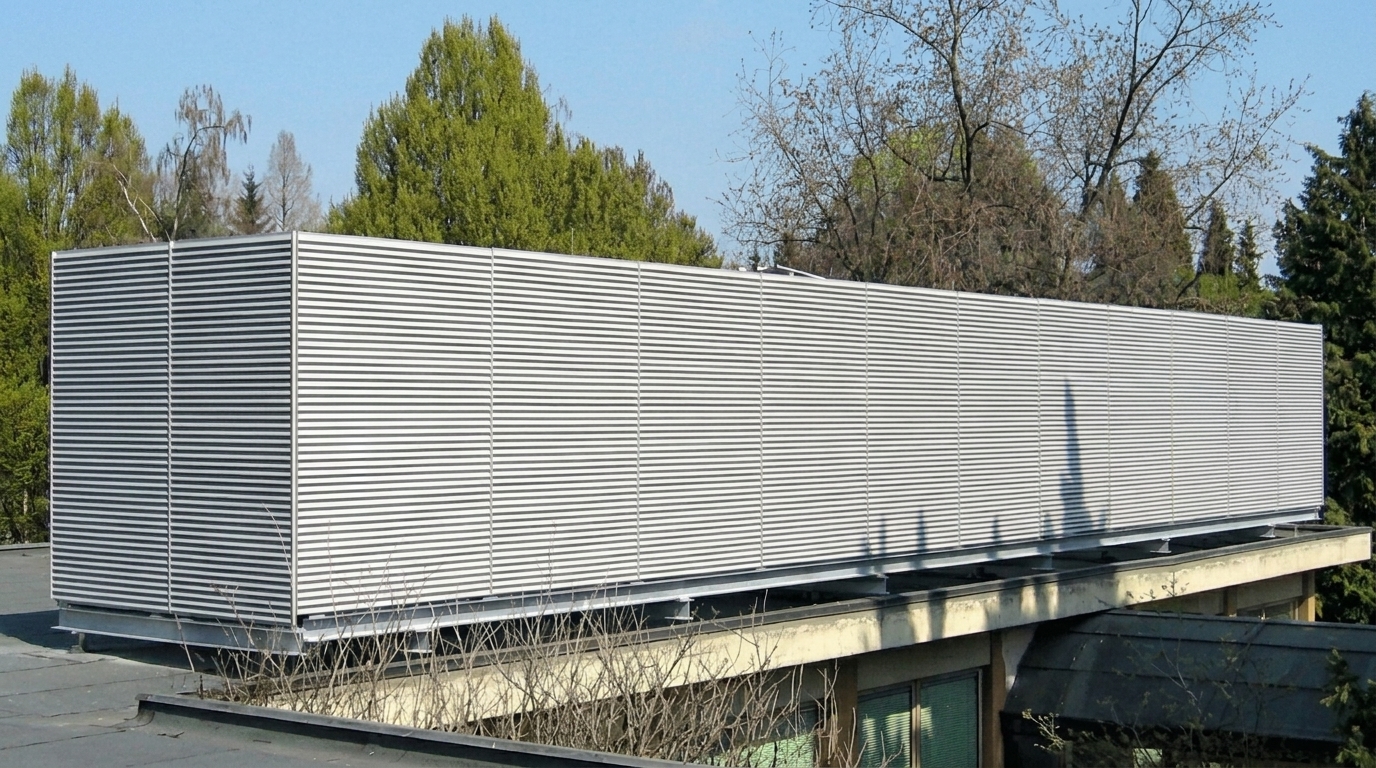
Металлический шумозащитный экран с горизонтальными ламелями на крыше здания среди деревьев

Comparison of Options for Protecting Roofing Equipment

Efficiency Criterion Open Placement Solid (Blind) Screen «MehBud» Blinds Enclosure
Protection against precipitation and UV None (maximum wear) Full protection Full protection (lamella tilt)
Free air intake Ideal Critically disrupted (overheating) Optimal (natural ventilation)
Load on floor slabs Zero High (requires reinforcement) Minimal (lightweight metal)
Building aesthetics Spoils the appearance Bulky appearance Modern premium design

Design of the Enclosure Based on Blinds Panels

The engineering protective enclosure filled with metal blinds panels features a carefully thought-out, rigid, and at the same time simple-to-assemble modular design. It consists of several basic functional elements:

  1. Load-bearing power frame. The base of the entire structure is made of high-quality profiled steel pipe with a rectangular cross-section or thick-walled metal angle. The frame undergoes mandatory anti-corrosion treatment and powder coating under factory conditions. The finished spatial frame is securely attached to the concrete roof slab using expansion or chemical anchor bolts, ensuring absolute resistance to tearing out during hurricane-force winds. In cases where metal embedded elements tightly linked to the building’s reinforcing belt are included in the design, fixing the frame by arc welding followed by thorough waterproofing of the joints is permitted.
  2. Protective and ventilated infill. Long metal lamella panels, profiled on specialized machines of the «MehBud» plant, are used as the wall infill for the sections. The lamellas are made of galvanized steel with a final protective and decorative polymer coating (polyester, matte polyester, or pural). The unique diagonal placement of the lamellas at a strictly calculated angle ensures the so-called ‘blinds effect’. Due to this, the geometry of the panels effectively diverts rainwater and wet snow outwards, creating an insurmountable barrier against direct wind flows, large dust fractions, flying debris, and prying eyes. At the same time, the technological gaps between the lamellas guarantee a stable, continuous volumetric access of fresh cooling air to the equipment.

Important to know! Constant natural ventilation through the lamellas of the blinds panels completely eliminates the risk of air mass stagnation, overheating of climate control equipment, and prevents harmful condensation accumulation on any internal surfaces of the equipment and electronic control boards.

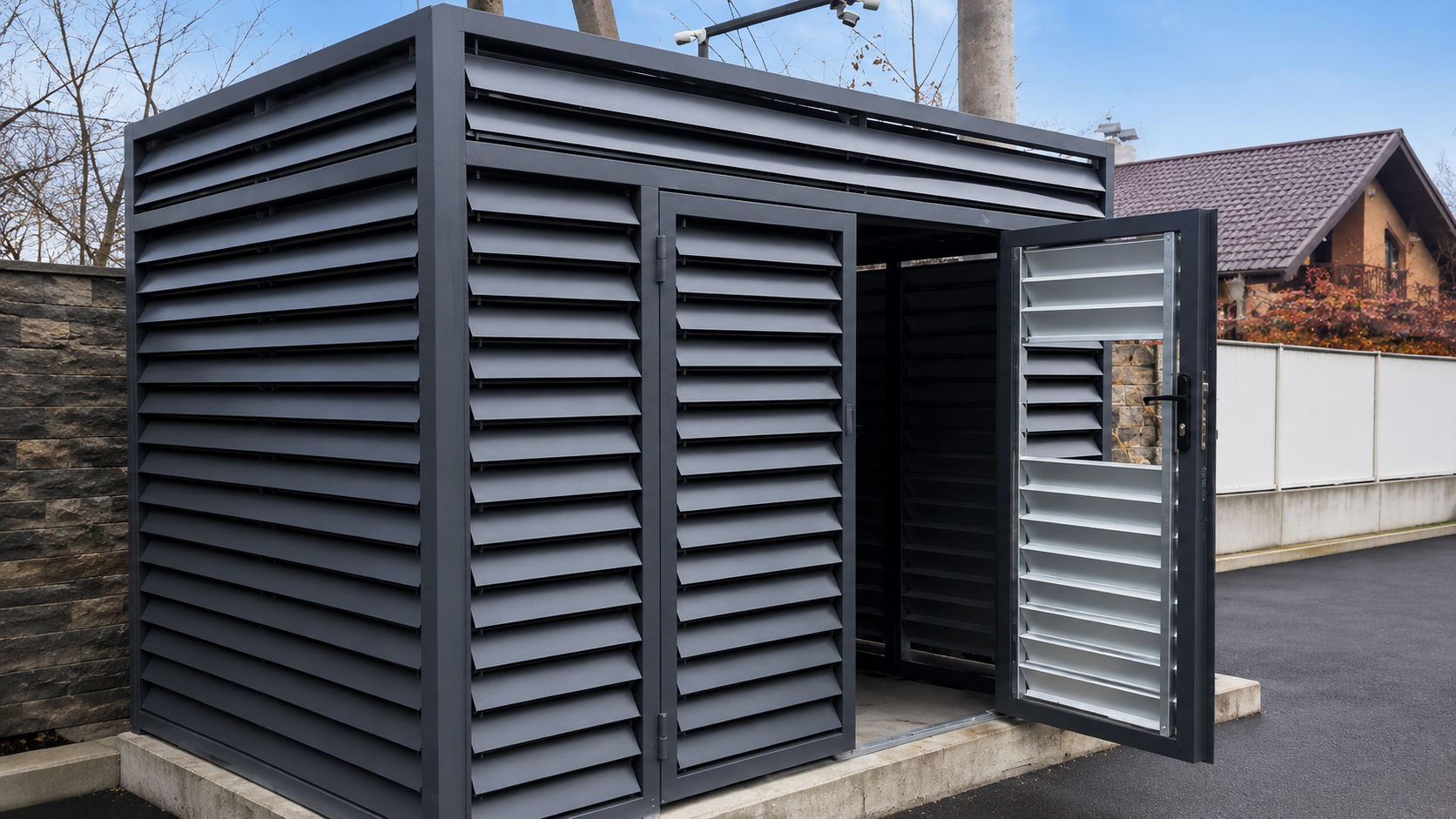
  1. Inspection zones and technological access. To carry out regular maintenance, routine inspection, cleaning, or emergency repair of ventilation ducts and air conditioning units, a service passage is mandatory within the perimeter of the enclosure. It is closed with a swing door or a gate. The door leaf infill is made of the same blinds panels to maintain the overall style and ventilation properties. The door is equipped with a reliable lock with anti-vandal protection and ergonomic hardware, which completely blocks unauthorized access of outsiders to the protected technological perimeter.

The overall spatial configuration, height, length of sections, and dimensions of the entire structure are selected individually, taking into mandatory account the overall dimensions of the ventilation equipment, the minimum allowable technological clearances (service exclusion zones) specified in the manuals of the climate control equipment, and the architectural features of the roof. The full range of work on developing a detailed engineering design, conducting strength calculations, and preparing working documentation (KM/KMD) for the subsequent manufacture of the protective enclosure is promptly and professionally performed by qualified specialists of the «MehBud» plant.

Современное металлическое сооружение с жалюзийными панелями и открытой дверью на территории частного дома

Types of climate control equipment for which blinds casings are recommended:

  1. Outdoor compressor units of multi-split VRF and VRV air conditioning systems.
  2. Industrial chillers and remote air-cooled condensers of refrigeration systems.
  3. Rooftop monoblock air conditioners (rooftops) of general and special purpose.
  4. Outlets and tops of vertical exhaust and intake ventilation shafts.
  5. Gas and electric boiler plants of modular (rooftop) type.
author
About the author:

A marketing and communications expert at the Mehbud factory. Develops the brand, showcasing all the advantages of Mehbud products to clients. Helps you make the right choice by providing consultat...

More
0 0 votes
Article Rating
Subscribe
Notify of
guest
0 Comments
Oldest
Newest Most Voted
Inline Feedbacks
View all comments