
Analytical Report: The Best PC Building and Renovation Games
Generic selectors
Exact matches only
Search in title
Search in content
Post Type Selectors

Analytical Report: The Best PC Building and Renovation Games

July 24, 2026
4  

Introduction to the Evolution of the Construction Simulator Genre

The modern digital entertainment industry offers users an extremely wide range of interactive experiences, among which the best PC building and renovation games occupy a special, steadily growing place. These projects allow players to try on the roles of architects, engineers, city planners, interior designers, or even ordinary handymen. Restoring abandoned buildings, designing ideal megacities, erecting infrastructure facilities, and surviving in extreme conditions — all of this stimulates creativity and satisfies the basic human need to create order out of chaos. Market analysis indicates that renovation simulators and city builders have evolved from primitive two-dimensional object-placement tools into complex, multi-level systems that account for material physics, macroeconomic models, the social sentiments of a virtual population, and even the micromanagement of individual residents’ emotional states.

Over recent years, the genre has split into several distinct subgenres, each attracting its own target audience. On one hand, there are global city-building simulators, where the player operates entire districts, industrial supply chains, and global budgets. On the other hand, games focused on micromanagement have gained extraordinary popularity — projects where attention is concentrated on renovating a single room, manual wall painting, tile laying, and furniture selection. This division reflects different types of cognitive satisfaction: strategic planning of large-scale systems versus tactile, meditative labor. Furthermore, hybrid projects have appeared on the market, combining construction with survival mechanics, RPG elements, and even randomized level generation, making this segment of the gaming industry one of the most dynamic.
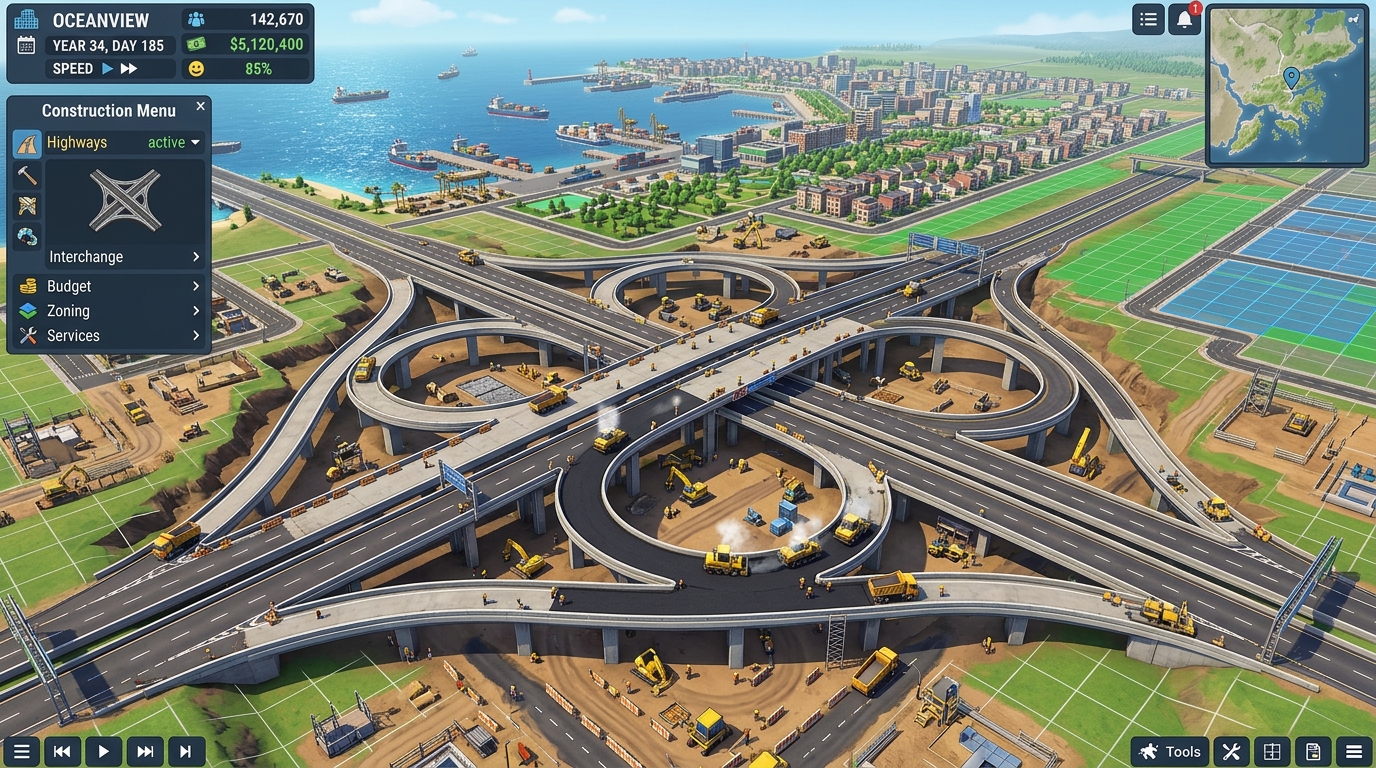
Highway construction in city bui… 202607220829

Psychological and Macroeconomic Drivers of Genre Popularity

The appeal of projects where the core mechanics involve real estate renovation or architectural construction is based on the concept of “flow” and the sense of guaranteed, visually confirmed progress. In real life, renovation work or construction is associated with colossal stress, unpredictable financial costs, delays, and physical fatigue. In contrast, virtual counterparts isolate the outcome from these negative side factors. The player receives an immediate, tangible reward for their actions: a dirty, trash-filled room transforms into a luxury lounge after just a few minutes of interface interaction.

This process provides a pronounced therapeutic effect. Restoring order in a chaotic environment resonates with the psychological need for control over one’s own space. Such PC games, discarding real-world risks, allow players to experiment with design, colors, and layouts. At the same time, large-scale economic strategies satisfy the ambitions of managing complex systems, where every action — from laying a new subway line to changing a tax rate — has cascading consequences for the transport network, ecology, and the budget of the entire virtual society. Industry development also points to a shift toward so-called “cozy games” (games without harsh fail conditions), where the main goal is relaxation rather than competition.

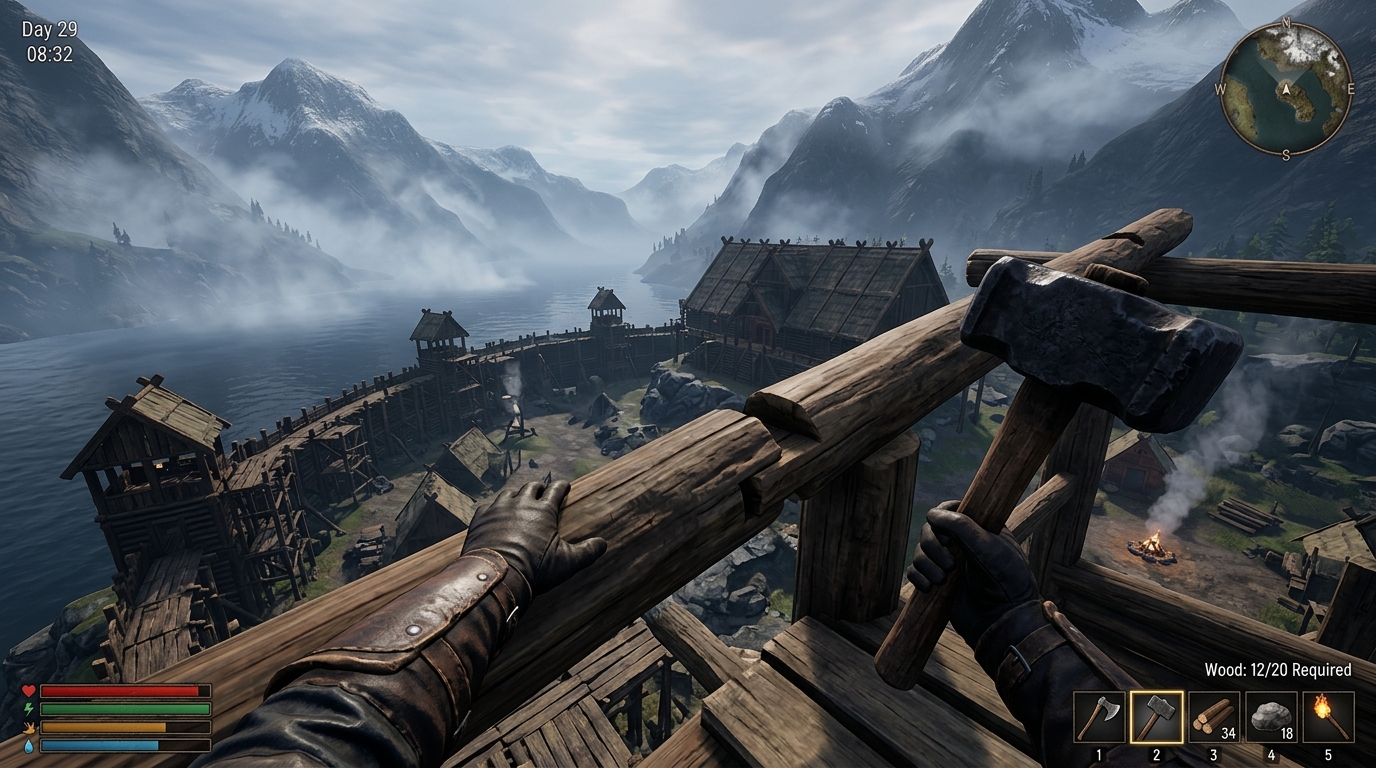
Player building wooden fortress … 202607220829

The Evolution of Micromanagement: Restoration and Interior Design

The most vivid example of the commercial and cultural success of space restoration games is the real estate renovation simulator subgenre. These projects focus heavily on detailing the player’s interaction with the environment at the level of a single house or even a room.

The House Flipper Series Phenomenon

The first installment of House Flipper (2018) effectively laid the foundation for an entire video game direction. It offered a simple yet extremely satisfying gameplay loop: purchasing a dilapidated house at a low price, cleaning up trash, doing repair work (washing windows, plastering, painting, installing plumbing fixtures), and subsequently reselling it for a profit. However, the release of House Flipper 2 (2023) demonstrated how this formula could be improved by taking years of community feedback into account.

Analysis of House Flipper 2 reveals a significant leap in the quality of tools and overall gameplay polish. The player is no longer restricted by a rigid vertical grid when painting walls or laying panels. A new free-painting mechanic creates a more realistic sensation of interacting with surfaces. Moreover, the ability to set boundaries for painting has been introduced, allowing players to create complex geometric patterns on walls without the risk of going over the edges. Instead of monotonous clicking, the material application process has become more dynamic. The wall demolition tool has also changed: it now works much more precisely, allowing players to punch small holes or clear out entire spans using a sledgehammer in a few precise strikes. The need to apply a layer of glue before laying each tile has been eliminated, significantly speeding up routine processes.

A key innovation of the second part is the fully fledged sandbox mode. While the original game limited users to renovating existing buildings, the sequel allows houses to be built from scratch. This includes full terrain modification capabilities: creating hills, deep basements, or even buildings organically embedded into complex landscapes (such as houses reminiscent of dwellings from fantasy films). Thanks to built-in tools, the community gained the ability to create their own architectural assignments and share them, exponentially increasing the project’s lifespan.

Visual design has also evolved, shifting from a somewhat sterile realism to a cozy, slightly stylized aesthetic with improved lighting that advantageously highlights material textures at different times of day. The game introduced the “flipper sense” tool — a special spatial scanning mode that highlights dirt or objects requiring interaction. This solution, borrowed from adventure games, significantly reduces frustration during the final stages of cleaning when you need to find that last unnoticeable spot on the floor. An interesting, albeit somewhat experimental, addition is the “Floor is Lava” minigame in the console versions (PS5), where players can use virtual in-game glasses to complete parkour challenges, though the controls in this mode leave something to be desired.

Despite its overall success, the project did not escape criticism. Some users note that the story mode does not allow purchasing empty plots to build houses from scratch within the economic campaign, strictly limiting this feature to the sandbox mode. Additionally, the new tile-laying and trash-bagging mechanics feel a bit too routine to some compared to the first part. However, the general consensus is that the project remains one of the best in its niche, offering an exceptionally addictive and calming experience.

Business Scaling: Hotel Renovator and ContractVille

If the concept of flipping private houses seems too small-scale, the market offers projects like Hotel Renovator. The player’s task here is to turn a ruined, trash-filled hotel into a functioning five-star establishment. This project combines tactile repair mechanics (prying up old flooring, cleaning walls, painting, wallpapering) with light business management elements.

A distinctive feature of the game is that after finishing a room’s renovation, the player must rent it out to guests who have specific demands. This creates an extra layer of complexity, as you must factor in different client categories’ preferences regarding color schemes or furniture styles. Successful service generates income that is reinvested into opening new rooms out of the 24 available across different floors, as well as creating specialized zones like pools or restaurants.

However, reviews reveal significant technical and conceptual issues. Users complain about numerous bugs related to object collision (items floating in mid-air), unstable framerates (especially when ray tracing is enabled), and an extremely inconvenient furniture catalog interface that forces players to scroll through endless lists instead of providing user-friendly sorting. Graphics are often characterized as a set of generic asset-store models lacking a distinct artistic direction. Developers also implemented random events to spice up the routine, such as a ghost wrecking fresh floor renovations or a chicken you have to chase around the hotel to play dice with. Such elements split the audience: for some, it’s amusing variety (e.g., a vampire guest or a cowboy with a horse), while for others, it’s an irritating distraction from the meditative design process. The project also faced sharp criticism for aggressive monetization: developers actively pushed paid downloadable content packs featuring small furniture sets (e.g., for a gym) while ignoring critical base game bug fixes.

Another interesting representative of the genre is ContractVille (2024), which expands the boundaries of the profession. In this game, the process of real estate restoration starts with purchasing a land plot. The player must manually lay foundations, erect exterior walls, install roofs, manage material logistics, and only then proceed to interior finishing. A huge advantage of the project is support for co-op up to four players, turning routine labor into fun teamwork. Nevertheless, the game suffers from numerous technical bugs and overly complex mechanics in the early stages.

Social Micromanagement: The Tenants

The game The Tenants offers a unique perspective on the real estate market, mixing interior design mechanics reminiscent of the iconic The Sims series with a deep economic tenant-management model. The player acts as a landlord in a fictional city who must not only renovate apartments but also carefully screen tenants, resolve domestic disputes, and monitor business financial stability using detailed analytical tools.

Simulation Aspect Implementation in The Tenants
Personality System

Three-tier architecture: Archetype (e.g., Artist), Traits (e.g., Diligent, Clumsy), Preferences (loves sweets, hates flowers).

Tenant Interaction

The ability to host a cooking show to boost mood, or send a loud musician to a neighbor’s apartment for sabotage.

Economy and Finance

Detailed income tracker, ongoing rent negotiations, credit rating evaluation of potential tenants.

Space Design

Isometric view focused on furniture placement, room partitioning, and fulfilling basic utilities (heating, water, electricity).

The developers continuously adapted the project during its long early access phase, reacting swiftly to community feedback. For example, an initial mechanic where tenants could completely wreck apartment property was temporarily disabled due to widespread player frustration and only returned after thorough rebalancing. The renovation tools here are not as free-form as in first-person games (players mostly deal with object placement and texture swapping on a rigid grid), but this is fully compensated for by the depth of social and economic planning.

At the same time, the game has its drawbacks: in late-game stages, managing dozens of tenants can turn into exhausting micromanagement of minor household issues (e.g., constant plumbing calls or pest control), creating monotony. Some contracts are generated incorrectly by the algorithm. Instances have been recorded where the system demands installing specific expensive items (like a gun cabinet) whose total cost far exceeds the virtual client’s allotted budget, making the task physically impossible without spending out-of-pocket funds or abandoning the mission.

Genre Deconstruction: Social Realism and Hard Labor

If most renovation games create a glamorized fantasy of easy real estate money, Landlord’s Super shatters this illusion completely, offering one of the most unusual and grim experiences in the genre. The game takes place in the fictional British town of Sheffingham in the 1980s, during a period of harsh economic reforms and mass unemployment under Margaret Thatcher’s government. The player steps into the shoes of a marginalized handyman living in an old trailer, trying to manually restore a dilapidated house to become a landlord and escape poverty.

The game’s mechanics are intentionally clunky, slow, and exhausting. Building materials do not appear out of thin air with a mouse click: you have to earn pennies washing dishes at the local pub, walk to the hardware store, buy cement, haul it to the site in a wheelbarrow, manually mix the mortar, and methodically lay every single brick or hammer in every nail individually. Moreover, the game deeply integrates harsh survival simulator mechanics. Players must constantly monitor energy levels, calories (food affects running stamina), hygiene (working in filth lowers this stat), sobriety, and even bladder fullness (the game features a mechanic for urinating anywhere outdoors). Interestingly, the fastest way to earn money in the game is not hard labor, but playing slot machines at the pub, emphasizing the developers’ social commentary on the hopelessness of the working class at the time.

The visual style perfectly matches the depressive mood: dirty, dull browns and grays, low-poly graphics reminiscent of old CRT televisions, and constant rain create a thick atmosphere of despair. The project received scathing criticism for a massive number of technical bugs that developers never fixed after leaving early access: disappearing tools, physics and interface issues, and unachievable achievements due to bugs. However, it is precisely this desperate, almost masochistic realism that makes Landlord’s Super a unique work of art. It demonstrates the true, exhausting price of physical labor, something completely absent in other games of the genre.

Heavy Machinery and Construction Site Logistics

A separate yet fiercely loyal audience belongs to construction simulators focusing on the actual process of erecting large-scale buildings using specialized heavy machinery. The flagship of this direction is the Construction Simulator series, particularly the 2022 release.

This project offers players a unique experience of directly operating construction equipment. Instead of simply designating a construction zone and watching a building automatically go up, the player must personally dig a foundation pit with an excavator, pour concrete using a mixer truck, deliver building materials with a heavy-duty truck, and hoist roofs or floor slabs into place with a towering crane.

Key features of Construction Simulator include:

  1. Massive Fleet: The game features over 90 real-world, licensed vehicles from leading global manufacturers, each equipped with a detailed cockpit and unique sound design.
  2. Environmental Scale: Two huge maps inspired by European and American landscapes are available. Each location has its own story campaign. For instance, restoring a port district in an American city feels conceptually distinct from tasks in a European setting.
  3. Complex Control System: The vehicle handling model is ideally adapted for gamepads. Switching to “work mode” allows both analog sticks to be used for ultra-precise positioning of crane booms or excavator buckets. However, driving these same vehicles on regular roads often feels clumsy, suffering from poor feedback across different road surfaces and camera positioning issues when reversing. PS5 console versions disappointed players by omitting support for specific DualSense controller features (no trigger resistance or haptic feedback).
  4. Co-op Mode: The game supports joint contract execution online, where one player can skillfully operate a crane while another unloads materials from a truck, greatly accelerating gameplay.

Despite high detail, the game suffers from a certain conceptual monotony. Completing large construction contracts frequently turns into lengthy, routine logistics — hauling supplies from base to site. Furthermore, the physics model is remarkably forgiving: imprecise soil dumping auto-levels, and collisions with other cars cause no damage or financial penalties, nullifying the need for high skill and caution.

It is also worth mentioning the simplified version, Construction Simulator 4 – Pocket Edition, ported from mobile platforms to PC. This release drew a wave of criticism due to outdated graphics, simplified physics, optimization issues when rendering distant objects, and a general lack of depth inherent to the series’ full-fledged “adult” PC entries.

Macro Level: City Building, Economy, and Strategic Planning

If interior renovation games focus on personal space, then city-building simulators demand advanced macroeconomics skills, spatial logistics, and human resource management on the scale of thousands of residents.

Modern Standard: Cities: Skylines

The Cities: Skylines series remains the undisputed leader and de facto standard in the realistic city-design genre. Released by Colossal Order in 2015, the first installment capitalized on the failure of SimCity (2013), offering players unprecedented freedom in creating traffic interchanges, flexible land zoning (residential, commercial, industrial districts), and managing complex municipal services ranging from healthcare to fire safety. The game turned empty green fields into a tool for engineering creativity.

The project’s success is largely driven by its software architecture, which simulates the individual behavior of every single resident (agent). Players must account for noise pollution levels, access to educational facilities, optimize public transit routes, and even calculate river flow directions when placing sewage discharge pipes to avoid ecological disasters. A rich modding environment transformed the game from entertainment into a serious tool used by urban planners to model real urban environments. The release of Cities: Skylines II in 2023 introduced an even deeper economic and logistical simulation, though it encountered serious performance optimization issues that somewhat affected audience reviews.

Historically, the genre owes its existence to Maxis studio and their iconic SimCity series (especially SimCity 2000), which laid the foundational principles of zoning and simulation. However, following the controversial 2013 release, developer focus shifted to other life simulators, leaving the realistic city-building niche open to newcomers.

Ethics and Survival: Frostpunk

Unlike the optimistic creation of sunny megacities, Frostpunk (2018) and its sequel Frostpunk 2 (2024) radically deconstruct the genre, placing the player in the extreme conditions of a post-apocalyptic ice age. This is not merely a city builder, but a game about society surviving on the brink of extinction. The city is built in concentric circles around a giant coal generator, which serves as the sole source of heat.

Every architectural and management decision carries existential weight. Total resource scarcity forces players to make difficult political and moral choices via a law system: Should child labor be permitted to mine critical coal? Should food be diluted with sawdust to feed more people?. Physical city planning is inseparable from the psychological state of residents, measured by “Hope” and “Discontent” meters. The project brilliantly proves that development games can carry deep emotional and social narratives, forcing players to feel guilt over their choices.

Historical Eras, Satire, and Politics: Anno 1800 and Tropico 6

For those seeking deep historical and economic context, the market offers the renowned Anno series. Notably, Anno 1800 is recognized as one of the best strategies for fans of incredibly complex production chains. Set during the 19th-century Industrial Revolution, players must balance agricultural needs, a rapid transition to industrialization, extensive railway expansion, and the development of early trade unions. A unique feature is the necessity to simultaneously manage multiple settlements across different climate zones (Old and New World) and establish smooth trade routes between them. Graphical detail lets you watch residents loading cargo onto carts or discussing news in town squares, creating the illusion of a living world. Other entries like Anno 2070 transplant these complex mechanics into a futuristic ecological context.

On the other end of the spectrum is Tropico 6, offering a sharply satirical take on urban management. The player acts as “El Presidente” — the eternal dictator of a fictional Caribbean banana republic. Aside from placing plantations, industrial factories, and luxury tourist resorts, it is vital to constantly juggle the interests of various political factions (communists, capitalists, militarists, religious groups) and global superpowers. While Cities: Skylines challenges you with traffic jams, Tropico 6 presents the threat of armed uprisings or military coups due to low freedom of speech or poor labor conditions. In this installment, developers introduced archipelago management for the first time, letting players connect separate islands with bridges and cable cars, as well as build and upgrade their own presidential palace using funds siphoned into offshore accounts.

Standing outside classic city builders is the monumental Civilization VI. Though a turn-based global strategy, it features exceptionally deep city-development mechanics where each district (campus, industrial zone) occupies a distinct tile on the global map and gains adjacency bonuses from mountains or rivers. This game lets you blend architectural styles across eras, watching modern skyscrapers rise next to medieval walls. For sci-fi enthusiasts, projects like Surviving Mars and Planetbase challenge players to build sealed domes and supply colonists with oxygen and water on hostile planets, where any infrastructure design flaw leads to the rapid death of the entire colony.

Hybrid Genres: Survival, Roguelike, and Sci-Fi

The industry constantly seeks new forms, crossbreeding construction with other mechanics to yield remarkably deep hybrid projects.

Game Title Genre Hybridization Key Construction & Management Mechanics
RimWorld Sci-Fi, Survival, Storytelling

Colony management on a remote planet, tile-by-tile base building, micromanagement of each colonist’s psychology, defense against enemy raids.

Dwarf Fortress Fantasy, Roguelike, Simulator

The most complex dwarven settlement management simulator, multi-level underground tunneling, creating intricate mechanisms, incredibly detailed world generation.

Against the Storm Roguelite, City Builder

Building settlements under a relentless destructive rainstorm, completing objectives within time limits before moving on to establish the next city while retaining global progress.

The Riftbreaker Action-RPG, Base Defense

Futuristic base building, laying pipes and wires, alongside personally shredding thousands of alien enemies in a robotic suit.

Prison Architect Management, Prison Sim

Designing cells, canteens, security systems, and patrols, controlling prisoner needs satisfaction to prevent riots and escapes.

These games, notably RimWorld and Dwarf Fortress, offer emergent gameplay rather than mere architectural beauty — situations arising spontaneously from interacting complex systems (e.g., a kitchen fire can spark mass panic, base destruction, and the death of the entire colony). Against the Storm innovatively injected roguelite elements into city building, forcing players to adapt to randomly generated conditions and resources on every new map, eliminating late-game boredom.

Sandboxes, Voxel Worlds, and Ruin Restoration

It is impossible to analyze building games without mentioning projects based on voxel technologies or tile-based systems. The undisputed giant here is Minecraft, which has remained the world’s best-selling video game for over a decade. The absence of strict goals allows players to build anything — from a modest hut to precise block-by-block replicas of real megacities. A similar principle of absolute spatial building freedom from scratch is implemented in survival hits like Valheim, Conan Exiles, Sons of the Forest, and ARK: Survival Evolved, where erecting a sturdy base is key to protection against a hostile environment. For space enthusiasts, No Man’s Sky and Starbound offer base building on procedurally generated planets.

However, audience analytics reveal an interesting phenomenon: a significant portion of players prefer restoration and rebuilding already existing, ruined locations over building on empty plots. This process brings a special psychological satisfaction from watching abandoned ruins brought back to life. This mechanic is vividly featured in:

  1. Fallout 4: The player clears radioactive Commonwealth ruins of trash and scrap, using them as materials to build new walls, generators, and defenses on top of old foundations.
  2. The Division 2: Gradual visual and functional upgrades of the White House and settlements following completed missions, providing a sense of civilization being restored.
  3. Dragon Quest Builders 1 & 2: The player receives specific tasks to restore ruined objects (a castle, a tree, a spaceship), where rooms only gain functionality once specific furniture items are correctly placed.
  4. Enshrouded: Utilizing a voxel system for meticulous restoration of abandoned fantasy villages and castles.
  5. Infection Free Zone: A unique approach where players pick any real city on the planet (using GIS map data), and the game generates its buildings, which must then be barricaded and repurposed for zombie defense.
  6. Total War: Attila: As ruler of a declining Roman Empire, the player encounters ruined cities and must spend vast sums on their gradual reconstruction amidst constant barbarian raids.

Aesthetics and Procedural Generation: Rejecting Rules

The most massive departure from traditional genre rules is the emergence of games that entirely abandon economics, management, or goals in favor of pure aesthetics and creativity. A prime example of this trend is Tiny Glade (2024).

This game is a pure architectural diorama featuring a gridless building system. Construction relies on complex procedural detail generation. When a player stretches a wall, the game automatically adds stonework textures. Dragging a path tool right through that wall instantly spawns an elegant archway without any extra effort. Lowering ground levels around a building automatically generates stairs or wooden supports holding up the structure. This seamless interaction creates the impression of collaborating with the program: humans set broad outlines, and algorithms take care of flawless aesthetics.

This approach is the quintessential “cozy game.” The visual style resembles living watercolor paintings, featuring sheep opening umbrellas if you clear the ground beneath them, and the ability to smoothly change seasons and sun angles to frame the perfect shot. Daily challenges (like building a “Wizard Academy”) encourage the community to share creations, compensating for the lack of a story campaign.

At the same time, critical analysis highlights limitations to such an ultra-casual approach. Full automation frustrates players craving micro-control — you cannot manually decide where a specific window, door, or barrel goes. Some reviewers note that the toolkit is so “safe” and idealized that it’s physically impossible to build something ugly or chaotic, which paradoxically restricts true self-expression. Life simulation is also missing: aside from a few animals (ducks, sheep), worlds remain devoid of people. Nevertheless, user scores (over 97% positive Steam reviews) undeniably reflect colossal demand for games offering pure escapism and relaxation after a hard workday.

Conclusions and Prospects for Genre Development

Synthesizing data from the review of a wide spectrum of market projects, we can highlight several deep trends shaping the future of the best building games genre:

  1. Democratization of Architectural Design. Tools are becoming more intuitive. Procedural generation systems, like in Tiny Glade, shift the paradigm of interacting with virtual space. Players no longer need to calculate object placement down to the millimeter; algorithms handle texture stitching and physical intersection logic. This radically lowers the entry barrier.
  2. Deep Socialization and Cooperation. Construction has historically been considered a solitary, meditative experience. However, projects like ContractVille and the co-op multiplayer mode in Construction Simulator prove that coordinated teamwork brings a new level of enjoyment, mimicking the social dynamics of real construction crews.
  3. Shifting Focus to Eco-friendliness and Restoration. Instead of aggressive expansion and developing empty land, players increasingly opt for renovation simulators and the recovery of ruined structures, correlating with global trends toward conscious consumption, waste recycling, and preserving historical heritage.
  4. The Community as Main Content Generator. The long lifecycle of games (such as Cities: Skylines or House Flipper 2) is possible exclusively due to the integration of modding tools. Players create new furniture styles, maps, and traffic algorithms themselves, turning the base game into an endless creative platform.

In summary, the building simulator genre on personal computers is at the peak of its development, offering unprecedented variety. From hyper-realistic macroeconomic strategies like Anno 1800, through the tense social realism of Landlord’s Super, to carefree art sandboxes like Tiny Glade — these games satisfy one of the deepest needs of the human psyche: the need to leave behind an orderly, aesthetically polished, and functional space. Whether a player is designing a transit interchange for a million-strong megacity or meticulously picking out ceramic tile colors for a virtual bathroom, virtual construction remains one of the most powerful and constructive tools of escapism in the modern digital world.

author
Alex Z
About the author:

Oleksandr — Digital Marketing Expert for Construction & Manufacturing Industries Oleksandr is a seasoned digital marketing specialist, delivering powerful results for the construction and manuf...

More
0 0 votes
Article Rating
Subscribe
Notify of
guest
0 Comments
Oldest
Newest Most Voted