Top EV Charging Networks in Ukraine: Architectural and Infrastructural Ranking
Generic selectors
Exact matches only
Search in title
Search in content
Post Type Selectors

Top EV Charging Networks in Ukraine: Architectural and Infrastructural Ranking

September 8, 2026
2  

As of 2026, the top electric vehicle charging networks in Ukraine include ECOFACTOR, TOKA, GO TO-U, YASNO E-Mobility, EVA Chargers, and AutoEnterprise. The market is demonstrating rapid growth: the zero-emission vehicle fleet has exceeded 110,000 units, and the infrastructure includes over 5,000 public stations, of which more than 1,000 are high-speed DC terminals. Modern architectural trends have shifted from installing standalone chargers to creating full-fledged EV hubs with protective canopies, solar panels, and recreation areas, fully complying with new DBN requirements (specifically regarding the allocation of 10% of parking spaces for EVs) and strict fire safety standards.

Infrastructure Evolution: From Standalone Terminals to Architectural EV Hubs

The rapid growth in the number of electric vehicles in the country dictates new, much stricter rules for urban planning, transport logistics, and commercial architecture. According to statistics from Ukrautoprom, the vehicle fleet in Ukraine alone in 2025 was replenished with 110.2 thousand zero-emission vehicles (BEVs), which is twice as much compared to the previous year. In accordance with such rates of motorization, urban infrastructure is also forced to transform rapidly. As of mid-2025, there were over 5,000 public charging stations in Ukraine, and this figure increases every month. High-speed direct current (DC) terminals deserve special attention, as their number has already exceeded the psychological milestone of 1,000 units (1,002 powerful points recorded), with more than 72% of them being domestically produced equipment.

The architectural landscape of EV charger placement has undergone dramatic changes. If just a few years ago electric vehicle charging stations were mounted haphazardly in existing parking lots without additional landscaping or a review of traffic flows, today top charging networks are systematically investing in the creation of EV hubs (Electric Vehicle Hubs). These are complex architectural objects that include deeply thought-out access logistics, specialized canopies for protection against precipitation, energy-efficient LED lighting, and seamless integration with the facades of shopping or business centers. Such changes require developers to involve specialized architects as early as the building concept stage, since powerful hubs require laying large-scale cable routes and erecting separate transformer substations.
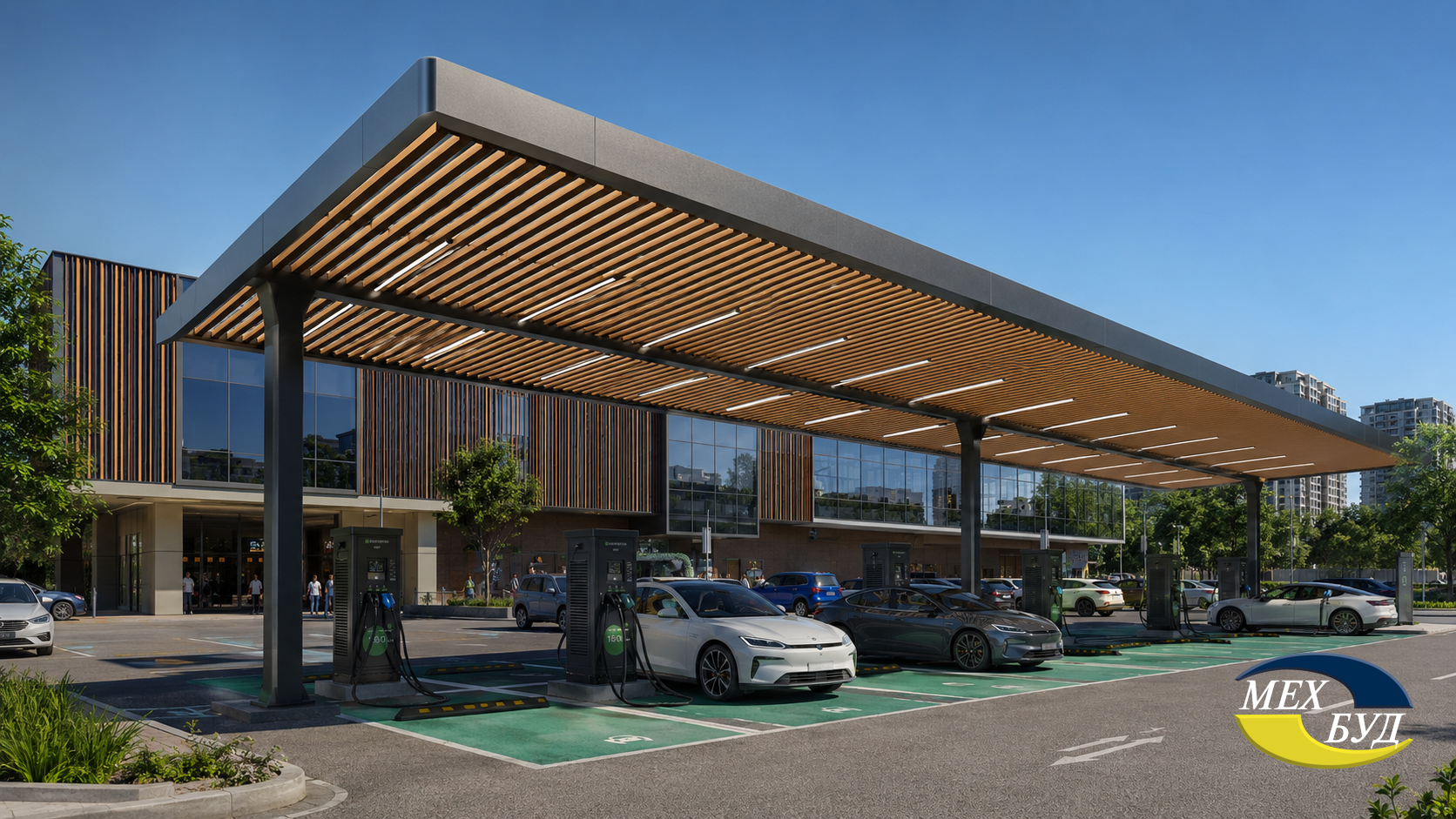
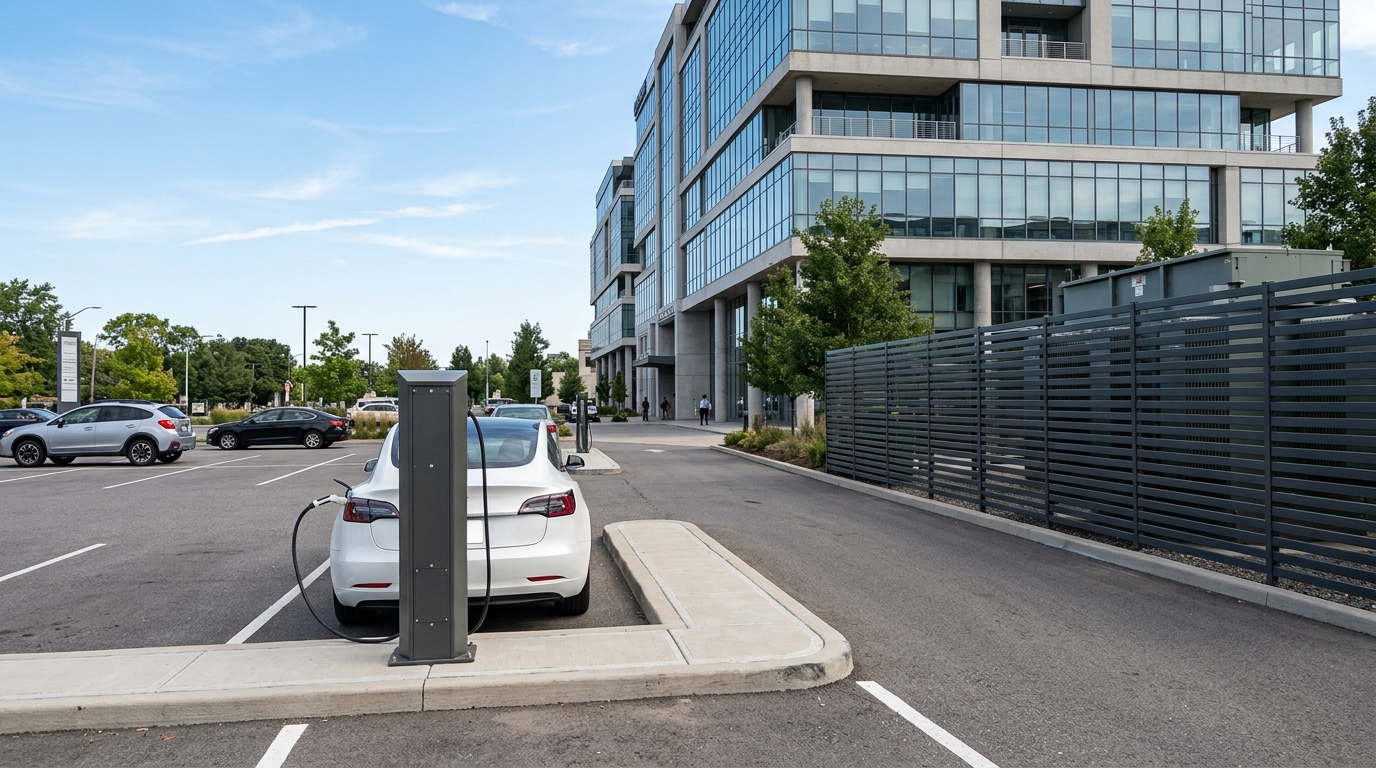
Electric vehicle charging at station

Top EV Charging Networks: Architectural Profile of Market Leaders

Below is a detailed, comprehensive analysis of seven leading companies shaping the modern face of Ukraine’s charging infrastructure. Each network is evaluated through the lens of architecture, spatial design, and construction innovations applied during the deployment of their capacities.

1. ECOFACTOR

Reason for inclusion: ECOFACTOR is the largest charging infrastructure ecosystem in Ukraine, which not only develops and manufactures its own hardware but also provides comprehensive cloud management of stations. The company is actively building large urban hubs, setting standards for the entire industry.

Architectural profile: ECOFACTOR’s architectural strategy tends toward deep integration into large retail projects and the formation of multi-port locations with a high density of terminals. Their facilities are designed as an integral part of the overall landscape of shopping centers. This requires architects to carefully calculate the load on the building’s electrical grids, optimize parking space to avoid congestion during prolonged charging, and create safe pedestrian corridors between cars.

Notable facilities or projects: One of the most telling projects is the partner hub at the HIT Mall shopping center in Kyiv. This location features 16 DC connectors of 160 kW each, making it one of the most powerful urban charging spaces in the country. In addition, the company implemented a hub near the TV Tower at Dorohozhychi (jointly with VIWATT, featuring 13 connectors) and a powerful location at the Kyiv Hippodrome (jointly with MSM Energy).

Materials and technologies: Station housings are made from special corrosion-resistant and vandalism-resistant metal alloys. The heart of the system is a proprietary cloud management platform that supports the OCPP protocol and optimizes the energy consumption of the entire hub using dynamic balancing, preventing critical overloads of shopping center transformer substations.

Interior and exterior features: ECOFACTOR stations feature a minimalist exterior, allowing them not to clash with modern building facades made predominantly of glass, steel, and architectural concrete. Terminal interfaces are designed with strict ergonomics and inclusivity requirements in mind, ensuring convenient access to screens and connectors for all categories of users.

Renovations or upgrades: The company regularly modernizes existing locations, turning outdated AC points into powerful DC hubs, which involves complex excavation work to replace power cables in already functioning urban environments.

Energy-efficient and eco-friendly solutions: ECOFACTOR actively implements technologies for the intelligent redistribution of power between ports, which is critical for increasing the energy efficiency of large commercial facilities and reducing power transmission losses.

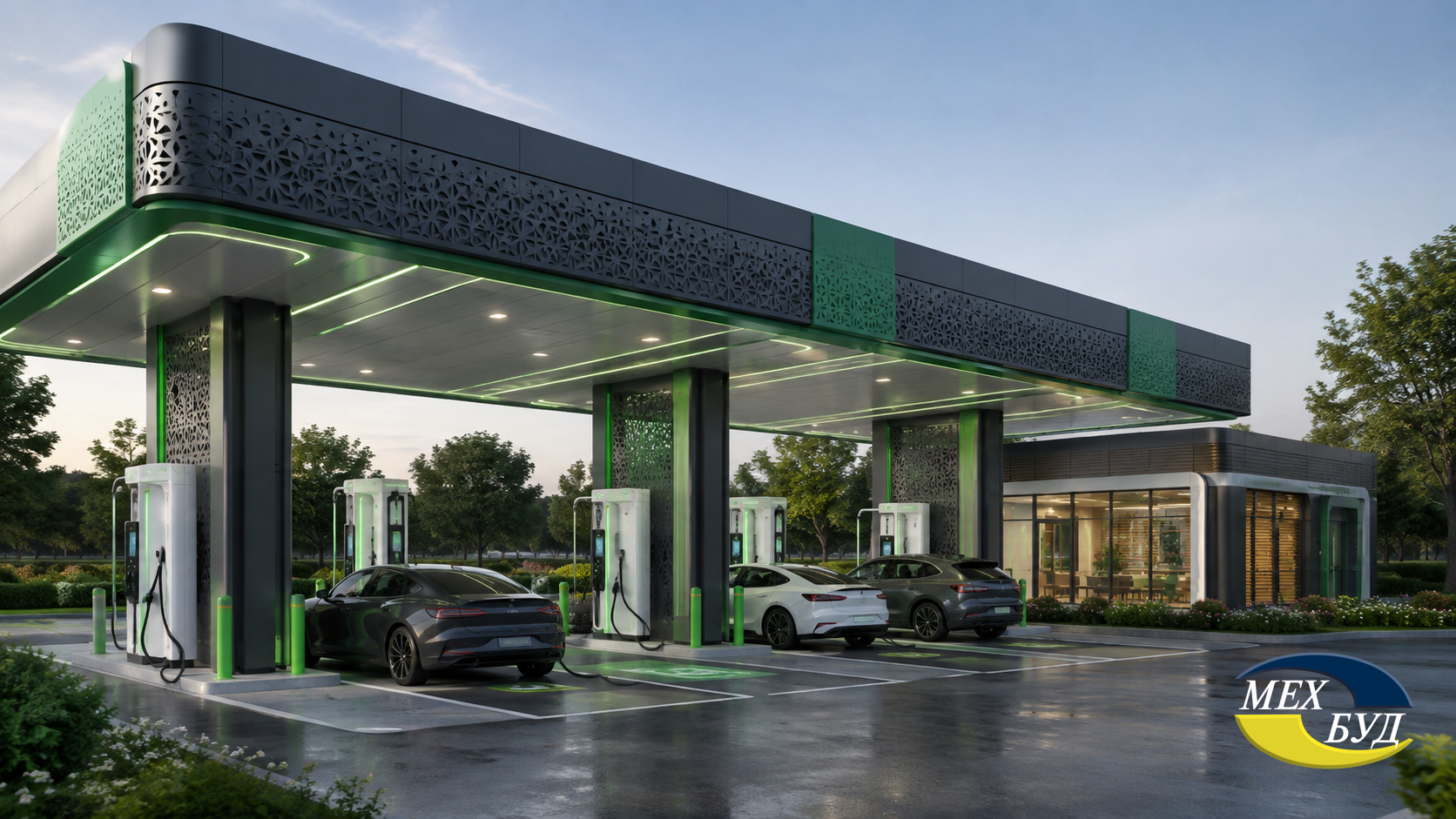
Mehbud’s conceptual solution for ECOFACTOR: To optimize the architectural space of large multi-port hubs (such as locations like HIT Mall), an ideal and modern solution would be the erection of massive protective canopies utilizing a cube-shaped ceiling from the Mehbud plant. Thanks to the deep U-shaped profile of the lamellas, such a ceiling system creates a pronounced 3D volume effect and visually “lightens” the massive canopy frame. Moreover, the cube-shaped ceiling provides excellent natural cross-ventilation, which is a critical engineering parameter for dissipating heat from powerful charging terminals (over 160 kW) during hot summer months. The inter-ceiling space allows for the concealed routing of complex cabling and the seamless integration of smart LED lighting.

1 ECOFACTOR

2. TOKA

Reason for inclusion: TOKA is the first national network to massively integrate charging complexes into traditional roadside infrastructure and gas station complexes (GSC). The company has created and scaled the concept of high-power “monohubs” along the country’s key highways.

Architectural profile: TOKA’s architectural strategy is based on maximum synergy with existing facilities. Instead of prolonged and costly infrastructure construction from scratch on empty plots, the company adapts the territories of traditional gas stations, roadside hotels, and large shopping malls to the specific needs of EV users. This requires complex spatial planning to separate the flows of electric vehicles (which park for 30–40 minutes) and internal combustion engine cars (which refuel in 5 minutes).

Notable facilities or projects: The network’s most impressive architectural projects are its highway monohubs. In particular, locations in Hlybochytsia, Hoshcha, and Krasnohorivka form holistic highway nodes. In Krasnohorivka, for instance, 12 DC connectors of 160 kW each operate successfully. Furthermore, TOKA has implemented a large-scale integration of its stations directly on the premises of WOG and OKKO gas station complexes.

Materials and technologies: The network actively cooperates with leading international manufacturers such as SINO Energy and Schneider Electric, installing massive metal stations that support the OCPP 1.6 protocol and are equipped with smart power balancing systems.

Interior and exterior features: Since most TOKA stations are located outdoors along busy highways, their exterior provides the highest degree of protection against aggressive environmental factors (dust, moisture, reagents) — IP54 standard and above. The landscape design of such locations often includes concrete safety islands and protective metal bumpers that physically separate the charging zone from main traffic flows.

Renovations or upgrades: The network continually modernizes its facilities. Replacing slow stations with high-speed DC complexes requires a complete reconstruction of underground utilities and reinforcement of foundations to support new, heavier equipment.

Energy-efficient and eco-friendly solutions: The use of intelligent energy redistribution systems between neighboring ports avoids peak overloads on the local gas station network, ensuring the stable operation of the entire complex infrastructure.

Awards or recognition: The company is recognized as a pioneer in creating a national charging network in Ukraine and has received additional investment rounds from major fuel retailers (specifically OKKO).

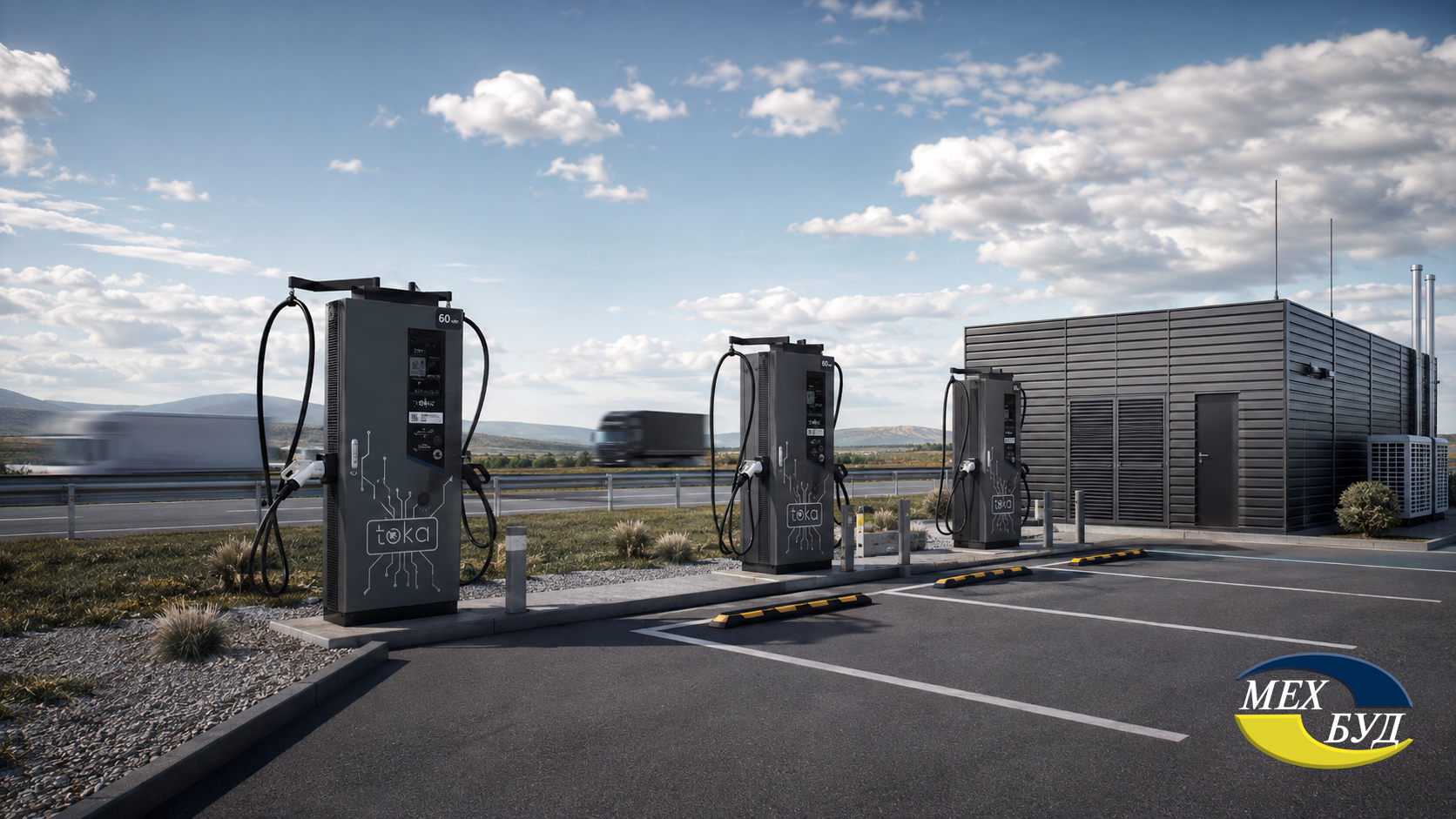
Mehbud’s conceptual solution for TOKA: For highway monohubs where charging stations and associated infrastructure are subjected to extremely harsh weather conditions (squall winds, abrasive highway dust, chemical de-icing agents in winter), technical pavilions or auxiliary modules for high-voltage transformers can be finished using a rack facade from Mehbud. This facade material guarantees the highest level of anti-corrosion protection due to quality galvanizing and polymer coating. Installed as a ventilated rainscreen facade, the rack facade reliably protects sensitive technical equipment from overheating caused by direct sunlight while harmoniously blending into the overall industrial aesthetics of high-speed highways.

2 TOKA

3. GO TO-U

Reason for inclusion: GO TO-U offers a unique software and hardware platform featuring an innovative connector pre-reservation function. In addition, the company has implemented the most powerful public charging hub in Ukraine, setting a new benchmark for speed and service.

Architectural profile: The company focuses on creating premium, technologically advanced, and comfortable spaces. The architecture of their locations differs conceptually from competitors: since users arrive at a precisely reserved time, there is no need to create large buffer zones for queues. This allows architects to focus on landscape design and the quality of the parking space itself.

Notable facilities or projects: The flagship facility is a hub in Rivne, featuring an ultra-fast ABB 360 kW station combined with a 120 kW UGV station. This is the most powerful public location in the country, capable of adding 100 km of driving range to an electric vehicle (such as a Kia EV6 with an 800-volt architecture) in just 3 minutes. The company has also established a strategic partnership with the Epicenter retail chain, developing large-scale EV hubs (e.g., featuring 22 DC connectors in Lviv) that operate effectively at the intersection of urban and suburban traffic.

Materials and technologies: The use of premium-class equipment requires specific construction solutions. Installing a 360 kW station involves complex foundation work due to the heavy weight of the modules, as well as the installation of wide cable trays for routing liquid-cooled power lines.

Interior and exterior features: Navigation at GO TO-U locations is thought out to the smallest detail. The exterior is complemented by bright LED indicators on the stations themselves, informing users of the state of charge (SoC) and visually highlighting the terminals in the dark, turning them into an architectural accent of the parking lot.

Renovations or upgrades: Continuous software platform updates require the parallel upgrading of hardware controllers at existing locations to support new communication standards (such as Plug&Charge).

Energy-efficient and eco-friendly solutions: Optimizing charging times through reservations reduces electric vehicle idle times and minimizes energy losses. The platform as a whole contributes to the decarbonization of the transport sector.

Awards or recognition: The platform is a graduate of TechStars, one of the world’s top accelerators, and currently provides access to over 330,000–370,000 charging stations across 64–66 countries worldwide through roaming agreements (including with Hubject and Ionity).

Mehbud’s conceptual solution for GO TO-U: The network’s cooperation with major national retailers requires an impeccable, premium visual style. Canopies over ultra-fast charging stations (360 kW capacity) can be styled using a panel facade from Mehbud. This innovative construction allows architects to combine panels of varying width, depth, and color (e.g., corporate green and graphite), creating a dynamic, rhythmic, and ultra-modern look. Using the panel facade to decorate massive load-bearing columns or wide canopy friezes will emphasize the charging hub’s high technological status and ensure its durability without requiring regular cleaning or maintenance.

3 GO TO U

4. YASNO E-Mobility (DTEK)

Reason for inclusion: Developed with the support of the powerful national energy brand DTEK, this network focuses on providing highly reliable infrastructure in major cities and along key intercity highways.

Architectural profile: YASNO’s architectural and construction projects are characterized by deep, organic integration into existing premium infrastructure facilities, such as underground and ground-level parking lots of Class A business centers, gated residential communities, and shopping malls. They set high standards of corporate aesthetics and safety in the industry.

Notable facilities or projects: The network has integrated its stations into the UNIT.City innovation park in Kyiv (totaling 13 DC connectors in the hub), supporting the overall “smart city” concept. Another landmark project is participation in creating an urban hub at the Victoria Gardens shopping mall in Lviv (21 DC connectors), as well as the deployment of charging stations on the underground levels of elite business centers (e.g., Yasno IQ BC on Bolsunovska St.).

Materials and technologies: The company uses reliable industrial metal enclosures that meet European quality standards. The network has invested heavily in high-speed stations (50 kW and above), which require the engineering of a reliable loop grounding system and a high level of moisture protection during construction work.

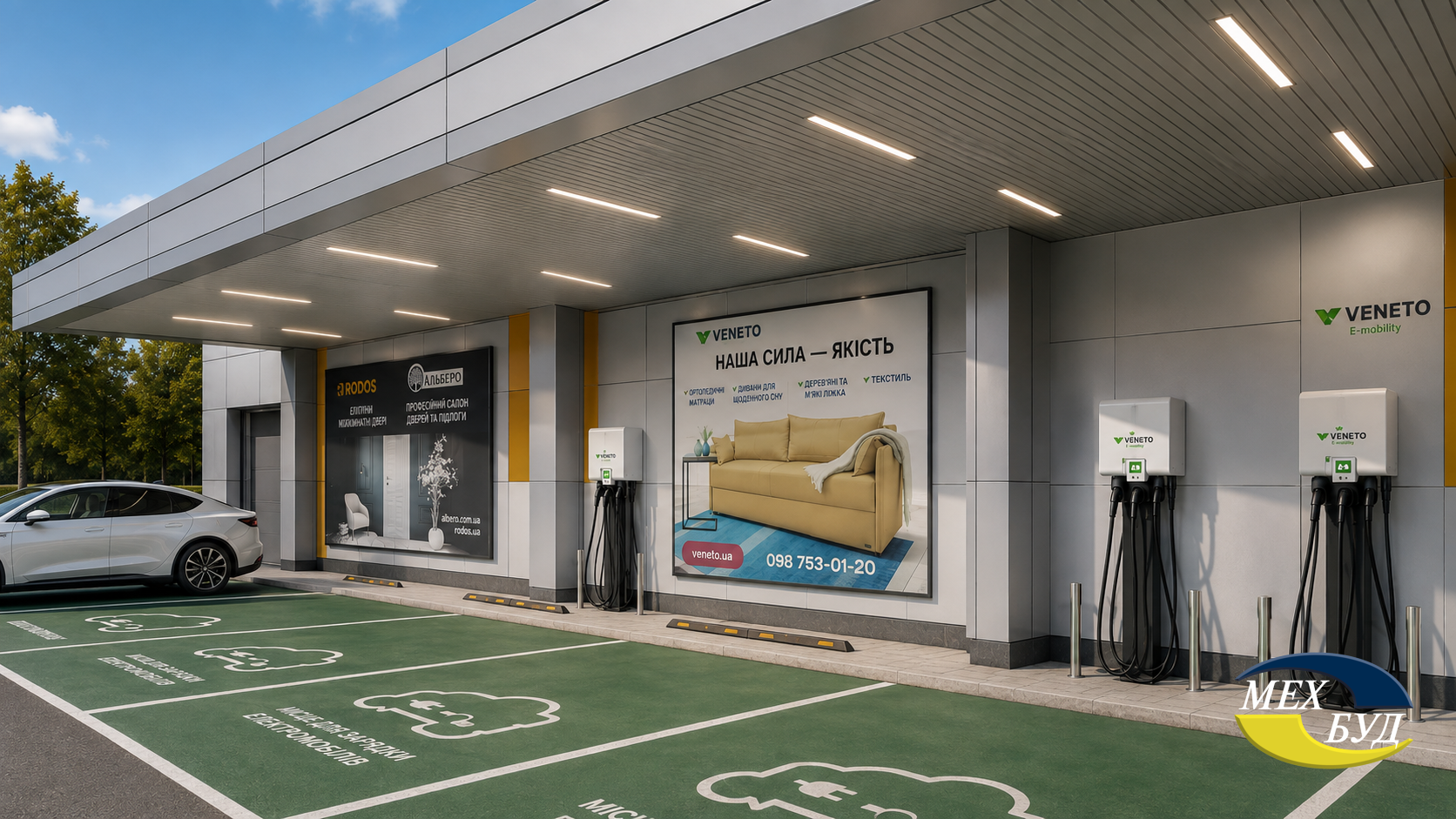
Interior and exterior features: YASNO’s spatial design of locations necessarily includes corporate branding (colored asphalt painting, wall graphics), making parking spaces visually segregated. In underground parking lots, special attention is paid to enhanced lighting and the installation of protective metal bollards to prevent mechanical damage to expensive equipment during vehicle maneuvering.

Renovations or upgrades: In 2019, the network underwent a large-scale successful rebranding (formerly known as STRUM), which was accompanied not only by a change in signage but also by the architectural and visual renovation of all existing locations to meet new brand standards.

Energy-efficient and eco-friendly solutions: YASNO projects are based on the use of high-quality components that ensure operational stability amid voltage fluctuations in urban grids.

Awards or recognition: The brand is part of a large retail ecosystem supplying electricity to over 3.5 million customers in Ukraine, demonstrating the highest level of corporate trust.

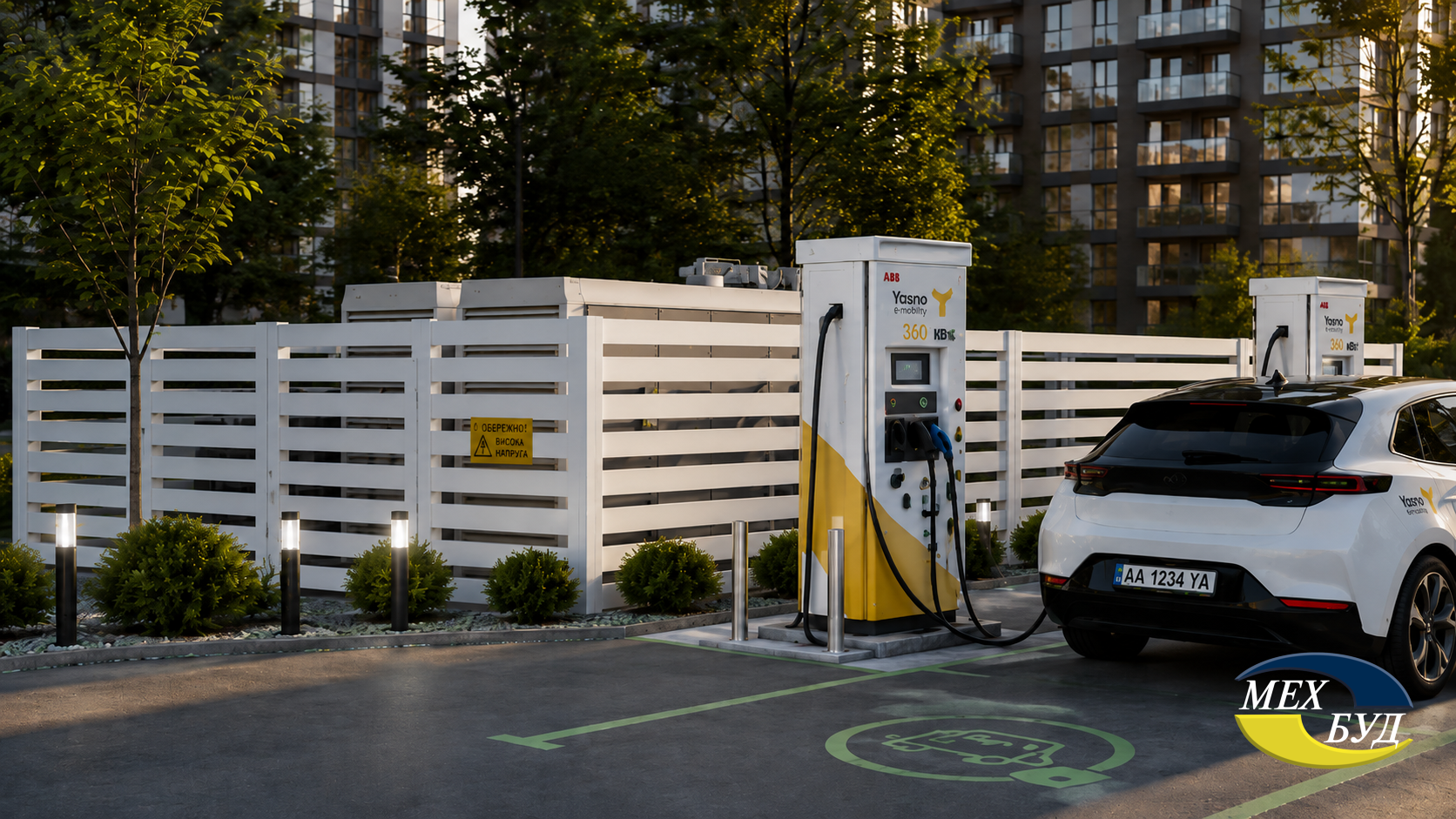
Mehbud’s conceptual solution for YASNO E-Mobility: Since YASNO’s ambitious projects often require the installation of additional, very powerful transformer substations directly next to charging hubs in densely populated urban blocks, using the “Rancho” metal fence is advisable for their safe and aesthetic enclosure. Its classic design with wide horizontal lamellas and precisely calculated gaps ensures excellent air circulation—a critical condition for cooling transformers—while reliably protecting hazardous equipment from vandalism or accidental pedestrian interference. The white or corporate color of the “Rancho” metal fence will allow it to naturally and harmoniously fit into the urban landscape of modern residential ecosystems and business complexes.

4 YASNO E Mobility

5. EVA Chargers

Reason for inclusion: An ambitious Ukrainian manufacturer and operator specializing exclusively in high-power charging stations. The company is actively developing infrastructure with a view to rapid commercial payback (up to half a year at 20% daily utilization).

Architectural profile: EVA stations are designed on the principle of maximum functionality and minimization of the footprint. They take up minimal space in parking lots, allowing architects to install them in extremely dense urban developments without significantly altering existing parking space contours.

Notable facilities or projects: The network built a powerful hub near the TOKYO Business Center in Lviv, installing a station with a record-breaking power output for that location of 280 kW. Also noteworthy is the central hub in Kremenchuk (a joint location near the Lider shopping center and the ATB supermarket parking lot), featuring 160 kW and 120 kW terminals.

Materials and technologies: Production emphasis is placed on high-strength steel housings with resistant multi-layer powder coating. This prevents corrosion from road de-icing agents and fading of the polymer coating under intense sunlight.

Interior and exterior features: EVA stations feature a strict, utilitarian, and industrial design. They are distinguished by a tall vertical form factor, making touch screens convenient to use from any position, while massive power cables do not touch the ground thanks to a suspension system, preserving space aesthetics and cleanliness.

Renovations or upgrades: The company continuously improves the internal architecture of its stations, introducing new cooling modules for power units.

Energy-efficient and eco-friendly solutions: EVA Chargers engineers develop stations with an exceptionally high coefficient of performance (COP), guaranteeing minimal thermal energy losses when converting AC from the city grid into DC for an electric vehicle battery.

Awards or recognition: Recognized by experts as one of the most cost-effective equipment manufacturers for commercial use on the Ukrainian market.

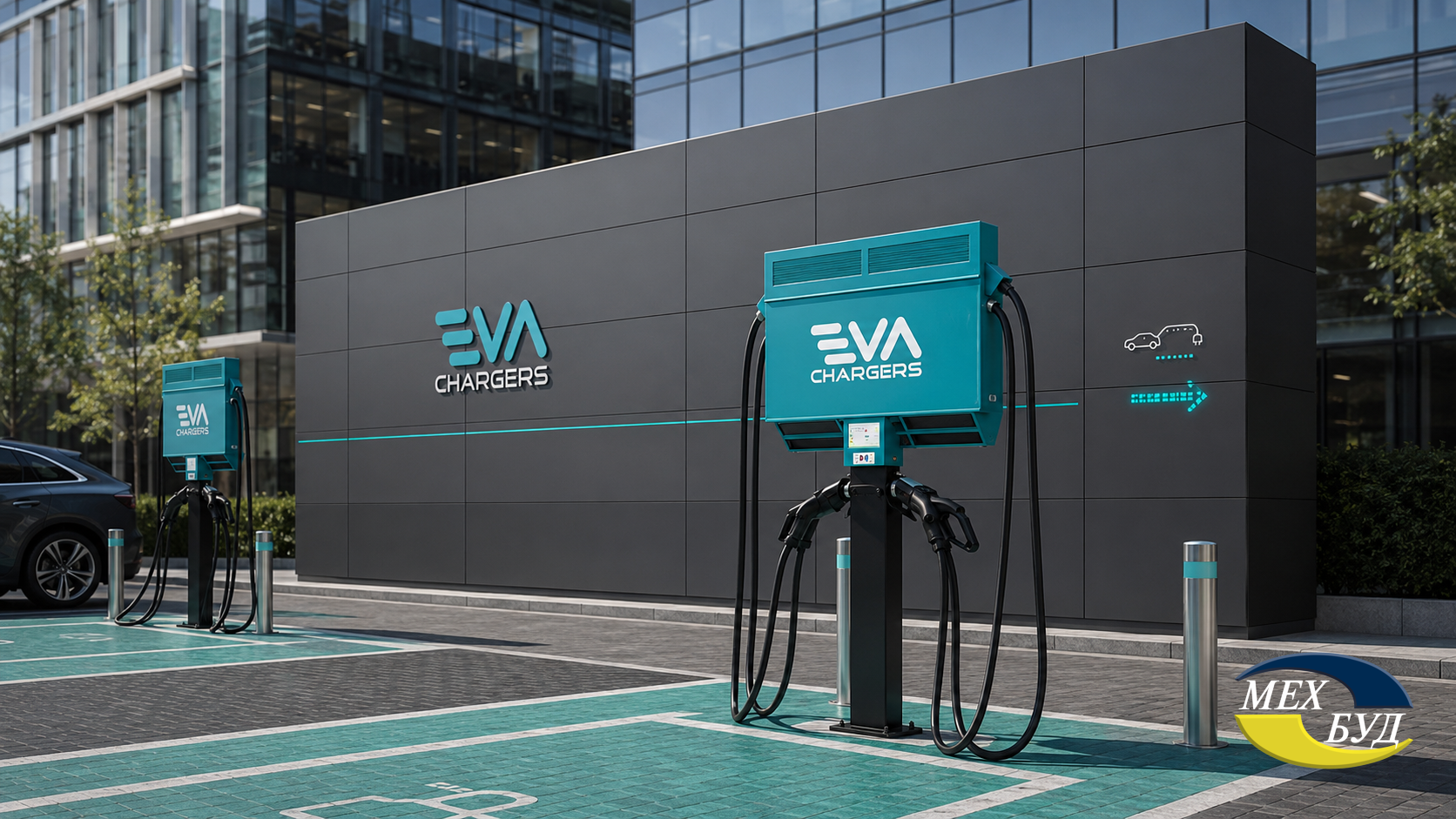
Mehbud’s conceptual solution for EVA Chargers: To clearly and visually highlight high-power stations (e.g., near modern business centers with glass facades) amid a general, often chaotic parking area, operators could use branded wall screens or architectural false panels utilizing facade cassettes from Mehbud. These high-precision metal modules create an ideally smooth, wear-resistant, and non-combustible surface directly behind the charging station. Navigation elements, instructions, or company logos can be conveniently placed on this surface. Thanks to a concealed fastening system, the facade cassettes form an absolute monolithic, strict, and premium look for the charging zone, matching the spirit of corporate architecture.

5 EVA Chargers

6. AutoEnterprise

Reason for inclusion: One of the oldest pioneers of the electric mobility market in Ukraine, possessing a strong production base in Kharkiv and an extensively ramified national network of stations in various formats.

Architectural profile: AutoEnterprise locations are characterized by unprecedented geography and a variety of architectural forms. Their equipment can be found everywhere: from compact wall-mounted AC terminals neatly mounted on historical building facades to freestanding massive complexes in open suburban areas.

Notable facilities or projects: The company has implemented thousands of municipal and private locations in Kharkiv, Kyiv, and other regions. The main plant and office are based in Kharkiv on Rudyka Street, which also houses a large-scale exhibition and test charging zone demonstrating the evolution of their equipment design.

Materials and technologies: Production makes wide use of lightweight aluminum alloys and durable polycarbonate screens. The architecture of the stations themselves provides high modularity of internal components, allowing service teams to quickly replace damaged elements without fully dismantling the housing.

Interior and exterior features: The design features high adaptability. Thanks to various mounting types, stations are easily installed both on existing round concrete columns in underground parking lots and on specially poured foundation pads outdoors.

Renovations or upgrades: The network has vast experience in retrofitting old Soviet parking zones to meet modern infrastructure needs, which often requires partial demolition of asphalt pavement, soil replacement, and the installation of new drainage systems around stations.

Energy-efficient and eco-friendly solutions: The company offers solutions integrating local energy storage systems, helping smooth out peak loads on outdated urban electrical grids.

Awards or recognition: A historical leader in terms of the total number of AC ports installed in the early years of market development.

Mehbud’s conceptual solution for AutoEnterprise: Considering that many stations in this extensive network are located in semi-enclosed parking lots, under concrete building overhangs, or in old building archways, installing a rack ceiling over such charging zones is advisable to radically improve aesthetics and hide unattractive utility lines (cable wrinkles, drainage pipes). Unlike outdated drywall or plastic solutions, a modern aluminum or steel rack ceiling from Mehbud is completely unaffected by moisture, temperature fluctuations, or aggressive exhaust gases from nearby passing internal combustion engine cars. It is easily washed with a high-pressure water jet and allows for the quick integration of linear or spot lighting to ensure full user safety in the dark.

6 AutoEnterprise

Building Codes (DBN) and Architectural Innovations of EV Hubs

The design and development of EV charging networks in Ukraine today are impossible without strict compliance with the updated regulatory framework. This directly affects the architectural appearance of new buildings, parking lots, and traffic interchanges.

New Construction Requirements (DBN B.2.2-12:2019)

According to revolutionary amendments to DBN B.2.2-12:2019 “Planning and Development of Territories” (Change No. 1, which comes into force and becomes completely mandatory by January 1, 2026), charging stations cease to be a market caprice and become a mandatory infrastructure element. In parking lots and garages, at least 10% of all parking spaces must be equipped with electric vehicle charging points, with a mandatory power reserve provision on the transformer for subsequent expansion. From an architectural standpoint, this means cardinal changes: for instance, when designing a standard parking lot for 960 spaces, an architect is required to allocate a minimum of 96 charging points. This requires allocating massive areas for technical rooms, ventilation shafts for cable cooling, and altering the entire geometry of the underground space in new buildings back at the foundation pouring stage.

Fire Safety and Spatial Planning (DSTU 9222:2023)

The key document regulating the spatial placement of charging stations is the new standard DSTU 9222:2023 “Fire Safety. Fire Protection of Electric Vehicle Charging Systems”. This standard strictly defines minimum safe fire distances between charging stations, technological equipment (especially fuel or gas storage tanks at gas stations), and other capital structures.

  1. Level of engineering protection: Outdoor stations must have an enclosure protection rating against moisture and dust of at least IP54.
  2. Restrictions at gas stations: It is strictly prohibited to place EV terminals directly in petroleum product discharge zones. Fuel spills must be prevented through earth bunds and special thresholds.
  3. Underground parking lots: Installing EV chargers in enclosed and underground structures requires designing significantly more powerful smoke extraction systems and automatic powder or water fire suppression systems with signal output to a monitoring station, in accordance with DBN V.2.5-56:2014.

Solar Canopies: A Symbiosis of Energy and Architecture

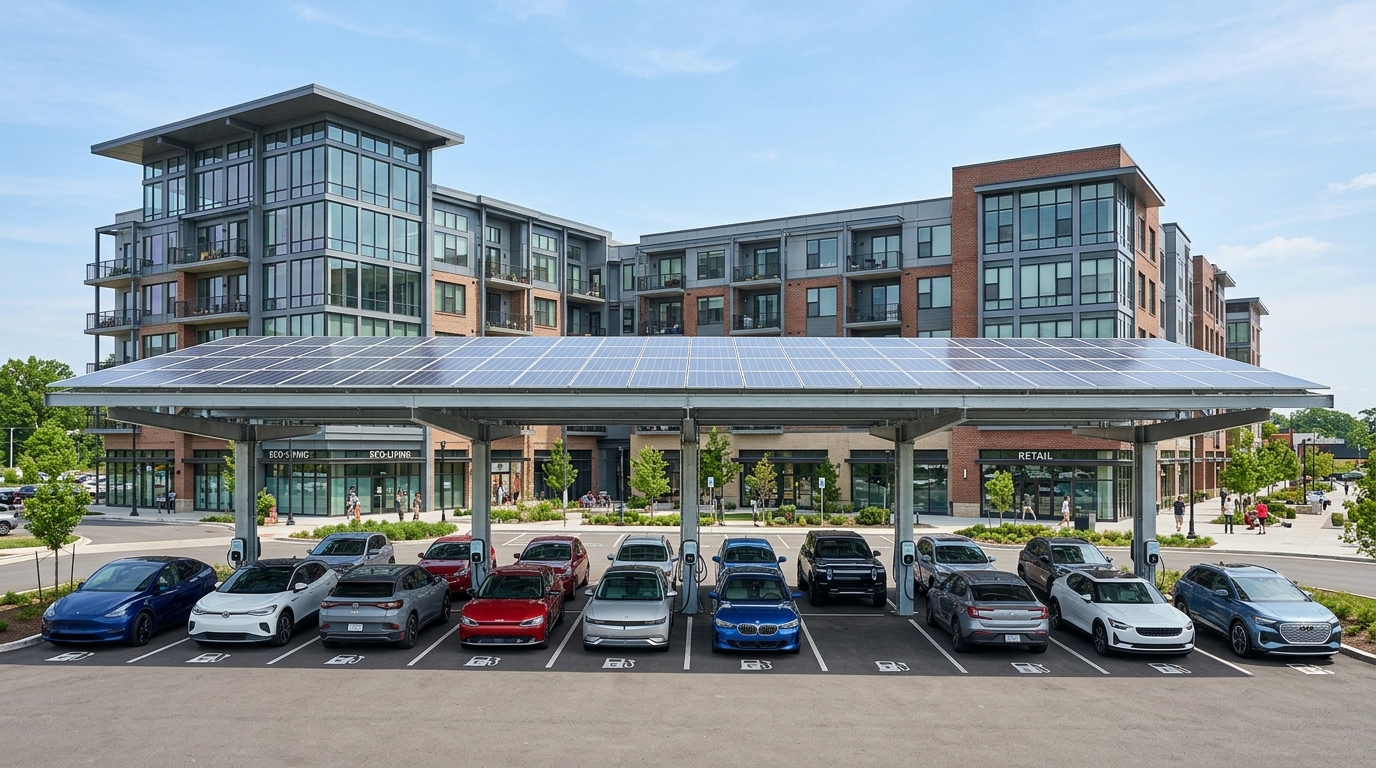
A separate, highly prominent architectural trend in Ukraine is the erection of solar canopies (carports) directly over charging hubs. These specially designed engineering structures, made of anodized aluminum or ultra-strong structural steel, serve a dual function. First, they protect vehicles and equipment from harsh weather conditions (modern canopies are designed for wind loads up to 40 m/s and snow loads up to 60 cm). Second, they generate clean energy. For example, a standard two-car canopy equipped with 32 photovoltaic modules (1956×992 mm in size) is capable of generating up to 14 kW of peak power. Combined with inverters (e.g., Sofar) and battery storage systems (e.g., Pylontech), such solutions ensure partial energy autonomy for the location, turning an ordinary parking lot into an object of sustainable architecture.

Electric vehicles charging

Company Comparison Table

Company / Operator Key Architectural Specialization of Spaces Maximum Station Power Innovative Construction / Technical Solutions Main Geographic Location of Facilities
ECOFACTOR Multi-port urban hubs (retail, shopping malls, business parks) Up to 160 kW Cloud OCPP platform, proprietary national production, cable route optimization All of Ukraine, active expansion into international markets
TOKA Highway monohubs, deep integration with gas station territories Up to 160 kW Power balancing, partnership with SINO Energy, high IP enclosure protection Major international highways, Kyiv, Lviv, Odesa
GO TO-U Premium standalone spaces with an emphasis on UI/UX navigation Up to 360 kW Unique guaranteed reservation software technology (reduces the need for large parking lots) All of Ukraine (with special focus on large hubs in regional centers)
YASNO E-Mobility Underground and ground parking lots of business centers, elite residential complexes Up to 160 kW Uniform corporate design, “smart city” concept, compliance with underground structure DBNs Kyiv, key highways toward Lviv and Odesa
EVA Chargers Utilitarian urban parking, hypermarket parking lots Up to 280 kW High equipment COP, extremely durable narrow-profile anti-vandal metal enclosures Lviv, Kremenchuk, other industrial cities
AutoEnterprise Universal urban parking (from historical center to outskirts) Up to 120+ kW Modular polycarbonate screen designs, flexible mounting systems for various facades Kharkiv (base region), Kyiv, broad national network

Key Conclusions

Analyzing the Ukrainian charging infrastructure market through the prism of architecture and construction allows for several fundamental conclusions:

  1. Transformation of urban space: Leading EV charging networks have finally moved beyond the primitive format of a “charging pole on the roadside.” Modern locations (such as in HIT Mall or Victoria Gardens shopping malls) have turned into full-fledged infrastructure EV hubs with dozens of connectors. This requires extremely complex architectural, logistical, and engineering planning to avoid traffic jams.
  2. Industrial independence and quality: It is telling that over 72% of installed high-speed DC stations in Ukraine are manufactured by domestic producers (ECOFACTOR, EVA Chargers, AutoEnterprise). This indicates a high level of national engineering capability and the ability to create housings that meet strict European architectural standards.
  3. Regulatory urban planning revolution: The enactment of updated DBN B.2.2-12:2019 norms (the requirement to allocate 10% of parking spaces for electric vehicles) and the DSTU 9222:2023 standard (strict fire safety) fundamentally changes approaches to designing new commercial and residential buildings in Ukraine. Developers are now required to lay powerful electrical networks and smoke extraction systems back at the excavation stage.
  4. Aesthetics, sustainability, and energy independence: The integration of massive solar panels into protective vehicle canopies (carports), the use of durable ventilated metal facades, and modern ceiling systems (offered by the Mehbud plant) turn charging hubs not just into technical structures, but into genuine futuristic decorations of the urban and roadside landscape.
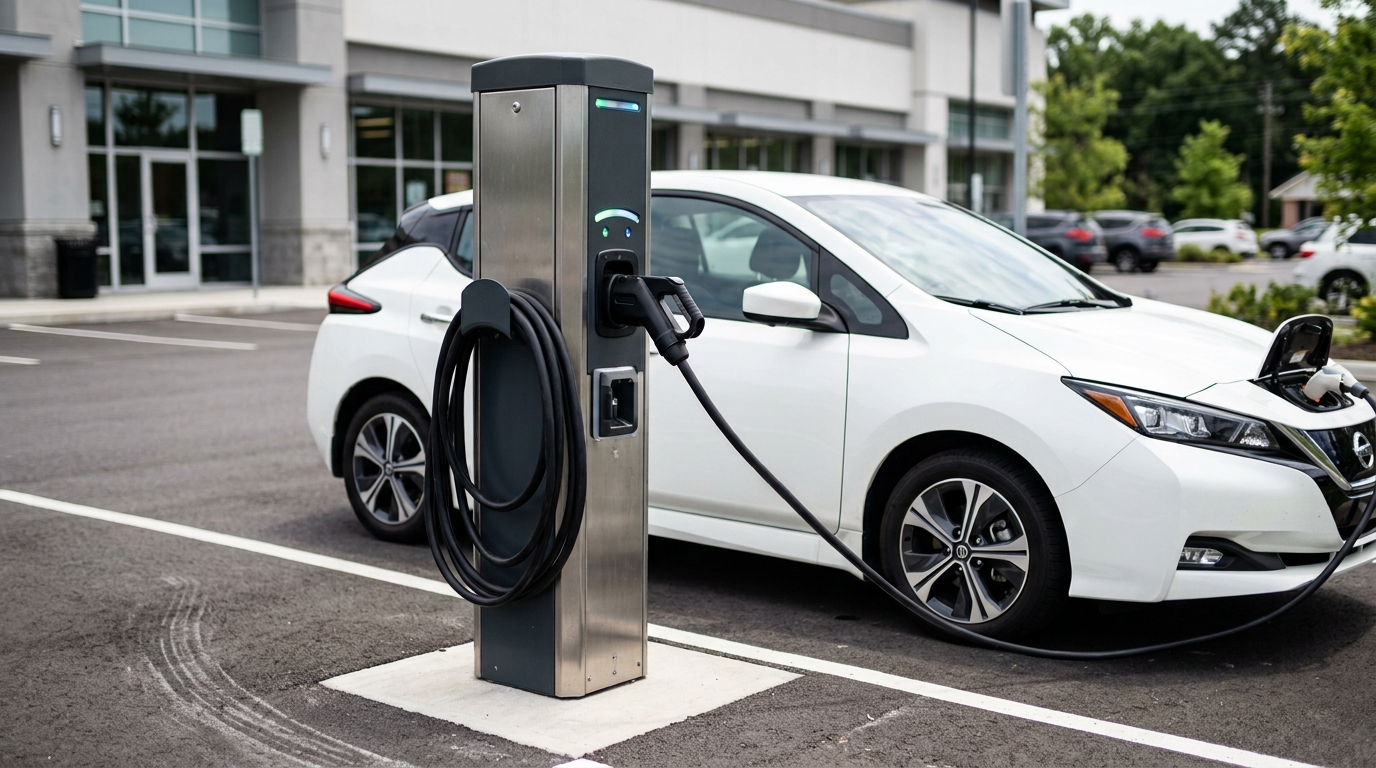
Electric car charging at terminal

FAQ

How many total electric vehicle charging stations operate in Ukraine?
As of mid-2025, over 5,000 public charging stations operate successfully in Ukraine. Of this number, more than 1,000 are high-tech high-speed (DC) terminals that allow cars to charge in a matter of minutes.

What is a modern EV hub from an architectural perspective?
An EV hub is a specially designed architectural location with a large number of high-speed charging terminals (usually from 10 to 20+ connectors). It is necessarily equipped with protective canopies, special lighting, well-thought-out traffic logistics, and is often combined with commercial infrastructure (cafes, shopping malls).

What specific building codes and standards regulate the installation of chargers?
Space design and terminal installation are strictly regulated by urban planning norms DBN B.2.2-12:2019 (requirements for calculating the number of parking spaces) and the DSTU 9222:2023 standard (fire protection of EV charging systems, safe distances).

What is currently the most powerful public charging station in Ukraine?
Currently, one of the most powerful public charging stations is the flagship 360 kW terminal by the Swiss company ABB, successfully installed and operated by the GO TO-U network in the city of Rivne.

Is it really mandatory to install charging stations near all new buildings?
Yes. According to recent amendments to urban planning DBNs coming into full force, at least 10% of spaces in all new parking lots, garages, and parking structures must be equipped with EV charging points featuring an established network power reserve.

What building materials are best suited for setting up durable EV hubs?
To reliably protect expensive equipment and create comfort, specialized metal structures (anodized aluminum, polymer-coated galvanized steel), modular canopies, facade cassettes, and anti-vandal station enclosures with an enclosure rating of at least IP54 are used.

author
About the author:

A marketing and communications expert at the Mehbud factory. Develops the brand, showcasing all the advantages of Mehbud products to clients. Helps you make the right choice by providing consultat...

More
0 0 votes
Article Rating
Subscribe
Notify of
guest
0 Comments
Oldest
Newest Most Voted