
To keep a metal facade undamaged during adjacent construction processes, three mandatory measures must be combined: removing the factory protective film on time, isolating the installed wall with temporary barriers appropriate to the type of threat, and prohibiting work nearby with an angle grinder, welding, and acid washes. In practice, most damage occurs not due to defects in the metal itself, but because of contractors’ false confidence that the polymer coating will withstand construction debris or that the factory packaging will protect the cladding until the building is commissioned.
The consequences of such negligence are especially noticeable on modern ventilated systems made of steel and aluminum — in particular cassette, rack, cubic shaped structures, or blinds facades manufactured by the “Mehbud” plant. While on the “Blinds Standard on Comb” models a single damaged lamella can be replaced relatively easily, cassettes with concealed fastening are connected sequentially and suffer from the so-called “domino effect”. Replacing one damaged panel in the middle of a wall requires careful disassembly of adjacent elements, preserving the integrity of the locks, frequent use of lifting equipment, and precise color matching, which creates significant additional financial costs and a risk of delaying building handover.
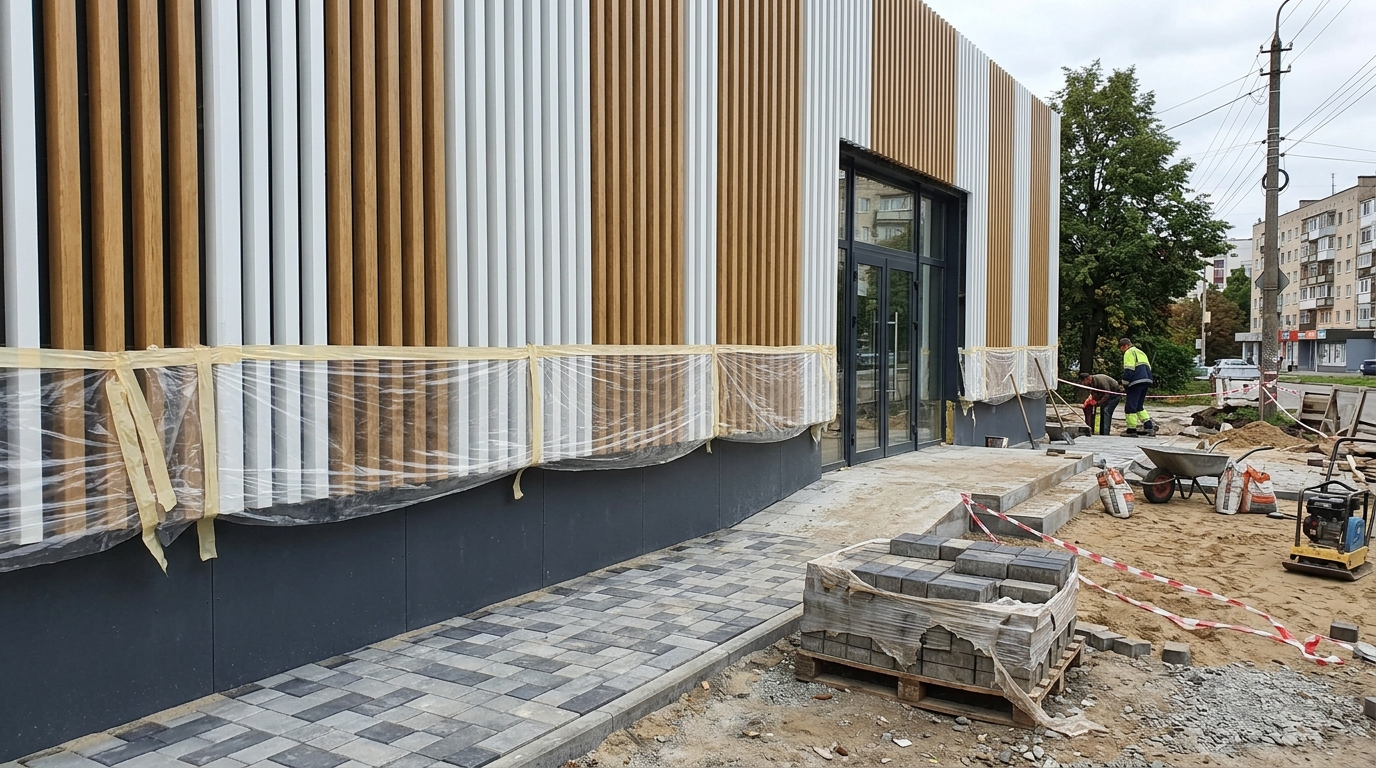
Why Metal Facades Are Particularly Vulnerable on a Construction Site
A metal ventilated facade is designed for long-term resistance to rain, wind, and temperature fluctuations, but its multi-layer structure poorly tolerates point impacts, red-hot metal particles, and aggressive mortars. The base of such cladding systems is usually galvanized steel or aluminum (in a number of cubic shaped systems, Corten steel is also used), protected by a polymer or powder coating. According to technical materials from the “Mehbud” plant, hot-dip galvanizing slows down steel corrosion by approximately 30 times compared to ungalvanized metal, while top-grade powder and fluoropolymer coatings are designed for 20–30 years of service without noticeable fading or chalking. However, a single deep chip that penetrates the polymer and zinc layers down to the steel base is enough for moisture and oxygen to trigger the rusting process.
Different facade systems from the “Mehbud” plant have different sheet thicknesses, fastening types, and geometries, and therefore their own vulnerable spots during adjacent works.
| Facade System Type | Material and Metal Thickness | Design Feature | Main Threat During Adjacent Works |
| Cassette facade | Galvanized steel 0.7–1.5 mm or aluminum 1.2–2.0 mm (less commonly zinc, copper) | Bent edges, closed shape, often concealed fastening | Difficult spot replacement due to the “domino effect” and risk of bending locks during dismantling |
| Rack facade | Galvanized steel 0.45–0.7 mm or aluminum 0.5–0.8 mm | Linear racks 150–525 mm wide, interlocking joint, wood-grain or rusticated textures | Dents and deflections from scaffolding pressure, scratches on the decorative surface |
| Blinds facade and model on a comb | Galvanized steel (0.45 mm standard, 0.7 mm custom) or extruded aluminum | Slanted lamellas, invisible fastening; individual lamella replacement is possible on the comb system | Clogging of gaps between lamellas with construction dust, mortar splashes, and paint overspray |
| Cubic shaped facade | Steel, Corten, or aluminum 0.45–0.7 mm | Volumetric racks (closed 50 by 50 mm on stringers or open 85 by 70 mm on traverses) | Snagging and deformation of protruding racks when carrying long materials |
| Panel facade and trim strips | Galvanized steel (panel thickness is not specified in the catalog); parapet flashings 0.45–2.0 mm | Large modular sheets on a frame; framing of parapets and reveals | Burn-through of polymer by sparks and bitumen contamination during roofing works |
In construction practice, the limitations of available specifications should be taken into account. According to the manufacturer “Mehbud”, plastisol coating fades and chalks faster in the sun, standard polyester is suitable for moderate conditions, and powder and fluoropolymer systems provide the highest resistance to impacts and ultraviolet light, with the quality of the powder layer directly depending on metal preparation and curing. At the same time, exact numerical indicators of individual polymer types’ resistance to high temperatures or aggressive fresh mortar are not provided in the manufacturer’s available documentation, and there are no independent comparative durability tests in a construction environment. Because of this, on a construction site, any factory coating should be considered sensitive to mechanical, thermal, and chemical influences.

The Trap of the First Days: Protective Transport Film and Storage Conditions
The most common mistake builders make is leaving the factory protective film on an already installed facade “until all messy work is finished.” Temporary protective film is intended solely to protect the sheet during roll forming, transportation, and installation, not for long-term exposure to sunlight.
According to recommendations from the “Mehbud” plant blog, the protective film must not be left on the metal for longer than 1–2 weeks. Industry guidelines for handling temporary films are even stricter: it should be removed directly during installation — before lifting the cassette or rack, or immediately after fixing it to the frame. Under the influence of UV radiation and heat, polyethylene becomes brittle, while the adhesive layer ages rapidly and bonds permanently to the paint; in very hot weather in direct sunlight, it takes only 1–2 days for the film to bake onto the surface.
Improper storage of facade elements on site before installation causes no less damage:
- Monitor storage timelines and microclimate. According to industry recommendations for temporary protective films, products with applied film should not be stored for longer than 6 months (even indoors at an optimal 10–15.5 degrees Celsius and 40–60 percent relative humidity), because after a year the film can no longer be removed without damage.
- Follow the “first in — first out” rotation principle. Order facade panels strictly according to the installation schedule and do not stack them in excessively high, heavy piles, as the weight of the upper sheets combined with heat presses the adhesive into the coating.
- Ensure a dry base and ventilation. Metal parts must not be placed directly on the ground, damp concrete, or wet surfaces — wooden pallets, rubber pads, or metal grids must be placed under the bundles. It is also prohibited to tightly wrap stored metal in ordinary non-breathable film: without ventilation, condensation forms underneath, leading to corrosion.
If these rules are violated or workers are allowed to walk on stacked panels in film, ring-shaped stains, adhesive residue, or a light haze may remain on the facade after removal, and the film itself will tear into tiny pieces.
Protection Against Impacts from Scaffolding, Ladders, and Mechanical Scratches
After removing the factory film, the greatest danger comes from scaffolding, leaning ladders, moving long profiles, and falling tools. Particularly vulnerable to mechanical dents and deep scratches are thin-sheet elements 0.45–0.7 mm thick (racks, cubic shaped lamellas, blinds on a comb), as well as the lower rows of cassettes along walkways, plinths, columns, and doorways where people and loads are constantly moving.
Protection begins with proper organization of work at height in accordance with building regulations DBN A.3.2-2-2009. All scaffolding and staging must be inventory-grade, assembled strictly according to the manufacturer’s technical documentation, and inspected before work begins, while workstations at a height exceeding 1.3 m and closer than 2.0 m to an elevation drop must have safety guardrails. Unless otherwise specified, tied scaffolding is anchored to the wall at least every other tier, and the anchors must not press against the face panels. If crews use leaning wooden ladders up to 5.0 m long, they must be positioned at an angle of 70–75 degrees to the horizontal, fitted with non-slip shoes on smooth floors, and must not rest their rigid metal or wooden ends directly against thin facade lamellas.
Exact regulatory distances from scaffolding standards to the face plane of finished metal cassettes or standardized impact-resistant structures for covering them are not separately defined in available building codes. In practice, a combination of organizational and covering solutions is used to protect installed walls:
- Proper installation sequence. Whenever possible, intensive work from scaffolding (installation of heavy structures, insulation of adjacent sections, roofing) is completed before hanging the finished metal cladding.
- Specialized protective tapes and drop cloths. When a wall needs to be covered with a temporary drop cloth or film to protect against dirt and scratches during finishing work, the material is secured around the perimeter without wrinkles exclusively with professional low-tack painter’s tape for delicate surfaces. Ordinary packaging tape must not be used — it leaves hard-to-remove adhesive residue or damages the top clear coat.
- Isolation of contact points. Where scaffolding or walkways run right next to the panels, potential contact points are separated with soft pads or shields without pressing against the metal itself.
Hot Work and Metal Cutting Near the Facade
Perhaps the most irreversible damage to a facade is caused by hot sparks from an angle grinder and welding spatter. The danger lies in the fact that immediately after the work, the damage may be almost invisible, yet over time rust spots and streaks appear on the metal where the red-hot particles landed.
When cutting with an abrasive disc, the metal in the cut zone overheats, the zinc and polymer coating burn off, and red-hot sparks bake into adjacent painted surfaces, forming microcracks. Moreover, corrosion can appear several months later not only on the front side, but also on the back side of the sheet. Even if it is not the facade itself being cut or drilled, but canopies, handrails, or brackets nearby, fine steel shavings settle on the painted or galvanized surface and begin to rust directly on it.
Therefore, strict hot work regulations are enforced near a finished metal facade:
- Prohibition of abrasive cutting of cladding. Painted parts and trim flashings are trimmed with specialized sheet metal snips or a special drill attachment, and exposed cut edges are mandatorily treated with anti-corrosion agents.
- Enclosure of the work zone under the Fire Safety Rules in Ukraine. Before starting welding or open-flame work, a hot work permit is issued. The workplace is cleared of combustible materials within a radius of at least 5 m, cylinders with oxygen and flammable gases are kept at least 5 m away from the welding zone, acetylene generators no closer than 10 m, and bitumen heating boilers during roofing works are placed at a distance of 10–30 m from buildings depending on their fire resistance rating. Serviceable fire extinguishers, sand, and water must always be kept nearby.
- Protective barriers made exclusively of non-combustible materials. Red-hot sparks easily burn through ordinary polyethylene film and household fabric, making it dangerous to cover the facade with them during welding. Between the welding or cutting point and the facade, solid metal screens, barriers at least 1.8 m high, or fireproof blankets are installed, and immediately after the shift ends, all metal filings and scale are thoroughly swept away with a soft non-metallic brush.
Protection Against Cement, Paint, Acids, and Adjacent Equipment Installation
A significant portion of defects occurs during so-called “wet” works — concreting perimeter walkways, laying tiles, plastering, and painting adjacent walls — or during the subsequent installation of air conditioners, light fixtures, and advertising structures.
Fresh concrete, cement, and lime mortars have an alkaline environment and contain abrasive sand particles that scratch the polymer coating when rubbed. No less dangerous are acidic efflorescence cleaners for brick and stone (which often contain hydrochloric acid): splashes of these onto sensitive metals can leave irreversible chemical burns and stains.
The most effective way to avoid a clash of technologies is to schedule all earthworks, concreting, and plastering before hanging the finished cassettes or lamellas. Additional protection for the lower tier is provided by proper execution of the plinth detail: according to recommendations for protecting the plinth from wetting and splashes, extruded polystyrene insulation (with water absorption of less than 0.2 percent by volume and compressive strength exceeding 250 kPa) is raised at least 300–500 mm above ground level. If wet or painting processes must be carried out next to finished cladding, the wall is covered with protective film using delicate-hold painter’s tape, tightly sealing the perimeter without wrinkles. Immediately after the messy shift ends, the film must be removed from ventilated facades so as not to block air circulation and create condensation.
When adjacent contractors install outdoor air conditioner units, cameras, or lighting onto the facade or behind decorative grilles and blinds, two details must be monitored:
- Fastener tightness and hole cleanliness. After drilling, metal shavings must be swept away, and when driving self-tapping screws, care must be taken to ensure the sealing washer is not skewed or damaged — otherwise moisture will be trapped in the hole and rust will form around the fastener.
- Compatibility of metals. Direct uninsulated contact between dissimilar metals (for example, mild carbon steel or brass with galvanized steel or aluminum) must not be allowed in facade assemblies, as galvanic corrosion occurs in a humid environment, accelerating structural degradation.
| Adjacent Work | Main Risk Factor | What Must Not Be Used for Protection or Cleaning | Recommended Protection Method |
| Concreting perimeter walkways, masonry, plastering | Alkaline splashes, abrasive sand particles in mortar | Hammer for knocking off buildup, wire brushes, acidic efflorescence washes | Protective film on delicate painter’s tape with immediate removal after the shift |
| Exterior and interior painting | Paint overspray, drops of acrylic or alkyd enamels | Random organic solvents or strippers without testing on an inconspicuous area | Full masking of adjacent panels and ventilation grilles with pre-taped masking film |
| Welding, metal cutting, roofing | Red-hot sparks, overheating and zinc burn-off, bitumen splashes | Ordinary polyethylene film, paper, or flammable fabric | Metal screens, barriers at least 1.8 m high, and fireproof blankets |
| Scaffolding work, carrying in materials | Impacts, dents, deformation of cassette locks | Packaging tape, protective transport film left in the sun | Inventory scaffolding per instructions, non-slip ladders, soft pads at contact points |
| Installation of air conditioners and utility networks | Metal shavings, over-compressed washer, contact of incompatible metals | Cutting fasteners on site with an angle grinder, direct joint of carbon steel and aluminum | Compatible fasteners with intact seals, isolation of dissimilar pairs, cleanup of filings |
If the Facade Is Already Contaminated or Damaged: Safe Cleaning and Repair
If contaminants still get onto the metal or scratches appear during work, the golden rule is not to try to quickly scrape off the problem with sharp objects or aggressive chemicals.
Safe Removal of Baked-On Film, Cement, and Paint
When factory film has been left on too long and tears into tiny shreds, it must strictly not be removed with a knife or metal putty knife — this will cut the coating and cause corrosion. According to technical advice from the “Mehbud” plant and guidelines for cleaning painted surfaces, gentle methods are applied:
- Heat or a strip of tape over the film itself. The affected area is carefully warmed with a heat gun on a low setting (without overheating the coating), and once the adhesive softens, the film is peeled off by hand or with a plastic scraper. Alternatively, a strip of wide adhesive tape can be pressed firmly over the film remnants and slowly pulled from one side so the polyethylene comes off along with the tape.
- Gentle softening of adhesive residue. Recommendations on the “Mehbud” blog describe soaking a cloth in diesel fuel and leaving it for 2–2.5 hours to soften the adhesive. On delicate surfaces, alcohol, vegetable oils, or a soft paste of baking soda and oil are also used to remove glue residue. Using strong solvents like acetone is risky — any agent must first be tested on an inconspicuous spot to ensure it does not dissolve the polymer or alter its color or texture.
Construction stains are also removed in stages. Fresh mortar splashes are rinsed off abundantly with water and a soft sponge, constantly rinsing out sand grains, while hardened cement, after soaking with water, is carefully removed with a plastic spatula without hammer blows and without acidic cleaners meant for tile or brick. Fresh acrylic or water-based paint is softened with warm soapy water for 15–20 minutes, whereas for dried oil enamel, white spirit is used cautiously after a preliminary test on the coating. After any localized treatment, the area is thoroughly washed with warm water and a mild soap solution and dried.
For final cleaning of the entire facade after construction work is finished, washing the surface with water and a mild detergent using a low-pressure jet is sufficient. At the same time, “Mehbud” specialists warn: wet washing a metal facade in winter is dangerous, as water can freeze faster than dirt washes away, forming an ice crust on the wall.
When Touch-Up Painting Suffices and When Panel Replacement Is Required
Clear numerical thresholds such as maximum scratch length or dent depth are not recorded in the open documents of the “Mehbud” plant; however, general practice for restoring steel surfaces with a polymer layer is based on assessing the depth of damage and the element’s residual strength.
Shallow scratches that do not breach the zinc layer are cleaned of dust, degreased with an agent compatible with the factory layer, dried, and covered with a thin coat of touch-up enamel matching the facade color. If a chip reaches the base steel or rust has already appeared at a spark impact site, the corrosion is carefully removed without enlarging the spot (for deep oxidation, a rust converter or zinc-rich compound is used), the surface is degreased, dried, coated with an anti-corrosion primer for galvanized steel, and only then covered with finish touch-up paint.
If the metal has sustained a deep dent, a burn-through hole, or severe structural damage, it is safer to replace the damaged element. For systems with open access (such as “Blinds Standard on Comb” lamellas), replacement is quick. By contrast, spot replacement of a concealed-fastening cassette turns into a complex four-stage engineering procedure: inspection and repair of the load-bearing frame, restoration of the thermal insulation envelope, adaptive installation of the new cassette while preserving adjacent locks, and final fastening and sealing. The new element must precisely replicate the joint geometry and account for any slight shade shift of the existing facade under sunlight. Since the exact cost and labor intensity of such work are individual to each project, careful wall protection during adjacent construction remains the smartest way to avoid unnecessary expenses.
Related articles
Metal Siding for Facades: How to Choose, Install, and Maintain
How to choose metal siding for a house, compare it with vinyl siding and corrugated metal, calculate the full kit, and check cladding installation and maintenance.
What is glass wool and how to choose it for insulation
How to choose glass wool for a roof, facade, and partition, determine the thickness, and avoid mistakes during installation. Seven answers to frequently asked questions.
Rainscreen Ventilation Gaps at Windows, Wall Bases and Parapets
Three rainscreen sections show how trims can obstruct cavity ventilation at windows, wall bases and parapets, with drainage checks and references to Ukrainian DBN V.2.6-33:2018.