
A high-quality ventilated facade is inconceivable without reliable insulation. But how do you make the right choice among the multitude of materials so that the facade serves for decades and truly saves money?
Table of Contents:
- The role of insulation in a suspended ventilated facade system
- Types of mineral wool: why raw material is everything
- Key properties of basalt insulation
- Density, thickness, and structure: double or single-layer insulation?
- Do you need a windproof membrane over mineral wool?
- Top 3 fatal mistakes during insulation installation
- Economic benefits: why quality mineral wool pays off
Our clients often ask which insulation is best suited for suspended ventilated facades. Today, the energy efficiency of buildings is not just a trend, but a strict necessity driven by rising energy costs. A ventilated facade works like a perfect thermos, but only with the right “filler.”
Therefore, we decided to thoroughly analyze the most popular, safe, and effective material for this purpose — mineral wool.
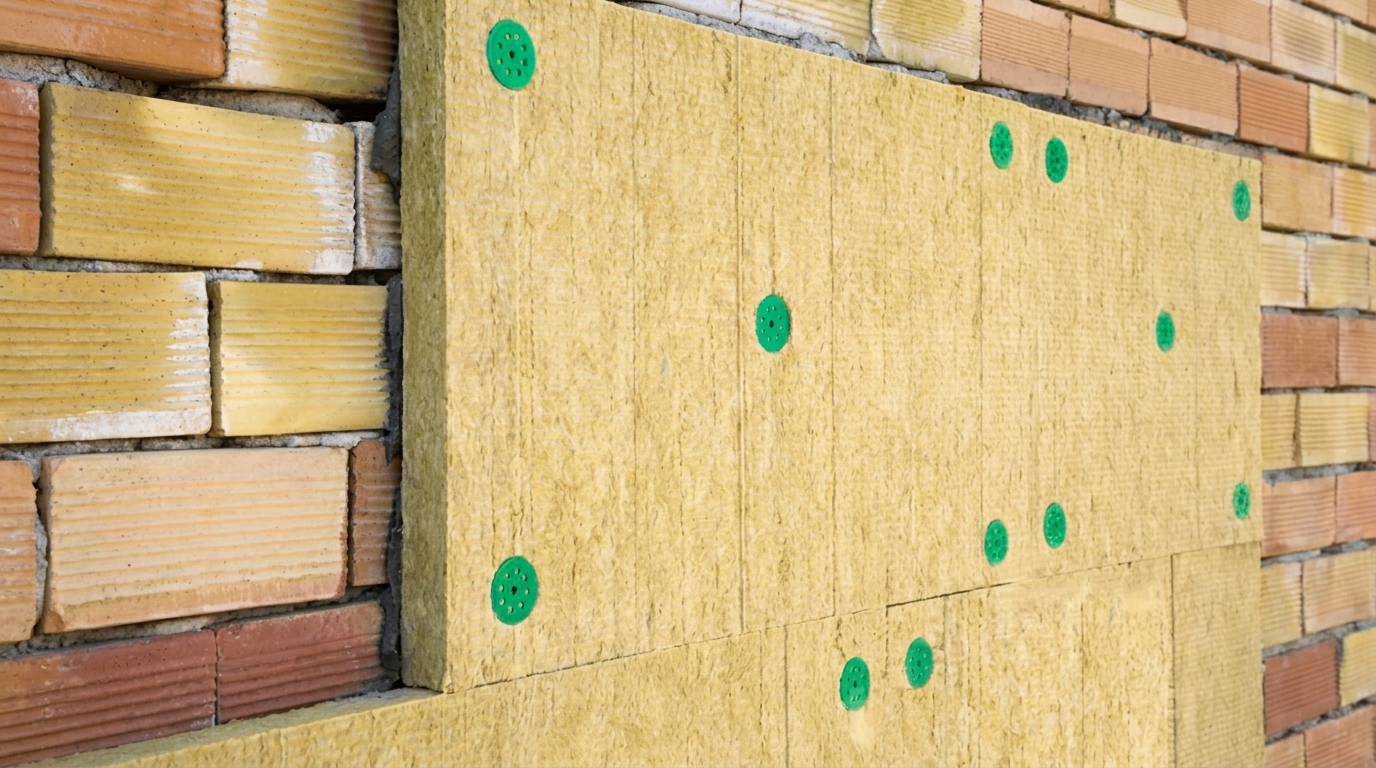
Mineral wool is a modern fibrous thermal insulation material. Imagine cotton candy, but made from real molten stone. It is produced by melting silicate rocks or metallurgical slags at ultra-high temperatures (around 1500 °C) and then spinning them into the finest threads. Thanks to its structure, consisting of randomly intertwined fibers and millions of tiny air bubbles between them, it is the absolute leader among facade insulators.
Types of mineral wool: why the raw material is everything
Depending on the raw material used, mineral wool is divided into several types. For suspended ventilated facade (SVF) systems, it is critical to understand the difference between them, as a mistake at the selection stage will lead to the destruction of the entire system.
Stone (basalt) wool — The gold standard in construction
It is produced by melting volcanic rocks (mainly of the gabbro-basalt group). This is a premium quality material. Stone wool is used in serious building structures, high-rise buildings, and suspended facade systems. It is characterized by the highest durability, zero shrinkage over time, resistance to vibrations, and the best fire resistance indicators. Basalt fibers can withstand colossal thermal loads without breaking down.
Slag wool — Savings that will turn into a disaster
It is made from blast furnace slags and non-ferrous metallurgy waste. Although this material has certain thermal insulation properties (and a very attractive price), we strongly do not recommend using it for ventilated facades.
Why? First, slag wool has increased residual acidity. With the slightest wetting (and there is always condensation in a ventilated facade), it forms an aggressive environment that causes active corrosion of the metal sub-structure elements — your brackets and profiles will simply rust. Second, it is brittle, easily absorbs moisture, and experiences severe shrinkage. As they say, when buying a new Mercedes, you wouldn’t fill it up with low-octane gasoline mixed with water, would you?

Key properties of basalt mineral wool
Let’s look in detail at why stone wool has become the #1 material in the design of suspended ventilated facades:
- Low thermal conductivity (0.032 – 0.040 W/m·K). Still air trapped between the fibers is the best natural insulator. For comparison: a 100 mm thick layer of high-quality mineral wool is equivalent to a solid ceramic brick wall over 1170 mm thick or a solid concrete wall nearly 2 meters thick in its ability to retain heat!
- Hydrophobicity (non-hygroscopic). During production, the fibers of facade mineral wool are treated with special water-repellent oils and impregnations (hydrophobizing agents). Thanks to this, moisture rolls off the material’s surface in drops without penetrating inside. The water absorption level upon short-term immersion is no more than 1-1.5%.
- Vapor permeability (“breathing” walls). This is the most crucial advantage of mineral wool over foam plastics (expanded polystyrene). Mineral wool does not hinder the diffusion of water vapor from the room to the outside. Condensation does not linger in the walls; it freely passes through the insulation into the air gap of the facade, where it is instantly evaporated by upward air currents. This permanently rids the building of “wet corners,” mold, and fungus problems.
- Absolute fire resistance (Non-combustible class). Basalt wool melts at temperatures above 1000°C. It does not burn, does not support combustion, does not melt into flaming drops, and does not emit toxic gases during a fire. In facade systems, it acts as a powerful fire barrier, preventing the spread of flames across the building.
- Excellent sound insulation. The chaotic interlacing of fibers of varying thicknesses effectively absorbs sound energy, dampening both airborne and impact noise. A facade insulated with mineral wool makes the premises significantly quieter, which is especially important for buildings near busy highways.
- Eco-friendliness and biostability. Stone wool is not a breeding ground for microorganisms. Rodents do not settle in it (it is prickly and indigestible), nor do insects and bacteria. Modern production standards minimize the use of formaldehyde resins, making the material safe.
- Durability. The effective service life of basalt insulation in a properly designed facade exceeds 50 years. Stone does not age!
Density, thickness, and structure: how to choose correctly?
For suspended facades, it is strictly forbidden to use ordinary rolled insulation — it will quickly slide down under its own weight and block the ventilation gap. Only rigid boards are used here.
- Density of the outer layer: Air constantly circulates in a ventilated facade, creating a draft. To prevent the wind from “blowing out” the heat and fibers from the wool, the outer layer of insulation must have a density of 80 to 90 kg/m³.
- Double-layer insulation: The two-layer technology is frequently applied for facades. Softer wool (density 30-45 kg/m³) is attached to the wall, which tightly fits all the irregularities of the brick or concrete without leaving gaps. Then, a rigid wool layer (80 kg/m³) is placed on top, acting as a protective screen.
- Dual-density wool: An innovative material where a single board has a soft inner layer and a rigid outer layer. This significantly saves time and money on installation.
- Thickness: It is not chosen “by eye.” The thickness is calculated by a heating engineer depending on the wall material and climate zone. On average, for Ukraine, it is 100 – 150 mm.
Do you need a windproof membrane?
This is one of the hottest debates among builders. About 10 years ago, a windproof membrane was always stretched over mineral wool to protect it from fiber blow-out by the airflow in the gap.
Today, the approach has changed.
A membrane in the facade presents an additional fire risk (even if declared as flame retardant). Modern manufacturers produce basalt wool with an already compacted outer layer or faced with fiberglass (faced wool). Such mineral wool, with a density of 80 kg/m³ or higher, does not require a wind barrier. This makes the facade 100% non-combustible and saves money on buying and installing the membrane.
Top 3 fatal mistakes during insulation installation
Even the most expensive basalt will lose its properties if the crew makes mistakes:
- Installation with gaps. Boards must be installed in a staggered pattern (with staggered joints, like brickwork). Gaps between boards of more than 2 mm act as “cold bridges” through which heat escapes.
- Skimping on fasteners. Mineral wool is secured with special plastic disc anchors (umbrella dowels) equipped with a steel pin (a plastic pin cannot hold the weight of the wool over time). The standard consumption is at least 5-7 dowels per 1 m². If there are fewer, the wool may detach from the wall.
- Squeezing the wool. The insulation should not be compressed by brackets or the cladding. It is not the stone itself that holds the heat, but the air between the fibers. Compress the wool — squeeze out the air — lose the thermal insulation.
Economic benefits: is it worth paying more?
Investments in high-quality basalt insulation for a suspended facade seem substantial only at the purchasing stage. In practice, they start paying for themselves in the very first heating season:
- Reduction in winter heating costs by up to 30-40%.
- Reduction in summer air conditioning costs (the facade prevents the walls from heating up under the sun).
- No need for wall repairs due to dampness and mold.
- An increase in the building’s market value (the capitalization of a property with an energy-efficient SVF is significantly higher).
Summing up, we can state with absolute certainty: by choosing certified stone (basalt) insulation for a suspended ventilated facade, you are choosing reliability.
Besides stone wool, the construction market also sometimes uses glass wool. What are its features, why is it cheaper, and can it safely compete with basalt in facade systems? You will learn about this in our next article.
You can also get a detailed calculation of materials, learn more about suspended ventilated facades, and receive help in selecting the ideal thickness of mineral wool by contacting our engineering experts directly.
Related articles
Facade Finishing Passport in Kyiv and Major Cities: A Step-by-Step Guide to Obtaining Permits in 2026
A Step-by-Step Guide to Obtaining a Facade Finish Passport in Kyiv (2026): Approvals, Design Code, Signage, DBN Standards, and Materials.
Analysis of the cost and technological features of the installation of modern metal facades in the regions of Ukraine: Kyiv, Lviv, Dnipro
Cost analysis and installation of modern metal facades (cassettes, rack, blinds) in Ukraine (Kyiv, Lviv, Dnipro). Tech features & prices.
Planned preventive maintenance of metal ventilated facades of commercial facilities: methodology, regulations, and technologies
How to extend a metal facade's lifespan to 50 years? Effective strategies for preventive maintenance, diagnostics, and modern cleaning technologies.