
If you live, work, or do business in Kyiv, sooner or later you will encounter the rules for the improvement of the city’s territory. These rules determine who is responsible for the cleanliness of courtyards, streets, and parks, what can be done on the adjacent territory, what is prohibited, and what consequences await violators. The article explains the main provisions of the document in simple terms — without legal jargon, and immediately clarifies its real legal status.
The material, often referred to as the “Rules of Improvement of the Territory of the City of Kyiv”, as of the time of preparation of this article, exists as a draft decision of the Kyiv City Council, published by the Department of City Improvement for public discussion. Currently, the officially valid rules in Kyiv remain the Rules of Improvement of the City of Kyiv, approved by the decision of the Kyiv City Council No. 1051/1051 dated 25.12.2008 (as amended on 15.11.2018). The new draft is designed to replace the outdated document and bring it into compliance with the Typical Rules of Improvement, approved by the order of the Ministry of Regional Development (Minregion) dated 27.11.2017 No. 310. Both documents regulate the maintenance of streets, courtyards, parks, green spaces, parking lots, temporary structures, and waste management, and violation entails administrative responsibility under Article 152 of the Code of Ukraine on Administrative Offenses (KUAO).
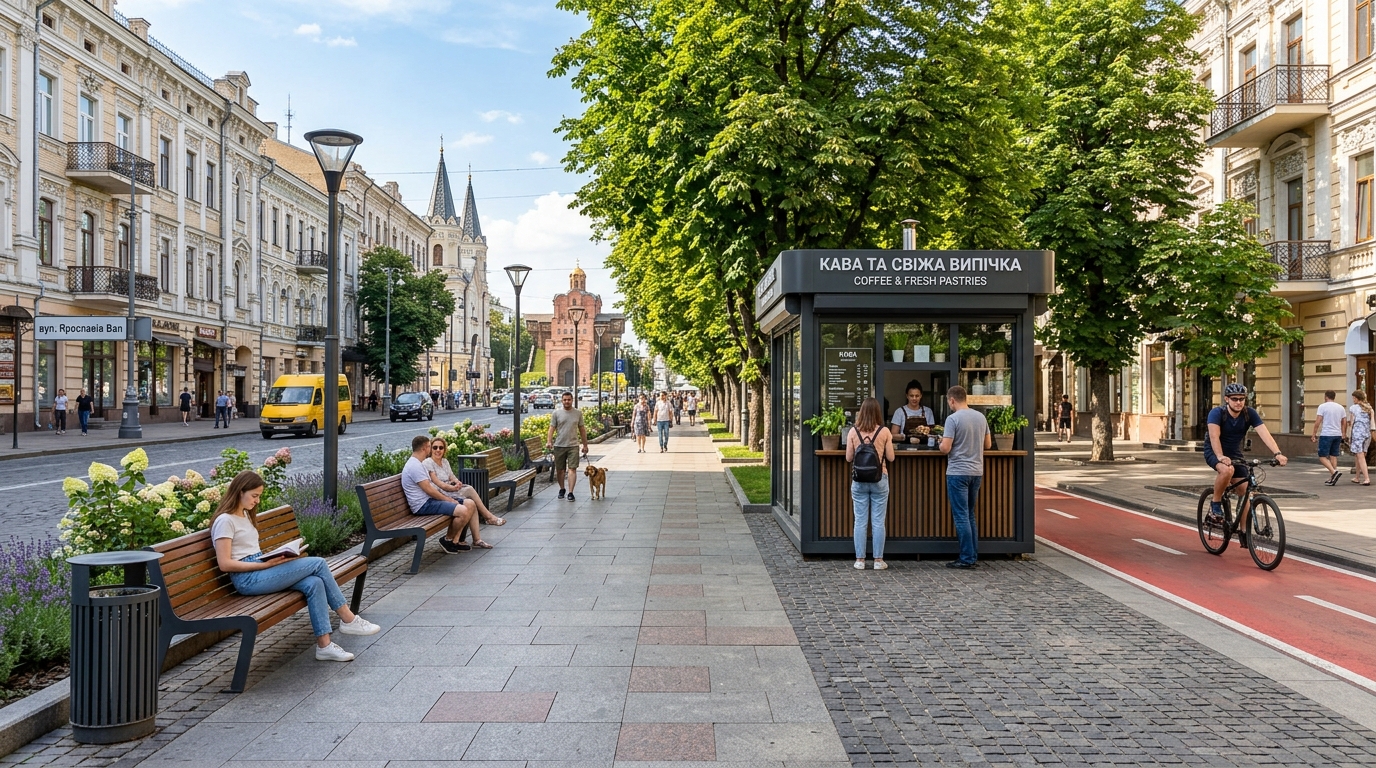
What kind of document is this
The full name of the document is the “Rules of Improvement of the Territory of the City of Kyiv” (hereinafter referred to as the Rules). According to the developers’ plan, this is a decision of the Kyiv City Council that regulates the rights and obligations of participants in legal relations in the field of settlement improvement and defines a set of measures to ensure cleanliness and order in the city.
It is important to distinguish between the two documents:
- The current Rules of Improvement of the City of Kyiv — approved by the decision of the Kyiv City Council No. 1051/1051 dated 25.12.2008 (with subsequent amendments, the latest dated 15.11.2018). These are the ones that have legal force right now.
- The draft of the new Rules of Improvement of the Territory of the City of Kyiv — the text analyzed in this article. It was published by the Department of City Improvement as a draft regulatory act for public discussion, and in the version provided to us, the date of adoption of the decision and its number are not filled in — this directly indicates the status of a draft, not a current act.
The main goal of the developers of the new draft is to replace the outdated document of 2008, align it with the current legislation and the Typical Rules of Improvement of the Minregion, as well as to regulate parking, sanitary cleaning, and the unauthorized placement of temporary structures in more detail.
The Rules (both current and draft) are based on national laws — in particular, the Law of Ukraine “On the Improvement of Settlements” — as well as on State Building Norms (DBN) and State Standards (DSTU), detailing their application specifically for Kyiv.
Before practically applying any provisions, you should check the current legal status of the document on the official portal of the Kyiv City Council (kyivcity.gov.ua) or consult a specialized professional.
Who does the document apply to
Both the current and draft Rules apply to everyone located on the territory of Kyiv:
- residents of Kyiv and owners of apartments and houses;
- condominium associations (OSBB), housing construction cooperatives (ZhBK), housing cooperatives, and property managers;
- businesses — retail outlets, cafes, parking lots, construction companies;
- developers and customers of construction projects;
- balance holders of improvement objects (utility companies);
- state authorities and local self-government bodies;
- owners of temporary structures (TS) and small architectural forms (MAF);
- foreigners and stateless persons residing in the city.
Main provisions of the document in simple terms
| Clause / Topic | What the document says | What this means in simple terms |
|---|---|---|
| Objects of improvement | Parks, squares, streets, courtyards, beaches, cemeteries, protection zones of utility networks, etc. | Almost any public territory in the city falls under the scope of the Rules |
| Obligations of owners/users | To maintain objects and adjacent territories in proper condition, to repair damages at their own expense | If a plot or building is assigned to you, cleaning and maintenance are your responsibility |
| Adjacent territory | The size of the adjacent territory boundaries is defined in Appendix 1 (e.g., 20 m for an OSBB, 50 m for a gas station) | You are responsible not only for your plot but also for the strip around it |
| Prohibitions on improvement objects | Unauthorized construction, destruction of lawns, dumping of garbage, unauthorized advertising, etc. | A list of actions for which you can receive a protocol for an offense |
| Temporary structures (TS) and MAF | Placement — only with a linking passport (pasport pryvyazky); unauthorized objects are subject to dismantling | A kiosk or pavilion without permits can be dismantled |
| Green spaces | It is forbidden to cut down trees without permission, park on lawns, or light fires | Green zones are protected by a separate list of prohibitions |
| Snow and ice removal | Owners are obliged to remove snow, ice, and icicles from roofs immediately | The responsibility for pedestrian safety in winter lies with the owner/balance holder |
| Waste management | A contract for waste collection is mandatory for all owners and users | Without a signed contract for waste removal, you violate the Rules |
| Control and responsibility | Self-governing control is exercised by the Department of City Improvement and other bodies; protocols are drawn up under Art. 152 of the KUAO | A violation is officially recorded and can have financial consequences |
| Dismantling of objects | Unauthorized MAF/TS are dismantled according to a notice within 1–3 days | The owner is warned with a notice, and then the object can be dismantled forcibly |

What is allowed
- To maintain and arrange your own land plot and adjacent territory in accordance with the Rules.
- To place temporary structures (kiosks, pavilions) provided there is a properly executed linking passport.
- To install MAF (benches, bins, flowerpots, etc.) observing safety and aesthetic requirements.
- To improve a household plot on your own or under a contract with a utility company.
- To participate in financing improvement measures (voluntarily, in accordance with Article 37 of the Law “On the Improvement of Settlements”).
- To appeal a dismantling or notice in the manner prescribed by law, in particular through the court.
What is prohibited or restricted
The document explicitly prohibits the following on improvement objects:
- performing works without the necessary permission;
- unauthorized setting up of vegetable gardens, destroying or damaging lawns and green spaces;
- dumping garbage, branches, or snow in undesignated places;
- storing building materials outside the construction site — the document requires that the work area be protected by a proper temporary fence for the construction site, and not just a tape or a symbolic barrier;
- unauthorized installation of advertising, stalls, kiosks, pavilions;
- washing or repairing vehicles outside specially designated areas;
- grazing livestock and walking animals in undesignated places;
- lighting fires outside specially designated areas;
- parking or driving on lawns and in green zones;
- moving snow from the roadway onto sidewalks or into green zones;
- putting up notices and advertising on improvement elements (poles, trees, fences, etc.).
Separately, within the “red lines” of streets and roads, it is prohibited to place structures, burn garbage, pitch tents, or dump snow or industrial water into road storm drains.
What obligations does the document establish
Owners, users, and balance holders of improvement objects are obliged, in particular, to:
- maintain improvement objects and adjacent territories in proper condition;
- repair damages to utility networks and the consequences of accidents caused by their fault at their own expense;
- conduct inventory and certification of assigned objects;
- paint and repair metal elements of facades, wash shop windows and glass surfaces at least once a quarter;
- protect green spaces with curbstones or fences;
- conclude a contract for the removal of household waste with an authorized business entity;
- immediately clean roofs of snow and icicles while observing safety measures;
- compensate for damages caused by the violation of legislation in the field of improvement.
Responsibility, risks, or fines
The document directly refers to the responsibility under Article 152 of the Code of Ukraine on Administrative Offenses: authorized employees of control bodies have the right to draw up protocols on an administrative offense using the form provided in Appendix 2 to the Rules.
In addition to the protocol, if a violation is detected (for example, an unauthorized installed MAF or TS), the person is handed an official notice demanding to eliminate the violation within a specified period (usually from one to three days). If the notice is not executed, the control body may organize the forced dismantling of the object, and all costs for dismantling, transportation, and storage are reimbursed by the violator.
If the violation caused material damage to an improvement object (for example, a lawn or tree was damaged), the balance holder creates a commission to determine the replacement cost of the damaged object, and the amount of damages is collected from the guilty person, if necessary, through a court.
In the provided document, the specific sizes of fines (monetary amounts) are not detailed — they are established by the Code of Ukraine on Administrative Offenses and require separate verification.
What this means for construction and manufacturing companies
Developers and contractors working in Kyiv fall under the scope of the Rules separately: project documentation for the construction, reconstruction, or overhaul of improvement objects must comply with the composition and content defined by DBN A.3.1-5:2016 “Organization of Construction Production”, and the construction site must be fenced and not interfere with pedestrian traffic. Companies participating in municipal procurement and seeking contracts for improvement objects should regularly monitor specialized tender platforms for construction in Ukraine, where relevant government orders are published.
For manufacturers of architectural metal structures and other B2B players in the construction market, compliance with local regulations is also a matter of reputation. As a B2B expert in construction and marketing consulting notes, companies that transparently communicate their compliance with improvement standards and permit procedures gain more trust from developers and general contractors during tender procedures.
Practical example
Example 1. An owner of an apartment in a multi-story building. The OSBB of your building is responsible for cleaning the courtyard, sidewalks, and driveways within a radius of at least 20 meters from the boundary of the building’s land plot to the roadway of the street (Appendix 1 to the Rules). In winter, the OSBB or property manager must clear snow and ice, sprinkle paths, and in summer — sweep and water the territory.
Example 2. A kiosk (TS) owner. If you have placed a temporary structure for trade, you need a valid linking passport. Near the kiosk, there should be at least two trash bins, outdoor lighting, a path to the sidewalk, and a well-maintained adjacent territory within a radius of no less than 20 meters. If the linking passport is canceled or the structure was installed without authorization, you will be handed a notice demanding dismantling within a few days.
What needs to be done in practice
- Check the current version of the Rules on the official website of the Kyiv City Council.
- Determine whether the document applies to your situation (homeowner, business owner, developer, etc.).
- Find the relevant section of the Rules (for example, Section X — on the adjacent territory, Section VIII — on MAF).
- Check the boundaries of your adjacent territory according to Appendix 1 to the Rules.
- Make sure that a contract for the removal of household waste has been concluded.
- If there is a temporary structure, check the validity of the linking passport.
- In complex or controversial cases, contact a specialized lawyer or the Department of City Improvement.
Most important conclusions
- The reviewed text is a draft of a new edition of the Rules; the 2008 Improvement Rules remain in force and are mandatory for everyone in Kyiv.
- Every owner or user of land or a building is responsible not only for their own plot but also for the adjacent territory of a certain radius.
- A violation is recorded by a protocol under Article 152 of the KUAO, and unauthorized MAFs and TSs can be forcibly dismantled.
- The costs of dismantling, storing, and restoring the improvement are placed on the violator.
- The document regulates in detail waste management, maintenance of green spaces, streets, and parking lots.
FAQ
What does this document regulate?
The Rules regulate the maintenance and improvement of all public and adjacent territories in Kyiv — streets, courtyards, parks, green spaces, parking lots, temporary structures, and waste management.
Who does the document apply to?
It applies to residents, OSBBs, businesses, developers, balance holders, government bodies, as well as foreigners and stateless persons residing in Kyiv.
Is this document mandatory?
Currently, the 2008 edition (Decision No. 1051/1051 dated 25.12.2008, as amended on 15.11.2018) has legal force — it is generally mandatory. The text reviewed in this article is a draft of a new edition, which will take effect only after official adoption by the Kyiv City Council.
What will happen for violating the Rules?
The authorized control body can draw up a protocol on an administrative offense under Article 152 of the KUAO, issue a notice to eliminate the violation, and in case of non-compliance — organize the forced dismantling of the object at the violator’s expense.
Where can I check the current version of the document?
On the official website of the Kyiv City Council / Kyiv City State Administration, as well as at the Department of City Improvement.
Does the document apply to individuals?
Yes, individuals (owners of apartments, household plots, TS) are directly named as subjects of responsibility under the Rules.
Does a business need to comply with these requirements?
Yes. Enterprises, institutions, and organizations are obliged to maintain their own and assigned territories, conclude contracts for waste removal, and comply with the requirements for the placement of advertising, TS, and MAF.
When should you contact a lawyer or specialized professional?
If you have received a notice or a protocol on an offense, are appealing the dismantling of an object, or are not sure whether the requirements for the adjacent territory apply to you — it is worth consulting a lawyer.
How does the new draft differ from the current 2008 Rules?
The draft regulates in more detail the parking of vehicles, sanitary cleaning of territories, the procedure for selling dismantled temporary structures, and brings the document into line with the Typical Improvement Rules of the Minregion of 2017.
Conclusion
Regardless of whether the current 2008 edition or the new draft will ultimately be in effect in Kyiv, the logic of the Improvement Rules remains common: keep your territory and the adjacent zone in order, sign a waste removal contract, and check permits for temporary structures. These rules affect practically everyone who lives, works, or does business in the capital — from cleaning a yard to placing a kiosk. Before making decisions, you should check the current status of the document on the official resources of the Kyiv City Council.
Related articles
Top 7 Companies to Buy Gabions in Ukraine: Ranking of Trusted Manufacturers
Rating of reliable manufacturers. Price comparison, expert tips on wire thickness and stone selection for durability.
Warranty for metal structures in Ukraine: Legal regulation, engineering standards, and judicial practice
Metal structure warranties in Ukraine: Legal regulation (10 years), DBN standards, ISO corrosion protection, fireproofing, and how to file defect claims.
Top companies performing foundation works in Kyiv
Rating of TOP foundation work companies in Kyiv 2026. Current prices, contractor comparison, market analysis, and expert advice on choosing a reliable foundation.