
When designing a building, it is necessary to solve a whole range of fundamental issues in advance. And when it comes to exterior finishing, it is important to decide whether a wet or ventilated facade will be the optimal solution in the given situation. Without analyzing the initial data, it is impossible to answer this question, so below we will try to thoroughly understand the use of facade finishing technologies, analyze their strengths and weaknesses, and provide recommendations on choosing one or another option.
Wet Facade
Installation Technology.
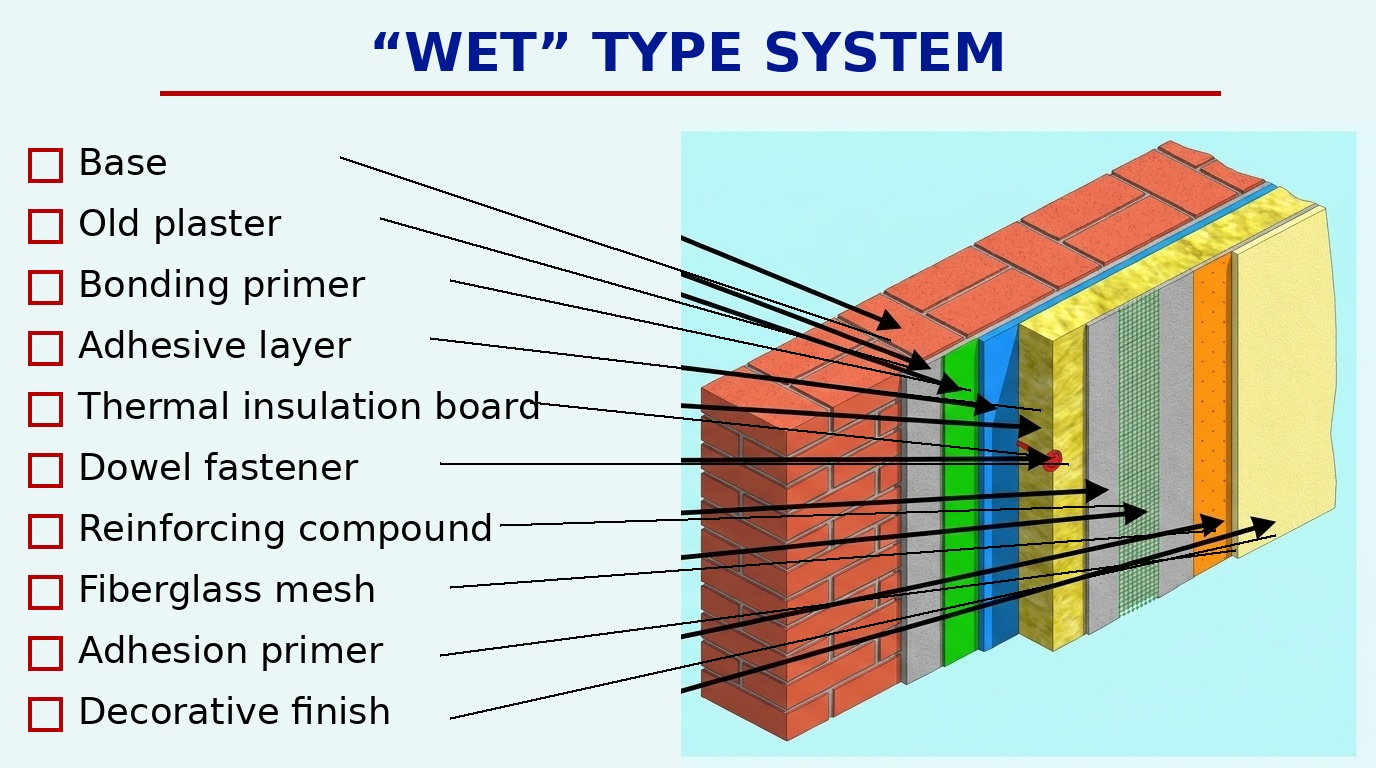
Originally, the wet facade was the basic technology for exterior building finishing — plastering has been used for as long as humans have been building houses. However, modern technology for insulating and decorating a facade using the wet method is much more complex:
- At the first stage, preparatory treatment of the facade is performed. It usually includes repair of surface defects (cracks, gaps), application of primer, and installation of a plinth profile. The plinth profile is fixed using mechanical fasteners and serves as a support for the thermal insulation layer.
- Then the prepared surface is insulated. For this, cement-based adhesive is applied to the walls, and thermal insulation panels are glued. Both synthetic (foam plastic, expanded polystyrene) and mineral (basalt wool and analogues) materials can be used when installing a wet facade.
- After the adhesive mixture polymerizes, mechanical fixation of the insulation is performed using disc dowels.
The fixed thermal insulation layer is treated with an adhesive compound and then plastered using a reinforcing mesh. The plastered surface is decorated — it is either painted or treated with special plaster.
All materials used for wet facade installation must comply with the requirements of DBN V.2.6-31:2016 “Thermal Insulation of Buildings”.
Materials for Wet Facade
The appearance and performance parameters of a facade finished using wet technology are directly determined by the materials used for its finishing. As noted above, plaster is most often applied over the insulation reinforced with a mesh and leveled with a cement-based compound. What types of facade plasters are used in exterior finishing:

- Cement compositions are the most common type of plaster, suitable for finishing large surfaces. The base consists of a mixture of Portland cement and sand. Mineral granules may be added to the plaster to increase strength and improve appearance. The main drawback is the limited number of shades, so a facade finished with cement plaster must be painted with exterior paint.
- Silicate compositions also belong to mineral plasters (the base is liquid glass). Quartz sand and mineral chips are used as additives that determine the strength and texture of the finished facade. Plasters based on silicate mixtures are suitable for finishing facades exposed to intensive loads, but they have disadvantages — complexity of high-quality application and high price.
- Acrylic and silicone plasters. They are mainly used for finishing low-rise building facades, although acrylic mixtures with increased strength have recently gained popularity — they can also be used for commercial facilities. Acrylic and silicone-based materials are easy to apply and level or shape without effort — this significantly speeds up the finishing process. An advantage is the possibility of pre-tinting the plaster mixture, which reduces time spent on wet facade finishing.
According to the appearance of the plaster used in the final stage of wet facade finishing, it can be divided into 3 main groups:
- Smooth — tinted in mass or painted after application and sanding.
- Textured — plasters whose appearance is determined by the mineral elements embedded in them. This includes both plaster mixtures with visible mineral granules and popular compositions where texture appears during special application (“Bark Beetle”, “Lamb”, etc.).
- Patterned (Facture) — plasters where relief is formed by special laying of plastic mass. They can be single-layer or multi-layer, single-color or tinted (deeper areas have a darker shade).
There are situations when choosing a wet facade is the optimal solution. Here, the advantages of such facades come to the fore:
- Relatively low weight of the facade finishing, which reduces the load on load-bearing structures.
- Lower complexity of installation compared to ventilated facades.
- Good thermal insulation performance.
- Additional sound insulation and protection from vibration.
- Great design potential: you can paint it any color, apply structural or mineral plaster, etc.
The relatively low price can also be considered an advantage of wet facades, so under a limited budget, this technology is more often chosen.
Ventilated Facades
Facade Structure
The discussion about what is better — wet or ventilated facades — would be incomplete if the second option was not considered in the same detail.
A ventilated facade is a multi-layer structure mounted on top of the building. Its main feature is the presence of an air gap that ensures the preservation of natural ventilation of the wall enclosure:
- The basis of the ventilated facade is a frame, which is fixed to the walls using a system of brackets.
- Thermal insulation is placed in the frame cells. When installing a ventilated facade, mineral-based materials (basalt wool) are almost always used — this ensures vapor permeability and low flammability.
- To protect against wind, a windproof membrane with one-way vapor permeability is laid over the thermal insulation: it releases moisture outward but does not allow it inside the insulation layer.
- The facade finishing is attached to the frame — these can be metal cassettes, porcelain stoneware panels, fiber cement boards, etc.
The finishing is mounted on the frame over the insulation — always with the formation of a gap.
The gap formed between the finishing and the windproof membrane is very important: ascending air flows are formed inside the structure, which effectively remove condensing moisture. Thanks to this, the microclimate in a room with ventilated finishing will be more favorable.
Materials for Ventilated Facade
A ventilated facade, as mentioned above, is mounted on a frame. A rigid structure made of galvanized steel or aluminum profile, or (less often) wooden beams impregnated with water-repellent and fire-retardant compounds, is used as the frame.
The following materials can be attached to the frame over the insulation and windproof membrane:
- Wooden panels — clapboard, false beam, block house, etc. Mainly used in private construction and for finishing country properties.
- Wood-polymer composite (WPC) panels. The material consists of cellulose fiber and polymer, making WPC a “hybrid” of wood and plastic. Today, this material is gradually gaining popularity in facade finishing.
- Fiber cement boards. The material includes Portland cement and fibrous materials, which provide the boards with high strength and good thermal insulation properties. Very often the outer surface of the board is covered with a decorative layer of PVC or polyurethane, so such structures do not require painting.
- Porcelain stoneware panels. This artificial stone is very popular in facade finishing. At present, hidden installation systems are actively used, allowing a suspended porcelain stoneware facade to look monolithic.
- PVC panels. This group of products is mainly represented by siding, which is widely used in private low-rise construction.
A separate and rather large group of materials for ventilated facade installation consists of metal products. These include:
- Metal siding.
- Facade cassettes and panels.
- Blind panels (Jalousie).
Metal cassettes and panels used in facade finishing are characterized by high strength, durability, and attractive appearance. In addition, the ability to apply protective and decorative coatings in various colors allows commercial building facades to be finished in corporate shades.
Advantages of Ventilated Facades
The question of when to choose a ventilated facade should also be decided after a thorough analysis of the advantages:
- Installation of a suspended ventilated structure allows hiding all defects of the main facade (up to masking wall curvature).
- Multi-layer structure provides effective thermal insulation, waterproofing, and wind protection.
- Use of durable finishing materials increases the facade’s resistance to external factors and extends its service life.
- Thermal insulation using mineral materials makes the facade fireproof.
For the sake of fairness, the disadvantages should also be noted. Provided high-quality insulation and good durable finishing materials are used, the cost of a ventilated facade will be higher than that of a facade finished using wet technology. The qualification of craftsmen during the installation of ventilated structures also plays a much more important role.
COMPARISON OF REQUIREMENTS FOR WET AND VENTILATED FACADES
Regulatory Requirements
When designing facade finishing, it is also necessary to take into account the requirements for facades. There is no single standard here, so information from several sources must be considered.
For wet facades, the most important are:
- DBN V.2.6-31:2016 “Thermal Insulation of Buildings”.
- DBN V.2.6-33-2008 “Structures of External Walls with Facade Thermal Insulation. Requirements for Design, Installation, and Operation”.
- DSTU B V.2.6-36:2008 “Structures of Buildings and Structures. Structures of External Walls with Facade Thermal Insulation and Plaster Finishing”.
For ventilated facades:
- DBN V.2.6-31:2016 and DBN V.2.6-33-2008 (remain relevant).
- DSTU B V.2.6-35 “Structures of External Walls with Facade Thermal Insulation and Finishing with Industrial Elements with Ventilated Air Gap”.
- DSTU B V.2.6-34 “Structures of External Walls with Facade Thermal Insulation. Classification and General Technical Requirements”.
At the same time, metal products for ventilated facades must comply with the following standards:
- GOST 24767-81 “Cold-formed profiles from aluminum and aluminum alloys for enclosing building structures”.
- DSTU B V.2.6-3-95 (GOST 22233-93) “Pressed profiles from aluminum alloys for enclosing building structures”.
- DSTU B V.2.7-58-97 (GOST 30246-94) “Thin-sheet rolled products with protective and decorative paint coating for building structures”.
A separate group of requirements consists of fire safety requirements for facade structures:
- SNiP 21-01-97 “Fire Safety of Buildings and Structures”.
- DBN V.1.2-7-2008 “System for Ensuring Reliability and Safety of Construction Projects. Basic Requirements for Buildings and Structures. Fire Safety”.
Comparative Table of Facade System Characteristics
| Comparison Criterion | Wet Facade (Plaster) | Ventilated Facade (Suspended) |
|---|---|---|
| Installation Seasonality | Exclusively in warm season (above +5°C) | All-season (no “wet” processes) |
| Base Requirements | Strict: perfectly flat, strong and dry wall | Minimal: frame levels any curvature |
| Service Life | 15–25 years (requires regular renewal) | Up to 50+ years (especially metal and porcelain stoneware) |
| Wall Ventilation | Low (especially with expanded polystyrene) | High due to air gap |
| Resistance to Damage | Medium (sensitive to impacts, house shrinkage) | High (vandal-resistant metal cassettes) |
| Maintainability | Complex (local patches are visually noticeable) | High (quick replacement of individual cassette or panel) |
| Cost (materials + labor) | Budget / Medium | Above average / Premium |
Base Requirements
For a wet facade to function effectively, it is necessary to:
- Level the base surface as thoroughly as possible, ensuring tight adhesion of the thermal insulation material to the wall enclosure;
- Strengthen the base to the maximum, removing all weakly adhering or peeling fragments;
- Completely eliminate base mobility due to settlement and other deformations to avoid cracking of the plaster layer;
- Provide waterproofing of the base and its protection against fungi and bacteria under the insulation layer.
Technology Comparison: Making the Final Choice
Having understood the basics of finishing technologies and analyzed their advantages, we have every right to compare them. So, what to choose — a ventilated facade or a wet facade?
First, the parameters in which these options are equivalent:
- Thermal insulation. Both with plaster finishing and with the installation of suspended structures, you can select the optimal thickness of the insulation layer that will provide the required level of energy saving.
- Sound insulation. As in the case of heat loss protection, the effectiveness of insulation against external loud sounds primarily depends on the structure of the panels and insulation. Both finishing options protect walls well from street noise penetration.
- Fire safety. If the materials used for facade finishing meet regulatory requirements, there is no need to worry about flammability. In the case of wet technology, the plaster layer provides protection, while ventilated facade installation almost always uses non-combustible insulation (mineral wool) and fire-resistant cladding.
Now let’s consider situations when one or another option is better.
Requirements for the base for a ventilated facade are less strict:
- Facade finishing perfectly compensates for all irregularities, so preliminary leveling is not required. It is enough to dismantle structures that will interfere with facade works;
- the strength of the base must be sufficient to support the weight of the load-bearing structure, insulation, and finishing. The presence of peeling finishing is undesirable but does not significantly affect the overall strength of the frame structure;
- the design of the ventilated facade provides normalization of the humidity regime through ventilation, so waterproofing and antifungal protection work on the main wall can be carried out in smaller volumes.
Analysis of these requirements shows that ventilated facades are less demanding on the quality of the base, meaning they are suitable for finishing a larger number of buildings in various conditions.
Requirements for Finished Finishing
The final part of the analysis involves comparing requirements for finished surfaces. Most of them will coincide for both ventilated facades and surfaces finished using wet technology:
- no plane differences;
- effective thermal insulation;
- fire safety;
- mechanical strength.
Wet facades must:
- Be treated with plaster compositions that resist mechanical impacts well.
- Not peel off from the base (and there should be no delamination of the thermal insulation and plaster layers).
- Not crack due to shrinkage of the plaster layer or decorative coating.
Ventilated facades must:
- Be installed with minimal gaps between finishing elements (the permissible gap size is determined by the project and the type of finishing materials used).
- Provide the possibility of replacing finishing elements if damaged.
- When using metal finishing details, effectively resist corrosion (aluminum or galvanized steel details with protective and decorative polymer coating are used for this).
Compliance with these requirements is necessarily monitored during project handover.
When to choose a wet facade?
- If it is necessary to minimize costs for exterior finishing.
- If it is necessary to minimize the load on load-bearing surfaces (old walls, light foundations).
- If the walls are sufficiently even and do not require significant preparation costs.
- If there are no special requirements for mechanical strength and wear resistance of the facade (i.e., the risk of vandalism is minimal).
- If it is necessary to implement a classic design that involves painting, stucco, or decorative plaster application.
When to choose a ventilated facade?
- If work needs to be performed in winter or at sub-zero temperatures.
- If it is necessary to mask significant defects and curvature of the existing facade without major wall leveling.
- If maximum strength, durability, and resistance to external factors are required for the facade.
- If it is necessary to normalize humidity in the room by improving the efficiency of natural wall ventilation.
- If it is necessary to implement a modern industrial or minimalist design (for example, combining metal panels, cassettes, or blind profiles with glazing).
SCOPE OF APPLICATION OF FINISHING TECHNOLOGIES
Summarizing the recommendations provided, we can highlight the main areas of use for wet and ventilated facades.
Wet facades are more often used:
- For finishing private low-rise houses and cottages.
- For budget mass insulation of multi-storey residential buildings (the so-called “patchwork” insulation of apartments).
- For the restoration of historical buildings, where it is important to preserve the original stucco decor and wall texture.
The scope of application of ventilated facades is much wider. It includes:
- Modern private construction (houses in Hi-Tech, modern, minimalist styles).
- Finishing of new buildings in the field of multi-storey residential and premium construction.
- Finishing of facades of public and administrative buildings.
- Finishing of commercial real estate — office and business centers, shops, shopping malls, car dealerships, hotels, etc.
In the private sector, vinyl siding, metal siding, or rack structures are usually used. In multi-storey buildings — inexpensive and reliable metal cassettes. Public buildings are often clad with porcelain stoneware, and for commercial real estate, the list of materials is the widest — from glass panels to aluminum composite cassettes and modern blind facades (Blinds), which provide an exclusive appearance and durability.
Conclusion
Both wet and ventilated facades have their undeniable advantages and certain installation nuances. By studying the technological features of each system and using the advice from this article, you will be able to make a fully justified and conscious choice that will allow you to get a durable, aesthetic, and energy-efficient facade that best meets the budget and technical requirements of your project.
Related articles
Facade Finishing Passport in Kyiv and Major Cities: A Step-by-Step Guide to Obtaining Permits in 2026
A Step-by-Step Guide to Obtaining a Facade Finish Passport in Kyiv (2026): Approvals, Design Code, Signage, DBN Standards, and Materials.
Analysis of the cost and technological features of the installation of modern metal facades in the regions of Ukraine: Kyiv, Lviv, Dnipro
Cost analysis and installation of modern metal facades (cassettes, rack, blinds) in Ukraine (Kyiv, Lviv, Dnipro). Tech features & prices.
Planned preventive maintenance of metal ventilated facades of commercial facilities: methodology, regulations, and technologies
How to extend a metal facade's lifespan to 50 years? Effective strategies for preventive maintenance, diagnostics, and modern cleaning technologies.